



Difference between petrol & diesel: The essential UK driver guide
- Misfuelled Car Fixer

- Jan 7
- 15 min read
At the heart of the petrol vs diesel debate lies a simple mechanical truth. A petrol engine uses a spark plug to ignite a mix of air and fuel. In contrast, a diesel engine uses extreme pressure to heat the air until the injected fuel spontaneously combusts. This one fundamental difference sets off a chain reaction, influencing everything from performance and fuel economy to long-term running costs.
Petrol vs Diesel: A Quick Comparison for UK Drivers
Deciding between a petrol or diesel car is one of the biggest choices you'll make as a driver in the UK. It directly impacts your wallet through day-to-day running costs and future maintenance bills, and it even shapes how the car feels to drive. Though both fuels originate from crude oil, they couldn't be more different in their chemical makeup and how they work inside your engine.
Getting to grips with these differences isn't just for car enthusiasts; it's essential for making an informed choice. It helps you pick the right car for your lifestyle and, just as importantly, avoid the disastrous mistake of putting the wrong fuel in your tank.
Key Differences Petrol vs Diesel at a Glance
To cut through the noise, let's put the core distinctions side-by-side. This table offers a quick snapshot of what really separates petrol and diesel, giving you a clear starting point.
Characteristic | Petrol | Diesel |
|---|---|---|
Ignition Method | Spark-ignition (uses a spark plug) | Compression-ignition (uses high pressure) |
Energy Density | Lower (approx. 34.2 MJ/litre) | Higher (approx. 38.6 MJ/litre) |
Fuel Economy | Generally lower MPG | Typically 20-30% more fuel-efficient |
Performance Feel | Quicker acceleration, higher revving | Strong low-end torque, ideal for towing |
Engine Complexity | Simpler, often cheaper to maintain | More robust, can have higher repair costs |
Upfront Cost | Vehicles are usually cheaper to buy | Vehicles often have a higher initial price |
Emissions Profile | Higher CO₂ emissions per mile | Lower CO₂, but higher NOx emissions |
Best Use Case | City driving, short journeys, performance | Motorway driving, high mileage, heavy loads |
While this table gives you the basics, the real-world impact is far more nuanced. For instance, diesel's superior fuel economy looks like a clear winner for saving money. But this benefit truly shines for drivers who rack up serious miles, especially on the motorway.
For drivers who mainly do short, stop-start trips around town, a petrol engine is often the more practical and economical choice. Modern diesels rely on a Diesel Particulate Filter (DPF) which needs regular high-speed runs to clear itself out. Without them, it can get clogged, leading to eye-watering repair bills.
This is exactly why understanding the real difference between petrol & diesel is so critical. It’s all about matching the engine to your driving habits. A diesel car that never gets a proper run on the motorway can easily end up costing more in maintenance than its petrol equivalent, wiping out any savings you made at the pump. We'll dive deeper into these practical scenarios throughout this guide.
The Science Behind the Fuel Pump
To really understand what sets petrol and diesel apart, you have to look beyond the pump nozzle and right down to their chemical makeup. Both fuels come from the same raw material—crude oil—but they're separated out during the refining process based on how heavy they are and at what temperature they boil. Petrol is lighter and evaporates easily, while diesel is much denser and feels oily to the touch.
This isn't just a bit of trivia; it’s the fundamental reason they work so differently. The big secret is in their energy density. Because diesel is denser, it packs more of a punch in every single drop.
To put some numbers on it, a litre of diesel contains about 38.6 megajoules (MJ) of energy. A litre of petrol, on the other hand, only has around 34.2 MJ. This built-in energy advantage is precisely why diesel cars can often go so much further on a tank of fuel, typically clocking 20-30% better fuel economy.
Why Density Dictates Demand
This superior energy efficiency explains a lot about the vehicles you see on UK roads. In 2023, the UK got through a massive 20.4 million metric tons of hydrocarbon diesel, easily beating petrol, which has been in second place since way back in 2005. This shift shows how diesel’s power and efficiency make it the go-to fuel for HGVs, taxis, and anyone needing to haul heavy loads, which is why its demand shot up to over 50% of all road fuel use by the 2010s. You can dig into the full data on road fuel usage to see these trends for yourself.
But that same density gives diesel another critical property that many drivers overlook: lubricity. Diesel fuel is naturally oily, and modern diesel engines are engineered to depend on this characteristic.
It's a crucial point: the diesel fuel itself lubricates high-pressure parts like the fuel pump and injectors. These components are precision-engineered with incredibly tight tolerances, and the fuel's oily film is all that stands between them and destructive metal-on-metal friction.
And right there, you have the real danger of misfuelling. Putting petrol into a diesel tank isn't like mixing two similar drinks; it’s more like pouring a solvent into an engine that relies on oil to survive.
The Destructive Power of a Misfuel
When petrol gets into a diesel system, it immediately strips away that vital lubricating film. Acting as a powerful solvent, it dissolves the oily properties of the diesel and leaves critical engine components completely exposed.
The moment you turn the key, the damage begins, and it's both immediate and severe:
Friction Damage: The high-pressure fuel pump, now starved of lubrication, starts grinding itself to pieces, creating tiny metal filings.
System Contamination: These metal fragments are then blasted through the entire fuel system under immense pressure.
Component Failure: The fine metal shards quickly obliterate the delicate injectors, causing catastrophic damage that can run into thousands of pounds to put right.
This is the hard science behind the one piece of advice you must always follow if you misfuel: do not start the engine. The damage isn't from the fuel burning incorrectly; it's from the mechanical self-destruction that kicks off the second the contaminated fuel starts moving. A good grasp of fuel chemistry also helps you understand how certain treatments work. For anyone curious, you can learn more about what fuel additives are and how they work in our detailed guide.
How Spark and Compression Engines Actually Work
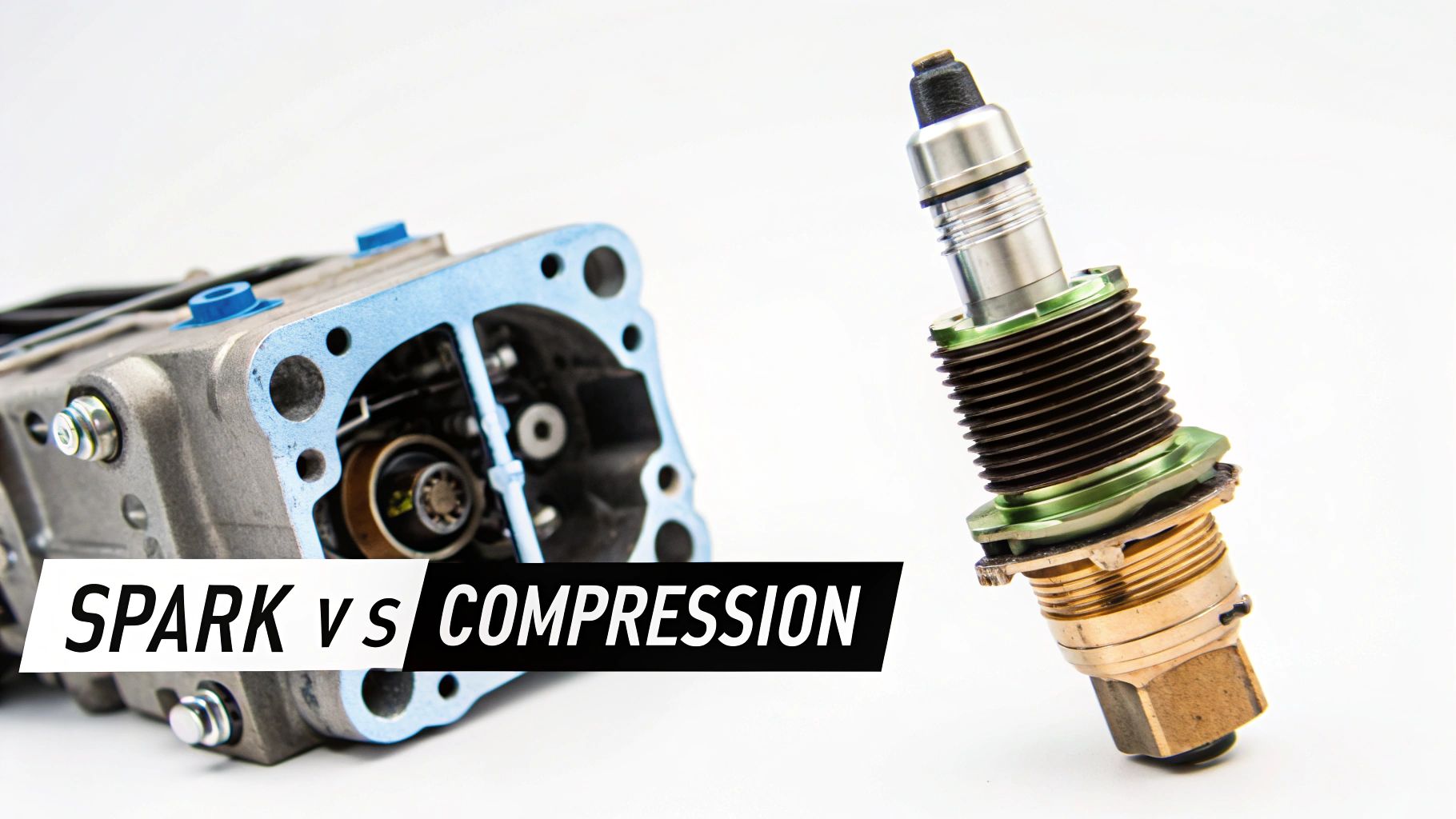
While the chemistry of petrol and diesel sets the stage, the real performance difference plays out inside the engine. Both are internal combustion engines, of course, but they use fundamentally different methods to get you moving. It all comes down to one component a petrol engine has that a diesel doesn't: the spark plug.
This single part completely dictates the engineering philosophy behind each engine type.
The Spark That Powers Petrol
A petrol engine runs on what’s called spark ignition. Picture it as a series of tiny, perfectly controlled explosions happening thousands of times every minute. This process is a carefully timed four-step dance.
First, a fine mist of petrol vapour is mixed with air and pulled into the engine's cylinder. A piston then travels up, compressing this volatile cocktail. Just as it reaches maximum pressure, the spark plug fires. That tiny bolt of electricity ignites the fuel, forcing the piston down with a powerful shove that turns the crankshaft. This rapid-fire cycle is exactly why petrol engines are known for their responsiveness and ability to rev high.
The whole operation is a delicate balance of timing and precision, often called the Otto cycle. Here’s a quick look at the four strokes:
Intake: The piston moves down, sucking in the air-fuel mixture.
Compression: The piston moves up, squeezing the mixture. Compression ratios in petrol engines are typically around 8:1 to 12:1.
Power: The spark plug ignites the mix, driving the piston down.
Exhaust: The piston moves up again, pushing the spent gases out.
Because they rely on a spark, petrol engines are built for lower compression. If you squeeze the air-fuel mix too much, it can detonate on its own—a destructive phenomenon known as 'engine knock'. Keeping compression lower allows for lighter engine parts and contributes to the smoother, quieter ride most of us expect from a passenger car.
The Brute Force of Compression
Diesel engines, on the other hand, do away with the spark plug entirely. They work on a far more forceful principle: compression ignition. Instead of mixing fuel and air at the beginning, a diesel engine pulls in nothing but air.
The piston then compresses this air to an incredible degree, with ratios starting at 14:1 and going all the way past 20:1. This extreme squeezing generates immense heat, raising the air temperature in the cylinder to over 500°C. Only at this moment of peak pressure and heat is a fine mist of diesel injected directly into the chamber.
The intense temperature causes the diesel to ignite instantly and spontaneously, driving the piston down with tremendous force.
This spontaneous combustion is precisely why diesel engines produce so much more torque, or pulling power, at low engine speeds. It’s a much more violent event than the spark-ignited "push" in a petrol engine, making it perfect for shifting heavy loads.
The immense pressures involved mean diesel engines have to be built like brick outhouses. Their components are heavier and stronger to withstand the constant, powerful combustion events. This is why diesels are famously durable but also heavier, louder, and generally more expensive to build than their petrol cousins.
Those high pressures also place extreme demands on the fuel injection system. High-pressure diesel injectors can operate at up to 2,000 bar, while a petrol engine’s system sits around 100-200 bar. This makes them incredibly sensitive to fuel quality. Using the wrong fuel is devastating; unlike petrol, diesel relies on the heat of compression to ignite. If petrol gets into this high-pressure system, its solvent properties strip away lubrication and circulate contaminants with deadly speed. Our technicians at Misfuelled Car Fixer are often called out to Ipswich to drain over 50 litres from a single vehicle—a crucial step to save fleets from costly downtime. To get a sense of the scale of road transport, you can discover more insights about the volume of fuel consumed in the UK.
How They Stack Up: Performance, Economy, and The Environment
Knowing the difference between spark and compression ignition is one thing, but what does it actually mean for you behind the wheel? This is where the choice between petrol and diesel gets personal. It shapes everything from how the car feels pulling onto the motorway to what it costs you over a year and its impact on the world around us.
Let's start with how they feel to drive. A petrol engine is all about responsiveness and revs. It’s zippy, agile, and loves to be pushed, making it feel lively and quick around town or when you need a sudden burst of speed. The power delivery is smooth and consistent, building steadily as the rev counter climbs.
Diesel engines are a completely different animal. They are all about torque—that muscular, pulling power you feel at very low revs. The result is a satisfying, immediate surge of acceleration right from a standstill. It's this effortless shove that makes diesels so brilliant for towing a caravan or just cruising along the motorway in top gear without ever feeling strained.
Fuel Economy and Running Costs
For most drivers in the UK, this is where the decision really gets made. Thanks to its higher energy density and the sheer efficiency of its combustion process, a diesel car will typically be 20-30% more fuel-efficient than its direct petrol counterpart. If you spend your life on the motorway, racking up serious mileage each year, those savings at the pump can be huge and easily offset the higher initial cost of the car.
Of course, the financial side of things is a bit more complicated than just miles per gallon. For a fuller picture, it's worth looking into the real cost of owning an EV compared to petrol cars, which adds a whole new dimension to the modern car-buying puzzle.
To make things clearer, let's break down the practical differences that matter to most owners.
Real-World Driving and Ownership Costs Compared
Aspect | Petrol Vehicle | Diesel Vehicle |
|---|---|---|
Best Driving Style | Great for short trips, nipping around town, and enjoying a spirited drive on a B-road. | Perfect for long-distance motorway cruising and easily towing heavy loads. |
Performance Feel | Higher-revving and responsive. Generally runs quieter and with less vibration. | Strong, effortless pull from low revs. Feels powerful and relaxed at speed. |
Fuel Efficiency | Lower MPG means it’s less economical for those covering very high mileage. | Superior MPG delivers significant fuel savings, especially on long journeys. |
Maintenance Profile | The engine design is simpler, which often leads to lower routine servicing costs. | DPF systems need regular high-speed runs to avoid getting clogged, which can be costly to fix. |
As you can see, there isn’t a single ‘best’ option. The right choice really comes down to how you actually use your car day-to-day.
One of the biggest differences is in the fuel itself. Diesel has a higher cetane number (usually 45-55), which helps it ignite smoothly under compression. This is key to its efficiency, resulting in 10-15% less CO₂ per mile than petrol, despite all the debates about other emissions. It's also why misfuelling became such a headache; as diesel cars grew to nearly 45% of the UK fleet by 2019, incidents of putting petrol in a diesel tank shot up, particularly on Fridays.
The Environmental Equation
For years, the environmental debate around petrol and diesel has been fierce. Historically, diesels got a bad rap for pumping out higher levels of nasty pollutants like Nitrogen Oxides (NOx) and Particulate Matter (PM), which are major culprits in poor urban air quality.
But modern diesel technology has come on leaps and bounds. Today's diesel cars are packed with clever systems to clean up their act:
Diesel Particulate Filters (DPFs): These are essentially sophisticated soot traps, catching and burning off over 99% of harmful particles before they can escape the exhaust.
Selective Catalytic Reduction (SCR): This system uses a special fluid called AdBlue (a urea-based solution) which is injected into the exhaust. It sets off a chemical reaction that converts most of the harmful NOx into harmless nitrogen and water.
While these systems are incredibly effective, they do add complexity. The DPF, in particular, can get clogged if the car is only ever used for short, slow journeys, leading to expensive repairs. On the flip side, while petrol engines produce far less NOx and PM, they generally emit more Carbon Dioxide (CO₂) per mile—a key greenhouse gas. So, you're left with a tricky trade-off between local air pollutants and global climate impact.
The Anatomy of a Misfuelling Disaster
Putting petrol in a diesel car is one of the most common—and costly—mistakes a UK driver can make. It’s far more than a simple inconvenience; it kicks off a rapid and destructive chain reaction inside your car’s highly sensitive fuel system. The fundamental difference between petrol & diesel lies in their chemical makeup, and this is exactly where the disaster begins.
Diesel fuel is naturally oily. This isn’t a bug, it’s a feature. Modern diesel engines are built to rely on this inherent lubricity. The fuel itself acts as a vital lubricant for high-precision components, especially the high-pressure fuel pump and injectors. These parts operate under immense pressure with microscopic tolerances, and that oily film from the diesel is all that stops them from grinding themselves to pieces.
How Petrol Unleashes Chaos
When you pour petrol into this finely tuned system, you're essentially adding a powerful solvent. Petrol has none of diesel’s lubricating properties. Instead, it immediately starts to strip away that protective oily film from every surface it touches, leaving critical metal components completely exposed and vulnerable.
The real damage starts the moment you turn the key. Just turning on the ignition can be enough to prime the fuel pump, starting the flow of the contaminated mixture.
If you actually start the engine, the sequence of destruction is swift and severe:
Fuel Pump Starvation: The high-pressure fuel pump, now starved of its vital lubrication, starts running metal-on-metal. This intense friction causes it to wear down incredibly fast, creating tiny, sharp metal particles known as swarf.
System-Wide Contamination: This cloud of metal swarf is then blasted through the entire fuel system under thousands of PSI of pressure. It travels through the fuel lines, rails, and filters, contaminating everything in its path.
Injector Annihilation: The journey for these metal fragments ends at the fuel injectors. These parts have incredibly fine nozzles designed to spray a precise mist of diesel. The abrasive particles effectively sandblast them from the inside out, often destroying them beyond any hope of repair.
The single most important thing you can do to prevent catastrophic damage is this: DO NOT START THE ENGINE. Don't even turn the key to the 'on' position to check the radio or mileage. The initial damage isn't caused by the engine running poorly; it's the mechanical self-destruction that begins the second that contaminated fuel starts to circulate.
Spotting the Immediate Warning Signs
If the engine has been started, you'll notice symptoms almost immediately. The car’s performance will nosedive as its fuel system literally tears itself apart.
Keep an eye (and an ear) out for these clear distress signals:
A loud knocking or rattling sound from the engine as combustion becomes erratic.
Excessive white or grey smoke billowing from the exhaust.
A severe loss of power and jerky, hesitant acceleration.
The engine misfiring, running rough, or cutting out completely.
The engine management light flashing up on your dashboard.
Eventually, the engine will likely stall and refuse to start again. By this point, significant damage is already a certainty, and the repair bill can easily climb into thousands of pounds, often requiring the replacement of the entire fuel system.
While putting petrol in a diesel is a major problem, the reverse scenario is a little different. To get your head around the consequences of that mistake, you can find helpful information in our guide about what happens when you put diesel in a petrol car. In either case, getting professional help isn't just a good idea—it's essential.
Your Emergency Misfuelling Action Plan
It’s a moment every driver dreads. That sudden, gut-wrenching realisation at the pump that you’ve put the wrong fuel in your car. A simple mistake that instantly feels like a major disaster. But take a breath—panic is your worst enemy right now. A calm and measured response is what will save you from a repair bill that could easily stretch into the thousands.
The one, single, absolute golden rule is this: do not turn the key. Don't even put it in the ignition to listen to the radio. The second you do, the car’s fuel pump whirs into life and begins circulating the contaminated fuel through the system. Your number one job is to stop that from happening.
What to Do Immediately
If you've caught the mistake while still at the petrol station, follow these steps to limit the damage and keep everyone safe.
Stop Everything: Whatever you do, do not start the engine.
Go Neutral: Pop the car into neutral. It’ll make it much easier to move if you need to.
Tell the Staff: Let the petrol station staff know what's happened. They can close off the pump and help manage the situation safely.
Move to a Safe Spot: With some help, push your vehicle to a parking bay, well away from the busy pumps.
Call in the Experts: This is the most critical step. You need to call a specialist wrong fuel recovery service.
This simple flowchart lays out the critical choice you have to make and what happens next.
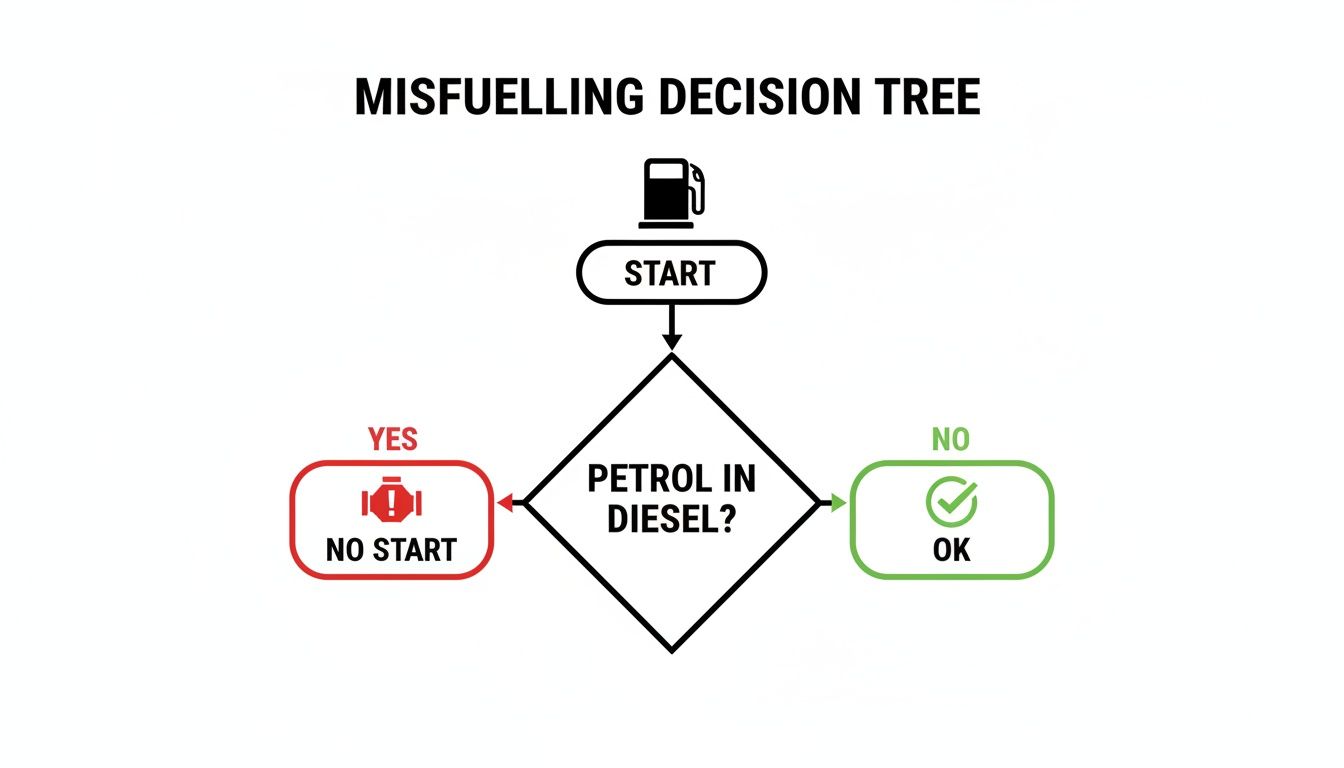
As you can see, the outcome really boils down to one thing: whether or not you start the engine. Keeping it switched off prevents the wrong fuel from being drawn into the places it can do serious harm.
Your Direct Line to a Solution
Trying to drain the tank yourself is a risky business, and calling a main dealer can be a slow and surprisingly expensive ordeal. The fastest, most cost-effective fix is a specialist mobile service. Here at Misfuelled Car Fixer, we run a 24/7 mobile fuel drain service right across Suffolk and the surrounding areas. It doesn't matter if you're stuck in Ipswich, Bury St Edmunds, or on the hard shoulder of the A14—our technicians come to you.
We'll arrive with all the kit needed to safely drain the contaminated fuel, flush the entire system clean, and get you topped up with the correct fuel. Our goal is always to get you back on your journey as quickly and safely as possible. To see exactly how we do it, take a look at our complete emergency guide on what to do when you put petrol in a diesel car.
A misfuel doesn't have to be a catastrophe. With a quick, professional fix, the problem can be sorted right there on the spot in under an hour, preventing the kind of catastrophic engine damage that happens once the wrong fuel starts circulating.
Don't let a moment's mistake spiral into a huge expense. If you've misfuelled, just stay calm, leave the engine off, and give us a call straight away. Our team is always ready to provide the expert help you need, wherever you are.
Answering Your Top Fuel Questions
To wrap things up, let's tackle some of the most frequent questions we get from drivers across the UK. Getting straight answers can help you make smarter choices on the road and know exactly what to do if you ever find yourself in a tight spot.
Is Petrol or Diesel Better for City Driving?
If your driving is mostly short, stop-start trips around town, a petrol car is almost always the smarter option. Modern diesel cars are fitted with a Diesel Particulate Filter (DPF), which is designed to capture soot. The catch is, this filter needs a good, long run at a consistent speed to heat up and burn off the trapped particles – a process called regeneration.
City driving simply doesn't give the DPF a chance to do its job. Over time, it gets clogged, which can strangle your car's performance and land you with a hefty repair bill. Petrol engines, on the other hand, are perfectly happy with this kind of use and don't face the same problem.
How Much Damage Can a Little Bit of Petrol Do to a Diesel Engine?
It's a common mistake to underestimate this, but even a small amount of petrol in a diesel tank can cause catastrophic damage. Petrol acts as a solvent, stripping away the essential lubricating properties of diesel fuel. If you turn the key, that petrol gets circulated through the high-pressure fuel pump and injectors, causing metal components to grind against each other.
It's never worth the risk, no matter how little you think you've put in. The repair costs can quickly spiral into thousands of pounds. Your best and only move is to call for a professional fuel drain.
Are Diesel Cars Actually Going to Be Banned in the UK?
This one causes a lot of confusion. The government's plan is to end the sale of new petrol and diesel cars by 2035. This is not a ban on driving the ones already on the road. You'll still be able to own, drive, and sell your used diesel car long after that date.
What you do need to keep an eye on, though, are the expanding Clean Air Zones (CAZ) and London's Ultra Low Emission Zone (ULEZ). Older diesel vehicles that don't meet the latest emissions standards often face a daily charge to enter these areas, which can significantly increase your running costs if you live or work in a major city.
Made a mistake at the pump? The most important thing to do is stay put and don't start the engine. For fast, professional help anywhere in Suffolk, get in touch with Misfuelled Car Fixer. Our 24/7 mobile fuel drain service will get you sorted. You can reach our experts here: https://www.misfuelledcarfixer-suffolk.co.uk.


