
.jpg)


Small Amount of Petrol in a Diesel Engine Suffolk What Happens Next
Updated: Oct 1
24/7 Hotline Wrong Fuel Drain Nationwide: 0330 122 6640
If you found this page, we cover you in England!
That sinking feeling at the pump is a familiar nightmare for many drivers. You've just put petrol in your diesel car, and panic starts to set in. But what you do in the next few minutes is absolutely crucial. While even a small amount of petrol in a diesel engine is a serious problem, it's often manageable if you act quickly and correctly.
The number one rule? Do NOT start the engine. Don't even put the key in the ignition.
Putting the wrong fuel in car is surprisingly common. It’s an easy slip-up, especially if you’re distracted, in a hurry, or driving a hire car. But the consequences can be disastrous if you don't handle it right.
Think of petrol in a diesel system like sugar in a petrol tank—it’s a contaminant that simply doesn't belong. Diesel fuel isn't just a fuel; it's also a lubricant for the high-pressure fuel pump and injectors. Petrol, on the other hand, is a solvent. It strips away that vital lubrication, causing metal parts to grind against each other.
The absolute golden rule is to keep that contaminated fuel right where it is: in the tank. As long as it stays there, the fix is usually a straightforward and affordable fuel drain. The real damage starts the moment you turn that key. That single action primes the fuel pump, sending the destructive petrol-diesel mix hurtling towards your engine's most sensitive—and expensive—components.
Your Immediate Action Plan
If you've realised your mistake while still at the petrol station, here’s exactly what to do. No exceptions.
Don't Start the Engine: This is the most important advice you will ever get in this situation. Starting the car will circulate the petrol, causing friction, heat, and rapid wear.
Don't Even Turn the Ignition On: In many modern cars, just turning the key to the 'on' position activates the electric fuel pump. Leave the keys out of the ignition entirely.
Tell the Petrol Station Staff: Let them know what's happened. They've seen it all before and can help you push your vehicle to a safe spot, away from the pumps.
Call a Professional Immediately: Your first and only call should be to a specialist mobile wrong-fuel drain service like Misfuelled Car Fixer. Don't call a general recovery service; you need an expert.
To make things even clearer, this handy table breaks down the do's and don'ts.
Immediate Do's and Don'ts After Misfuelling
Action | Why It's Critical |
|---|---|
DO NOT start the engine. | Prevents the contaminated fuel from circulating and causing catastrophic damage. |
DO inform the petrol station staff. | They can help you move the car to a safe location and manage the situation. |
DO NOT turn on the ignition. | This can prime the fuel pump, pushing petrol into the lines and engine. |
DO call a wrong-fuel specialist right away. | They have the proper equipment to safely drain the tank and get you back on the road. |
Sticking to these simple rules can be the difference between a minor inconvenience and a major financial headache.
This decision tree gives you a clear visual guide on what to do next.
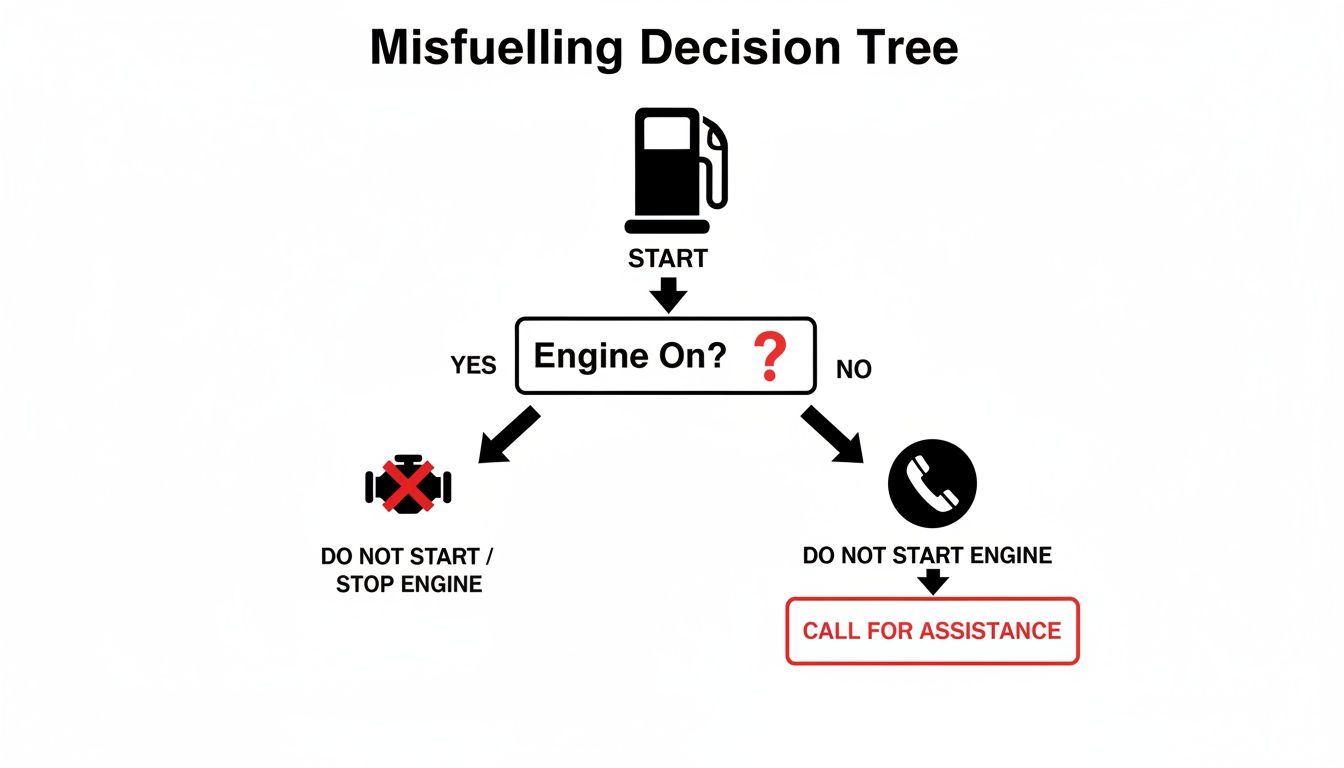
As you can see, keeping the engine off is the fork in the road that leads to a much better outcome. It separates a simple fuel drain from the grim possibility of extensive, costly mechanical repairs.
Just How Common Is This Mistake?
If you're feeling a bit foolish, don't. Misfuelling is an incredibly widespread issue. A survey of over 1,000 drivers revealed that an astonishing 29% of UK motorists have put the wrong fuel in their car at some point. That works out to roughly 150,000 drivers making this mistake every single year. You are far from alone.
A calm head and a quick phone call can save you thousands of pounds in repair bills. For a complete walkthrough of the emergency procedure, have a look at our comprehensive guide on what to do when you put petrol in a diesel car. By calling a professional service straight away, you're taking the smartest, safest, and most cost-effective route back to the road.
How Petrol Destroys a Modern Diesel Engine
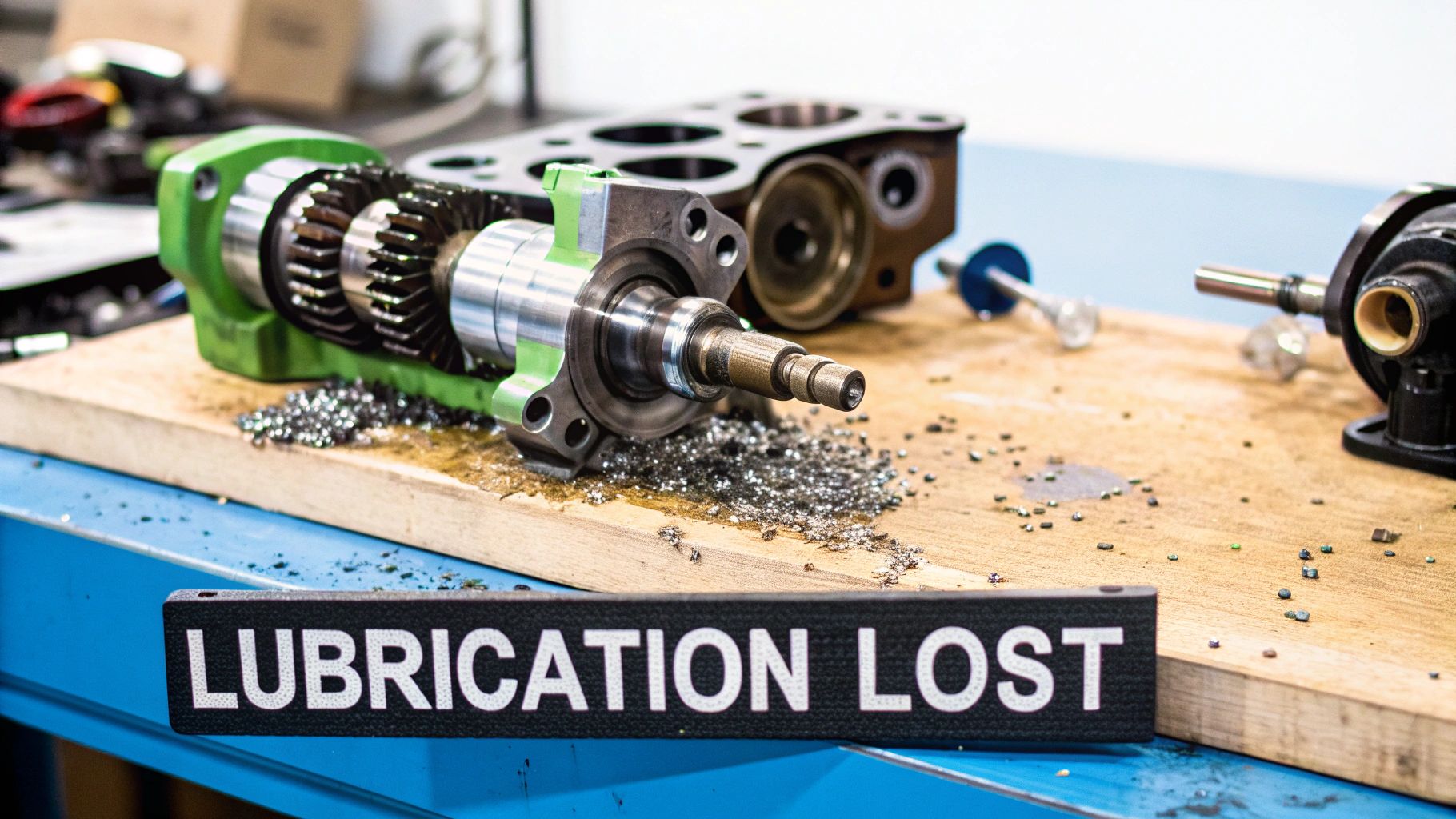
To really get your head around why misfuelling is such a big deal, you need to see why even a small amount of petrol in a diesel engine causes such catastrophic damage. This isn't just a simple mix-up; it’s like pouring sand into a Swiss watch. You’re introducing a chemical that actively sabotages how your engine is designed to work.
You see, diesel isn't just fuel. It's a thick, oily substance that plays a second, crucial role: it lubricates the incredibly precise, high-pressure components inside your fuel system. The unique standard diesel fuel properties are fundamental to its operation.
Petrol, on the other hand, is the polar opposite. It’s a solvent. Think of it like paint thinner or nail polish remover—its very nature is to dissolve and strip away oils. That’s the last thing your high-pressure fuel pump and injectors need.
The Immediate Loss of Lubrication
The real damage kicks off the second that petrol-contaminated mixture gets drawn from the tank. Modern diesel engines, especially common-rail systems, run under eye-watering pressures, often pushing beyond 2,000 bar. The components inside the fuel pump and injectors are engineered to microscopic tolerances, spinning at thousands of revs per minute.
These parts don't have a separate oil supply; they rely entirely on the oily film of the diesel fuel itself to stop metal grinding against metal.
When petrol enters the scene, it immediately washes this protective film away. It's the equivalent of draining the oil from your engine and then going for a drive—the result is just as quick and just as brutal. Friction and heat go through the roof, and the delicate internals start to tear themselves to pieces. In fact, studies show that just 5% petrol contamination is enough to completely strip away diesel's lubricating properties. Understanding the critical impact of petrol in diesel highlights why you absolutely cannot delay taking action.
The Creation of Swarf
This intense metal-on-metal friction creates something mechanics dread: swarf. Swarf is a fine metallic dust, like tiny filings of glitter, shaved from the internals of the fuel pump as it self-destructs.
If you start the engine, this swarf doesn't just stay put. The fuel pump, doing the job it thinks it's supposed to, dutifully pumps this abrasive, metallic paste throughout the entire fuel system. It effectively becomes liquid sandpaper.
This is the point where a simple mistake snowballs into a full-blown mechanical disaster. The swarf is forced at high pressure through the fuel lines, into the common rail, and then blasted through the microscopic holes in your fuel injectors.
Consequences of Swarf Circulation
Fuel Pump Failure: This is where the swarf is created, so it's usually the first component to die a very noisy death.
Blocked Injectors: The tiny metal particles easily clog the injector nozzles, causing misfires, rough running, and eventually, complete seizure.
Contaminated Fuel Lines: The whole network of pipes and hoses gets coated in this metallic sludge, meaning they need a deep-clean or, more likely, complete replacement.
Engine Damage: In the worst-case scenario, swarf gets past the injectors and into the cylinders themselves, where it can score the cylinder walls and damage pistons.
This destructive domino effect is exactly why the golden rule is always, always the same: do not start the engine. Keeping the contaminated fuel in the tank contains the problem. It allows a specialist to simply drain the tank and get you back on your way.
Starting the car, even for a second, is what turns a simple fuel drain into a potential £5,000+ repair bill. It's the single most expensive mistake you can make.
Spotting the Telltale Signs of a Misfuelled Engine
If you’ve driven away from the pump before that sinking feeling of realisation hits, your car will quickly start to protest. The damage from even a small amount of petrol in a diesel engine isn’t exactly subtle. You'll notice a rapid drop in performance, and ignoring these signals can escalate a fixable mistake into a complete financial write-off.
Think of these symptoms as your engine's SOS signal. The moment you notice them, pulling over safely and killing the engine is the single best thing you can do to save yourself thousands of pounds in repair bills.
The most immediate sign is a sudden, dramatic loss of power. Your car will feel heavy and sluggish, as if it's towing a massive weight. It'll struggle to accelerate, and you'll get the distinct impression it's not firing on all cylinders. This is because petrol ignites differently from diesel, throwing the engine's timing completely out of whack and crippling its ability to produce power.
Your Engine's Cries for Help: Sights and Sounds
It won't just feel wrong; you'll likely see and hear some pretty alarming things, too. Pay close attention to any strange noises coming from under the bonnet.
A Loud, Metallic Knocking: Often called 'pinking', this is the classic sign. It’s the sound of the petrol igniting far too early under the intense pressure of a diesel engine. Instead of a controlled, powerful push on the piston, you get a series of violent, badly-timed explosions that sound like someone rattling a box of spanners inside your engine.
Billowing Exhaust Smoke: Look in your rearview mirror. If you see thick clouds of white or bluish smoke pouring out of the exhaust, that's a major red flag. It’s the engine's way of showing you it can't properly burn the contaminated fuel mix.
Alongside these physical clues, your car will probably use its own voice to warn you. Modern engines are packed with sensors that know instantly when something is fundamentally wrong.
That dreaded flashing Engine Management Light (EML) on your dashboard is your car's computer screaming that there's a critical fault in the fuel system. If it lights up right after you've filled up, treat it as a code-red emergency and stop driving immediately.
From a Stutter to a Complete Shutdown
If you press on, things will go from bad to worse very quickly. The petrol, acting like a solvent, is busy stripping away the essential lubrication from your high-pressure fuel pump and injectors, causing the delicate metal components to start grinding themselves to pieces.
This rapidly snowballing damage leads to a cascade of failures:
Engine Stuttering and Misfiring: As tiny metal filings (known as swarf) from the disintegrating fuel pump contaminate the injectors, they get clogged and damaged. They can no longer spray fuel into the cylinders correctly, causing the engine to run erratically, jerk, and misfire.
Failure to Restart: If you switch the engine off, there's a good chance it won't start again. The fuel pump might already be too damaged to build up the massive pressure needed to ignite diesel fuel.
The Engine Cuts Out Entirely: Ultimately, the system-wide damage and lack of lubrication will cause the engine to seize up or stall. It will simply die while you're driving, creating a very dangerous situation.
Recognising these symptoms for what they are—a direct result of the wrong fuel—is the key. The second any of them appear, your only move is to find a safe place to pull over, turn off the ignition, and call for professional assistance.
How We Get You Back on the Road: The Fuel Drain Process
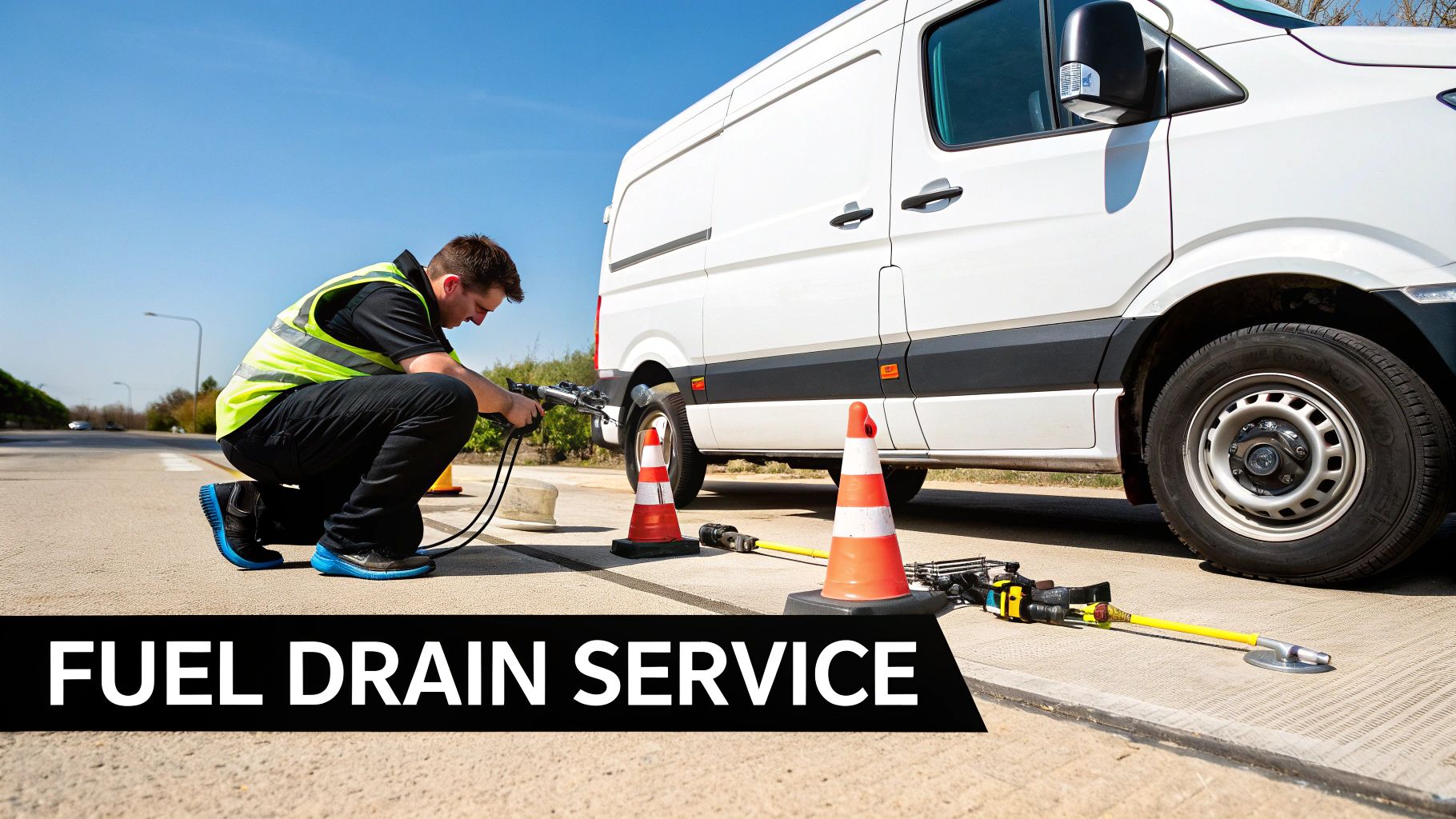
Calling a mobile fuel drain service might feel a bit dramatic, but trust me, it’s the quickest, safest, and most effective way to sidestep the catastrophic damage that even a small amount of petrol in a diesel engine can cause. Knowing what to expect when a technician turns up can take the stress out of the situation and reassure you that you’ve absolutely made the right decision.
From the moment our specialist arrives, everything they do is dictated by strict safety standards. This isn't just a mechanic with a hose; you're getting a trained technician who deals with flammable, hazardous materials at the roadside every single day. Their van is a purpose-built mobile workshop, kitted out for this one specific, high-stakes job.
Safety is always the first priority. The technician will secure the area around your vehicle, usually with cones, and make sure there's proper ventilation. They'll have fire suppression gear ready and follow a strict checklist to kill any risk of sparks. This is no time for shortcuts—that petrol-diesel mix is seriously volatile.
The Drain and Flush Explained
Once the area is safe, the real work begins. It’s a lot more involved than just siphoning the tank; it's a systematic purge of the entire fuel system.
Gaining Access: We’ll access your fuel tank, either through the filler neck or by temporarily removing the fuel sender unit (which is usually under the back seats or in the boot). This gives us the access we need to get every last drop out.
Specialist Pumping Gear: We use industry-standard, UN-approved pumps designed specifically for flammable liquids. They have anti-static hoses and spark-arresting features to make the transfer completely safe.
Draining the System: First, we drain the tank completely. But we don't stop there. We then move on to the fuel lines and the filter housing, flushing out any contaminated fuel that's hiding in the system.
A common mistake people make is thinking that just draining the tank is enough. The real danger lies in the petrol left in the fuel lines and filter. A professional flush is the only way to be certain that corrosive petrol won't hit your high-pressure pump later on.
This level of detail is what sets a professional service apart. If you want a closer look at the technical side, you can read more about the safe and necessary steps for a fuel tank drain here.
Finishing the Job and Disposing of the Fuel
With the nasty mix gone, we need to get the system ready for a fresh start.
The technician will put a small amount of clean diesel into the tank and circulate it through the lines and pump. This acts like a final rinse, washing away any trace amounts of petrol. This step is crucial—it guarantees that only pure, lubricating diesel will reach your engine's delicate parts when you turn the key.
Once the flush is done and everything is put back together, we'll add enough fresh diesel to get you to the nearest petrol station. We’ll then talk you through starting the engine and will hang around for a few minutes, just to make sure it's running smoothly.
And the contaminated fuel? We take our environmental responsibility very seriously. It's transferred into secure, UN-approved containers in our van and taken to a licensed facility for safe and legal disposal. Your mistake won't end up harming the environment.
The best part? This entire process is incredibly efficient. From arrival to you driving away, we can typically have you back on your journey in under an hour. It turns a potential crisis into a minor inconvenience.
Potential Damage and Estimated Repair Costs
The moment you realise you’ve put even a small amount of petrol in a diesel engine, one question immediately flashes through your mind: "How much is this going to cost me?"
The answer to that question hangs entirely on a single, critical action: did you start the engine? That one decision creates two completely different outcomes. One is a minor, manageable hiccup. The other is a potential financial nightmare. The cost isn't just about the wasted fuel; it's about the mechanical chaos that petrol unleashes once it leaves the tank.
The financial gap between these two scenarios is enormous. A quick, preventative fuel drain is a smart, small investment. Driving away from the pump, on the other hand, can trigger a catastrophic system failure, leading to repair bills that can easily run into the thousands.
Scenario One: Engine Not Started
If you caught the mistake at the pump and stuck to the golden rule – do not start the engine – you can take a massive sigh of relief. Right now, the problem is completely contained within your fuel tank. The petrol hasn't had a chance to circulate and wage war on your engine's sensitive, high-precision components.
This really is the best-case scenario, and the solution is straightforward and relatively cheap.
The Fix: A professional mobile fuel drain. Simple as that.
The Process: A specialist technician comes to you, drains the contaminated mix from your tank, flushes the system with clean diesel, and gets you safely back on your way.
The Cost: You're looking at the cost of the call-out service, which is just a fraction of what a full garage repair would ever be.
The Time: The whole thing is usually done and dusted in under an hour, right there at the roadside.
You've successfully sidestepped a disaster and turned it into a small inconvenience.
Scenario Two: Engine Has Been Started
This is where things get serious, and the costs start to climb alarmingly fast. The moment you turn that key, the petrol-diesel cocktail is sucked into the fuel system. Petrol acts like a solvent, stripping away the vital lubricating properties of diesel fuel.
Almost immediately, the high-pressure fuel pump starts to grind itself to pieces, creating tiny metal filings (known as swarf) which are then blasted at immense pressure through your entire fuel system.
The damage isn’t just one broken part; it’s a devastating domino effect. The affordable cost of a fuel drain is now off the table, replaced by a long, painful list of expensive parts and intensive labour at a garage. This can easily keep your vehicle off the road for days, or even weeks.
To put the financial impact into perspective, let's compare the two situations.
Cost Comparison: Misfuelling Scenarios
This table lays out the stark difference in cost and time depending on whether the engine was started. For a more granular look at what makes up these expenses, have a read of our full guide on diesel car repair costs after misfuelling.
Scenario | Typical Components at Risk | Estimated Repair Cost Range | Estimated Resolution Time |
|---|---|---|---|
Engine Not Started | None - fuel is contained in the tank | £150 - £300 (for mobile fuel drain) | Under 1 Hour |
Engine Started | High-Pressure Fuel Pump, Fuel Injectors, Fuel Filter, Fuel Lines, Common Rail | £2,000 - £7,000+ (for parts & labour) | Days to Weeks |
The numbers speak for themselves. The cost of a preventative fuel drain is pocket change compared to the bill for rebuilding a wrecked fuel system.
Calling a professional mobile service like Misfuelled Car Fixer isn't just about fixing a mistake. It's an insurance policy against a repair bill that could genuinely be more than the car is worth.
How to Avoid Misfuelling Your Vehicle in the First Place
Knowing what to do when you've put a small amount of petrol in a diesel engine is one thing, but avoiding the mistake altogether is the real goal. Let's be honest, misfuelling is almost always down to a brief moment of distraction. The good news is that a few simple habits can build a rock-solid defence against this expensive and frustrating error.
For most of us, the solution is just to build a simple, conscious routine every time we pull up to the pump. These little steps can literally save you thousands of pounds.
Tips for Everyday Drivers
The easiest way to stop yourself from grabbing the wrong nozzle is to turn filling up into a deliberate, mindful checklist. Before you even think about putting the nozzle in your car, just take a second to pause and check what you're doing.
Check the Nozzle and Pump: This is your first and best line of defence. In the UK, diesel handles are almost always black, and unleaded petrol is green. But don't just rely on colour – always give the label on the pump a quick glance to make sure it says ‘DIESEL’.
Ditch the Distractions: If you're chatting on your phone or deep in conversation, your brain is on autopilot. This is precisely when mistakes happen. Make a point of focusing on fuelling the car until the cap is screwed back on.
Fit a Misfuel Prevention Device: For an extra layer of security, you can buy a special cap that replaces your existing one. These clever gadgets are designed to physically block the narrower petrol nozzle, making it impossible to insert it into your wider diesel filler neck.
Think of these habits as building your own personal safety net. It’s all about making the correct choice automatic, so you don't make a costly mistake when you're tired, stressed, or rushing around.
Strategies for Fleet Managers
If you're running a business with multiple vehicles, a single misfuelling incident is a massive headache. It means expensive downtime, unexpected repair bills, and a whole lot of disruption to your operations. A proactive, company-wide strategy isn't just a good idea—it's essential.
Putting clear policies and simple visual reminders in place across the fleet can make a huge difference, protecting your vehicles and your bottom line.
Essential Fleet Management Protocols:
Driver Training is a Must: Never assume your drivers know the risks. Make misfuelling prevention a key part of your onboarding process and run refresher sessions. Hammer home the astronomical costs involved if they turn the key after making a mistake.
Label Everything Clearly: Get some large, impossible-to-miss ‘DIESEL ONLY’ stickers. Put one on the fuel filler cap and another inside the fuel flap of every single vehicle. This simple visual cue works wonders.
Have a Clear Emergency Plan: Create a simple, one-page guide explaining exactly what to do in a misfuelling emergency. The two most important points should be: DO NOT START THE ENGINE and the direct phone number for your chosen fuel drain service. Stick a copy in the glovebox of every van and car.
Your Misfuelling Questions Answered
When you're stood on the forecourt after realising you've put the wrong fuel in, your mind races with questions. It's a stressful situation, but let's clear up some of the most common worries we hear from drivers who've put a small amount of petrol in a diesel engine.
"Can I just top it up with diesel and drive on?"
This is hands-down the most frequent question we get, and it's a dangerous myth. The short answer is an emphatic no. It might sound like a logical fix, but just 1% petrol contamination is enough to strip the vital lubricating qualities from your diesel fuel.
Think of it this way: diesel is oily for a reason. It lubricates the incredibly precise, high-pressure components of your modern engine. Petrol, on the other hand, is a solvent. When you mix them, you're not just diluting the problem; you're pumping a damaging, engine-scouring liquid through a system that's depending on oiliness to survive. It's a gamble that can cost you thousands.
The only proper fix is to drain and flush the entire system. Don't try to water down the problem – get rid of it completely. The risk of wrecking your fuel pump and injectors is simply too high.
"Have I just voided my car's warranty?"
More than likely, yes. Car manufacturers see misfuelling as driver error, not a mechanical failure that they are responsible for. If their technicians find that damage to your fuel system was caused by petrol, they will almost certainly refuse to cover the repairs under warranty.
It's a similar story with insurance. Most standard policies won't cover misfuelling damage either. While some companies offer specific "misfuel cover" as an optional extra, it's rarely included as a default part of a comprehensive policy.
"How much petrol is actually a problem?"
Honestly? Any amount. There is no 'safe' quantity of petrol you can put in a modern diesel engine. The old idea that a litre or two won't hurt is a relic from the days of tough, old-school mechanical engines.
Today's common-rail systems are finely tuned machines with incredibly tight tolerances. Even a splash of petrol starts to dissolve the lubricating film, causing friction and potentially creating tiny metal filings (swarf) that can destroy the entire fuel system from the inside out. Treat every single drop of petrol as a serious threat and act immediately.
If you've put even a small amount of petrol in your diesel engine in Suffolk or the surrounding areas, stay calm and, whatever you do, don't start the engine. Call the experts at Misfuelled Car Fixer for immediate, 24/7 help. We’ll safely drain the tank, flush the system, and get you back on the road without the drama. Visit our website at https://www.misfuelledcarfixer-suffolk.co.uk or call now for a rapid roadside rescue.


