



A UK Driver’s Guide to Wrong Fuel Rescue
- Misfuelled Car Fixer

- Dec 19, 2025
- 13 min read
It’s a heart-stopping moment. That instant you realise you’ve grabbed the wrong nozzle at the pump is a feeling no driver ever wants. But what you do in the next few minutes is what really counts. The golden rule, the one thing that can save you a world of hassle and expense, is simple: do not start the engine. Don't even put the key in the ignition. Keeping that contaminated fuel from circulating through your engine’s delicate components is the key to turning a minor mishap into a major repair bill.
What to Do Immediately After Misfuelling

Panic is a natural reaction, but a clear head is your best asset right now. It might feel like you're the only person this has ever happened to, but trust me, you’re in good company. Misfuelling is an incredibly common mistake.
Industry insiders reckon it happens to between 130,000 and 150,000 UK drivers every single year. That’s a staggering 350 incidents a day. So, take a breath and follow these steps to manage the situation properly.
Your Immediate Action Plan
First things first, leave the car exactly where it is. Resist every urge to start it, even just to move it a few feet to a parking bay.
Let the petrol station staff know what’s happened. They’ve seen this all before and will know what to do, usually by closing off the pump and helping make the area safe for everyone.
Next, you'll need to move your car. Put the gearstick in neutral. With a bit of help—perhaps from the forecourt staff or a willing stranger—gently push the vehicle to a safe spot. Getting it out of the way of the pumps not only helps other drivers but also gives a wrong fuel rescue technician the space they need to work.
The moment you realise the error, your priority shifts from fuelling your car to protecting its engine. Every action should be geared towards keeping the contaminated fuel isolated within the tank.
Once your car is safely parked up, it's time to call in the professionals. This is exactly what specialised mobile services are for. The whole point of a mobile auto repair service is to get an expert to you quickly, wherever you are, to sort the problem on the spot.
Knowing how to find a fuel drain near me fast is crucial, as it connects you directly with the right people who can prevent a long, stressful wait.
Immediate Do's and Don'ts After Misfuelling
To make it crystal clear, here’s a quick-reference guide. Getting this right in the first few minutes can make all the difference between a simple drain and a four-figure repair bill.
Action (DO) | Reason | Mistake (DON'T) | Reason |
|---|---|---|---|
Stay Put | Prevents fuel from entering the engine system. | Start the Engine | This is the worst thing you can do. It circulates the wrong fuel, causing major damage. |
Inform Staff | They can secure the area and offer assistance. | Turn on the Ignition | Even without starting the engine, this can prime the fuel pump and start circulation. |
Put in Neutral | Makes it possible to push the car safely. | Try to Drive Away | This will cause severe, costly damage to your fuel system and engine components. |
Push to Safety | Clears the pump and provides access for the technician. | Attempt a DIY Drain | Fuel is highly flammable, and this is dangerous without proper equipment and training. |
Call a Pro | A specialist has the right tools for a safe and complete fuel drain. | Ignore the Problem | The wrong fuel will not just "work its way out" and will cause serious long-term damage. |
Following the 'DO' column is your roadmap to a swift and safe resolution. Avoiding the 'DON'T' column is your best defence against turning a common mistake into a catastrophic one.
What Happens When You Drive with the Wrong Fuel?
That sinking feeling doesn't always hit you at the pump. Sometimes, it's only a few miles down the road when your car starts acting up that you realise your mistake. Spotting the symptoms early is your best defence against turning a fixable problem into a catastrophic engine failure.
The warning signs your car gives you are quite specific, and it all depends on what you've put in the tank. Each fuel mix-up creates a very different set of problems for your engine, leading to tell-tale signs you really can't ignore.
Putting Petrol in a Diesel Engine
This is by far the most common, and unfortunately, the most damaging type of misfuelling. Modern diesel engines are high-precision machines, running under immense pressure. They rely on the natural lubricating qualities of diesel fuel to keep critical parts like the fuel pump and injectors happy.
Petrol, on the other hand, is a solvent. Instead of lubricating, it strips that essential protective film away, causing metal parts to grind directly against each other. This friction creates a swarm of tiny metal particles—we call it swarf—that get sent right through your entire fuel system, causing absolute chaos.
The symptoms usually appear quite quickly:
Loud Knocking Noises: You might hear a rattly, metallic knocking sound from the engine as the components protest.
Lots of Smoke: You'll likely see clouds of smoke billowing from the exhaust, often white or a light grey colour.
Sluggish Performance: The car will feel like it's lost all its get-up-and-go. Acceleration will be weak, and the engine might judder violently.
Dashboard Warning Lights: Expect your dashboard to light up like a Christmas tree with engine management warnings.
Engine Cuts Out: Ultimately, the engine will lose all power, cut out completely, and then refuse to restart.
If you spot any of these signs right after filling up, your first and only move should be to pull over safely, switch off the engine immediately, and call a professional for a fuel drain. Trying to push on will only cause expensive, often irreversible damage.
Putting Diesel in a Petrol Engine
This is a less frequent mistake, mainly because the diesel nozzle is physically bigger than most modern petrol filler necks, but it definitely still happens. Unlike the petrol-in-diesel scenario, the damage here isn't caused by friction.
The problem is all about combustion. Diesel is much oilier and far less flammable than petrol; it needs to be ignited by compression, not a little spark from a spark plug. When you introduce it to a petrol engine, it simply won't burn properly. Instead, it clogs up the spark plugs and fuel system with a thick, sooty gunk.
The symptoms are different, but the outcome is the same:
Engine Misfires and Sputters: The engine will struggle to ignite the oily diesel, causing it to run rough, misfire, and sound awful.
Failure to Start: If you try to start the car with a tank of diesel, it probably won't fire up at all. If you've managed to drive a bit, it will be very hard to restart once stopped.
Thick, Black Smoke: All that unburnt diesel has to go somewhere, and it comes out of the exhaust as thick, black smoke.
Engine Stalling: The engine will run erratically for a short while before eventually giving up and stalling completely.
No matter which way you've mixed it up, the advice is identical: stop the car as soon as it's safe and call for help.
The Professional Fuel Drain Process Explained
So, you’ve made the call. That initial wave of panic is probably giving way to a new question: what actually happens next? It’s a good question to ask. Knowing what our technicians do step-by-step will give you some much-needed peace of mind while you wait. A proper wrong fuel rescue isn't just a quick fix; it's a precise, safe, and surprisingly efficient process designed to get you moving again without any fuss.
When our mobile fuel draining unit pulls up, the first thing we do is make the area safe. This is especially important on a busy petrol station forecourt or the side of a road. We’ll set up cones and make absolutely certain there are no ignition sources nearby before we even think about touching your fuel tank.
Draining The Contaminated Fuel
The main event, of course, is getting every last drop of that contaminated fuel mix out of your tank. For this, our technicians use specialist, mobile pumping equipment. This kit is ATEX-approved, which is the official certification for equipment that is explosion-proof and completely safe for handling flammable liquids like petrol. It’s a world away from trying to do it yourself with a bit of hose and a jerry can.
We'll access your fuel tank, usually via the filler neck or sometimes by removing the fuel sender unit under the seat, and start the drain. We’re incredibly thorough here, aiming to get 99% or more of the bad fuel out. The contaminated fuel is pumped directly into a secure, purpose-built container inside our van, ready for safe and legally compliant disposal later on. If you're interested in the nitty-gritty of the regulations, our guide explains more about how to drain a petrol tank safely and legally in the UK.
If you’ve already driven a short distance, you’ll know how alarming the symptoms can be—that tell-tale rattling, the plumes of smoke, and the engine losing all its fight. This is the classic progression when petrol gets into a diesel engine.
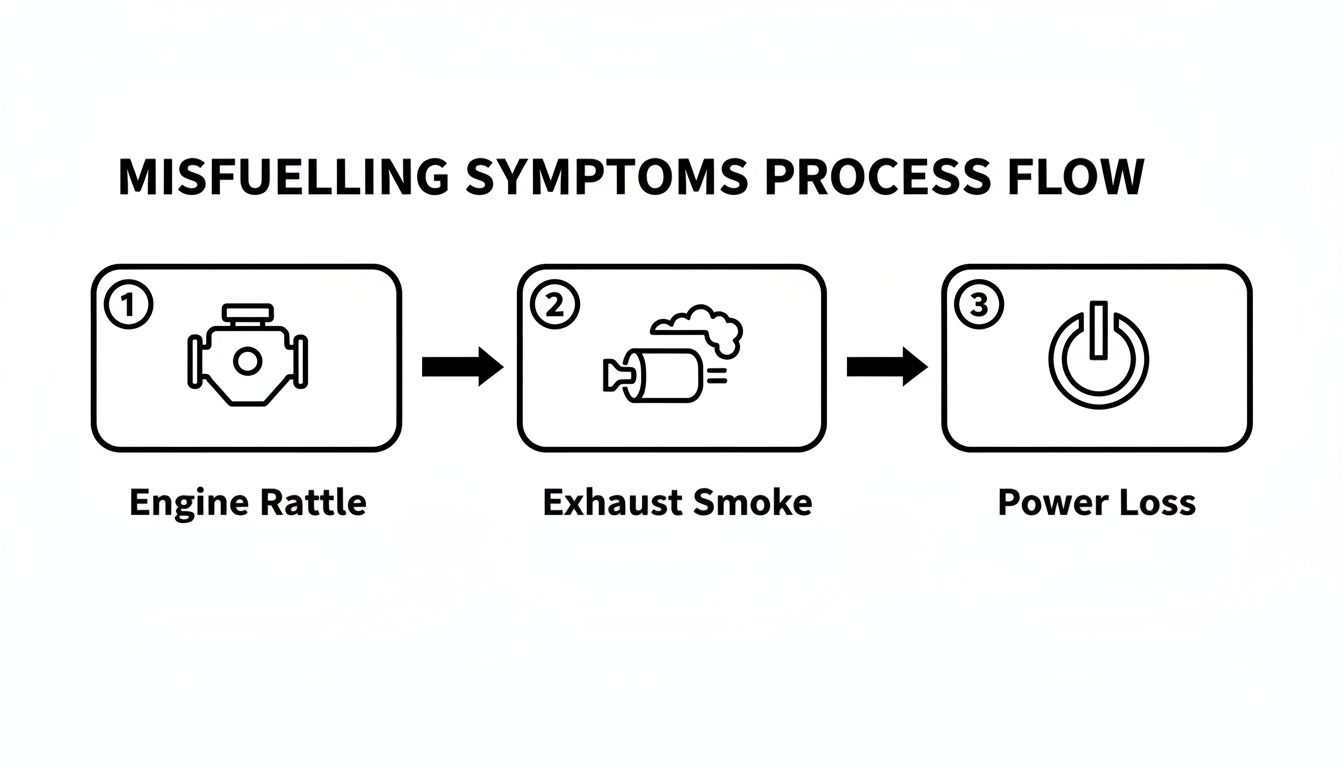
These signs are your car's way of screaming for help, and they show just how fast the wrong fuel affects performance. Stopping immediately is key, and our professional flush is designed to reverse this contamination before it can cause any lasting damage.
Flushing The Fuel System
Just draining the tank often isn't enough, particularly if you’ve switched on the ignition or started the engine. The moment you do, the wrong fuel gets pulled into the fuel lines, the filter, and can even reach the injectors. That’s why the next step is so important: flushing the entire system.
Our technician will circulate a small amount of fresh, correct fuel through the lines. Think of it as a deep clean for your car’s fuel system. It pushes out any lingering pockets of contaminated fuel, making sure every component is pristine before you fill up properly.
A thorough system flush is what really separates a professional wrong fuel rescue from a basic drain. It’s this crucial step that protects your engine's delicate components from residual contaminants that could cause headaches and running problems down the line.
Refuelling And Final Checks
With the flush complete, we’ll add around 5-10 litres of the correct fuel back into your tank. This is just enough to get the system primed and the engine running smoothly again.
Now for the moment of truth. We'll ask you to start the car. Our technician will listen to the engine, run a few final checks to ensure everything is ticking over as it should, and make sure there are no warning lights on your dash. Once we're both happy your car is back to its old self, we’ll get packed up, and you’ll be all set to get back on your way.
How Much Does a Wrong Fuel Rescue Cost and How Long Will It Take?
Once the initial "oh no" moment of putting the wrong fuel in your car passes, your mind will probably jump straight to two things: "How much is this going to cost me?" and "How long am I going to be stuck here for?"
These are the first questions everyone asks, and thankfully, the answers are usually a lot less scary than you might imagine.
Getting a professional wrong fuel rescue is, without a doubt, a far cheaper option than risking catastrophic engine damage. The RAC once estimated that misfuelling cost UK drivers a staggering £40 million in a single year, and that figure doesn't even touch on the eye-watering repair bills that come from starting the engine. For a really detailed look at the numbers, you can learn more about wrong fuel in car costs in our complete UK guide.
Breaking Down the Call-Out Cost
So, what's the damage? For a standard roadside fuel drain here in the UK, you're typically looking at a bill between £200 and £300. That price usually covers everything you need: the technician's journey to you, the complete draining of the contaminated fuel, a full system flush, and a top-up of the correct fuel to get you safely on your way.
Of course, a few things can nudge that price up or down:
Time of Day: A late-night or bank holiday call-out will naturally cost a bit more than a job in the middle of a weekday.
Your Location: If you've broken down in a really remote spot, the price might reflect the extra mileage and time for the technician to get to you.
The Vehicle: A large 4x4 with a massive fuel tank or a van with a complex fuel system might take a little longer, which can affect the final cost.
Even with these variables, the cost is just a fraction of what you'd be forced to pay for new fuel pumps or injectors if you were to drive the car.
So, How Long Will You Be Waiting?
The second part of the puzzle is time. The good news is that mobile fuel drain services like ours are built for speed. We know you just want to get going.
From the moment our technician arrives on the scene to the minute you're turning the key to drive away, the entire job is usually done and dusted in under an hour. Our whole focus is on minimising the disruption to your day.
Here's a rough idea of the timeline you can expect:
Arrival Time: We always aim to be with you within 30 to 60 minutes of your call, traffic and your location permitting.
The Actual Job: The drain and flush itself is a surprisingly swift process. Our technicians are pros, and they can typically get it all sorted in 20 to 40 minutes.
This screenshot from the RAC’s own service shows just how much the industry focuses on speed, which is exactly what specialist providers deliver.
As you can see, it's all about providing a fast, on-the-spot fix. When you add it all up, you can realistically expect to be back on the road in about 90 minutes from the moment you first pick up the phone.
Simple Habits to Avoid Putting the Wrong Fuel in Your Car
While our wrong fuel rescue service is a reliable safety net, nobody wants to have to use it. Prevention is always the best medicine, and the good news is that avoiding this all-too-common mistake really just comes down to forming a couple of simple habits at the forecourt.
Let's be honest, the root cause of most misfuelling incidents isn't a lack of knowledge – it's distraction. We’ve all been there: rushing, tired after a long day, or just mentally running through a to-do list. That's when autopilot kicks in and you grab the wrong nozzle without a second thought.
Create Your Own Fuelling Routine
The most powerful tool you have is a consistent mental checklist every single time you pull up to the pump. It only takes a few seconds, but it can save you hundreds of pounds and a whole lot of hassle.
Before you even touch the fuel cap, make a conscious effort to check two things:
The Pump Nozzle & Label: Take a proper look at the colour and the trigger label. In the UK, diesel nozzles are almost always black, while unleaded petrol is green. A quick glance is all it takes.
Your Car's Fuel Cap: Most cars tell you exactly what they need. Look for the 'DIESEL' or 'UNLEADED PETROL ONLY' reminder printed right on the inside of the fuel flap or on the cap itself. Make reading it part of your routine.
This simple two-step check is brilliant for breaking that autopilot behaviour, especially if you’re driving an unfamiliar hire car or have borrowed a vehicle from a friend or family member.
"The single most effective way to prevent misfuelling is to interrupt your routine. Just pause for a second at the pump and consciously confirm your choice. That one moment of awareness is your best defence against a costly error."
Know the Common Triggers
It’s interesting to see who is most likely to make this mistake, as data from UK surveys shows that behaviour plays a huge role. For example, younger drivers often report higher rates of misfuelling. One survey even noted that a staggering 54% of 18–24-year-olds admitted to having done it.
The analysis also connects these mistakes to factors like rushing to find a cheaper petrol station, which really highlights how stress and distraction are the main culprits. You can learn more from these misfuelling statistics from Go.Compare.
Just being aware of these risk factors is half the battle. If you're feeling particularly tired, stressed out, or are behind the wheel of a car you're not used to, give yourself that extra moment of focus at the pump. It’s a tiny habit that pays off massively.
Got Questions? We’ve Got Answers
That sinking feeling at the pump is often followed by a flood of questions. You’re stressed, your mind is racing, and you just want to know what to do next. We get it. Over the years, we’ve heard every question imaginable, so we've put together answers to the most common ones we get from drivers in your exact situation.
Will Putting the Wrong Fuel in My Car Void My Warranty?
This is a big one, especially for owners of newer cars. Let’s clear it up: the act of misfuelling itself won’t instantly void your entire vehicle warranty.
However, and this is the crucial part, any damage caused by it almost certainly will not be covered. A manufacturer's warranty covers faults in their workmanship, not driver error. If you stick to the golden rule – don’t start the engine – and call a professional like us, there won't be any damage to worry about. Your warranty remains intact. If you drive the car, on the other hand, you risk serious harm to the fuel system, and those repair bills will be coming out of your own pocket.
Is Petrol in a Diesel Car Worse Than Diesel in Petrol?
Yes, absolutely. Putting petrol in a diesel engine is far more damaging, and sadly, it's the more common mistake of the two. It all comes down to one thing: lubrication.
Diesel fuel is oily. It lubricates the high-pressure fuel pump and injectors as it flows through them. Petrol is the complete opposite; it’s a solvent that washes that lubrication away. This causes metal-on-metal friction at incredible pressures, which can chew up expensive components in minutes, sending tiny metal shards all through your fuel system.
Putting diesel in a petrol car is harder to do (the nozzle is bigger) but less destructive if it happens. The engine will splutter, chuck out a lot of smoke, and eventually cut out. It’s not great, but it’s unlikely to cause the same kind of catastrophic failure you see with petrol in a diesel.
The bottom line: It’s a case of destruction versus clogging. Petrol in a diesel engine causes rapid, expensive friction damage. Diesel in a petrol car mainly just clogs things up. Both need a fuel drain, but the first scenario is a much more serious emergency.
Should I Call My Insurance or a Wrong Fuel Rescue Service First?
For the quickest, most direct solution, your first call should always be to a specialist wrong fuel rescue service. That's us. Our entire service is designed to get a technician to you fast and sort the problem right there at the roadside, usually in under an hour.
You should definitely let your insurance company know, but be aware that going through them first can add significant delays. You'll likely be dealing with call centres and claims handlers, which all takes time. Many comprehensive policies do include "misfuel cover," so you can probably claim back the cost of the fuel drain later. But your number one priority is preventing damage, and calling a specialist directly is the fastest way to do that.
What Happens to the Contaminated Fuel After It's Drained?
This is a fantastic question and one that shows you're a responsible driver. Any reputable wrong fuel rescue company must be registered as a licensed waste carrier. In the UK, this isn't optional; it's a legal requirement.
The mixed fuel we drain from your tank is never, ever reused or dumped. It's stored safely in specialised, sealed containers in our vans and transported to a licensed hazardous waste facility. There, it's processed and recycled according to strict environmental laws. This ensures the whole process is safe not just for your car, but for the environment too. It's one of the key things that separates a true professional from a 'cowboy' outfit.
If you've put the wrong fuel in your car in Suffolk or anywhere in the UK, stay calm and don't turn the key. Contact Misfuelled Car Fixer straight away on our 24/7 hotline or send us a message on WhatsApp for a fast, professional wrong fuel rescue. Visit our Misfuelled Car Fixer Suffolk website to get help now.


