



Safety Alert: small amount of petrol in diesel engine - what to do now
- Misfuelled Car Fixer

- Feb 12
- 14 min read
24/7 Hotline Nationwide: 0330 122 6640
National Wrong Fuel Rescue: https://www.misfuelledcarfixer.co.uk
If you found this page, we cover you in England!
We’ve all had that heart-in-your-mouth moment at the petrol station. You glance down and realise you've grabbed the wrong nozzle. You've just put a small amount of petrol in your diesel engine. Take a deep breath. The single most important thing you can do right now is incredibly simple: do not start the car. Don't even turn the key.
Even a splash of petrol can cause serious, wallet-denting damage if it gets a chance to circulate through your fuel system.
Your First Steps After Putting Small Amount of Petrol in Diesel Engine

Realising you've made this mistake is stressful, but trust me, you are far from alone. This happens to thousands of drivers every single year. The key is to sidestep the panic and follow a few simple, immediate steps to protect your engine.
Here’s why it’s such a big deal. Think of diesel as an oily, lubricating liquid that keeps your engine’s high-pressure fuel pump and injectors running like a well-oiled machine. Petrol, on the other hand, acts like a solvent. When it mixes with diesel, it strips away that vital lubrication, essentially forcing precision metal parts to grind against each other. It’s the mechanical equivalent of running an engine without oil.
Your immediate response is absolutely critical. By not starting the engine, you keep the contaminated fuel safely contained in the tank. This makes the fix much simpler and cheaper – a straightforward fuel drain by a professional.
This simple mix-up is so common it's a major headache for UK motorists. Data from the UK Department for Transport suggests that misfuelling incidents affect between 50,000 to 100,000 vehicles annually nationwide. Petrol-in-diesel mistakes make up the lion's share, accounting for about 60% of these cases. Here in Suffolk, with the busy A12 and A14 corridors around Ipswich and Felixstowe, local services like ours at Misfuelled Car Fixer handle hundreds of these call-outs every year. You can dig deeper into the official UK misfuelling statistics and their impact if you're curious.
To make things crystal clear, here’s a quick-glance guide on what to do (and what to avoid) the second you realise your mistake.
Immediate Dos and Don'ts After Misfuelling
Action | What to Do (The Right Way) | What NOT to Do (The Risky Way) |
|---|---|---|
Ignition | Leave the keys out of the ignition. Keep the engine and electrics off. | Do not start the engine or even turn the key to the 'on' position. |
Position | Put the car in neutral and inform the station staff. They can help you push it to a safe place. | Do not try to drive the car off the forecourt, even a few feet. |
Communication | Let the petrol station attendant know what’s happened so they can put up a sign on the pump. | Don't feel embarrassed and try to hide the mistake. It happens to the best of us! |
Next Step | Immediately call a professional wrong fuel drain service. This is the fastest and safest solution. | Do not call your breakdown provider first (they often subcontract to specialists at a higher cost) or attempt a DIY drain. |
Following these simple 'dos' will turn a potential disaster into a manageable inconvenience, getting you back on the road safely and without a massive repair bill.
Why Petrol is Poison for Your Diesel Engine
Putting petrol in a diesel car, even just a little bit, is a recipe for disaster. It's not just a case of diluting the fuel; it's more like introducing a toxic substance that actively attacks your engine's most delicate components. To really get why, you need to understand how differently diesel and petrol work.
Diesel fuel (or derv) has a naturally oily, slightly greasy feel. This isn't just a random characteristic—it's essential. Modern diesel engines, particularly the common rail systems found in most cars on the road today, rely on the fuel itself to lubricate vital moving parts. The high-pressure fuel pump and injectors are engineered with microscopic precision, and it's that oily film from the derv that stops them from tearing themselves apart.
Petrol, on the other hand, is the complete opposite. It's a solvent. Its job is to clean and dissolve greasy residues. When it gets into your diesel tank, it immediately starts stripping away the lubricating qualities of the derv.
Think of it like this: running a diesel engine with petrol in the mix is the mechanical equivalent of running it without any engine oil. That crucial protective barrier vanishes, leaving metal to grind directly against metal under incredible pressure.
The Knock-On Effect of Damage
Once you start the engine, a destructive chain reaction kicks off almost instantly. The first casualty is usually the high-pressure fuel pump. Starved of its essential lubrication, friction skyrockets. This creates intense heat, causing the pump’s internal metal surfaces to wear down and shed tiny metallic filings, often called swarf.
These microscopic metal shards are then blasted through the fuel lines along with the contaminated fuel, straight into your injectors. These injectors are sophisticated bits of kit, designed to spray a perfectly atomised mist of diesel. When they get clogged with this metallic debris, the whole combustion process falls apart. If you want to dive deeper into the science, you can read our guide on the core differences between diesel and petrol.
And it all happens frighteningly fast. Tests by roadside recovery engineers have shown that just 1-3 litres of petrol can slash the diesel's lubricating ability by a whopping 20-30%. This can cause irreversible metal-on-metal damage within minutes of turning the key.
This isn’t some rare mistake, either. In 2023 alone, UK roadside services dealt with around 45,000 wrong-fuel incidents. Here in Suffolk, our numbers often run about 15% above the national average, probably due to our mix of busy A-roads and quiet rural filling stations. You can find more research into the health and mechanical impacts of fuel issues in specialist reports.
To top it all off, petrol and diesel ignite differently. Petrol needs a spark plug, while diesel ignites simply from being squeezed under immense pressure. Introducing petrol causes it to detonate prematurely in the engine's cycle. This mistimed explosion is what creates that awful knocking or rattling sound—a clear distress signal that something is very, very wrong.
Recognising the Telltale Signs of Misfuelling
It’s an easy mistake to make, but if you’ve driven away from the pump with petrol in your diesel tank, your car is going to let you know about it, and fast. That small amount of wrong fuel starts a chain reaction of problems, and the symptoms that follow are your engine's desperate cry for help. How quickly you act on these signs can make all the difference.
One of the very first clues you might get is trouble just starting the engine. The contaminated fuel blend simply doesn't ignite properly under the high compression a diesel engine relies on. You might find yourself cranking the engine for much longer than usual, or it might refuse to start at all.
If you do manage to get going, the drive will feel completely wrong. Expect a sudden, noticeable loss of power. The car will feel sluggish and won't respond when you put your foot down, a direct consequence of the fuel not burning as it should.
What Your Engine Will Do
Beyond that initial lack of 'oomph', you need to listen closely to your engine. A very common symptom is a sharp knocking or rattling sound, especially as you try to accelerate. This is the sound of the petrol igniting prematurely inside the engine, a process called detonation. It sends shockwaves through the engine's internal components and is a clear sign that serious damage is happening.
At the same time, a quick glance in your rearview mirror might reveal a worrying amount of white or light-grey smoke pouring out of the exhaust. This isn't just condensation; it's a plume of unburnt fuel being forced out because the petrol-diesel cocktail is failing to combust properly.
A sudden lack of power, a rattling engine, and clouds of white smoke are the three classic signs of misfuelling. If you experience them together, find a safe place to pull over and switch off the engine immediately.
To help you pinpoint the issue, we've put together a quick table summarising what you might see, hear, and feel.
Symptoms of Petrol in a Diesel Engine
Here's a breakdown of the most common signs and what they mean for your engine.
Symptom | What It Sounds/Looks Like | What's Happening Inside Your Engine |
|---|---|---|
Difficulty Starting | The engine turns over repeatedly but just won't catch, or takes a long time to fire up. | The fuel's cetane rating is too low for compression ignition to work effectively. |
Engine Knocking | A distinct metallic rattling or "pinging" that gets worse when you accelerate. | Petrol is detonating too early, fighting against the engine's natural cycle. |
Loss of Power | The car feels weak, unresponsive, and struggles to pick up speed. | The contaminated fuel isn't burning efficiently, producing very little energy. |
Excessive White Smoke | Billowing clouds of white or grey smoke coming from the exhaust pipe. | Unburnt fuel is being vaporised by the heat and pushed out of the exhaust. |
Engine Misfiring | A juddering, stuttering, or erratic engine rhythm, especially when idling. | The fuel is failing to ignite consistently in one or more cylinders. |
Warning Lights | The engine management light (or others) will likely appear on your dashboard. | The car's sensors have detected a major problem with combustion or fuel delivery. |
Knowing what to look for is the first step. If you're still not sure, our detailed guide on the symptoms of petrol in a diesel car has more information. Just remember, every moment you continue to drive increases the risk of irreversible damage to expensive parts like your fuel pump and injectors.
Engine Started vs. Not Started: Understanding the Two Scenarios
The moment of dread hits you at the pump: you've just put petrol in your diesel car. In that split second, one single action separates a manageable headache from a potential financial nightmare. It all comes down to one question: did you turn the key?
The consequences of starting the engine are vastly different from leaving it off, creating two very distinct situations.
This diagnostic chart walks you through the classic signs to look out for if you have, unfortunately, turned the ignition.
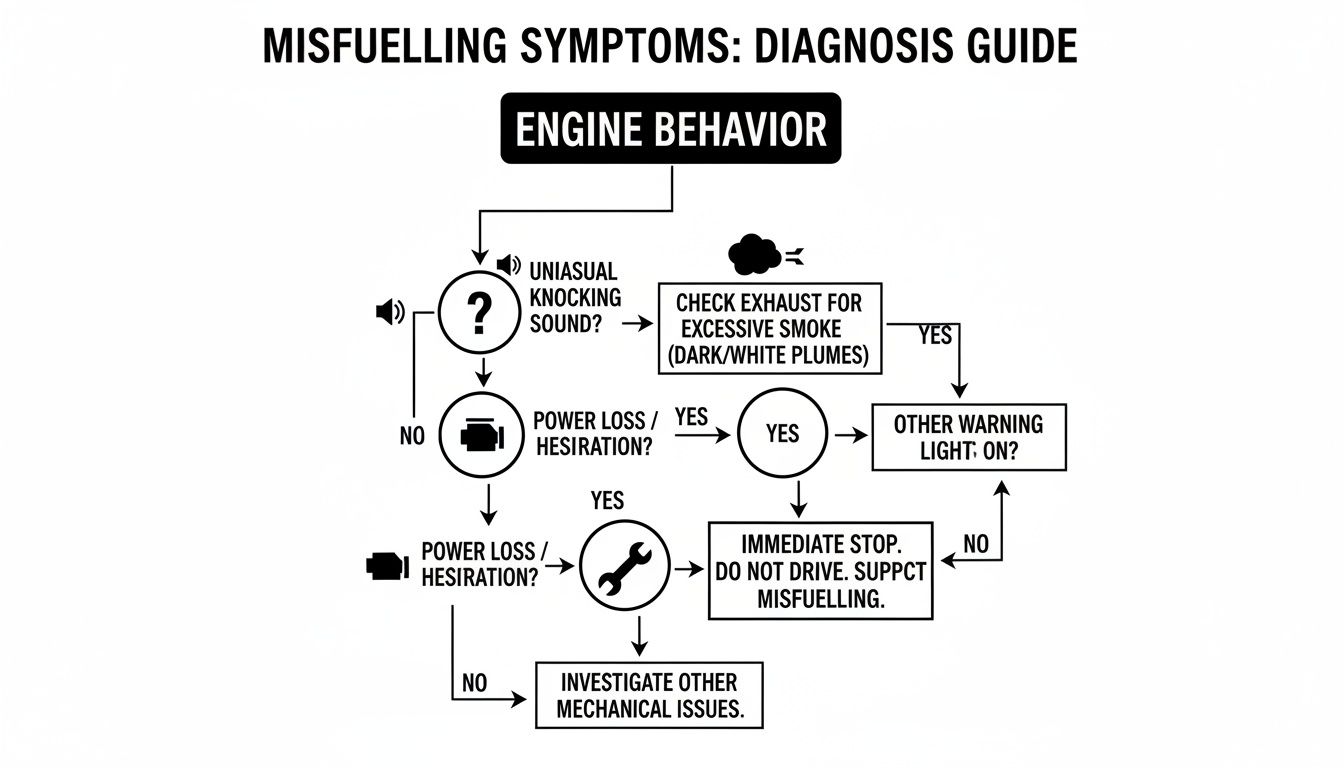
As you can see, things like engine knocking, a plume of extra smoke from the exhaust, or a sudden lack of power are the engine's cry for help.
The Best Case: Engine Not Started
If you caught the mistake right there at the forecourt and haven't touched the ignition, breathe a sigh of relief. You’re in the best possible position. The contaminated fuel is just sitting in the tank, completely isolated from the engine's delicate and expensive components.
Think of it like adding salt to the sugar bowl by accident. As long as you don't stir it and scoop it into your tea, the problem is contained and simple to resolve.
In this scenario, the fix is straightforward and relatively painless on the wallet. A professional wrong fuel drain service can meet you wherever you are, from a busy petrol station in Ipswich to your driveway in Bury St Edmunds. They'll safely drain the entire tank, flush out the dregs, and get you back on the road, ready for the right fuel, often in less than an hour.
The cost is a drop in the ocean compared to the alternative, usually falling somewhere between £200 and £300. It’s a small price for dodging a bullet that could cost you thousands.
The Worst Case: Engine Started
The moment you turn that key, the game changes entirely. The fuel pump whirs to life, sucking the petrol-diesel mixture from the tank and pushing it through the entire fuel system. What was a contained issue is now a full-blown crisis spreading through the veins of your vehicle.
Petrol, being a solvent, immediately starts to strip away the essential lubricating film that diesel provides. This leaves your high-pressure fuel pump and injectors grinding metal-on-metal. This friction creates tiny metal fragments, known as swarf, which are then blasted through the system, clogging and destroying delicate components along the way.
Once that engine has been started, the potential repair costs skyrocket. A simple fuel drain is off the table. Now you’re looking at a major mechanical operation, which could mean replacing the fuel pump, all the injectors, filters, and even the fuel lines. The bill for this can easily climb from £2,000 to well over £5,000, depending on your car.
This massive jump in cost is exactly why our number one piece of advice is always the same: do not start the engine. Calling for an immediate fuel drain isn't just a repair; it's damage limitation that can save you from a truly catastrophic bill.
How a Professional Fuel Drain Service Saves Your Engine
When you’ve put even a small amount of petrol into your diesel tank, the clock is ticking. Calling a professional mobile fuel drain service is, without a doubt, the quickest and safest way to head off catastrophic engine damage.
Forget the hassle and expense of towing your car to a garage. A mobile technician comes directly to you, whether you’re stuck on the forecourt of a petrol station in Felixstowe or parked on your own drive in Bury St Edmunds.
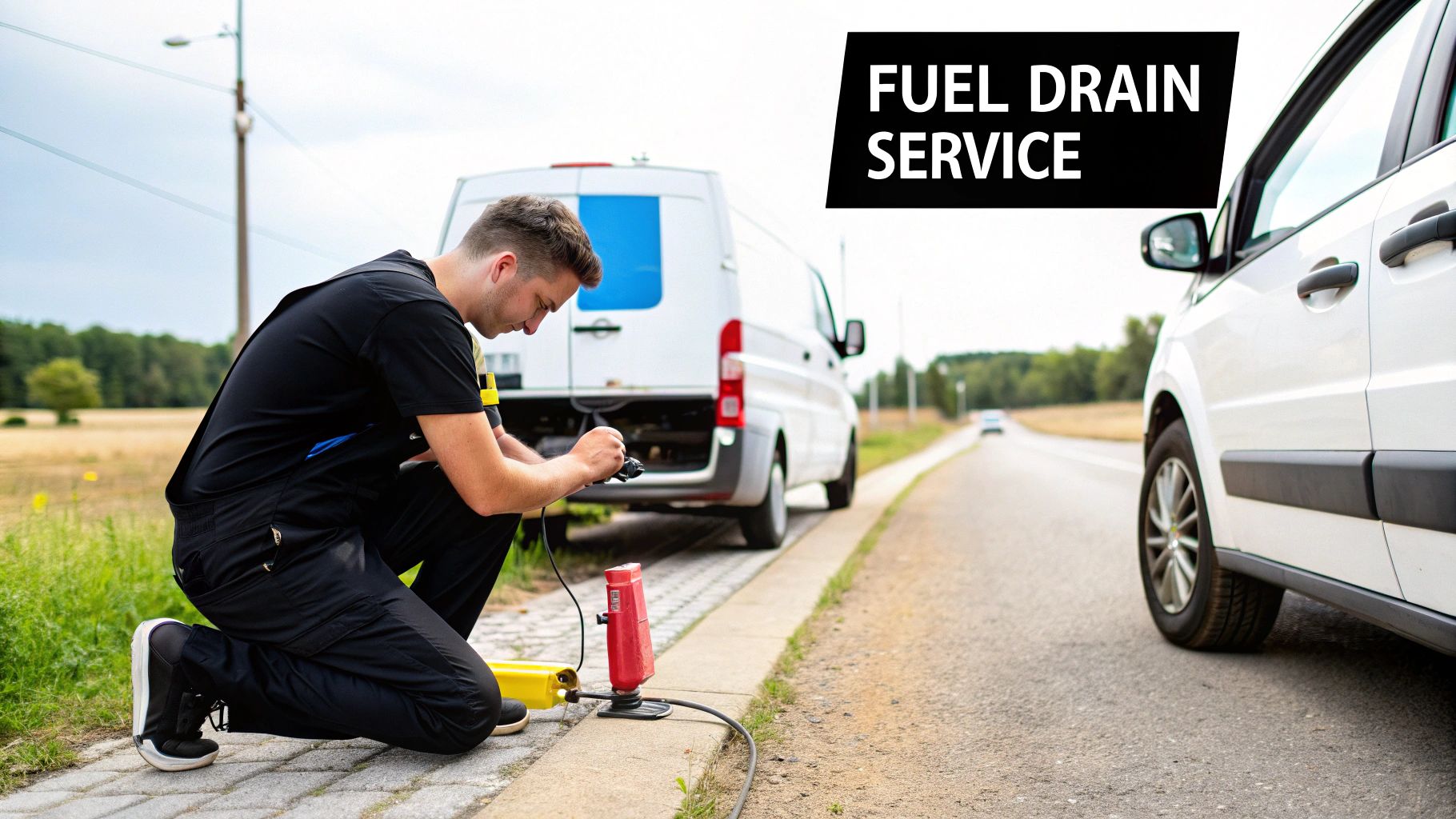
This immediate response is all about minimising your stress and getting you back on the road fast, often within an hour of arrival. The technician turns up in a fully equipped, compliant vehicle, ready to handle the entire job safely and efficiently right there on the spot.
What to Expect During a Fuel Drain
The whole process is methodical and incredibly thorough, designed to ensure every last drop of contaminated fuel is gone. First things first, the technician will make sure your vehicle is in a safe spot with the ignition firmly off.
Here’s a breakdown of the key steps you’ll see them take:
Siphoning the Contaminated Fuel: Using specialist pumping equipment, the technician will drain the entire contents of your fuel tank. This isn't just a hose and a bucket; it’s a professional setup that transfers the fuel into a secure, approved container to prevent any spillage of the hazardous petrol-diesel mix.
Flushing the Fuel System: With the tank empty, the system is then flushed through with a small amount of clean diesel. This is a critical step. It clears out any lingering petrol from the fuel lines, filter housing, and pump, leaving no trace of the contaminant behind.
Refilling with Clean Fuel: Next, the technician will add enough fresh, correct diesel to get your engine running smoothly again. It’s usually enough to get you safely to the nearest petrol station for a full top-up.
Safe Fuel Disposal: Finally, they take the contaminated fuel away for environmentally compliant disposal. This is a legal requirement that protects you from any responsibility for handling hazardous waste.
A professional mobile fuel drain isn't just a simple service; it's a critical intervention. The speed and efficiency of a 24/7 mobile unit means the entire problem can be solved in under an hour for a fraction of what a dealership would charge, which can easily run into thousands of pounds.
This on-the-spot solution is far more cost-effective than the alternatives. Garages often have to add charges for towing, workshop labour, and a premium for the emergency call-out. A mobile specialist offers a transparent, fixed-cost solution that's typically about half the price of going through a main dealer.
If you find yourself in this situation, our emergency guide on what to do when you need a fuel drain near you has more immediate advice. By choosing a professional mobile service, you're opting for the fastest, safest, and most affordable way to save your engine from serious, long-term damage.
Simple Habits to Stop Misfuelling Happening Again
Let's be honest, preventing a misfuelling mistake is infinitely cheaper and far less hassle than dealing with the aftermath. By building a few simple checks into your routine, both everyday drivers and fleet managers can pretty much eliminate the risk of putting petrol in a diesel car.
For most of us, the problem happens when we switch to autopilot at the petrol station. You pull into your usual spot, and muscle memory takes over. The trick is to consciously break that habit. Just take a second to pause and double-check before you even lift the nozzle. The colour-coding is your first big clue: diesel pump handles are black, and unleaded petrol handles are green.
On top of that, here are a few other habits that make all the difference:
Ditch the Distractions: Chatting on the phone or dealing with the kids in the back seat is prime time for a slip-up. Just a few seconds of not paying attention is all it takes to grab the wrong fuel.
Check the Label, Twice: Glance at the label on the pump and on the trigger. It will clearly say "DIESEL". It’s a tiny check that saves a massive headache.
Get a Misfuel Device: For total peace of mind, you can fit a special cap to your fuel tank. These clever gadgets physically block the smaller petrol nozzle from ever entering your wider diesel filler neck.
A Word for Fleet Managers Across Suffolk
When you're running a fleet of vans or lorries around Suffolk, a vehicle off the road is money down the drain. Making sure your drivers don't misfuel needs to be a fundamental part of how you operate.
Think about it: one simple mistake can sideline a vehicle for hours, wrecking your delivery schedule and cancelling jobs. A bit of training and some clear, simple rules are a small price to pay to keep your fleet rolling and your business on track.
Putting a proper prevention plan in place is straightforward:
Train Your Drivers: Don't just assume they know. Regularly drill it into your team to check the fuel type, and make sure they understand the serious mechanical damage and costs involved.
Label Everything: Stick a big, impossible-to-miss "DIESEL ONLY" sticker inside the fuel flap and even on the dashboard of every single vehicle.
Have a Go-To Expert: Find a reliable 24/7 service like Misfuelled Car Fixer and put their number in every driver's phone. Knowing exactly who to call when things go wrong saves precious time and guarantees the problem is sorted quickly and professionally.
Answering Your Misfuelling Questions
Even after knowing the risks, it’s natural to have a few more questions rattling around. It's a stressful mistake, and you need clear, no-nonsense answers to figure out your next move. Here are the most common things we get asked by drivers across Suffolk.
How Much Petrol is Too Much?
This is always the first question, but the answer isn't a simple number. The hard truth is that any amount of petrol is too much. From the moment it hits the tank, petrol acts like a solvent, immediately starting to break down the oily, lubricating film that diesel provides.
The real danger depends on a couple of things:
The mix: How much petrol went in compared to the diesel? Five litres in a nearly empty tank is far more damaging than one litre in a full one.
The engine: The biggest factor is whether you turned the key. If you haven't started the car, the problem is contained in the tank. If you have, that damaging mix is already circulating through your fuel system.
There's no "safe" amount of contamination. The only way to be certain you've avoided a massive repair bill down the line is to get the tank professionally drained.
Will My Car Insurance Cover This?
It’s a fair question, and many drivers hope their policy will bail them out. Unfortunately, it’s rarely that simple. While some fully comprehensive policies might cover "accidental damage," many insurers specifically exclude misfuelling. They often see it as a preventable mistake.
Your first step should be to dig out your policy documents and read the small print. But even if you are covered, think about the knock-on effects. You'll have to pay your excess, and making a claim will almost certainly push up your premiums next year. More often than not, the cost of a mobile fuel drain is far less than your excess, let alone the price hike on your insurance.
For most people, calling a specialist fuel drain service is the smartest and cheapest way out of this mess. You avoid the insurance headache, protect your no-claims bonus, and get the problem sorted much faster.
Can't I Just Top It Up with Diesel?
It seems like a logical fix, doesn't it? Just dilute the petrol until it's barely there. We hear this a lot, but it’s a gamble we’d strongly advise against. Topping up the tank doesn't get rid of the problem—it just puts it off.
The petrol is still sloshing around in there, stripping away lubrication and putting your fuel pump and injectors at risk. You’d have to drive for ages, constantly refilling, to get the petrol concentration down to a safe level. By that point, the damage could already be done. The only truly safe solution is to drain the entire tank and start fresh.
If you've put even a small amount of petrol in your diesel engine in Suffolk, don't leave it to chance. Contact Misfuelled Car Fixer straight away for a fast, 24/7 mobile fuel drain service. We'll get you safely back on the road. Visit us at https://www.misfuelledcarfixer-suffolk.co.uk or call our emergency line.


