



Diesel in petrol engine: Symptoms and steps; diesel in petrol engine tips
- Misfuelled Car Fixer

- Feb 13
- 17 min read
24/7 Hotline Nationwide: 0330 122 6640
National Wrong Fuel Rescue: https://www.misfuelledcarfixer.co.uk
If you found this page, we cover you in England!
Putting diesel in a petrol engine is a serious, but thankfully fixable, mistake. The most important thing to remember is to not start the engine. Keeping that oily diesel fuel out of the engine's delicate system is the key to avoiding a truly eye-watering repair bill.
That Sinking Feeling: You’ve Put Diesel in Your Petrol Car
It’s a moment of pure panic. You hang up the fuel nozzle, glance down, and your stomach drops—you've been holding the black diesel handle, not the green petrol one. You're not alone; this simple slip-up happens to thousands of UK drivers every single year, usually just from a moment of being distracted.
What you do in the next few seconds is absolutely crucial. The golden rule is simple: do not put the key in the ignition or start the engine. If the wrong fuel stays put in the tank, you're in the best possible version of a bad situation.
Think of your petrol engine like a thoroughbred racehorse designed to run on high-octane, easily combustible fuel. Pouring diesel into the tank is like asking that horse to run on thick, gooey treacle. It just won't work. Instead of combusting properly, the heavy diesel clogs fuel injectors, coats spark plugs, and gums up the entire system.
What to Do Right Now
If you've caught the error while you're still at the pump, take a deep breath and follow these steps. Acting calmly now can genuinely save you thousands of pounds down the line.
Don't Start the Car: This cannot be stressed enough. Don't even turn the key to the 'on' or 'accessory' position. Doing so can prime the fuel pump, which will start sending the diesel into the fuel lines.
Tell the Petrol Station Staff: Let an attendant know what’s happened. They’ve seen it all before and can help cordon off the pump and assist you.
Move Your Car to a Safe Spot: Put the car in neutral. With some help from the station staff or a kind stranger, push it to a safe parking space, well away from the busy pumps.
This decision tree breaks down exactly what to do next.
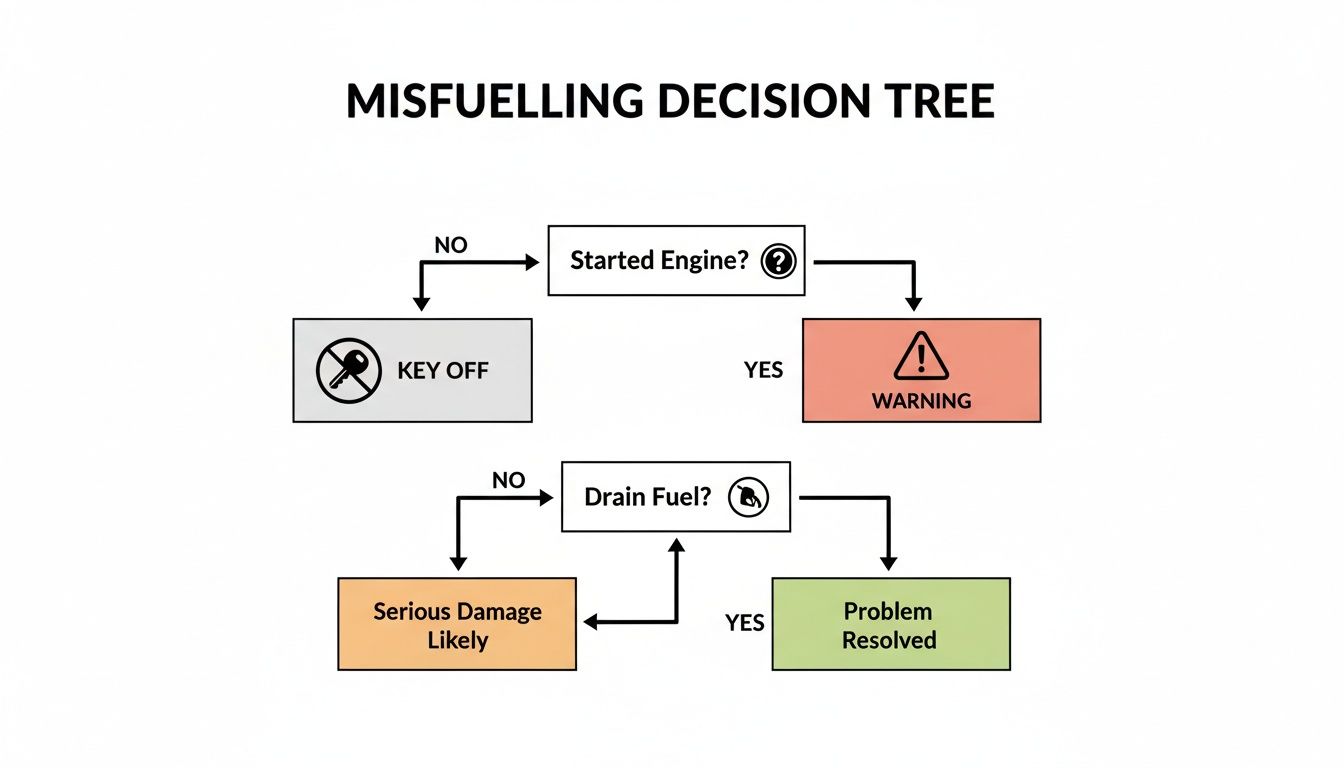
As the chart shows, whether you’ve started the engine or not, the only safe way forward is to get the contaminated fuel professionally drained.
By not starting the engine, you contain the problem to the fuel tank. This makes the solution much simpler, faster, and significantly cheaper. Starting the engine turns a straightforward fuel drain into a complex and expensive system flush and potential component replacement.
Your best bet is to call a specialist mobile fuel drain service like Misfuelled Car Fixer. We come straight to you, whether you're stuck at a petrol station in Ipswich or stranded on a country lane near Bury St Edmunds, and sort the problem out right there on the spot.
Why Diesel and Petrol Are a Terrible Mix
To really get why putting diesel in a petrol car is such a monumental mistake, we need to look at how the two engines are fundamentally different. They’re each built for a very specific type of fuel, and swapping them is like trying to run a high-performance sports car on treacle. It’s just not going to work.
A petrol engine is all about speed and precision. It takes highly flammable petrol, mixes it with air to create a fine vapour, and then ignites it with a perfectly timed spark. It's a quick, clean, explosive process that generates power.
Diesel fuel is a completely different beast. It's much oilier, less flammable, and far denser. A diesel engine doesn't even have spark plugs. Instead, it squeezes air so intensely that it becomes incredibly hot—hot enough to instantly combust the diesel fuel the second it's injected. The power comes from pure, brute-force compression, not a spark.
The Spark vs. Squeeze Problem
So, what happens when you pour that oily diesel into a system expecting petrol? The whole finely-tuned process just falls apart. Your petrol engine's spark plugs are nowhere near hot enough to properly light up that thick, heavy diesel.
Imagine trying to light a big, damp log with a single match. It won’t burst into flames. It'll just smoulder, spit, and create a ton of thick, nasty smoke. That's exactly what's happening inside your engine.
Instead of burning cleanly, the diesel just coats everything in a greasy, black, unburnt film. This kicks off a chain reaction of problems that can go from bad to worse in a matter of minutes.
How Diesel Wrecks a Petrol System
The damage starts the moment you turn the key. The fuel pump whirs into life and begins circulating the thick, engine-killing diesel through a system designed only for thin, clean petrol.
Here’s a step-by-step look at the carnage:
Smothered Spark Plugs: The oily diesel residue immediately coats the spark plugs, insulating them. This prevents them from generating a spark strong enough to ignite any petrol that might be left in the mix.
Blocked Fuel Injectors: Petrol injectors have microscopic nozzles designed to spray a perfect, fine mist. Trying to force thick diesel through them is like pushing mud through a colander—they clog up fast, ruining the fuel spray pattern.
Confused Oxygen Sensors: Sooty, unburnt fuel gets blown into the exhaust, where it smothers the oxygen sensor. This crucial sensor measures the fuel-to-air ratio, and once it's contaminated, it starts sending junk data to the car's computer.
Melted Catalytic Converter: The 'cat' is designed to clean up tiny amounts of unburnt fuel. When it gets flooded with raw, oily diesel, it can rapidly overheat and literally melt down internally. That’s an incredibly expensive repair.
This kind of misfuelling mistake has become far more common on UK roads. Between 2001 and 2018, the number of diesel vehicles on our roads more than doubled to 18.9 million, while petrol cars actually dropped by 15%. With more diesel pumps than ever, it’s easier to grab the wrong nozzle. You can find more details on these UK fuel consumption trends.
At the end of the day, the complete chemical mismatch means there's no "wait and see" option. A professional fuel drain isn't just a good idea; it's the only way to save your car from serious, long-term, and wallet-busting damage.
Identifying the Symptoms of Misfuelling
So, what happens if you didn't catch the mistake at the pump and have already started your car? The symptoms of putting diesel in a petrol engine can show up almost instantly. Being able to spot them is your next best line of defence against causing some serious, and expensive, damage. Your car has a way of letting you know when something is very, very wrong.
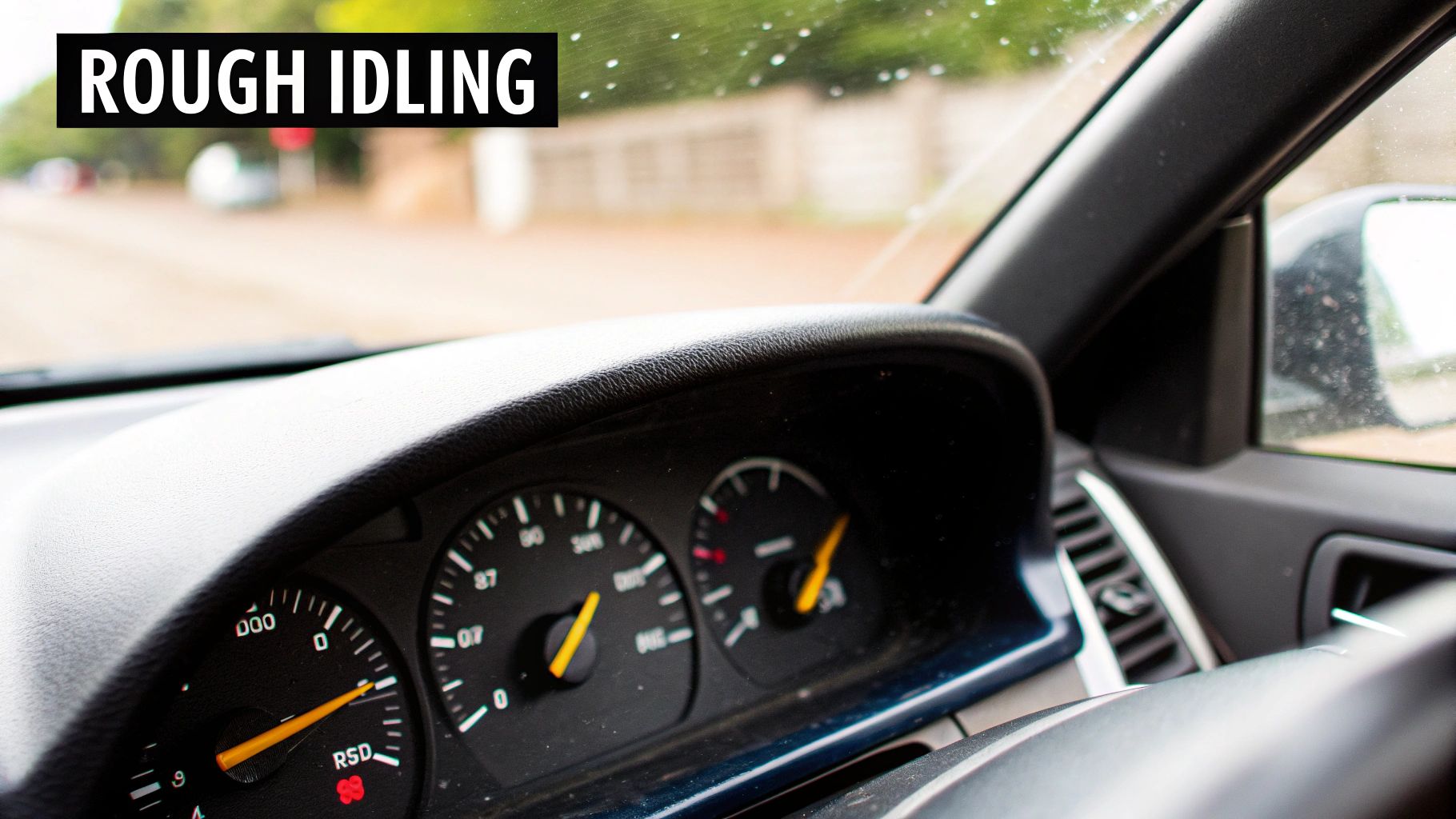
The exact signs depend on whether you’ve just turned the key or have actually managed to get moving. To make it easier, we've broken down the tell-tale signs into what you'll notice before and after you start driving.
To help you quickly identify what's going on, here's a quick-reference table outlining the most common signs that you've put diesel in your petrol car.
Table: Symptoms of Diesel in a Petrol Engine at a Glance
Symptom | What It Means | Severity Level |
|---|---|---|
Engine Won't Start | The spark plugs are likely coated in oily diesel, preventing ignition. | High |
Engine Stalls Instantly | It briefly ran on residual petrol before the diesel hit the engine. | High |
Juddering / Misfiring | The engine is failing to ignite the diesel, causing erratic combustion. | High |
Loss of Power | The engine isn't getting the right fuel to run properly. It's essentially starving. | High |
White/Grey Exhaust Smoke | This is unburnt diesel turning into vapour in the hot exhaust system. | High |
Loud Knocking Noises | The diesel is disrupting the normal firing sequence in the cylinders. | Critical |
Check Engine Light | The car's computer has detected a major engine or emissions fault. | High |
This table provides a snapshot, but understanding when these symptoms appear is key to minimising damage.
Signs Before You Start Driving
In a lot of cases, the trouble starts the very moment you turn the key. The thick, oily nature of diesel just doesn't play well with a system built for a fine, highly flammable petrol mist.
The Engine Won't Start at All: This is the classic, most obvious sign. Diesel has gummed up the spark plugs, making it impossible for them to create the spark needed to get things going.
Engine Stalls Immediately: You might hear the engine fire up for a second or two. That’s just it burning off the last drops of petrol in the fuel lines before the diesel arrives and brings everything to a grinding halt.
If either of these happens, please don’t keep trying to start the car. Every turn of the key just pushes more of that wrong fuel further into the system, making the clean-up job much harder.
Signs While on the Road
What if you had a good amount of petrol still in the tank? You might actually drive a short distance before the diesel contamination really takes effect. When it does, the symptoms will be dramatic and completely unmistakable.
Your car will begin to feel sick, very quickly. The juddering, smoke, and loss of power are direct protests from your engine as it tries—and fails—to process a fuel it was never designed to burn. It's a clear signal to pull over safely and turn off the engine immediately.
The car's performance will drop off a cliff as the diesel circulates, leading to some very clear signs:
Juddering and Misfiring: The car will feel like it's shaking, lurching, or hiccuping, especially when you try to accelerate. This is your engine misfiring because the spark plugs simply can't ignite the oily diesel.
Significant Loss of Power: Your car will suddenly feel sluggish and weak. Pushing the accelerator won't do much, as the engine is being starved of the correct, combustible fuel it needs to run.
Thick Smoke from the Exhaust: You'll probably notice a lot of smoke pouring out of the tailpipe. This is usually a white or greyish smoke, which is the unburnt diesel vaporising in the hot exhaust.
Loud Knocking Noises: A worrying knocking or 'pinking' sound can start. This is because the diesel is detonating at the wrong time inside the engine cylinders, disrupting the smooth combustion cycle.
Warning Lights on the Dashboard: You can bet the check engine light will pop up on your dashboard. The car's sensors are detecting huge problems with combustion and the exhaust.
Spotting these symptoms is the most important thing you can do. The sooner you realise what's happened and stop the car, the less damage you’ll do. You can find out more in our detailed guide to wrong fuel in car symptoms. The only correct action is to pull over safely, switch off the engine, and call for professional help.
Right, let's break down exactly what happens when diesel gets into a petrol engine. It's not one single 'bang' of a problem, but more like a chain reaction that gets worse with every second the engine is running. The damage spreads outwards from the fuel tank, and the potential repair bill climbs right along with it.
Think of it like pouring treacle into a water pistol. The first part to feel the strain is the fuel pump. It's designed to move thin, free-flowing petrol, but now it’s struggling to force thick, oily diesel through pipes and filters that are far too small for it. This puts immediate stress on the pump and is the first step towards clogging the entire system.
The First Signs of Trouble
The first components to wave the white flag are the most sensitive ones. Diesel is an oil, a lubricant, and it has an immediate and disastrous effect on the parts that need a clean, explosive fuel source.
Clogged Fuel Injectors: Your car’s fuel injectors are marvels of engineering, with tiny nozzles designed to spray a fine, vapour-like mist of petrol. Shove thick diesel through them, and they clog up almost instantly. This ruins the spray pattern, meaning the engine is starved of the properly mixed fuel it needs to run smoothly.
Fouled Spark Plugs: A petrol engine needs a clean, powerful spark to ignite the fuel. When diesel enters the combustion chamber, it coats the tips of the spark plugs in a greasy film, which effectively smothers the spark. Without a good spark, you get incomplete combustion, which is what causes the classic misfiring, spluttering, and juddering you'll feel from the driver's seat.
If you catch it at this stage, the damage is usually reversible with a professional fuel drain and system flush. But if you keep the engine running, the problem goes from bad to worse, and fast.
When the Damage Spreads
As your engine desperately tries (and fails) to burn the diesel, all that unburnt, oily fuel has to go somewhere. It gets forced into other highly sensitive—and expensive—systems. This is the point where a simple mistake snowballs into a potential nightmare.
The most vulnerable parts are the sensors that manage your engine's performance and the exhaust system that cleans up its emissions. These delicate components are simply not built to be coated in raw, oily diesel.
The real danger of driving with diesel in your petrol tank is that the repair costs don't just add up—they multiply. What starts as a simple fuel drain can quickly escalate into needing a new catalytic converter or lambda sensor, turning a bill of a few hundred pounds into a few thousand.
Long-Term Catastrophic Failure
If the car is driven for any real distance, the unburnt diesel will cause serious, potentially fatal, damage to two of the most expensive parts of your vehicle: the catalytic converter and the engine's internal moving parts.
Damage to the Catalytic Converter Your catalytic converter (or 'cat') gets incredibly hot in order to burn off harmful pollutants in the exhaust gas. When it gets flooded with raw diesel, it can overheat catastrophically. The delicate, precious-metal honeycomb structure inside can literally melt down and collapse, creating a total blockage in your exhaust. A replacement cat can easily set you back over £1,000.
Engine Lubrication Failure This is the most sinister problem of all. Unburnt diesel doesn’t just go out the exhaust; it can also seep past the piston rings and dribble down into the engine's sump, mixing with your engine oil. This is known as oil dilution. It thins the oil, ruining its ability to lubricate vital moving parts. This leads to massive friction and wear on critical components like:
Pistons and cylinder walls
Bearings
Crankshaft and camshafts
This accelerated wear is permanent and can quickly lead to a seized engine. At that point, you’re not looking at a repair anymore. You’re looking at a full engine replacement—a bill that can often be more than the car is even worth.
The choice is stark. A quick, professional mobile fuel drain from a service like Misfuelled Car Fixer stops this entire chain reaction in its tracks for a manageable cost. The alternative—keeping your fingers crossed and driving on—is a gamble that can turn a simple slip-up into a financial disaster.
How Do I Get This Fixed? Choosing the Right Fuel Drain Solution
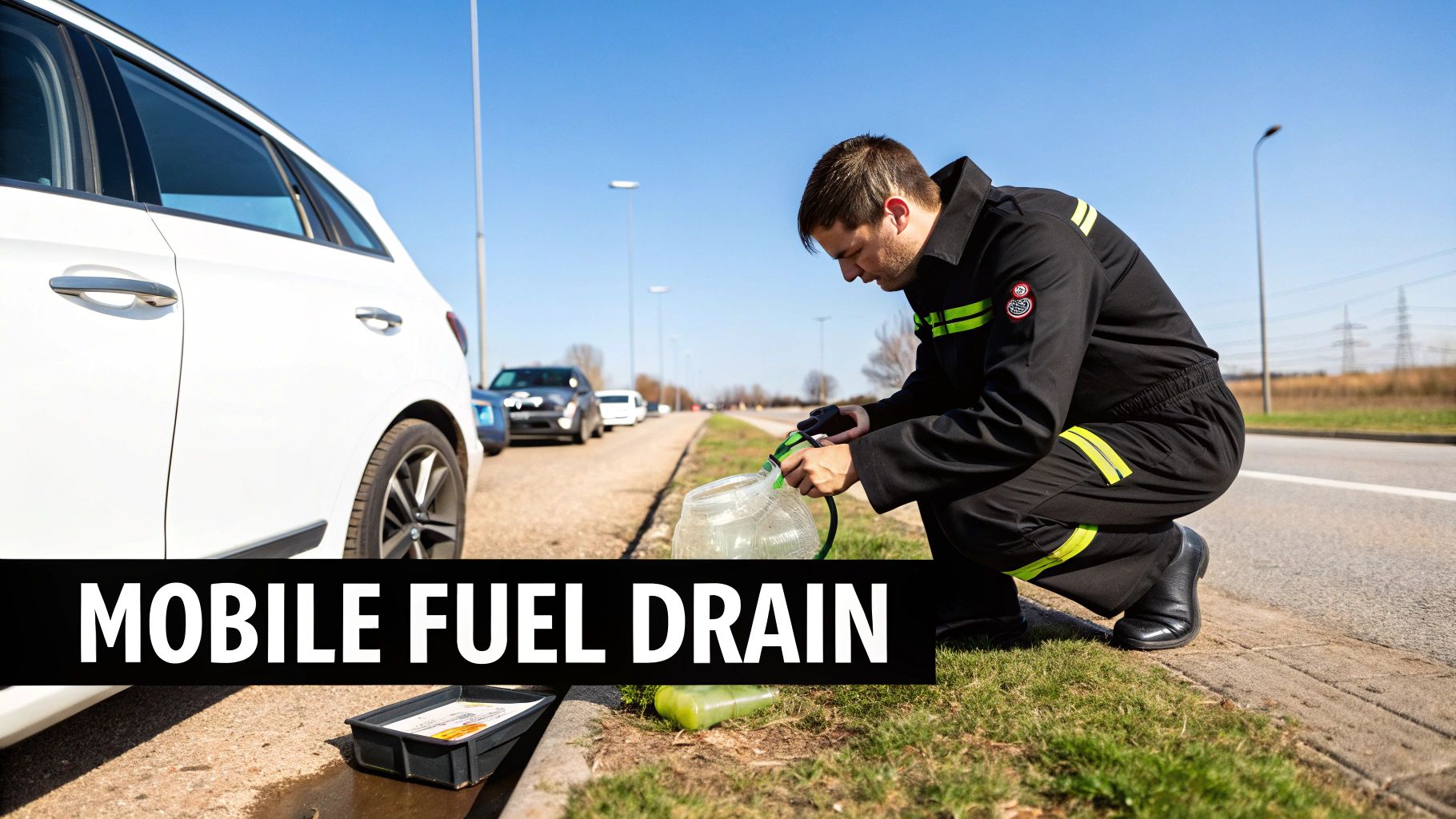
After the initial shock of realising you’ve put diesel in a petrol engine, your next thought is probably, "Right, how do I sort this out?" You’ve essentially got two main options: have your car towed to a garage or main dealer, or call out a specialist mobile fuel drain service.
Understanding the pros and cons of each is crucial for getting back on the road quickly and without a massive, unexpected bill. While your local garage might seem like the obvious first call, a mobile service is specifically designed for this exact crisis.
Mobile Fuel Drain vs Garage Towing: What's the Difference?
The traditional route involves a lot of waiting. First, you wait for a recovery truck. Then, you wait while your car is towed to a garage. Finally, you wait for the garage to squeeze your car into their already packed schedule. It's a slow, cumbersome, and often surprisingly expensive process before they've even touched your car.
A mobile fuel drain service, on the other hand, cuts right to the chase. A technician comes directly to you, whether you're stuck on a petrol station forecourt, in your office car park, or on the side of the road. They arrive with all the specialist gear needed to fix the problem on the spot.
Here’s a quick comparison to make things clearer.
Mobile Fuel Drain vs Garage Repair: A Cost and Time Comparison
When you're stuck, deciding between a mobile service and a garage can feel overwhelming. This table breaks down the key factors to help you see why a mobile specialist is often the better choice.
Factor | Mobile Fuel Drain Service | Garage or Main Dealer |
|---|---|---|
Speed | Arrives and completes the job in 1-2 hours on average. | Involves towing time, workshop queues, and repair time; can take several hours or even days. |
Convenience | The service comes to you. No need to leave your car or arrange other transport. | Requires towing your vehicle away, leaving you stranded and needing to arrange a way home. |
Cost | Typically a fixed, all-inclusive price. No towing fees, labour rates, or hidden extras. | You pay for towing, garage labour rates, and potentially storage fees, leading to a much higher bill. |
Expertise | Specialists who perform wrong fuel drains all day, every day. Highly efficient and knowledgeable. | A general mechanic may only see this issue occasionally, lacking the specialised tools and experience. |
As you can see, the mobile option is built around getting your specific problem solved as quickly and painlessly as possible, while the garage route adds extra steps, time, and cost.
The real advantage of a mobile service is its specialisation. A general garage mechanic might handle a fuel drain once a month, but a mobile technician does it several times a day. They are true experts in doing the job quickly, safely, and without any fuss.
What Does a Mobile Technician Actually Do On-Site?
A professional fuel drain is a precise, methodical process. It’s not just about siphoning the tank; it's a complete system flush to make sure no damaging diesel is left behind.
Here’s what you can expect when a technician from Misfuelled Car Fixer arrives:
Secure the Area: First things first, safety. The technician will make the area around your car safe with cones and ensure all safety protocols are followed before starting any work.
Drain the Fuel Tank: Using specialist, anti-static pumps, they will safely drain every last drop of the contaminated fuel from your tank into a secure, purpose-built container.
Flush the Entire System: This step is absolutely vital. The technician will then flush the fuel lines, filter, and injectors with a small amount of clean petrol to purge any lingering diesel residue.
Add Fresh, Correct Fuel: Once the system is spotless, they'll add enough clean petrol to your tank to get you safely to the nearest petrol station to fill up properly.
Start and Test the Engine: Finally, they will start your car and let it run for a few minutes, making sure everything is circulating as it should. They won't leave until they're 100% confident your car is running perfectly again.
This entire on-site service is designed to take the stress out of a bad situation. It's not just a faster fix; it also helps contain the financial damage. For instance, on 27 October 2025, UK petrol averaged 134 pence per litre, while diesel was nine pence more. Putting the wrong fuel in means you're not just paying for a drain, you're also discarding a tank of more expensive fuel. Learn more about UK weekly average fuel prices.
Choosing a professional mobile service like our wrong fuel rescue in Suffolk turns a day-ruining disaster into a minor hiccup that’s sorted in just an hour or two.
Simple Ways to Avoid Misfuelling in the Future
Right, so you’ve sorted out the mess of putting diesel in a petrol engine. The last thing you want is to go through all that stress and expense again. The good news? Making sure it never happens again is actually pretty straightforward. It’s all about creating a few simple habits at the petrol station.
Let's be honest, misfuelling usually happens when we're distracted. You might be on the phone, mentally running through your shopping list, or just on autopilot after a long day. The trick is to build a quick, conscious routine that makes checking the fuel type as automatic as checking your mirrors.
Build a Mindful Fuelling Routine
The best prevention methods don't cost a thing. They're all about adding a few small, deliberate checks to your fuelling routine. Try to do these every single time you pull up to the pump.
Check the Nozzle Colour: In the UK, the pumps are colour-coded for a reason. Green is for petrol, black is for diesel. Get into the habit of glancing at the colour before you even pick up the nozzle.
Read the Pump Label: Don't just go by the colour alone. Take a literal second to read the label on the pump and the trigger. It will clearly say 'Unleaded' or 'Diesel'. This is your best line of defence.
Look at Your Filler Cap: Your car's own filler cap tells you what it needs. Pop it open and have a quick look before the nozzle goes anywhere near it. This final check connects what's in your hand to what your car requires.
Honestly, these three steps take less than five seconds, but they are incredibly effective at stopping a misfuelling disaster in its tracks.
Misfuelling Prevention Gadgets
If you're still a bit worried, maybe you drive different cars for work and home, or you just want that extra peace of mind, you can buy a physical prevention device. These are clever bits of kit designed to make it physically impossible to put the wrong fuel in.
Think of a prevention device like a fuse in a plug. It’s a simple, one-off purchase that acts as a final, foolproof backstop against human error. It just takes the worry away completely.
You’ve got a couple of options here:
Specialised Fuel Caps: You can swap your standard filler cap for one that has a built-in mechanism. It's designed to physically block the wider diesel nozzle from ever fitting into your petrol tank's filler neck.
Filler Neck Inserts: This is a small device that you fit once into your car's filler neck and then forget about. It has a precisely shaped opening that only lets the correct, slimmer petrol nozzle through. If you try to insert a diesel nozzle, it simply won't go in.
These gadgets are a godsend for fleet managers whose drivers are constantly swapping between petrol and diesel vans. For your own car, they're a brilliant "fit and forget" solution, giving you the confidence that even on your most frazzled day, you can't make this expensive mistake.
Frequently Asked Questions About Misfuelling
Once the immediate panic is over and your car is sorted, you're bound to have a few questions rolling around in your head. It’s a stressful situation, so here are some clear, straightforward answers to the things we get asked most by drivers across Suffolk.
I Only Put a Little Diesel in My Petrol Car. Is It Still a Problem?
Yes, without a doubt. Even a splash of diesel can cause real trouble for a petrol engine. Think of diesel as a thick, heavy oil and petrol as a light, volatile spirit. Your petrol engine is designed for the latter, using a spark plug to ignite it. Diesel, on the other hand, is too oily to be ignited by a spark.
Even 5% diesel contamination is enough to start coating your spark plugs and gumming up the precision-engineered fuel injectors. Before you know it, the engine will start to misfire, kick out smoke, and will likely refuse to start at all. Topping up with more petrol to "drown it out" is the worst thing you can do—it just pumps the damaging mixture further into your car's system.
It doesn’t matter if it was a drop or a gallon. The only safe way forward is a professional fuel drain. Trying to run the car is a massive gamble you don't want to take with your engine.
Does My Car Insurance Cover a Wrong Fuel Incident?
That really depends on your provider and the fine print of your policy. Some fully comprehensive plans do include "misfuelling cover" as standard, while for others it’s an optional extra you have to pay for.
The catch is, many insurers see it as driver error and exclude it completely. The only way to know for sure is to dig out your policy documents or give them a call. Also, bear in mind that making a claim will almost certainly affect your no-claims bonus and could push up your premiums next year. In many cases, the cost of calling us out for a mobile fuel drain is actually less than the insurance excess, making it the quicker and cheaper option.
Can I Just Drain the Fuel Myself?
In a word: no. Please don't even think about it. Both petrol and diesel are incredibly flammable, and their fumes are not only toxic but also highly explosive. Attempting a DIY drain without the proper anti-static equipment is a recipe for disaster, posing a serious risk of fire and personal injury.
On top of that, the contaminated fuel mix is classed as hazardous waste. You can't just pour it down a drain; it needs to be disposed of according to strict environmental laws. Our technicians are fully equipped for safe extraction and are licensed to transport and dispose of contaminated fuel legally and responsibly. It’s just not worth the risk. The same goes for other contaminants; you can learn more about what to do if you put AdBlue in your fuel tank by reading our guide on the subject.
How Long Does a Professional Fuel Drain Take?
We know you want to get back on the road, so our mobile fuel drain service is designed to be as quick and efficient as possible. Once one of our technicians arrives, you can expect the entire job to be done in about 60 to 90 minutes.
That timeframe covers everything:
Safely draining every last drop of contaminated fuel from the tank.
Flushing the fuel lines and critical parts to clear out any residue.
Putting in some fresh, correct fuel to get you started.
Running the engine to make sure everything is back to normal.
Our whole aim is to get you safely on your way with the absolute minimum of fuss.
If you've put diesel in your petrol engine in Suffolk or the surrounding areas, don't panic and don't start the car. Call the experts at Misfuelled Car Fixer for immediate, professional assistance 24/7. Find out more at https://www.misfuelledcarfixer-suffolk.co.uk.


