



Diesel in a Petrol Engine What to Do and How to Fix It
- Misfuelled Car Fixer

- Feb 15
- 13 min read
24/7 Hotline Nationwide: 0330 122 6640
National Wrong Fuel Rescue: https://www.misfuelledcarfixer.co.uk
If you found this page, we cover you in England!
Realising you've put diesel in a petrol engine is a gut-wrenching moment, but it's a common and fixable mistake. The absolute most important thing to do right now is... nothing. Don't start the car. Don't even put the key in the ignition.
Keeping the ignition off is the one action that prevents a simple fuel drain from becoming a complex and expensive engine repair.
Your Immediate Misfuelling Action Plan
That sinking feeling at the pump happens to the best of us. But what you do in the next few minutes is crucial. Taking the right steps immediately can be the difference between a minor inconvenience and a bill for thousands of pounds. Your car's fate is literally decided before you even think about turning that key.
Here’s a quick, no-nonsense rundown of what to do.
To make things crystal clear, here are the essential first steps in an easy-to-read table.
Immediate Actions After Misfuelling
Action | Why It's Critical |
|---|---|
Don't Touch the Ignition | Prevents the fuel pump from sending diesel into the engine. This single action contains the problem. |
Alert Petrol Station Staff | They can secure the pump area for safety and are used to this scenario. It's a matter of safety for everyone. |
Move Your Vehicle Safely | Put the car in neutral and push it to a safe parking spot. This clears the pump for others and gets you out of the way. |
Call for Help | Contact a professional wrong fuel drain service. Avoid trying to fix it yourself. |
Following these steps keeps a manageable problem from spiralling into a nightmare.
The Golden Rule: Do Not Start the Engine
I can't stress this enough: do not start your engine. Not even to move it a few feet. The second you turn the key or press that start button, the fuel pump kicks into life. It immediately starts trying to push that thick, oily diesel through fuel lines and injectors designed for thin, volatile petrol. That’s when the real damage starts.
Let the Petrol Station Staff Know
Walk over to the kiosk and calmly explain what’s happened. They’ve seen it all before and can help manage the situation. They'll likely cone off the pump to keep other drivers safe and might have a specific procedure they follow. Your safety, and that of everyone else on the forecourt, comes first.
Expert Tip: The single most important decision you can make after misfuelling is to leave the engine completely off. This keeps the problem contained within the fuel tank, making the solution much faster, simpler, and infinitely cheaper.
Get Your Car to a Safe Place
Your car is now blocking a busy fuel pump. Pop it into neutral. You'll probably need to ask the station staff or a fellow motorist for a hand to push it to a safe parking bay. Getting it out of the way keeps the forecourt flowing and gives you a safe space to sort things out.
This simple flowchart shows the two paths you can take—and why one is much better than the other.
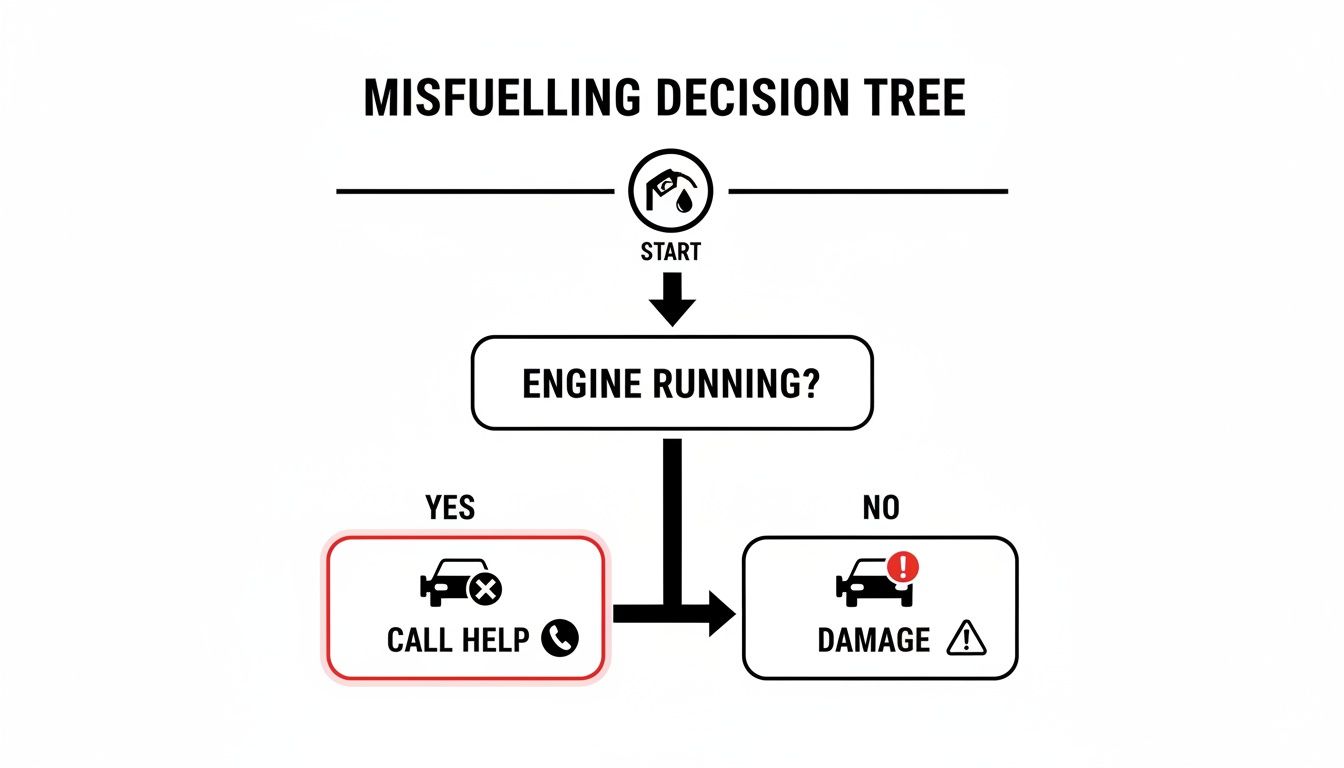
As you can see, leaving the engine off leads straight to a solution. Starting it? That path leads directly to potential damage and much bigger headaches.
What Really Happens When Diesel Goes Into a Petrol Engine?

To get a clear picture of why putting diesel in a petrol engine is such a nightmare, we need to quickly look at how different these two fuels are. Petrol is light, evaporates easily, and just needs a spark to ignite. Diesel is the total opposite—it's a thick, oily fuel that ignites under immense pressure, not from a spark. You can read more in our guide on the difference between diesel and petrol explained.
When you pump diesel into a petrol car, it's not like you're just diluting the fuel. It's more like pouring a light engine oil into your tank. The entire system, from the tank to the cylinders, is built for a completely different kind of liquid.
The Immediate Mechanical Struggle
A petrol engine's fuel system is a marvel of precision engineering. The fuel pump is designed to effortlessly push a thin, low-viscosity liquid (petrol). When it suddenly has to shove thick, syrupy diesel through the lines, it hits a wall.
The pump immediately strains, working overtime and generating a huge amount of heat. This can cause serious wear in a matter of minutes. If you turn that key, the diesel is forced through the system, coating everything it touches with a greasy film. This includes:
The fuel lines
The fuel filter
The delicate fuel injectors
The crucial spark plugs
The engine simply won't run properly. Why? Because diesel doesn’t ignite from a spark. The spark plugs get caked in an oily gunk, which stops them from creating the spark needed to ignite any good petrol left in the mix.
The Costly Chain Reaction of Damage
Things go from bad to worse very quickly once the contaminated fuel gets past the tank. Diesel is far too thick to be atomised into a fine mist by the fuel injectors. So, instead of a perfectly combustible vapour cloud, the engine gets clumsy squirts of oily liquid dumped into the cylinders.
This unburnt diesel sets off a cascade of problems. You'll feel the engine misfire and shudder violently. You'll see thick, white smoke belching from the exhaust as the engine tries desperately to get rid of a substance it can't burn.
The financial fallout can be staggering. Picture a delivery driver in Bury St Edmunds making this mistake. Even a small contamination of just 5% diesel can throw the fuel-to-air ratio into chaos, triggering misfires and a dashboard full of warning lights almost instantly. If they try to "drive it off," within 10 miles, around 80% of engines can suffer damage that can't be fixed.
Fuel pumps are often the first casualty, failing 40% more often because diesel lacks the lubricating qualities petrol systems need. A simple fuel drain might set you back £300, but if that diesel has wrecked your injectors or the catalytic converter, you could be looking at a repair bill creeping towards £5,000. And the worst part? Only 38% of car insurance policies will typically cover you for a misfuelling mistake.
The Bottom Line: Diesel acts like a thick, non-flammable poison in a petrol engine. It clogs up the works, smothers spark plugs, and overloads the fuel pump, leading to a swift and very expensive mechanical breakdown.
What Happens When You Drive with the Wrong Fuel?
If you've driven off the forecourt without realising your mistake, it won’t be long before your car starts complaining. Loudly. A petrol engine just isn't built to handle the thick, oily consistency of diesel, and the signs are usually pretty dramatic and immediate. Spotting them quickly is crucial so you can pull over safely and stop the damage from getting worse.
The first thing you'll almost certainly feel is a sudden lack of power, followed by a violent juddering. When you press the accelerator, the engine will feel like it's wading through treacle. That’s because the diesel is coating your spark plugs in an oily film, stopping them from creating the spark needed to ignite the fuel.
Telltale Signs from the Engine and Exhaust
Beyond just feeling sluggish, your car will give you some very clear warnings. You need to listen and watch out for these telltale signs:
Engine Misfiring: It’ll feel like the car is coughing and spluttering, particularly when you try to accelerate. That’s the sound of the engine's cylinders failing to fire properly.
A Plume of Smoke: Seeing a sudden cloud of white or black smoke billowing from your exhaust is a dead giveaway. This is raw, unburnt diesel being spewed out of the system.
Engine Cutting Out: The car might stall on you altogether, especially when you're stopped at a junction. Good luck trying to get it started again.
Dashboard Warning Lights: You can bet the engine management light will pop up on your dashboard. The car's computer knows something is seriously wrong with the combustion process.
For a fleet manager in Bury St Edmunds or a taxi driver working across Suffolk, even a small contamination of just 5-10 litres can be a disaster. The engine will start juddering violently and lose power almost straight away.
Once started, that oily diesel will gum up the spark plugs within about 10 miles in 80% of petrol engines. The risk of fuel pump failure also jumps by 40% because diesel just doesn't lubricate the high-pressure system the way petrol does. From there, unburnt diesel clogs the injectors and can completely destroy the catalytic converter. You could be looking at a £2,000+ repair bill before you even think about calling your insurer—and it's worth knowing that 62% of UK car policies don't cover misfuelling. You can find out more about what to do if you've only put a small amount of diesel in your petrol car on MisfuelledCarFixer-Suffolk.co.uk.
Crucial Takeaway: If you experience any of these symptoms—power loss, juddering, smoke, or stalling—pull over the moment it's safe. Turn off the ignition immediately. Every second the engine runs, it's pulling more contaminated fuel through the system.
How We Fix Your Misfuelling Mistake on the Spot

That sinking feeling when you realise you've put diesel in a petrol engine is something we see every day. But the fix is often quicker and less hassle than you might think. When you call a mobile fuel drain specialist, we come directly to your location, whether you’re stuck at a petrol station in Ipswich or stranded on a quiet lane near Stowmarket.
Our entire service is built around getting you out of a jam without the extra time and expense of towing your car to a garage.
Once we arrive, our technician will have a quick chat with you to understand exactly what happened. They’ll then secure the area and walk you through the process before starting any work. This is a job that absolutely demands professional, ATEX-approved (explosion-proof) equipment to handle flammable liquids safely, which is why a DIY approach is never a good idea.
Step 1: Draining the Contaminated Fuel
The first, most obvious job is to get every last drop of the wrong fuel out of your tank. Our technicians can usually do this through the filler neck, but sometimes they need to access the fuel pump sender unit under the back seat for a more direct approach.
The equipment we use is specifically designed to reach the lowest points of the tank, sucking out the thick, oily diesel that often settles at the bottom. A proper drain is more than just pumping out the obvious liquid.
A Complete Drain: Our powerful, purpose-built pumps ensure nothing is left behind.
Safety First: All our gear is anti-static to eliminate any risk of sparks.
Quick Assessment: We’ll visually inspect the drained fuel to see just how contaminated it is.
Getting the tank empty is only half the battle. Now we need to deal with the rest of the system. If you're interested in the nitty-gritty of the equipment and safety standards, you can find out more by reading our detailed UK guide on how to safely drain a fuel tank after misfuelling.
Step 2: Flushing the Fuel System and Adding Fresh Fuel
With the tank empty, we turn our attention to the fuel lines, filter, and injectors. This is arguably the most important part of the job.
We flush the entire system with clean petrol, which dissolves and pushes out any lingering diesel residue. It’s this oily film that, if left behind, can cause misfires, block injectors, and lead to more expensive problems down the road.
A Pro Tip From Experience: A simple tank drain is never enough. A comprehensive system flush is what truly fixes the problem and prevents you from having engine trouble a few days later. It's the difference between a quick fix and the right fix.
After the flush, we'll put some fresh, correct petrol in your tank. We’ll then start the engine and let it run for a few minutes, making sure it sounds right and is running smoothly as the clean fuel circulates through.
All the contaminated fuel is then transferred into a secure, UN-approved container in our van. We handle the responsible and legally compliant disposal at a licensed waste facility, so you don't have to worry about a thing.
Mobile Fuel Drain vs Garage Repair: What's the Difference?
When you’ve misfuelled, you generally have two options: call a mobile service like us or get towed to a traditional garage. While both can solve the problem, the process, time, and cost can be quite different. Here's a quick comparison to help you understand the key distinctions.
Factor | Misfuelled Car Fixer (Mobile Service) | Traditional Garage Repair |
|---|---|---|
Location of Work | Roadside, forecourt, your home – wherever you are. | At the garage's workshop; requires towing. |
Typical Timeframe | Usually resolved in 60-90 minutes from arrival. | Can take 1-2 days, depending on their workload. |
Process | On-the-spot drain, flush, and refuel. | May involve more extensive (and costly) parts replacement. |
Cost | Generally more cost-effective as it avoids tow fees and high labour rates. | Often more expensive due to towing costs, garage overheads, and potentially unnecessary work. |
Ultimately, a mobile service is designed for speed and convenience. We aim to solve the problem right there and then, getting you back on your journey with minimal disruption. A garage is a perfectly valid option, but it almost always involves more waiting time and logistical hassle.
Practical Tips to Avoid Misfuelling Again
Putting the wrong fuel in your car is an easy, and frustratingly expensive, mistake to make. The good news is that with a few simple habits, you can make sure it’s a one-time event rather than a recurring nightmare.
From what we see out on the roads in Suffolk, misfuelling almost always comes down to a brief lapse in concentration. It happens when you’re tired, stressed, or driving a car that isn't your usual one.
The most common culprits are distraction and a change in routine. Maybe you've just switched from a diesel to a petrol for the school run, or you’re in a hire car for the weekend. In these moments, your muscle memory can let you down. The trick is to create a deliberate, conscious routine every single time you pull up to the pump.
This isn’t just about avoiding a personal headache; it’s a massive financial issue across the country. Every year in the UK, misfuelling costs drivers a staggering £150 million. Putting diesel into a petrol engine accounts for 68% of the 500,000 incidents that happen annually.
Interestingly, younger drivers aged 18-24 are twice as likely to make this error, and men admit to doing it more often than women. With so many multi-car households here in East Anglia, the risk is higher than you might think. You can dig into these findings from a survey of over 1,000 motorists on MotorTradeNews.com.
Building Your Misfuel-Proof Routine
To avoid becoming another statistic, it pays to build a few simple checks into your refuelling process. It only takes a couple of seconds but could save you hundreds, if not thousands, of pounds.
A great place to start is just to pause and look before you even touch the nozzle. In the UK, the pumps are colour-coded for a reason, and it's your first line of defence.
Green Nozzle: Unleaded Petrol
Black Nozzle: Diesel
Before you lift the pump, consciously check the colour and the label on the trigger. It’s that simple.
Another powerful habit is to always read the label inside your car's fuel flap. It’s there for this very reason. Make it a non-negotiable step to glance at it every time you open it, just to reinforce what your car needs.
A Simple Memory Trick: As you get out of your car, say the fuel type out loud—"Petrol" or "Diesel." This tiny act of verbal confirmation engages a different part of your brain, breaking that autopilot mode that often leads to mistakes.
Extra Safeguards for Peace of Mind
If you often switch between cars with different fuel types or you’re a fleet manager in Suffolk looking after several vehicles, it might be worth adding some physical reminders. A brightly coloured, fuel-specific sticker on the inside of the fuel flap or even on your dashboard can be a surprisingly effective prompt.
For those who want a nearly foolproof solution, you can actually buy a misfuelling prevention device. These are special caps that replace your existing one and are cleverly designed to only allow the correct-sized nozzle to be inserted. Since a diesel nozzle is physically wider than a petrol one, it physically cannot fit into a petrol car's filler neck—which is why putting diesel in a petrol engine is less common than the other way around.
For more expert advice, check out our comprehensive wrong fuel in car fix and prevention guide.
Got Questions About Misfuelling? We've Got Answers
Putting diesel in a petrol car is a heart-sinking moment. It’s a surprisingly common mistake, but that doesn't make it any less stressful. When you're standing at the pump, you're bound to have a million questions running through your head. We hear them all the time from drivers across Suffolk, so let’s clear up some of the most common ones.
The biggest fear, of course, is about the car itself. "Have I completely destroyed my engine?" It's the first thing everyone asks. Thankfully, if you haven’t started the car, the answer is almost always a resounding no. The problem is isolated to the fuel tank. A professional fuel drain will get the wrong fuel out, and your engine will never even know it was there. The real damage starts when you turn the key and that diesel gets pumped through the system.
Another worry is the cost. "Will my insurance cover this?" Honestly, it’s a bit of a lottery. Many standard policies see misfuelling as an avoidable mistake and won’t cover it. It’s always worth digging out your policy documents to check for sure, but it's wise to assume you'll likely be paying for the drain yourself.
How Much Diesel Is "Too Much"?
This is a big one. People often wonder if they can get away with just a small mistake. "I only put a couple of litres in before I noticed. Can't I just fill the rest with petrol and drive off?"
It’s a tempting thought, but it’s a gamble you really shouldn't take. Even a little bit of diesel can cause a lot of trouble for a petrol engine. Here’s a rough idea of what you’re up against:
Less than 5% diesel: In a typical 50-litre tank, that's under 2.5 litres. An old banger from the 90s might just cough, splutter, and carry on. But a modern engine? They are far more sensitive. You're risking poor running, a lot of smoke, and potential damage to expensive parts like the catalytic converter.
More than 5% diesel: Now you’re entering the danger zone. The diesel dramatically lowers the petrol's octane rating, which can cause 'knocking' – a destructive process that can lead to serious internal engine damage. It also coats spark plugs and can clog your fuel injectors.
No matter how much you've put in, the only truly safe option is to get the tank drained by a professional. Trying to dilute it is never a guaranteed solution and could land you with a much more painful repair bill down the line.
What About a DIY Fuel Drain?
With a tutorial for everything online, it's easy to think, "I can probably just siphon this out myself, right?"
Please don't. Attempting a DIY fuel drain is incredibly dangerous, and we strongly advise against it. Petrol fumes are explosive, and all it takes is one tiny spark—from static electricity, a metal tool, anything—to cause a serious fire. We use specialised, ATEX-approved (explosion-proof) equipment and have strict safety procedures for a reason.
On top of the safety risk, you’ll be left with a container full of contaminated, hazardous fuel. You can't just pour it down a drain or put it in your bin; it needs to be disposed of legally and safely. A professional service handles all of that for you, removing the risk to yourself, the environment, and your wallet. It's a small price to pay for complete peace of mind.
If you've put the wrong fuel in your car in Suffolk or the surrounding areas, don't panic and definitely don't start the engine. Call the experts at Misfuelled Car Fixer for immediate, 24/7 roadside assistance. We’ll get you safely back on the road. Contact us now at https://www.misfuelledcarfixer-suffolk.co.uk.


