
.jpg)


Petrol in a diesel engine: Quick Guide for Immediate Action
Updated: Feb 12
24/7 Hotline Nationwide: 0330 122 6640
National Wrong Fuel Rescue: https://www.misfuelledcarfixer.co.uk
If you found this page, we cover you in England!
You get that horrible, sinking feeling the second you realise what you've done. You've just filled your diesel car with petrol.
It’s a surprisingly common mistake, but before panic kicks in, know this: what you do in the next 60 seconds is absolutely critical. The most important thing, above all else, is do not start the engine. Seriously. Don't even turn the key to check the mileage or listen to the radio. This single action can mean the difference between a simple fix and a bill running into the thousands.
Your Immediate First-Response Plan After Petrol in a Diesel Engine

It’s a stressful moment, for sure. But a calm head now will save your engine and your wallet. The problem is that petrol acts as a solvent, stripping away the lubricating properties that diesel fuel provides.
Modern diesel engines, especially the high-pressure common rail systems found in most cars today, are incredibly sensitive. They depend on the oily nature of diesel to keep vital parts like the fuel pump and injectors running smoothly. When petrol enters the system, it's like throwing sand into the works.
Starting the car forces this damaging mixture through the fuel lines. The lack of lubrication causes metal components to grind together, and it doesn't take long for this to destroy the fuel pump. When that happens, it can send tiny metal fragments careering through the entire fuel system, leading to catastrophic and expensive damage.
What to Do Right Now
The main goal is simple: keep the contaminated fuel isolated in the tank. Here’s a quick-fire guide to get you through the next few minutes.
In the critical moments after realising you've misfuelled, your actions can either prevent or cause major damage. This table breaks down the essentials into a simple list of do's and don'ts.
Immediate Actions After Misfuelling Do's and Don'ts
Do | Don't |
|---|---|
Keep the keys completely out of the ignition. | Don't start the engine, not even for a second. |
Let the petrol station staff know what's happened. | Don't turn the key to the 'on' or 'accessory' position. |
Put the car in neutral and get help to push it to a safe parking spot. | Don't try to drive the car, even a few feet. |
Call a professional misfuel assistance service right away. | Don't attempt to drain the tank yourself without proper equipment. |
Following these steps minimises the risk and sets you up for the quickest, most cost-effective solution.
The most crucial advice we can offer is to treat the situation as if the engine is completely immobilised. Resisting the urge to "just see if it will run" is the difference between a straightforward fuel drain and a catastrophic engine failure.
Making the Right Call
Once your car is safely out of the way, it’s time to call in the experts for a professional fuel drain. Trying to do this yourself is not only messy but can be incredibly dangerous and harmful to the environment. You can get a better idea of what the professionals do in our guide on how to drain a petrol tank safely.
A specialist mobile service is your best bet. They can come directly to you, whether you’re stuck on a forecourt in Ipswich or parked up at home in Bury St Edmunds. They have all the certified equipment needed to safely remove the wrong fuel, flush the system clean, and get you back on your way without any further damage.
Recognising the Signs You Have Misfuelled
Sometimes, the penny doesn't drop right there at the pump. You might pay up, pull away, and only realise something is seriously wrong a few miles down the road. Knowing the symptoms of putting petrol in a diesel engine is the key to pulling over safely and stopping a bad situation from becoming an expensive catastrophe.
Picture this: a delivery driver is cruising along the A14, somewhere near Bury St Edmunds. Suddenly, the van starts to feel sluggish, almost asthmatic, and it’s a real struggle to keep up with traffic. This serious loss of power is often the very first sign. The engine is being starved of the lubrication and proper combustion it needs, so it just can't perform.
That drop in power is usually just the start of your car’s cries for help.
Telltale Signs from Your Engine and Exhaust
Your vehicle will do its best to tell you something's not right. The engine might start to judder or shake, especially when you try to accelerate. You could also hear a distinct knocking sound from under the bonnet – that’s the sound of the highly volatile petrol igniting at the wrong time inside the high-compression diesel engine.
Another dead giveaway is excessive exhaust smoke. If you see clouds of white smoke billowing from your tailpipe, that’s often unburnt fuel being chucked out. It’s a direct result of the petrol failing to burn properly in an engine it was never designed for.
You may also notice:
Engine Misfires: The engine will likely run erratically, stuttering and hesitating.
Difficulty Starting: If you’ve stopped and try to turn the key again, the engine might turn over but simply refuse to fire up.
Warning Lights: It’s almost a guarantee that the engine management light will flash up on your dashboard.
The mechanical chaos unfolding inside your engine is what causes these symptoms. Petrol acts like a solvent, stripping away the essential lubricating film from critical parts like the high-pressure fuel pump and injectors. This leads to metal-on-metal friction and immediate, serious wear.
A National Problem with a Local Peak
Putting the wrong fuel in is far more common than most people think. Across the country, around 150,000 drivers misfuel their vehicles every year. And a whopping 95% of those cases involve putting petrol into a diesel car. For some reason, spring seems to be the peak season for this mishap.
Just as the daffodils start popping up along Suffolk’s country lanes, there's a corresponding 51% surge in UK Google searches for misfuelling help. Data shows that March is a peak month for these gut-wrenching moments, affecting drivers everywhere from Felixstowe to Ipswich. You can read more about these costly fuel station warnings on GB News.
Recognising these signals early means you can act fast. If your car starts behaving this way, find a safe place to pull over immediately, switch off the engine, and call for professional help. For a more detailed look at what to do in that moment, check out our guide on the symptoms of petrol in a diesel car and what to do next.
How Professionals Fix a Misfuelled Car
Once you've made the right call and have a specialist on the way, you can breathe a little easier. Whether you're stuck on the forecourt of a petrol station in Lowestoft or safely pulled over on a B-road near Stowmarket, a trained technician will handle the entire situation methodically and safely. It’s a world away from a risky DIY job and is all about protecting your car’s engine.
When the mobile unit arrives, their first job is to make the area safe. Petrol fumes are highly flammable, so they'll check for any ignition sources and secure the scene. Their van is essentially a workshop on wheels, kitted out with specialist, certified equipment built for this exact task. We’re not talking about a simple pump and a jerry can; this is a fully sealed, anti-static system designed to meet strict safety and environmental standards.
The Fuel Drain and System Flush
The real work starts with draining the contaminated fuel. Using a powerful, ATEX-approved pump, the technician will empty every last drop of the petrol-diesel mix from your tank. It's a clean and self-contained process, so you don't have to worry about spillage. All the bad fuel is transferred directly into a secure tank inside their van, ready for safe and licensed disposal later.
But just draining the tank isn’t the whole story. Small pockets of petrol can get trapped in the fuel lines, filter, and pump, which is where a proper system flush comes in. This is the step that really protects your engine from long-term harm.
This flow chart shows the simple, three-stage approach our technicians take to get you running again.
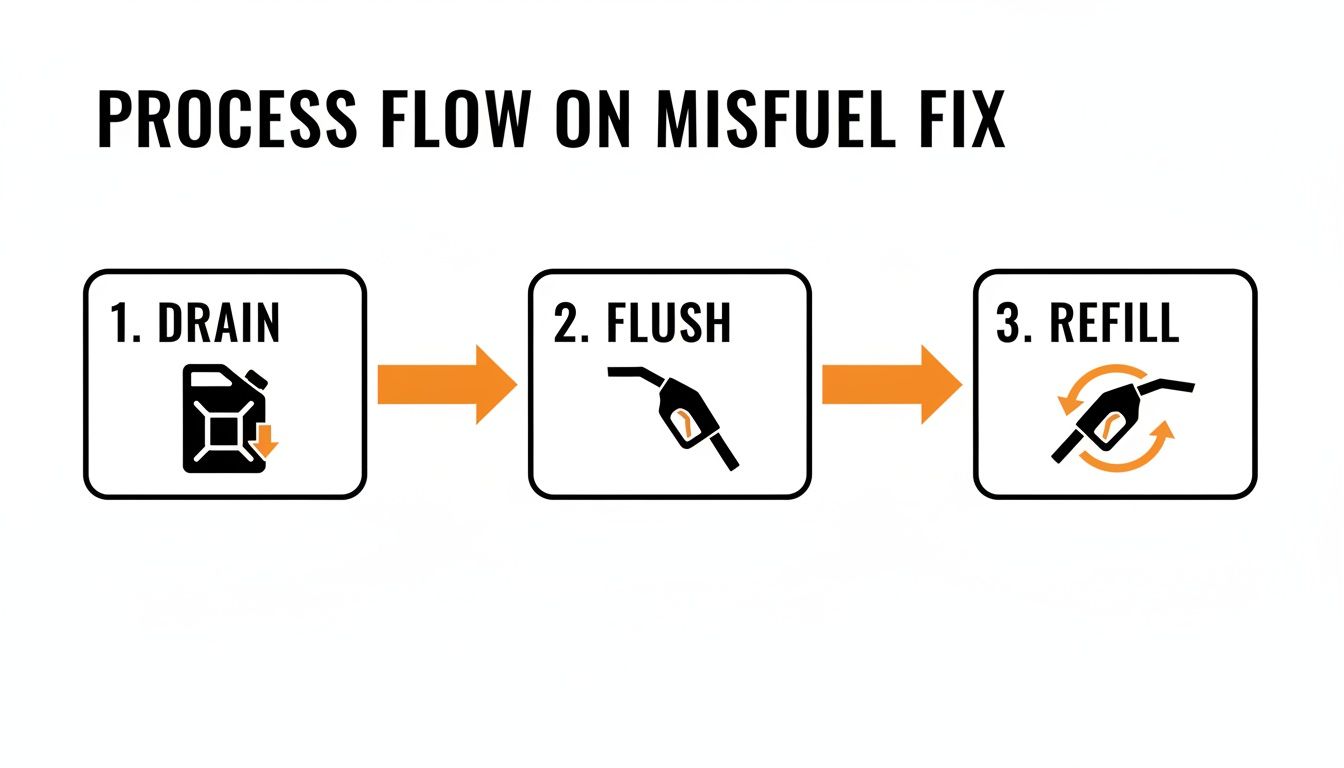
As you can see, the flush is a non-negotiable part of the process. It ensures every last trace of damaging petrol is gone before your engine sees a drop of fresh diesel.
To do this, the technician circulates a small amount of clean diesel through the entire system. It acts like a cleanser, pushing out any stray petrol and re-lubricating the delicate parts of the fuel pump and injectors that the petrol may have stripped of their vital diesel coating.
Think of the system flush as an insurance policy. It's the critical step that prevents premature wear on your high-pressure fuel pump and injectors by making sure the non-lubricating petrol is completely gone.
Refilling and Final Checks
With the tank empty and the lines flushed clean, the last step is getting some good fuel back in. Our technicians carry a stock of clean, correct diesel to put enough in your tank to get you safely on your way to the nearest petrol station.
But they won’t leave just yet. Before the job is officially done, they'll run through a few final checks:
Priming the Fuel System: They'll make sure there are no air bubbles in the lines and that fuel is flowing correctly to the engine.
Starting the Engine: With your go-ahead, they will start the vehicle to check it’s running smoothly and quietly.
System Diagnostics: A final glance at the dashboard to ensure no warning lights or error codes have popped up.
Once your car is purring like it should be, you’re all set. The whole thing, from the technician's arrival to you driving away, is usually sorted in less than an hour. It turns what feels like a complete catastrophe into a minor, manageable hiccup in your day.
Understanding the Real Costs of Misfuelling

The moment of realisation hits, and your first thought is almost always, "How much is this going to cost me?" The answer hinges entirely on what you do in the next few minutes. Calling a specialist mobile service like ours is a predictable, manageable expense. Driving away from the forecourt, on the other hand, can quickly escalate into a ruinous, five-figure repair bill.
A professional roadside fuel drain is a preventative measure, designed to get you out of trouble before it really begins. This kind of service is almost always significantly cheaper than going through a main dealer or even some breakdown services, who often have to tow your vehicle to a garage, racking up extra costs and delays along the way.
The Cost of a Simple Drain Versus Major Repairs
Think of it like this: a professional fuel drain is the small, upfront cost that saves you from a complete engine rebuild. The price of having a technician come directly to you is just a fraction of what you’ll face if that contaminated fuel gets a chance to circulate.
It's a surprisingly common mistake. In the UK, there are an estimated 175,000 misfuelling incidents every year, and a staggering 95% of them involve putting petrol into a diesel car. Starting that engine is where the real damage starts. Petrol acts like a solvent, stripping away the essential lubrication from your fuel pump, injectors, and filters. Repair bills for these critical components can easily soar past £5,000, especially on modern or premium vehicles. You can see more about this widespread issue through the misfuelling facts and figures on Dr Fuel.
The decision to call for an immediate fuel drain isn't an expense; it's a crucial, cost-saving investment. It protects your vehicle from catastrophic damage that could cost thousands to rectify.
Will My Insurance Cover Misfuelling?
It’s one of the first questions we get asked, but unfortunately, the answer is usually no. Most standard car insurance policies contain specific clauses that exclude damage caused by putting the wrong fuel in. It's typically classed as negligence or a preventable error, which means the driver is left to cover the entire bill.
This tough reality is exactly why it's so vital not to run the engine. The list of potential damage is as alarming as it is expensive:
High-Pressure Fuel Pump: This part relies on diesel's lubrication to function. Petrol causes rapid, destructive wear and almost certain failure.
Injectors: These can get clogged or permanently damaged by tiny metal fragments from a failing pump.
Fuel Filter: Becomes blocked by debris very quickly.
Engine Seals: The solvent properties of petrol can cause these to corrode and fail.
When you weigh the relatively low cost of a mobile fuel drain against these potential repairs, the choice becomes crystal clear. You can learn more about what’s happening inside your engine by reading our guide on the full repair costs of putting petrol in a diesel car. Acting fast and calling in a professional is the single best thing you can do for your car and your wallet.
Why Putting Petrol in a Diesel is Such a Common Mistake
It’s an easy mistake to make, and one that catches out even the most experienced drivers. Filling a diesel car with petrol isn't usually about not knowing the difference—it's almost always down to a simple moment of distraction.
Maybe you’re in a hurry, your mind is on the next meeting, or you're just running on autopilot at a petrol station you've used a thousand times before. It happens.
We often see this with people driving an unfamiliar hire car or switching between the family’s petrol and diesel vehicles. One day you’re filling up a little petrol runaround, the next you're at the pump with the big diesel estate, and old habits kick in. The design of the pump nozzles doesn't help, either. The narrower unleaded petrol nozzle slides easily into the wider diesel filler neck, giving you no physical clue that you're about to make a mistake.
The Real-World Reasons it Happens
This isn't some rare, freak accident. It happens far more often than you'd think. Just imagine pulling into a petrol station in Suffolk with your trusty diesel van, only to have that sinking feeling as you realise you've just pumped in unleaded. It’s a nightmare scenario we see play out across the UK every single day.
In fact, recent research shows that a staggering 29% of UK motorists admit to having misfuelled their car at least once. Petrol into a diesel engine is by far the most frequent slip-up. The same survey found the risk was even higher for younger drivers, with 54% of 18-24-year-olds having made the mistake. You can read more about these common fuel mix-ups in the research from Go.Compare.
This just goes to show how a brief lapse in concentration can quickly turn into a very expensive problem, particularly for those new to driving or using a car they're not used to.
Simple Habits to Prevent Misfuelling
The good news? A few simple, conscious habits can stop this from ever happening to you. It's all about creating a routine that becomes second nature every time you pull up to the pump.
Take a Beat: Before you even grab the nozzle, just pause. Glance at the colour of the trigger (usually green for petrol, black for diesel) and double-check the label on the pump.
Check Your Fuel Cap: Most diesel cars have ‘DIESEL’ written clearly on or inside the fuel flap. Make it a non-negotiable habit to look at it every single time you open it.
Leave a Reminder: A small, bright ‘DIESEL ONLY’ sticker on the fuel flap or even on your dashboard can be a brilliant visual cue, especially if you often switch between different cars.
For fleet managers and local businesses here in Suffolk, establishing a clear process is crucial. Training drivers to perform these quick checks is the first step. For total peace of mind, fitting misfuelling prevention devices—special caps that physically block the smaller petrol nozzle—can pretty much eliminate this costly error across your entire fleet.
By building these simple checks into your routine, you can save yourself the massive headache and expense that comes with misfuelling. It’s a classic case of an ounce of prevention being worth a pound of cure—or in this case, a very expensive fuel drain.
Your Misfuelling Questions Answered
That sinking feeling at the petrol station when you realise you've used the wrong pump... it's a moment filled with panic and a hundred questions. You're not alone, and having the right answers right now is the key to preventing a costly mistake from turning into a catastrophe. We hear these questions all the time from drivers across Suffolk, so let's clear a few things up.
"Can't I Just Top It Up with Diesel to Dilute It?"
This is the first thing that crosses almost everyone's mind, but the answer is always a hard no. It seems like simple maths—just drown out the bad stuff with the good stuff—but your engine doesn't see it that way.
Modern common rail diesel systems are engineered to incredibly fine tolerances. They rely on the natural oiliness of diesel fuel to lubricate high-pressure pumps and injectors. Petrol does the exact opposite; it's a solvent. It strips away that vital lubrication, causing metal parts to grind against each other.
Even a tiny amount of petrol, as little as 1% of the total volume, can compromise the fuel's lubricating properties and cause irreversible damage. Topping up just circulates this damaging cocktail through your entire fuel system.
"How Much Petrol is Actually a Problem?"
Honestly? Any amount.
There's no "safe" level of contamination. While a splash might not cause your engine to seize immediately, it's already introducing a solvent where a lubricant should be. The more petrol you've put in, the quicker and more severe the damage will be if you turn the key.
The only safe assumption to make is that any amount of petrol is too much. The only correct response is to call for a professional fuel drain.
You might have heard an old wives' tale about adding a bit of petrol to a diesel in winter to stop it from freezing. This might have been true for ancient, agricultural engines, but it's incredibly dangerous advice for any diesel vehicle made in the last 30 years. Don't listen to it.
"What if I've Already Started the Engine and Driven Off?"
First, don't panic. If you've already pulled away from the forecourt and the car has started to cough, splutter, or lose power, the priority is to get to a safe spot. Pull over as soon as it's safe to do so, and switch the engine off immediately.
The less time the engine runs with the wrong fuel, the better. Every second the engine is off is a second you're preventing that contaminated fuel from circulating further and causing more damage to sensitive components.
Once you're stopped safely, give a misfuel specialist a call. Even if the car has been driven, a comprehensive fuel drain and system flush can often prevent the need for expensive replacement parts. It’s never too late to stop the problem from getting worse.
"Will This Void My Car's Warranty?"
More than likely, yes. A manufacturer's warranty is there to cover faults with the car itself, not issues caused by user error. Putting the wrong fuel in is almost always classified as negligence, which means it won't be covered.
The same usually goes for standard car insurance policies. This is why it's so critical to avoid starting the engine. Paying for a fuel drain service is a minor inconvenience compared to a potential four-figure bill for a new fuel pump and injectors that you'd have to cover yourself.
A professional fuel drain can be completed in under an hour from the moment our technician arrives on site, getting you back on your journey with minimal fuss and cost.
If you've put petrol in your diesel tank, don't risk it. Contact Misfuelled Car Fixer immediately for 24/7 emergency assistance across Suffolk and beyond. https://www.misfuelledcarfixer-suffolk.co.uk


