



What Is AdBlue For? A Diesel Driver's Guide
- Misfuelled Car Fixer

- Dec 2, 2025
- 13 min read
You've probably seen the AdBlue filler cap next to your diesel one and wondered what it’s all about. Let's clear it up: AdBlue isn't a fancy fuel additive. It’s a dedicated exhaust fluid with one crucial job – cleaning up your car's emissions after the fuel has been burned. It's the reason modern diesel cars can be both powerful and surprisingly clean, allowing them to meet the tough Euro 6 emissions standards that came into force back in 2015.
What AdBlue Actually Does for Your Diesel Car
Think of AdBlue as a key player in your car’s environmental protection team. It’s a completely separate system from your engine, working tirelessly in the background to neutralise nasty pollutants before they ever hit the atmosphere.
So, what is it? AdBlue is a clear, non-toxic liquid made from a precise mixture of 32.5% high-purity urea and 67.5% deionised water. One of the biggest myths is that it gets mixed in with your diesel, but that's absolutely not the case. It has its own tank and is injected directly into the exhaust pipe, long after combustion has happened.
For those who like a quick summary, here's the lowdown.
AdBlue Explained in 60 Seconds
Key Aspect | Simple Explanation |
|---|---|
What It Is | An exhaust fluid (urea and deionised water), not a fuel additive. |
Its Purpose | To drastically reduce harmful nitrogen oxide (NOx) emissions. |
How It Works | It’s injected into the exhaust, triggering a chemical reaction that converts NOx into harmless nitrogen and water vapour. |
The System | This process is called Selective Catalytic Reduction (SCR). |
Driver's Role | You must keep the AdBlue tank topped up. The car won't start if it runs dry. |
It's as simple as that. AdBlue is an essential consumable that helps your car stay clean and legal.
How It Cleans Up Your Car’s Emissions
The magic happens in a system called Selective Catalytic Reduction (SCR). As hot exhaust gases flow from your engine, the SCR system sprays a fine mist of AdBlue into the stream. The high temperature instantly transforms the AdBlue into ammonia.
This ammonia then acts as a catalyst, reacting with the harmful nitrogen oxides (NOx) – a major source of air pollution. The chemical reaction is remarkably effective, converting up to 90% of these toxic gases into two things that are completely harmless:
Nitrogen (N2): The same gas that makes up around 78% of the air we breathe.
Water Vapour (H2O): Just simple steam.
This clever bit of chemistry means what leaves your tailpipe is significantly cleaner. It's a technology that has become indispensable for car makers, and its widespread use is clear – the UK's AdBlue market was valued at a massive $8.26 billion in 2023.
It’s vital to remember that AdBlue is a consumable fluid, just like your fuel or windscreen wash. You need to keep an eye on the level and top it up when the car warns you. Ignoring the light will eventually prevent the car from starting. Even more critical is avoiding a misfuel situation; if you accidentally put AdBlue in a diesel tank, do not start the engine. It’s a corrosive fluid that can cause catastrophic damage, and you’ll need immediate, specialist help to drain the system safely.
How AdBlue Cleans Your Car's Exhaust Fumes
To get a real grip on what AdBlue is for, it helps to picture a tiny, high-tech chemical plant tucked away inside your car's exhaust. That's a pretty good analogy for the Selective Catalytic Reduction (SCR) system. It’s a clever bit of engineering that neutralises nasty fumes after they’ve left the engine but before they hit the open air.
It's absolutely crucial to remember that AdBlue never, ever mixes with your diesel fuel. It has its own separate tank and is only introduced when the car needs it. This means it has zero effect on your car's performance or power – its one and only job is to clean up the exhaust.
The Step-by-Step Chemical Reaction
The whole process is incredibly efficient and happens in a flash, right after you turn the key.
Injection: As hot exhaust gases shoot out of the engine, the car’s brain (the ECU) figures out the exact amount of AdBlue needed. It then sprays a fine mist of the fluid directly into the hot exhaust stream.
Transformation: The blistering heat of the exhaust—often over 200°C—triggers an immediate chemical reaction. The urea in the AdBlue solution rapidly breaks down, converting into ammonia gas (NH₃).
Neutralisation: Now in its gaseous form, the ammonia travels into the SCR catalyst. Inside this special, honeycomb-like chamber, it reacts with the harmful nitrogen oxides (NOx) that are a major by-product of diesel engines.
This chemical handshake is where the magic really happens. The reaction effectively dismantles the pollutants, converting them into two things that are completely harmless: pure nitrogen (N₂) and simple water vapour (H₂O). In other words, the stuff that makes up about 80% of the air we breathe.
This diagram shows the journey from dirty engine emissions to clean air.
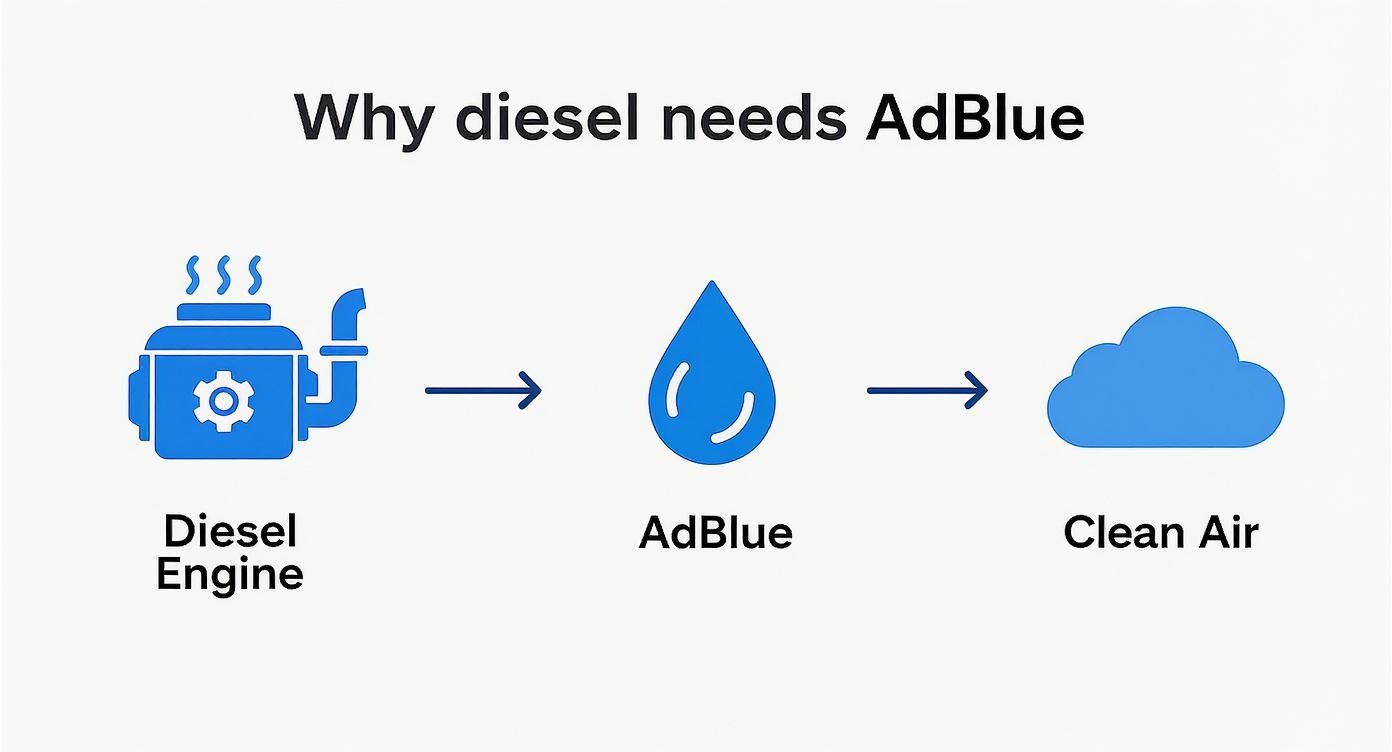
As you can see, AdBlue is the key middleman, transforming what comes out of the engine into something much cleaner.
A Completely Separate System
It’s so important to understand that AdBlue is an after-treatment fluid, not a fuel additive. While some products are designed to be mixed directly with fuel to improve engine health, AdBlue is definitely not one of them. If you're curious about the difference, have a look at our guide explaining what are fuel additives and how do they work.
The SCR system's ability to reduce NOx emissions by up to 90% is the main reason modern diesel cars can meet the tough Euro 6 emissions standards. Honestly, without this technology, diesel engines would have a very hard time being legal on UK and European roads.
This total separation is exactly why misfuelling is so catastrophic. Putting AdBlue in your diesel tank, or diesel in your AdBlue tank, introduces a corrosive, damaging substance into a delicate system it was never meant to enter, causing immediate and expensive problems.
Decoding Your Car's AdBlue Warning Lights
One thing you don't need to worry about is your car letting you run out of AdBlue without a fuss. Modern diesel vehicles are designed to give you plenty of warning, making sure you have ample time to top up. The key is knowing what these lights and messages mean and acting on them promptly.
It all starts with a simple, friendly reminder. The first you’ll hear of it is an amber warning light popping up on the dashboard. This is usually paired with a clear message like 'Refill AdBlue' and, most importantly, a mileage countdown. This tells you exactly how much further you can drive before things get serious. This first warning typically appears when you still have around 1,500 miles left in the tank.
When the Warnings Get More Serious
If you keep driving and ignore that initial heads-up, the car will naturally become a bit more insistent. The mileage countdown will become a more frequent feature on your display, and the tone of the alerts might get a little more urgent. Think of it as your car trying its best to get your attention before you run into trouble.
Let the tank run completely dry, however, and the situation gets critical. That gentle amber light will switch to a flashing or solid red light. This is an alert you absolutely cannot ignore.
The red warning is the final stop. It means that once you turn the engine off, the car is programmed not to restart. This isn't a fault; it's a built-in safety measure required by law to stop the vehicle from being driven without its emissions control system working properly.
What Is Limp Mode?
As the AdBlue level drops to a critical point, some cars might go into what's known as 'limp mode'. This is a protective measure where the engine's computer deliberately restricts power and speed. It’s not a breakdown, but a way to drastically reduce harmful emissions while giving you just enough power to get to a safe location to refill.
Thankfully, getting your hands on AdBlue is much easier than it used to be. While there were only 13 public AdBlue pumps in the UK back in 2018, that number is set to grow to nearly 500 by 2025. You can read more about the growth of the AdBlue European pump network from Argus Media.
The best advice? Act on that first amber warning, and you'll never have to worry about limp mode or a car that refuses to start.
How to Refill Your AdBlue Tank the Right Way
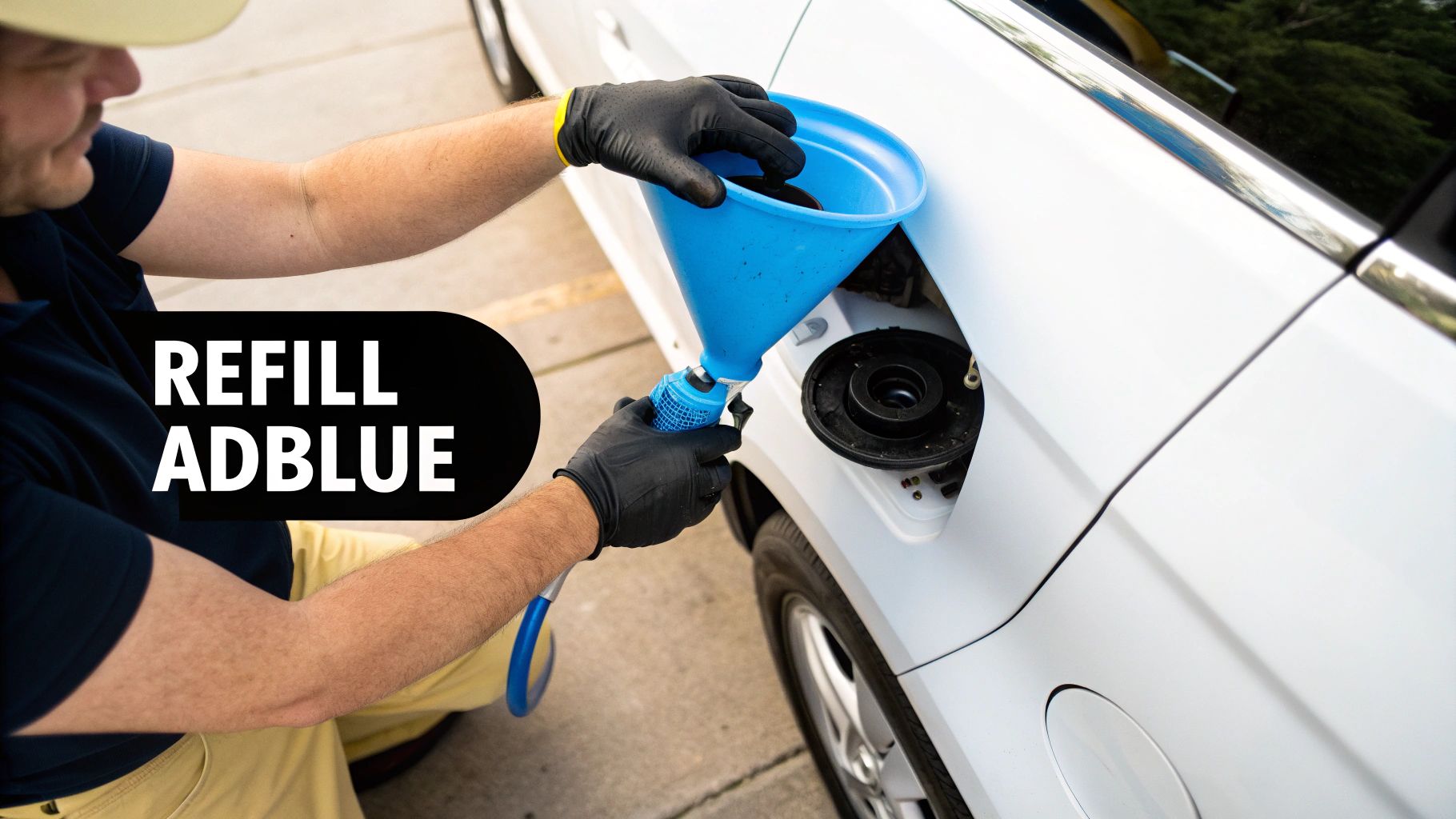
When that AdBlue warning light pops up on your dash, don't panic. Topping it up is a simple job you can easily handle yourself. The first step is to find the filler cap, which is almost always a very distinct, bright blue to stop you from accidentally putting it in the diesel tank.
You’ll usually find this cap in one of three places. Most of the time, it’s right next to the main diesel filler flap. On some cars, though, manufacturers tuck it away in the boot (have a look under the floor, near the spare wheel) or even under the bonnet. If you’re having trouble finding it, your car’s handbook will point you in the right direction.
Choosing Your Refill Method
Once you’ve located the filler cap, you've got a couple of choices for the top-up itself. It really just comes down to what's more convenient for you.
Pre-Packaged Bottles: These are the handy 5 or 10-litre containers you’ll see at petrol stations, supermarkets, and car part shops. They're brilliant for a quick top-up because they often come with a built-in spout, which makes pouring a spill-free doddle.
Service Station Pumps: If your tank is almost empty and you want to fill it right up, using a dedicated AdBlue pump at a larger service station is usually the cheapest way to do it. They work just like a regular fuel pump and are especially good for vans and larger vehicles with big AdBlue tanks.
Simple Steps for a Safe Top-Up
Refilling the tank is straightforward, but it pays to be careful. Following these simple steps will keep things clean and safe for both you and your vehicle.
Protect Yourself: It's always a good idea to wear gloves. While AdBlue is non-toxic, it can irritate your skin and leave stubborn stains on your clothes.
Use a Funnel: If your container doesn't have a spout, a clean funnel is your best friend. It’ll help you avoid any spills, which is important because AdBlue can be corrosive to your car's paintwork if it's not wiped off straight away.
Pour Slowly and Carefully: Don’t rush it. Add the fluid slowly to prevent it from splashing back or overfilling. You can often hear when the tank is getting full.
Double-Check the Cap: This is the most important step. Make absolutely certain you are pouring into the blue AdBlue cap, never, ever the diesel tank. The nozzles are designed to be different sizes to prevent this, but it’s a mistake you really don’t want to make.
Clean Up Any Spills: If you do spill a bit, just wipe it up immediately with a damp cloth and you'll be fine.
Crucial Quality Check: Always use AdBlue that meets the ISO 22241 standard. This is your guarantee of purity. Using a cheap, uncertified fluid is a false economy—it can cause serious damage to the very sensitive (and very expensive) SCR system.
Of course, if you'd rather leave it to the professionals, that's perfectly fine. For anyone concerned about handling fluids or just wanting complete peace of mind, using professional fluid exchange services ensures the job is done correctly every time.
Common AdBlue Mistakes That Cause Serious Damage
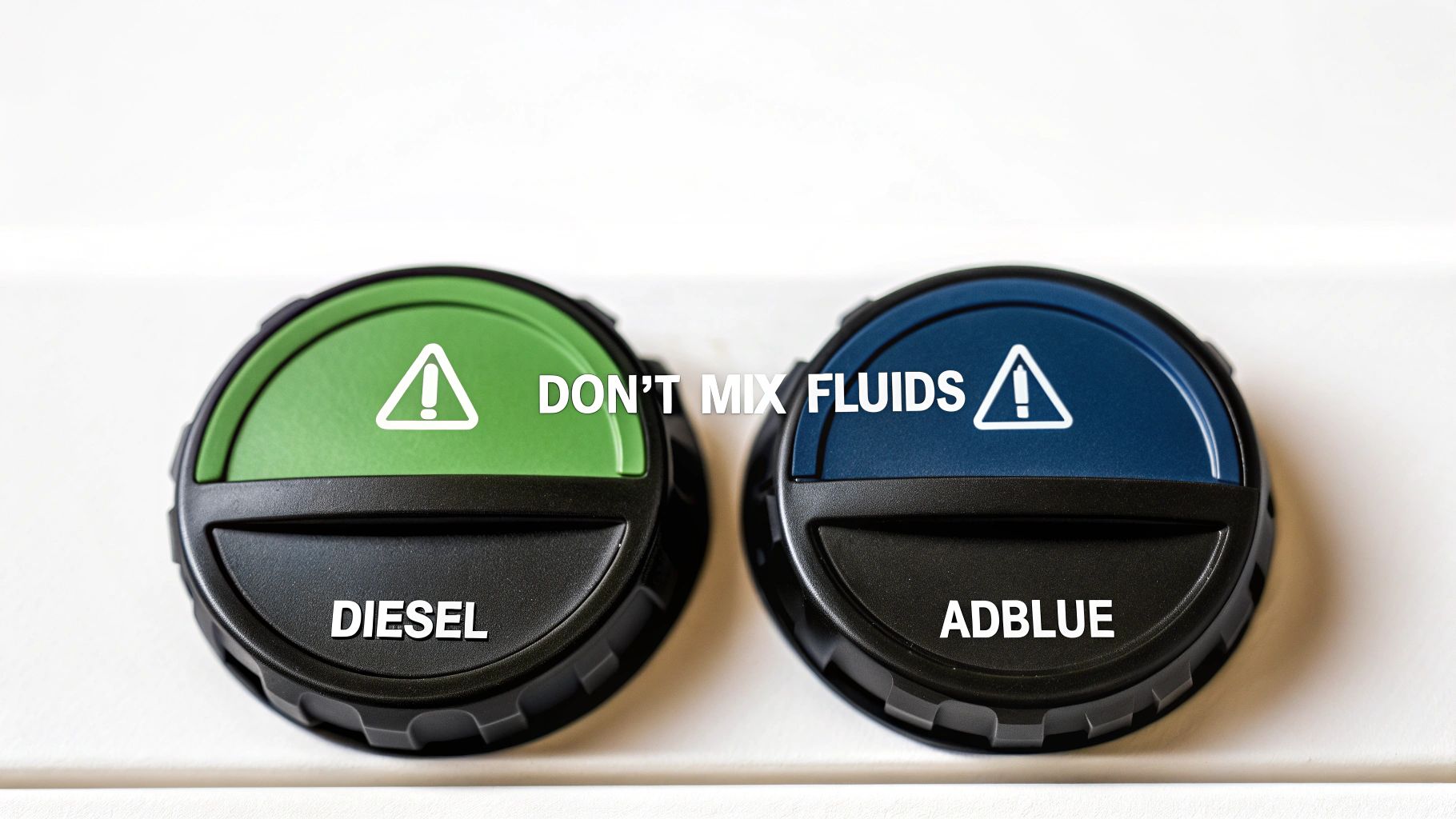
While topping up your AdBlue is usually a straightforward job, a simple slip-up at the filling station can lead to some seriously expensive trouble. Getting the wrong liquid in the wrong tank is one of the most damaging things you can do to a modern diesel engine, and it happens in two main ways.
Knowing what can go wrong is the best way to prevent it. It only takes a tiny amount of the wrong fluid to cause thousands of pounds in damage, turning a quick top-up into a mechanical nightmare that leaves you stranded.
Thankfully, these mistakes are easy to avoid. Just take a moment to double-check you've opened the right filler cap before you start pouring.
AdBlue Misfuelling Mistakes and Consequences
Even a momentary lapse in concentration can lead to one of two major misfuelling scenarios. Both are equally destructive, but they damage different parts of your vehicle. The table below breaks down what happens and what you need to do immediately.
Mistake | What Happens to Your Car | Immediate Action Required |
|---|---|---|
AdBlue in the Diesel Tank | AdBlue is heavier than diesel and sinks straight to the bottom of the fuel tank. It gets pulled into the fuel lines almost instantly, where its corrosive nature attacks and destroys the high-pressure fuel pump and injectors. | DO NOT START THE ENGINE. Call a specialist misfuel service immediately to drain the fuel tank and flush the lines. |
Diesel in the AdBlue Tank | The oily diesel contaminates the entire SCR system. It coats and ruins the AdBlue pump and injector, and ultimately destroys the sensitive and expensive SCR catalyst, which is vital for emissions control. | DO NOT START THE ENGINE. The SCR system needs to be professionally drained, flushed, and the damaged components will likely need replacing. |
The key takeaway is that prevention and immediate, correct action are vital to avoiding catastrophic repair bills.
Putting AdBlue into Your Diesel Tank
This is a surprisingly common and devastating error. At its core, AdBlue is a mix of de-ionised water and urea, neither of which has any business being in your fuel system. Because it’s denser than diesel, it sinks and is drawn into the fuel lines almost immediately after you turn the ignition.
Once it's in the system, its corrosive properties get to work on critical components. The high-pressure fuel pump, injectors, and delicate filters are all at risk of being damaged beyond repair. Replacing these parts can easily run into thousands of pounds.
Putting Diesel into Your AdBlue Tank
Pouring diesel into the AdBlue tank is just as bad, if not worse. This mistake contaminates the entire Selective Catalytic Reduction (SCR) system from top to bottom. The oily diesel coats the AdBlue pump, injector, and lines, making them completely useless.
Worse, it will completely ruin the sensitive SCR catalyst itself. This component is the heart of your car’s emissions control and is incredibly expensive to replace. The whole system will need draining and flushing, and most of its major parts will likely need replacing. In the UK, AdBlue usage is typically between 3% and 5% of diesel consumption, so frequent refills for high-mileage drivers can increase the chances of making this mistake.
The Golden Rule: If you realise you've misfuelled, do not start the engine. Don’t even turn the key to the 'on' position. Doing so primes the pumps, which will immediately start circulating the contaminant and begin the destructive process.
Your first and only move should be to call for specialist help. This isn't a job for your local garage. We've got a detailed guide covering the quick steps to fix AdBlue in your diesel tank. A mobile misfuel technician has the right equipment to safely drain the contaminated tank and flush the system wherever you are, preventing permanent damage before it takes hold.
So, you’ve put AdBlue in the diesel tank, or diesel in the AdBlue tank. Your first thought might be to call your trusted local garage, but hold that thought. This isn't your everyday breakdown; it's a specialist job, and time is absolutely critical.
A standard mechanic is great for routine servicing and repairs, but they rarely have the specialised kit needed for a roadside fuel contamination emergency. More often than not, their solution will involve towing your car to their workshop. That means delays, extra costs, and more time for the wrong fluid to wreak havoc on your vehicle's sensitive systems.
The Advantage of an On-Site Emergency Service
This is precisely where a mobile misfuel service proves its worth. Think of them as the paramedics of the motoring world—they’re equipped to handle this specific crisis, right where you are. Their entire operation is designed around one thing: fixing fuel contamination on the spot.
These technicians operate from vans that are essentially mobile workshops, kitted out with everything needed to safely drain, flush, and replenish your car's fuel system.
Here’s what a specialist service brings to the table:
They come to you. Whether you’re stranded on a petrol station forecourt, stuck on the M25, or parked on your driveway.
They have the right tools. They arrive with purpose-built pumps, containment tanks, and flushing systems ready to go.
They save you time and money. No need for an expensive and time-consuming recovery truck to a garage.
This rapid, on-the-spot response is the single biggest factor in stopping a simple mistake from escalating into a catastrophic repair bill that could run into thousands of pounds. Getting that corrosive AdBlue or contaminating diesel out of the system fast is everything.
The process is meticulous. A technician will start by completely and safely draining the contaminated tank. After that, they’ll flush the entire fuel system—lines, filters, and pumps—to get rid of every last drop of the contaminant. Only when the system is totally clean will they add the correct fuel, making sure your car is safe to start and drive away. It's a comprehensive fix designed to prevent long-term damage before it even has a chance to start.
Your AdBlue Questions Answered
Even when you know the basics, AdBlue can throw up a few tricky questions. We get it. Let's clear up some of the most common queries we hear from drivers, so you can handle your car's system like a pro.
Can I Drive My Car Without AdBlue?
For a little while, yes, but you’re on a countdown. Most cars give you plenty of notice, typically starting with a warning when you have about 1,500 miles of range left.
Ignore it, and you'll run into a big problem. Once the tank is completely empty, your engine is designed not to restart once you turn it off. This isn't a mechanical fault; it's a built-in safety measure to stop the car from breaching emissions laws.
Does the Brand of AdBlue Matter?
Not really, but the quality standard is everything. The only thing you need to look for is the ISO 22241 certification on the bottle. Using a cheap, uncertified fluid is a massive gamble that can wreck the sensitive and expensive components in your car’s Selective Catalytic Reduction (SCR) system.
While AdBlue is a registered trademark of the German Association of the Automobile Industry (VDA), any fluid that meets the ISO 22241 standard is the right stuff for your car, no matter who makes it.
How Long Does a Tank of AdBlue Last?
That’s a bit like asking "how long is a piece of string?" It really depends on your car, the size of its AdBlue tank, and your driving habits. As a rough guide, a full tank should see you through several thousand miles, often somewhere between 5,000 and 8,000 miles. Your dashboard will keep you updated with an estimated range.
Bear in mind that AdBlue doesn't last forever on the shelf, either. It has a life of about 12-18 months, so it’s always best to use fresh fluid rather than something that's been sitting in the garage for ages.
If the worst happens and you put AdBlue in your diesel tank (or diesel in the AdBlue tank), don't panic and absolutely do not start the engine. Call Misfuelled Car Fixer straight away for 24/7 emergency help. Our mobile technicians come directly to you, drain the contaminated fuel, and get you safely back on your way. You can learn more on our website at https://www.misfuelledcarfixer-suffolk.co.uk.


