
.jpg)


A Quick Look: adblue what is it? A Simple Guide for Diesel Drivers
Ever spotted that second, smaller blue cap next to your diesel filler and wondered what it’s for? That’s for AdBlue, and no, it’s not some kind of go-faster fuel additive. Think of it as a special purification fluid that’s absolutely essential for making modern diesel engines run cleaner. It’s the key to helping your car meet today’s tough environmental standards.
What Exactly Is AdBlue and Why Do Modern Diesels Need It?
So, let's get down to it. AdBlue is a clear, non-toxic liquid, and its recipe is surprisingly simple: a carefully measured mix of 32.5% high-purity urea and 67.5% de-ionised water. This specific blend is vital for a clever bit of engineering in your car called Selective Catalytic Reduction (SCR), which is basically an onboard cleaning system for your exhaust gases.
The reason AdBlue is now a common sight is down to the introduction of the strict Euro 6 emissions standards. These rules, which came into force for most new vehicles after 2015, put a serious cap on the nasty nitrogen oxides (NOx) that diesel engines can pump out. To put it bluntly, without AdBlue and an SCR system, modern diesel engines just wouldn't be clean enough to be sold legally in the UK.
Why Your Diesel Can't Live Without It
It's important to understand that AdBlue never actually mixes with your diesel fuel. It’s kept in a completely separate tank and is injected in tiny, precise amounts directly into the exhaust pipe. It sounds technical, but its job is simple: to neutralise harmful pollutants before they hit the atmosphere.
Before we dive deeper, here's a quick summary of what AdBlue is all about.
AdBlue at a Glance: Key Facts
This table breaks down the essentials of AdBlue into bite-sized pieces for a quick overview.
Characteristic | Description |
|---|---|
Purpose | To dramatically reduce harmful nitrogen oxide (NOx) emissions from diesel engines. |
Composition | A precise solution of 32.5% urea and 67.5% de-ionised water. |
Function | Works hand-in-hand with a vehicle's Selective Catalytic Reduction (SCR) system. |
Importance | Essential for meeting Euro 6 emissions laws. Ignoring low AdBlue warnings will stop the engine from restarting. |
Essentially, this fluid is a cornerstone of the UK’s strategy to cut down on traffic-related air pollution.
In a nutshell, AdBlue is the magic ingredient that lets powerful, efficient diesel engines play nice with our clean air targets. It converts up to 90% of harmful nitrogen oxides into completely harmless nitrogen and water vapour.
For any modern diesel owner, getting to grips with AdBlue is non-negotiable. It’s not just another fluid to top up now and then; it’s a critical part of your car’s engine management. Letting it run dry, or worse, accidentally putting it in your fuel tank, can lead to some very expensive problems. If you're worried you might have made that mistake, our guide on what happens when you put AdBlue in a diesel tank is essential reading.
How AdBlue Cleans Your Car's Exhaust Fumes
So, how does this simple-looking fluid actually clean up your car’s act? The whole process is a clever bit of chemistry called Selective Catalytic Reduction, or SCR for short. It’s like having a tiny, highly specialised chemical plant bolted onto your exhaust system, with one job and one job only: to neutralise nasty emissions.
It all starts once the diesel has done its job in the engine. The resulting hot exhaust gases, which are full of harmful nitrogen oxides (NOx), start their journey down the exhaust pipe. But before they can get out into the air, the car’s brain—the ECU—injects a fine, precisely measured mist of AdBlue into that stream of hot gas.
The intense heat of the exhaust gets to work immediately, breaking the AdBlue down into its two core components: ammonia (NH₃) and carbon dioxide (CO₂). This is the first step in the transformation.
The Magic Inside the Catalytic Converter
With ammonia now mixed into the flow, the exhaust gases are channelled into the SCR catalyst. This isn't just a simple bit of pipe. It's a complex ceramic honeycomb structure, coated with special metals that kickstart a chemical reaction.
As the ammonia and nitrogen oxides pass over this catalytic surface, they react together. This reaction is what neutralises the pollution, converting the harmful NOx and the ammonia into two things that are completely harmless:
Nitrogen (N₂): This is the same harmless gas that already makes up about 78% of the air we breathe every day.
Water Vapour (H₂O): Just plain old water, in the form of steam.
This diagram gives a great visual breakdown of how AdBlue works its magic inside the exhaust system.
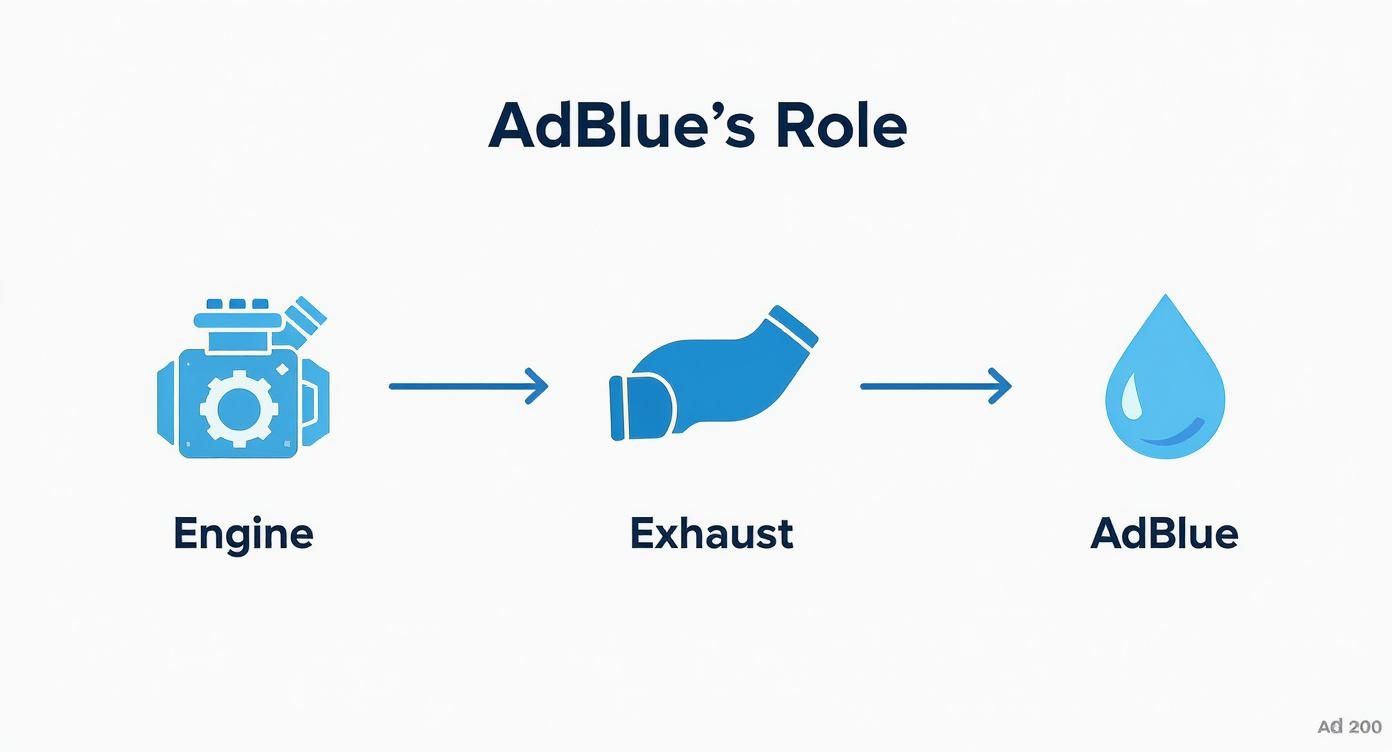
As you can see, it's a straightforward but incredibly effective way to tackle pollutants, turning them into natural elements before they even see the light of day.
The End Result: Cleaner Air
By the time the gases finally puff out of your tailpipe, the worst of the pollutants have been scrubbed out. Modern SCR systems are astonishingly good at this, capable of cutting NOx emissions by up to 90%. It’s a seamless, automatic process that just happens in the background while you drive.
It's important to remember that the SCR system isn’t there to boost your engine's power or save you fuel. Its sole purpose is to make sure your vehicle meets the strict Euro 6 emissions standards by slashing its air pollution.
Understanding this process makes it clear why AdBlue isn't just some optional top-up. It's a vital fluid that your car’s emissions system is built around. Without it, the chemical reaction can’t happen, and your car instantly becomes non-compliant with emissions laws. That’s exactly why your car gives you plenty of warning when the tank is running low and will eventually refuse to start if it runs dry—it’s protecting the environment and the system itself.
Does Your Car Use AdBlue and How to Tell?
With so many different types of diesel vehicles on the road, it's easy to get confused about which ones need AdBlue. The short answer is: it all comes down to the kind of emissions control system your car was built with. So, how can you be sure if your vehicle needs this crucial fluid?
As a rule of thumb, if you drive a diesel car, van, or light commercial vehicle made after September 2015, it almost certainly uses AdBlue. This is because it was designed to meet the strict Euro 6 emissions standards, which made Selective Catalytic Reduction (SCR) technology a standard feature for most manufacturers.
Quick Ways to Check Your Vehicle
Instead of second-guessing, there are a few straightforward ways to find out for certain. These checks only take a moment and will give you a definitive answer.
Here are the three easiest methods:
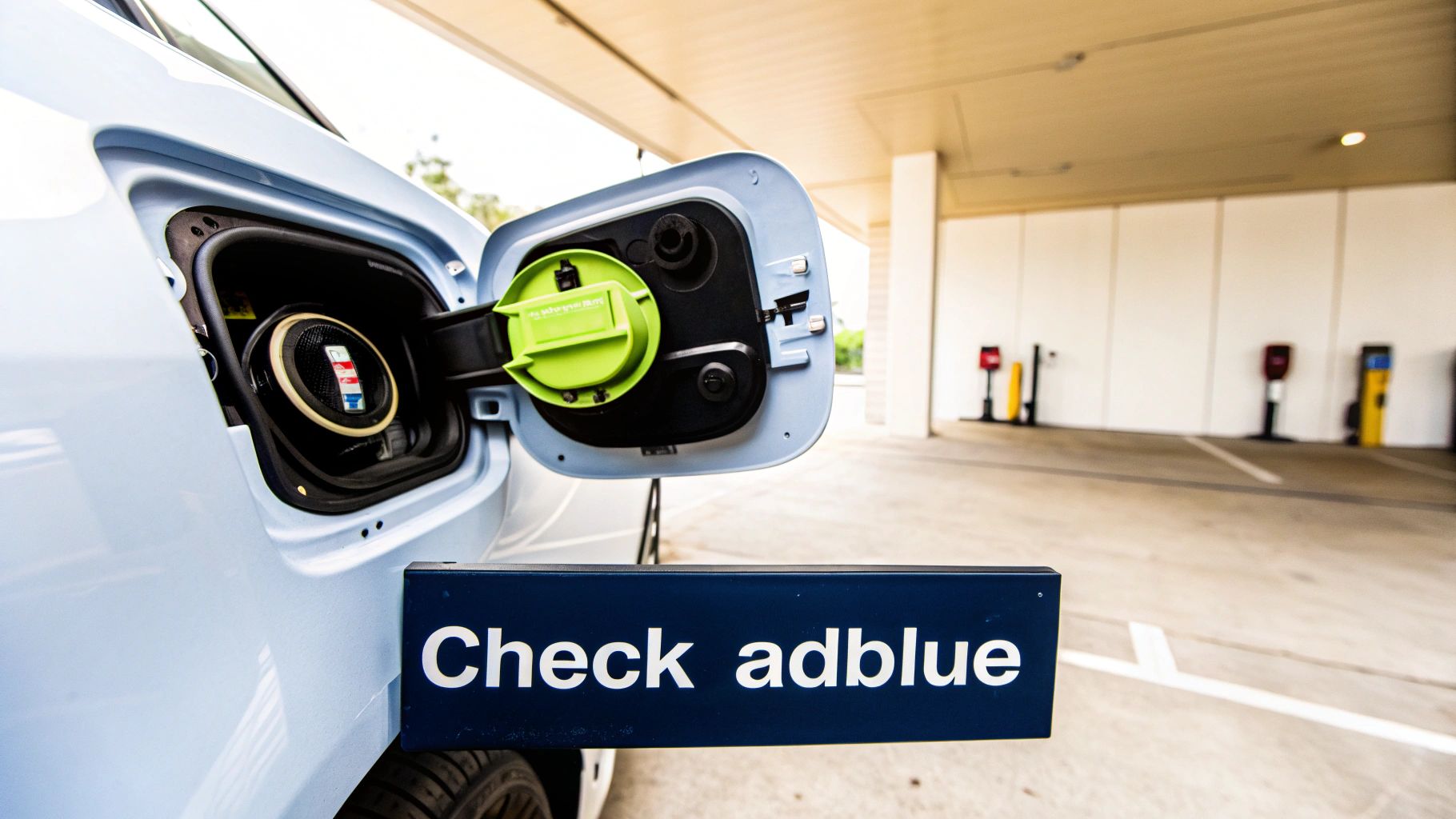
Look for the Blue Cap: The most obvious clue is a second, smaller filler cap right next to your main diesel cap. It’s usually bright blue and often clearly labelled ‘AdBlue’. While the fuel flap is the most common place, you might occasionally find it in the boot or under the bonnet.
Consult Your Vehicle's Handbook: Your car's manual is the definitive guide. Just flip to the index and look for "AdBlue" or "Diesel Exhaust Fluid (DEF)". The handbook will confirm if it’s needed and tell you everything about the tank size and how to refill it.
Check the Dashboard: When you start your engine, cars with SCR systems often show an AdBlue symbol or message for a second or two. If your levels are running low, you’ll get a persistent warning light—it usually looks like a little puff of exhaust or a canister pouring liquid. Don’t ignore it!
Understanding Consumption and Refill Frequency
One of the first questions people ask is, "How often will I need to top this up?" AdBlue consumption really depends on your engine size, how you drive, and the kind of trips you take. For a rough idea, a typical car uses about one litre of AdBlue for every 600 miles driven, but this can vary quite a bit from one model to another.
While sales of new diesel cars have slowed down, AdBlue is still absolutely vital for the UK’s commercial vehicle sector. A heavy-duty lorry, for instance, typically consumes AdBlue at a rate of 3% to 5% of its diesel fuel volume. This makes regular top-ups a fundamental part of keeping the fleet running and staying on the right side of emissions laws. You can learn more about AdBlue market trends and statistics.
Recognising Common AdBlue System Problems
While AdBlue systems are built to be dependable, they're not completely bulletproof. Learning to spot the early warning signs can be the difference between a quick top-up and a costly, time-consuming repair. Luckily, your car is designed to give you a fair bit of warning before things get serious.
The most frequent issue you'll come across is simply running low on AdBlue. Your dashboard will light up, usually with a warning light and a message giving you a mileage countdown until the tank is empty.
Think of this less as a polite reminder and more as a final warning.
The No-Start Countdown Explained
If that AdBlue tank runs completely dry, your vehicle will refuse to start again once you turn it off. This isn't a fault; it's an intentional feature mandated by emissions regulations to stop the car from being driven illegally. The engine simply won't turn over until you add a minimum amount of AdBlue back into the tank—usually at least five litres.
Letting that countdown hit zero can leave you completely stranded, so it’s crucial to act the moment that first warning appears. Don't risk it by driving until the last mile.
Beyond just low fluid levels, other glitches can trigger dashboard warnings. These tend to be a bit more complex and almost always need a professional to diagnose properly.
If you've refilled the tank but the AdBlue warning light stubbornly stays on, you're likely looking at a deeper issue within the Selective Catalytic Reduction (SCR) system itself. It could be anything from a faulty sensor to a blocked injector, so don't just ignore it.
Some of the more common system faults we see include:
Sensor Failures: The system relies on sensors to monitor the AdBlue's level and quality. If one of these fails, it can send false signals to the car's computer, triggering an alert.
Injector Clogs: The nozzle that sprays AdBlue into the exhaust can get blocked with urea crystals. This is especially common on vehicles that only do short, infrequent journeys where the exhaust doesn't get hot enough.
Poor Fluid Quality: Using a cheap, off-brand AdBlue solution that doesn't meet the right standards is a false economy. It can easily damage sensitive SCR components and throw up fault codes.
A clogged injector, for instance, stops the right amount of AdBlue from reaching the exhaust, which means the SCR system can't do its job of neutralising emissions. To get a better feel for how these systems are linked, you can read about the symptoms of bad fuel injectors in diesel vehicles. Spotting these signs early gives you the chance to get professional help before a minor headache turns into a major mechanical failure.
The Critical Mistake of Putting AdBlue in Your Diesel Tank
It’s an easy slip-up to make, especially when you’re rushed at the petrol station. But pouring AdBlue into your diesel tank is one of the most serious and wallet-busting mistakes you can make for your vehicle. The two fluids couldn't be more different, and they must never, ever be mixed.
Think of it this way: your fuel system is designed to handle oily diesel, but AdBlue is 67.5% water. Adding this water-based solution to your diesel is like pouring a pint of water into a chip pan full of hot oil—the reaction is immediate and destructive. The mixture won't combust, and if it reaches your engine, it will cause catastrophic damage.
What Happens Inside Your Fuel System
The moment AdBlue enters your diesel tank, the clock starts ticking. Because it's denser than diesel, it sinks straight to the bottom, right where your fuel pump intake is. This means it's the very first thing the pump will try to suck through the system.
Worse still, the urea in AdBlue is highly corrosive to many of the seals, plastics, and metal components found in a modern fuel system. As this damaging mix gets pulled through, it can wreck the high-pressure fuel pump, clog your injectors, and contaminate the entire fuel line. The result? Repair bills that can easily soar into thousands of pounds.
To be crystal clear on why these two fluids can't mix, let’s break down their fundamental differences.
AdBlue vs Diesel Fuel What to Know
Attribute | AdBlue | Diesel Fuel |
|---|---|---|
Primary Function | Reduces exhaust emissions | Powers the engine |
Base Component | De-ionised water | Hydrocarbon oil |
System | Selective Catalytic Reduction (SCR) | Fuel Injection System |
Compatibility | NEVER mix with fuel | NEVER mix with AdBlue |
As you can see, they are built for entirely separate jobs in entirely separate systems. Keeping them apart is essential for a healthy engine.
The Two Most Important Steps to Take
If the worst happens and you realise you’ve put AdBlue in your diesel tank, what you do in the next few seconds is absolutely crucial. Your immediate response can be the difference between a straightforward fuel drain and a complete fuel system replacement.
Crucial Advice: The single most important thing to do is to stop the contaminated mix from going anywhere. Do not, under any circumstances, put the key in the ignition or press the start button. Just turning on the ignition can prime the fuel pump, which will start pulling the corrosive fluid into your engine's delicate components.
Follow these two golden rules without hesitation:
DO NOT start the engine. Don’t even turn the ignition on to check the radio or see the dashboard light up. Keep the key out.
Call for professional help immediately. You need a specialist wrong fuel removal service. They have the equipment to safely drain the tank, flush the system clean, and dispose of the contaminated liquid correctly.
For a more detailed walkthrough, our guide offers quick steps to fix AdBlue in a diesel tank and save yourself from a massive repair bill. Acting fast is your best defence.
AdBlue FAQs: Your Questions Answered
Even after getting the basics down, it’s normal to have a few nagging questions about using AdBlue day-to-day. Let’s clear up some of the most common queries so you can handle your diesel with confidence.
Can I Drive My Car If the AdBlue Tank Is Empty?
Technically, yes—but only until you turn the engine off. Once the AdBlue runs out and you switch off the ignition, your car will refuse to restart. It’s not a fault; it’s a legal requirement built into the car's software to stop it from polluting.
Your dashboard will give you plenty of notice with alerts and a mileage countdown, usually starting with around 1,500 miles to go. The moment you see that first warning, make topping up your AdBlue a priority. You don’t want to get caught out.
How Long Does AdBlue Last and Does It Expire?
It certainly does. AdBlue has a shelf life, and using it past its prime is a bad idea. If you store it properly—away from direct sunlight and at a stable temperature between -6°C and 25°C—it should last for around 12 to 18 months.
Using old or degraded AdBlue is a false economy. It won't work as effectively and could end up causing expensive damage to your car’s delicate SCR system. Always check the expiry date on the bottle before you buy.
A classic mistake is buying AdBlue in bulk to save a few quid, only for it to sit in the garage for two years. It's better to buy only what you think you'll use within a year. That way, you know it's fresh and will do its job properly.
What Happens If I Overfill the AdBlue Tank?
It’s easy to do, but overfilling the AdBlue tank can cause real headaches. The tank is designed to have a small air gap at the top, which gives the fluid room to expand when it gets warm. When you fill it to the absolute brim, that gap disappears.
This can lead to a few problems:
Pressure Build-up: With nowhere to go, the expanding fluid puts stress on the tank and its components.
Crystallisation: Any fluid that spills around the filler neck will quickly turn into a crusty, white mess, which can stop the cap from sealing correctly.
Sensor Damage: Constant pressure and potential leaks can damage the sensitive sensors that tell you how much AdBlue you have left.
The best approach? Treat it like filling up with diesel. As soon as the pump nozzle clicks off, stop. If you’re pouring from a bottle, just empty the container and resist the urge to squeeze every last drop in.
If you've had a moment of confusion and put AdBlue in your diesel tank, DO NOT START THE ENGINE. Your next call should be to Misfuelled Car Fixer for 24/7 emergency help across Suffolk. We'll safely drain the contaminated fuel and get you moving again, saving you from a massive repair bill. Get urgent assistance on our website at https://www.misfuelledcarfixer-suffolk.co.uk.


