



Diesel In Unleaded Car: Quick fixes and damage prevention
- Misfuelled Car Fixer

- Nov 15, 2025
- 14 min read
Updated: Nov 24, 2025
That sinking feeling. You’ve just finished filling up, you hang the nozzle back on the pump, and then you see it – the black, greasy handle of the diesel pump in your hand, when your car takes green unleaded. It’s a common mistake, but what you do in the next few minutes is absolutely critical.
Getting it wrong can be the difference between a simple fix and a four-figure repair bill. But don’t panic. The golden rule, the one thing you must remember above all else, is this: do not start the engine. Seriously. Don’t even turn the key to listen to the radio.
Diesel In Unleaded Car | What to Do Immediately After Misfuelling
Right, you’ve realised the mistake. Before you do anything else, take a deep breath. Your car is still fine. As long as the diesel is just sitting in the tank, it's a containable problem. The real damage starts the second you turn that key.
Turning the ignition, even without starting the engine, often primes the fuel pump. That pump will immediately start sending the wrong fuel through the lines, towards your engine. That's when a simple tank drain becomes a much more complex and expensive system flush.
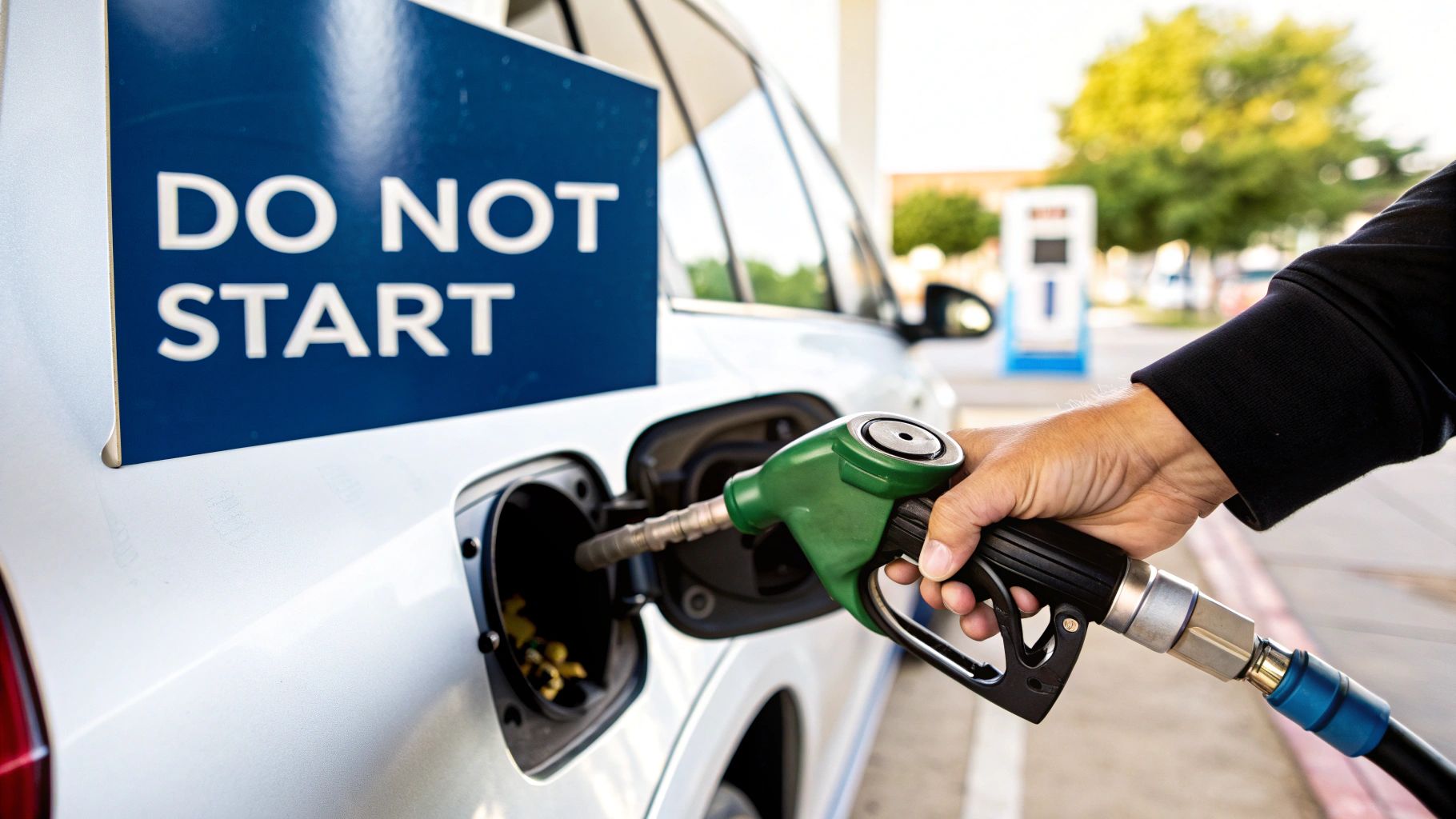
Actions to Take at the Petrol Station
You're currently blocking a pump, and the temptation to just quickly move the car is huge. Resist it. Here’s the practical, safe way to handle the situation:
Tell the staff immediately. Go into the kiosk and let them know what's happened. They've seen it all before and can help by coning off the pump so no one is trying to queue behind you.
Keep the engine off. I know I’m repeating myself, but it's that important. Don't start it to move it "just a few feet".
Pop it in neutral. If the forecourt is flat and it's safe to do so, engage neutral.
Push it to safety. Ask the station staff or a fellow driver for a hand to push the car into a safe parking bay. This gets you out of the way without risking any engine damage.
Key Takeaway: From the moment you realise you've misfuelled, treat your car as if it's broken down. The only safe way to move it is by pushing it. Starting the engine is off the table.
Who to Call for Help
Once your car is parked safely, it’s time to get professional help. While your first thought might be your usual breakdown provider, a specialist mobile fuel drain service is often the faster and more efficient option.
A breakdown service will likely just tow your vehicle to a local garage. That adds extra steps, time, and cost. The garage might not be able to look at it straight away, leaving you stranded for hours or even days. A dedicated misfuelling technician, on the other hand, comes directly to you.
Whatever you do, don't be tempted to try and drain the tank yourself. It’s a messy, dangerous job that can go very wrong. Siphoning fuel is not only a serious fire hazard but can also be illegal due to strict environmental regulations on disposing of contaminated fuel. For a better understanding of the risks, take a look at our guide on how to drain a petrol tank safely and legally in the UK.
This is a classic case where calling in the experts is the smartest move. They have the certified equipment to do the job safely, dispose of the contaminated fuel correctly, and get you back on your way.
How to Spot the Signs of Wrong Fuel
Maybe the penny didn't drop right there at the pump. You might have paid, driven off, and only now, a few miles down the road, you've got that sinking feeling that something is seriously wrong. It’s a scenario we see all the time, but catching the symptoms early is absolutely critical to preventing expensive damage.
When diesel goes into a petrol car, it creates a whole host of tell-tale signs. The engine is basically trying to process a fuel it was never built for. Petrol is highly volatile and ignites with a quick spark, but diesel is a much heavier, oilier fuel that needs high compression to combust. When it gets into a petrol engine, it just doesn't burn properly, and that’s when the problems start.

Common Symptoms After Driving Away
The first signs often show up within just a few minutes of driving. Your car's performance will start to drop off a cliff as that diesel makes its way from the tank and into the engine. You need to be alert to these classic indicators.
Lots of Exhaust Smoke: One of the most glaring signs is thick smoke pouring out of your exhaust. It’s usually white or grey as the engine struggles, and fails, to burn the oily diesel.
Engine Juddering or Misfiring: The car might feel like it’s bunny-hopping or shaking violently, especially when you try to accelerate. This is the sound and feel of incomplete combustion.
A Loud Knocking Sound: You might hear a very distinct knocking or rattling noise, often called "pinking," coming from the engine. That’s the engine telling you it's under serious strain.
Loss of Power: Your car will feel incredibly sluggish and weak. Pushing the accelerator won't give you the power you expect, and you'll find it hard to get up to speed or climb even a slight incline.
These symptoms are the direct result of diesel coating everything it touches. It clogs up the spark plugs so they can’t create a spark, and it fouls the cylinders, completely messing up the precise fuel-air mixture your engine needs to run.
Expert Insight: If your engine starts to misfire and you see smoke from the exhaust right after filling up, it’s almost certainly a misfuel. The absolute best thing you can do is pull over safely, switch off the engine immediately, and call for help.
What Happens as the Problem Gets Worse
If you try to push on and keep driving, the symptoms will only get worse until the engine cuts out completely. Knowing how things will progress can help you act before it gets to that point.
At first, you might just notice a slight hesitation. This will quickly turn into more obvious juddering and a serious lack of performance. Before you know it, the engine management light will probably flash up on your dashboard as the car's sensors scream that something is terribly wrong with the combustion.
Eventually, the spark plugs will get so caked in oily diesel that they can’t produce a spark at all. That’s when the engine will stall. And once it stalls, it’s almost guaranteed it won’t start again.
Understanding these signs is your first line of defence. For a more detailed look, check out our quick guide to wrong fuel in car symptoms for UK drivers. The sooner you spot the problem and stop the car, the less diesel gets pumped through the system, potentially saving you from much bigger, more expensive repair bills.
Understanding the Potential Engine Damage
The moment you put the wrong nozzle in your car, you create a fork in the road. The path you take next depends entirely on one single, critical action: turning the ignition key. That small movement is the difference between a simple inconvenience and a potentially wallet-emptying mechanical nightmare.
One route leads to a clean, straightforward fix with no lasting harm. The other sends thick, oily diesel on a destructive journey through your car's most sensitive components. Understanding what happens in each case is key to grasping the repairs your car might need.
The Best-Case Scenario: You Haven't Started the Engine
If you realised your mistake right there at the pump and haven't so much as touched the ignition, you can breathe a massive sigh of relief. This is the absolute best outcome you could hope for.
Right now, the heavier, oilier diesel is just sitting in your fuel tank, probably layered on top of whatever petrol was left. Crucially, it hasn't gone anywhere else.
The fuel lines that carry fuel to the engine are still clear.
The fuel pump hasn't been activated, so it hasn't tried to force the wrong fuel through its delicate mechanisms.
The injectors, which are precision-engineered to spray a fine mist of petrol, are completely untouched and safe.
The solution here is as direct as it gets. A professional fuel drain technician will simply pump the contaminated mix out of the tank, flush out any residue, and get you back on the road with fresh petrol. No engine parts are harmed, and there are no long-term consequences for your vehicle.
The Worst-Case Scenario: The Engine Was Started
The moment you turn that key, everything changes. The fuel pump primes and immediately starts forcing the wrong fuel into a system it was never designed for. A petrol engine’s fuel system is built for a thin, highly combustible liquid, not a thick, lubricating oil like diesel.
The diesel begins its destructive tour through your car's fuel system, leaving a trail of damage as it goes.
A Mechanic's Analogy: Pushing diesel through a modern petrol fuel system is like pouring treacle into a delicate Swiss watch. The system operates at high pressure with components engineered to microscopic tolerances. The thick, oily fuel clogs, coats, and ultimately stops everything from working as it should.
The Destructive Journey of Diesel Fuel
Once the engine is running, the diesel is circulated with force, and the damage begins almost instantly. It’s a domino effect where one component's failure puts stress on the next.
Fuel Pump Strain: The pump has to work incredibly hard to push the thicker diesel, causing it to overheat and, in many cases, burn out completely.
Clogged Fuel Filter: The fuel filter, designed to catch tiny particles in petrol, quickly becomes saturated and blocked by the much heavier diesel.
Blocked Injectors: Fuel injectors have microscopic nozzles designed to atomise petrol into a fine vapour. Diesel can't be atomised this way; it just coats and clogs them, leading to misfiring and eventual engine failure.
Fouled Spark Plugs: Unburnt diesel coats the tips of the spark plugs. This oily residue acts as an insulator, preventing them from creating the spark needed for combustion.
Engine Damage: If the engine manages to run for a while, the unburnt diesel can actually wash the essential lubricating oil off the cylinder walls. This leads to increased friction, scoring the pistons and cylinders.
Catalytic Converter Failure: Finally, any unburnt fuel gets shoved into the exhaust system. There, it can coat and ruin the catalytic converter—a component that can easily cost hundreds, or even thousands, of pounds to replace.
The table below breaks down just how quickly the risks escalate once the engine has been started.
Potential Damage Comparison: Engine Off vs Engine On
Affected Component | Engine Not Started (Contamination in Tank Only) | Engine Started (System-Wide Contamination) |
|---|---|---|
Fuel Tank | Contains contaminated fuel. Simple drain required. | Contains contaminated fuel. Drain and flush required. |
Fuel Lines & Filter | Unaffected. | Contaminated and potentially clogged. Requires flushing/replacement. |
Fuel Pump | Unaffected. | Strained and at high risk of burning out. |
Fuel Injectors | Unaffected. | Coated, clogged, and may need cleaning or replacement. |
Spark Plugs | Unaffected. | Coated with oily residue, causing misfires. Will need replacing. |
Catalytic Converter | Unaffected. | High risk of being clogged and ruined. A very costly repair. |
As you can see, the consequences get more severe—and expensive—with every component the diesel reaches.
Realising you've put diesel in a petrol car is stressful, but understanding these two distinct outcomes reinforces the golden rule: do not turn the key. If you've already driven off, pulling over and switching off the engine as soon as you notice the symptoms is the next best thing you can do to limit the damage.
What a Professional Fuel Drain Involves
When you call for help with a misfuelled car, you’re not just getting a simple tow. A specialist technician arrives with a mobile workshop on wheels, ready to perform a precise, multi-stage procedure to get you safely back on the road. It's about much more than just siphoning out the wrong fuel; it’s a meticulous process to clear out every trace of contamination and prevent any lasting damage.
The first thing a qualified expert does is secure the area. Petrol vapours are incredibly flammable, so they’ll immediately run a safety check to eliminate any nearby ignition sources. This is exactly why you should never try this yourself. Professionals use specialised, ATEX-certified (spark-free) pumps and gear designed specifically for handling volatile fuels. Your safety, and theirs, comes first.
The Draining and Flushing Process
Once the scene is safe, the real work begins. The technician will access your fuel tank—sometimes through the filler neck, other times by removing the back seat to get to the sender unit—and start draining the diesel-petrol mix into a secure, purpose-built container. It’s a slow and steady process to ensure every last drop is removed.
With the tank empty, the most critical part of the job starts: the flush. This is what truly sets a professional service apart.
System Flush: The technician circulates a small amount of clean, correct petrol through the entire fuel system—the lines, filter housing, and fuel rail.
Component Cleaning: This fresh petrol acts as a solvent, breaking down and washing away the oily diesel residue that has coated the inside of these vital parts.
Final Purge: All the flushing fuel is then drained away, taking the last of the diesel contamination with it.
If you’ve started the engine, the job becomes a bit more involved. The technician will likely need to clean or replace the fuel filter, as it can get clogged with the thicker diesel. They'll also inspect your spark plugs, which can become fouled and might need a good clean or even replacing to get the engine firing correctly again.
This infographic really drives home the difference between starting the engine and leaving it off.
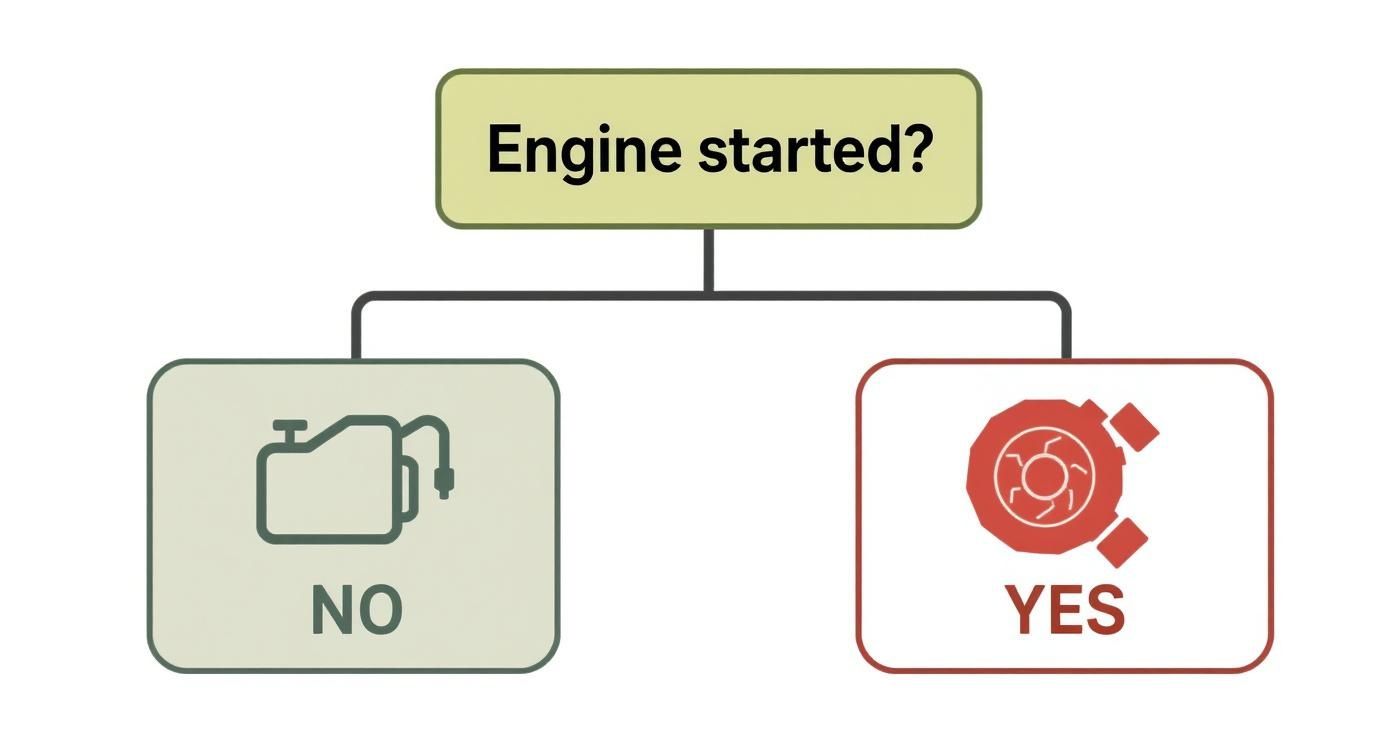
As you can see, keeping the key out of the ignition contains the problem to the tank. Turning it escalates the issue into a full system contamination.
Final Checks and Refuelling
After the system is completely clean, the technician will add a small amount of fresh unleaded petrol back into the tank. They won't fill it up, but will add just enough—usually around 5 to 10 litres—to get the car started and see you to the nearest petrol station.
Before you’re given the green light, they’ll start the car and let it run for a few minutes. They're listening for any unusual noises, hesitation, or misfiring, just to be certain the entire procedure has been a success.
A Crucial Point: Modern fuel systems are a world away from the engines of a few decades ago. Since Esso introduced unleaded petrol back in 1986, systems have become incredibly complex and sensitive. These high-pressure, precision-engineered components simply can't handle the wrong fuel, which is why a professional flush isn't just a good idea—it's essential. You can learn more about the evolution of fuel in the UK from the RAC fuel watch page.
From start to finish, the entire roadside process usually takes between 60 and 90 minutes. It's a highly skilled fix that properly rectifies a costly mistake and protects your engine from much bigger problems down the line.
What’s This Going to Cost Me? A Look at Repair Times and Bills
Let's be honest, the first thought that rockets through your mind after misfuelling is almost always, "How much is this going to set me back?" It’s a horrible feeling, but knowing the potential costs can help you tackle the problem with a clear head.
The final bill for putting diesel in a petrol car hinges almost entirely on one single action: whether or not you started the engine. The financial gulf between these two scenarios is massive. One is a straightforward fix; the other can quickly spiral into a seriously expensive repair.
If You Haven't Started the Engine: The Simple Fix
Caught the mistake at the pump before turning the key? Brilliant. You've just saved yourself a lot of money and hassle. This is the best-case scenario, and the solution is a professional mobile fuel drain.
Here in the UK, you can expect this service to cost somewhere between £150 and £300. A technician will come out to you, drain the contaminated fuel from the tank, flush the system to get rid of any residue, and have you back on the road. All in, from the moment you call to the moment you drive away, you’re typically looking at about 60 to 90 minutes.
If You Have Started the Engine: When Costs Escalate
The situation changes completely the second that diesel starts circulating through your petrol engine. It's no longer about just getting the wrong fuel out; it's about dealing with the damage it has caused along the way. The bill will now include diagnostics, labour, and potentially a long list of replacement parts.
Fuel Filter: This will almost certainly need replacing. Expect to add £40 - £80.
Spark Plugs: Diesel will have fouled the plugs, so they'll need changing. That’s usually £50 - £120.
Fuel Pump: This is a common casualty. A new pump can run from £200 to over £600, depending on the car.
Fuel Injectors: These can get clogged. A professional clean might cost £150, but a full replacement could be over £1,000.
Catalytic Converter: This is the big one. If the ‘cat’ is damaged, you’re looking at £500 to £2,000+ for a replacement.
If the engine was run until it stopped, the total bill for putting diesel in an unleaded car can easily climb into the thousands. For many older cars, that's more than the vehicle is even worth.
It’s a painful financial hit, especially when you think about the small price difference at the pump. In late 2023, for example, diesel was about 155.2 pence per litre while unleaded was 151.7 pence. A tiny gap that can lead to a monumental repair bill.
Ultimately, every situation is different. The final cost will depend on how much diesel went in, how long the engine ran, and your car’s make and model. For a much more detailed breakdown, have a look at our complete UK guide to wrong fuel costs. It really drives home why making that call for a fuel drain before you start the car is the smartest move you can make.
Got Questions? We've Got Answers
If you’ve just put diesel in your unleaded car, your mind is probably racing. It's a horrible, sinking feeling, but getting straight answers right now is the key to handling it properly. We hear the same questions every day from drivers in this exact situation, so let's tackle them head-on.
"Can I just top it up with petrol? It was only a little bit of diesel."
I wish I could say yes, but it’s a myth that can cost you dearly. The truth is, even a small amount of diesel—as little as 5% of your tank's total capacity—is enough to bring your petrol engine to a shuddering halt.
Think of it this way: a petrol engine needs a fine, explosive mist of fuel ignited by a spark plug. Diesel is a thick oil. It doesn't ignite with a spark; instead, it just coats everything in a greasy film, fouling your spark plugs and clogging sensitive fuel injectors. Trying to "run it through" is a gamble that almost never pays off and often turns a simple problem into a very expensive one.
"What about one of those fuel additives? Will that fix it?"
That’s another common hope, but unfortunately, the answer is a firm no. There is no magic potion in a bottle that can reverse what's happened. No off-the-shelf additive can magically transform diesel into petrol or neutralise its oily, damaging properties.
Those products you see are designed for routine maintenance, like cleaning a fuel system under normal conditions. They simply aren't engineered to handle major contamination. The only proven, safe solution is a professional drain and flush to get every last drop of the wrong fuel out of your system.
The Hard Truth: Don't waste your money on an additive. At best, it won't work. At worst, it gives you a false sense of security, tempting you to start the engine and cause thousands of pounds in damage.
"Will my insurance cover this?"
This is a real grey area, and it all comes down to the fine print of your policy. Many standard insurance policies consider misfuelling a self-inflicted error and won't cover it. But it's not always a closed case.
Here’s what you need to look for:
Accidental Damage: A few fully comprehensive policies might cover the cost under their 'accidental damage' clause, but you'll have to check your specific wording.
Breakdown Cover: Your breakdown policy might get you a tow to a garage, but they often don't cover the cost of the actual fuel drain itself.
Excess & Premiums: Even if you are covered, you'll have to pay the excess. On top of that, making a claim will almost certainly mean your premium goes up at renewal time.
It’s always worth a quick call to your insurer, but most drivers find that paying a specialist directly is quicker, easier, and often works out cheaper in the long run.
"Is it really that bad if I just start it to move a few feet?"
Yes, it really is. This is probably the single most critical mistake you can make. The moment you turn the key to the 'on' position—even without firing up the engine—you're likely priming the electric fuel pump. That's all it takes to start sucking the contaminated fuel from the tank into the lines.
If you actually start the engine, even for 30 seconds to get out of the way of the queue, you're pumping that diesel through the entire system. It's forced into the fuel pump, the filter, and the high-pressure injectors. This is exactly how a simple tank drain, which might cost around £200, spirals into a full system flush and component replacement costing thousands. The only safe way to move the car is to push it.
If you've put diesel in an unleaded car in Suffolk or the surrounding areas, don't take the risk. The fastest and safest way to get back on the road is to call in the professionals. For a rapid, 24/7 emergency fuel drain service that comes to you, contact Misfuelled Car Fixer immediately. Visit our website at https://www.misfuelledcarfixer-suffolk.co.uk or give us a call for immediate help.


