


Wrong Fuel in Car Cost Your Complete UK Guide
- Misfuelled Car Fixer

- Nov 13, 2025
- 11 min read
Updated: Nov 24, 2025
It's a moment of pure panic: you've just put the wrong fuel in your car. Your mind immediately races to the potential cost, which can swing wildly from a couple of hundred pounds for a simple fix to thousands for catastrophic engine damage.
So, what's the real cost of misfuelling? The final bill almost always boils down to one critical question: did you start the engine?
Wrong Fuel in Car Cost Your | The Real Cost of Misfuelling Your Car
That gut-wrenching feeling at the pump is an experience many drivers unfortunately share. You've realised your mistake, and now you're wondering just how much it's going to hurt your wallet. There’s no single, fixed price for this kind of problem; it’s a sliding scale of expense.
Think of it like spilling a drink on your laptop. If it's just water and you act fast, you might get away with it. But if it's a sugary, sticky drink that you let seep into the electronics, you're looking at a much bigger, more expensive problem.
This guide is here to walk you through exactly what shapes that final bill. More importantly, we'll outline the immediate steps you need to take to keep the damage—and the cost—to an absolute minimum.
A Surprisingly Common Mistake
First off, don't beat yourself up. Misfuelling happens thousands of times a year across the UK. It’s an easy mistake to make, especially if you're distracted, in a hurry, or driving a car you're not used to. A recent study revealed that over a quarter of motorists (29%) have admitted to doing it at least once.
The data from the study also highlights a few interesting patterns:
Younger drivers between 18-24 seem to be the most susceptible, with a huge 54% reporting they’ve used the wrong pump.
This is a stark contrast to the 12% of drivers over 55 who've made the same error.
Men are also slightly more likely to misfuel, with 33% admitting to it compared to 23% of women. You can see the full breakdown of these motorist habits at Go.Compare.
Understanding why this is such a big deal comes down to the fundamental properties of petrol and diesel. If you're curious about the science, have a look at our quick guide on the difference between petrol and diesel fuel.
For now, though, our goal is to turn that initial panic into a clear plan of action.
Why Turning the Key Can Cost You Thousands

The biggest, single factor that dictates your final repair bill is frustratingly simple: did you start the engine? Realising your mistake at the pump is one thing, but circulating the wrong fuel through your engine's intricate and delicate veins is another beast entirely. That one action separates a minor hiccup from a major financial disaster.
Think of it this way. Imagine you've accidentally poured bleach into your home's water tank. If you realise before turning on any taps, the fix is manageable – you drain the tank and refill it. But if you run the taps, that bleach surges through every pipe, boiler, and appliance, causing widespread, expensive damage.
Your car's fuel system works on the exact same principle. Keeping your hand off that ignition is, without a doubt, the most critical money-saving decision you can make at this moment.
Engine Off: The Simple Fix
If you haven't started your car, the good news is that the wrong fuel is contained entirely within the fuel tank. It hasn't had a chance to get sucked into the fuel lines, filters, pumps, or injectors. This is the absolute best-case scenario.
For a trained technician, the solution is pretty straightforward:
Fuel Drain: A specialist will safely drain every last drop of the contaminated fuel from your tank.
System Flush: They might then flush the tank to get rid of any lingering residue.
Correct Refuel: Finally, the tank is refilled with a bit of the correct fuel to get you going again.
This whole process is surprisingly quick and is usually done at the roadside in under 90 minutes. While it isn't free, the wrong fuel in car cost in this situation is far more manageable, typically landing in the low hundreds of pounds.
Engine On: The Costly Cascade
The moment you turn that key, the game changes completely. Your car's fuel pump whirs into life, immediately pulling the contaminated mixture from the tank and pushing it at high pressure through the entire system. This is where the real damage—and the costs—begin to spiral out of control.
Starting the engine has serious consequences, particularly when you've put petrol into a diesel car. The incorrect fuel mixture travels through critical parts that were never designed for it, leading to friction, corrosion, and catastrophic blockages.
A study by the RAC found that around 150,000 drivers in the UK make this mistake every single year. The repair bills can be eye-watering, sometimes reaching £3,000 per incident. The damage gets worse the longer the engine runs. You can read more about these potential misfuelling repair costs from Good Housekeeping.
Now, what was a simple drain becomes a complex mechanical repair. Your vehicle will likely need to be recovered to a garage, and you could be looking at replacing expensive components like:
The entire fuel pump
All the fuel injectors
Filters and seals
Fuel lines and sometimes even the tank itself
Suddenly, a quick roadside fix has become a garage job that could take days and cost thousands. The difference between these two scenarios hangs on one tiny, split-second action: turning the key.
To put it into perspective, here's a rough idea of what you might be looking at.
Estimated Wrong Fuel Repair Costs Based on Scenario
This table gives a clearer picture of how costs can escalate once the engine is started. The figures are estimates, but they highlight the stark financial difference between the two scenarios.
Scenario | Engine Not Started (Estimated Cost) | Engine Started (Estimated Cost) | Common Repairs Needed |
|---|---|---|---|
Petrol in Diesel | £200 - £400 | £500 - £5,000+ | Fuel drain, system flush. |
Diesel in Petrol | £200 - £400 | £400 - £4,000+ | Fuel drain, system flush. |
AdBlue in Fuel | £300 - £600 | £1,000 - £8,000+ | Specialist drain, new filter. |
As you can see, keeping the engine off is your best defence against a massive repair bill. It's the one thing you can control that has the biggest impact on the final outcome.
Petrol in Diesel: The Most Expensive Mistake
Let’s be clear: not all misfuelling mishaps are the same. While any mix-up at the pump is a headache, putting petrol into a modern diesel engine is easily the most damaging—and costly—scenario you can run into. The wrong fuel in car cost can climb alarmingly high here, and it all comes down to one crucial thing: lubrication.
Diesel fuel is naturally a bit oily. This isn't a design flaw; it's a feature. As it moves through your car's fuel pump and injectors, it coats and protects these highly-engineered components, letting them work seamlessly under incredible pressure.
Petrol, on the other hand, is the polar opposite. It’s a solvent. When you introduce petrol to a diesel system, it doesn’t just fail to lubricate—it actively strips away the essential oily film. Almost immediately, delicate metal parts start grinding against each other, creating intense friction and heat where there should be none.
The Chain Reaction of Destruction
That initial lack of lubrication sets off a devastating domino effect. The friction can tear the fuel pump apart from the inside, sending a shower of tiny metal fragments—like a fine, metallic dust—hurtling through the entire fuel system.
These particles then race down the fuel lines, lodging themselves in the pinhole-sized nozzles of the fuel injectors. An injector is supposed to create a fine, atomised mist of fuel, but once it's clogged with metal shavings, it’s completely ruined. And believe me, the damage doesn't stop there.
The real danger lies in how quickly petrol causes wear. It's like running an engine without any oil. The subsequent repair often involves replacing not just one part, but the entire fuel delivery system to guarantee all metal particles are removed.
Fixing this kind of internal damage is a massive job. It’s not just about draining the tank. You're often looking at a shopping list of new parts:
The high-pressure fuel pump
All of the fuel injectors
Fuel filters and fuel lines
Sometimes, the fuel tank itself needs to be removed for a deep clean or replaced entirely.
This is exactly how a moment's distraction can turn into a repair bill that runs into the thousands, especially if the engine has been started. Even a little bit of petrol can cause serious problems, which is why it's vital to know what to do if you've only put a small amount of petrol in a diesel car.
Diesel in Petrol: A Less Severe Problem
Putting diesel into a petrol car, while still a problem, is generally far less catastrophic. A petrol engine is designed for a highly flammable fuel, and it simply can't ignite the thick, oily diesel effectively.
What usually happens? The car will splutter, cough out a lot of smoke from the exhaust, and then cut out.
Because diesel is an oil, it doesn't have that solvent effect that destroys components. The fix is usually a straightforward fuel drain and system flush. You’ll likely need a new set of spark plugs, as the old ones will be fouled up by the oily residue, but it’s a far cry from the astronomical repair bills associated with the petrol-in-diesel nightmare.
What Misfuelling Really Costs: The Hidden Expenses
When you realise you’ve put the wrong fuel in your car, the first thing that comes to mind is the repair bill. But the cost of the fuel drain itself is often just the tip of the iceberg. Many drivers are blindsided by the other costs that quickly pile up, making a simple mistake a whole lot more expensive.
The first unwelcome surprise usually comes from your car insurance company. It’s a hard truth, but most standard UK policies won’t cover misfuelling. Insurers often classify it as a preventable error rather than an accident, which means you’re left to handle the entire cost on your own.
The Reality of Insurance and Breakdown Cover
It’s always worth checking the small print of your policy documents, but don't get your hopes up. Look for terms like "contamination" or "misfuelling" in the exclusions list. While your car insurance is unlikely to step in, some premium breakdown cover plans do offer misfuelling assistance. This might cover a roadside drain, but it almost never pays for any mechanical repairs needed afterwards.
Then there’s the recovery cost. If you’ve started the engine, your car is now a very heavy paperweight and will need towing. Towing fees can sting, varying wildly depending on where you are in Suffolk, the time of day, and what kind of vehicle you drive. It’s not unusual for this alone to add another £100-£250 to your final bill, completely separate from the repair itself.
Here’s the bottom line: don't assume your insurance will save you. Most policies will not cover damage from misfuelling, placing it squarely in their general exclusions. Always check your specific policy to avoid a nasty financial shock.
The Dangers of a DIY Fuel Drain
With costs mounting, you might be tempted to try draining the fuel yourself. In a word: don’t. It’s a genuinely dangerous idea that can lead to far worse outcomes for both you and your car. Petrol is incredibly flammable, and the fumes can ignite from a tiny spark, creating a serious fire hazard.
Putting the immediate safety risks aside, you could easily cause permanent damage to your vehicle. Modern fuel systems are packed with sensitive electronics and high-pressure pumps that can be ruined without specialist knowledge and equipment. You're also left with the problem of what to do with the contaminated fuel. It's legally classified as hazardous waste, and you can face hefty fines for disposing of it improperly.
Calling a professional mobile fuel drain service isn't a luxury; it's a necessity. It keeps you safe, prevents catastrophic damage to your car's engine, and ensures the contaminated fuel is disposed of correctly. Trying to save a few hundred quid on a DIY job could easily spiral into thousands in repair bills and environmental fines.
Your Immediate Misfuelling Action Plan
That sinking feeling when you realise you've grabbed the wrong nozzle is a horrible one. But panic is your worst enemy right now. A clear head can be the difference between a small blip in your day and a bill for thousands, seriously impacting the final wrong fuel in car cost.
There's one golden rule, and it's worth repeating: DO NOT START THE ENGINE.
Seriously. Don't even turn the key to the 'on' position or press the start button. Modern cars often prime the fuel pump the moment you do, and that’s when the contaminated fuel begins its destructive journey from the tank into your engine. Your number one job is to keep it right where it is.
With that in mind, here are the next crucial steps. Put the car in neutral. Let the petrol station staff know what's happened – they’ve seen it all before. They can help you push the car to a safe place, well away from the pumps and any potential fire hazards.
Calling for Professional Help
Once the car is safely out of the way, it's time to get your phone out. As tempting as a DIY fix might seem, it's a genuinely bad idea. You're dealing with flammable liquid and complex fuel systems, not to mention the challenge of disposing of the contaminated fuel legally. We've gone into more detail on the dangers in our guide about why draining a fuel tank is a job for the pros.
So, who do you call? Your choice is usually between a national breakdown company and a local, specialist mobile fuel drain service. While the big names are familiar, a local specialist is often the faster, more direct, and cheaper option.
Think about it: a specialist team right here in Suffolk is geared up for one specific job. They can get to you far quicker than a national service that might be juggling calls across three counties. They arrive with everything needed to drain the wrong fuel, flush the system, and get you back on the road right there and then. This completely bypasses the delay and expense of getting towed to a garage, which will likely charge a premium for the exact same job.
The decision tree below maps out the different paths and how they affect your wallet.
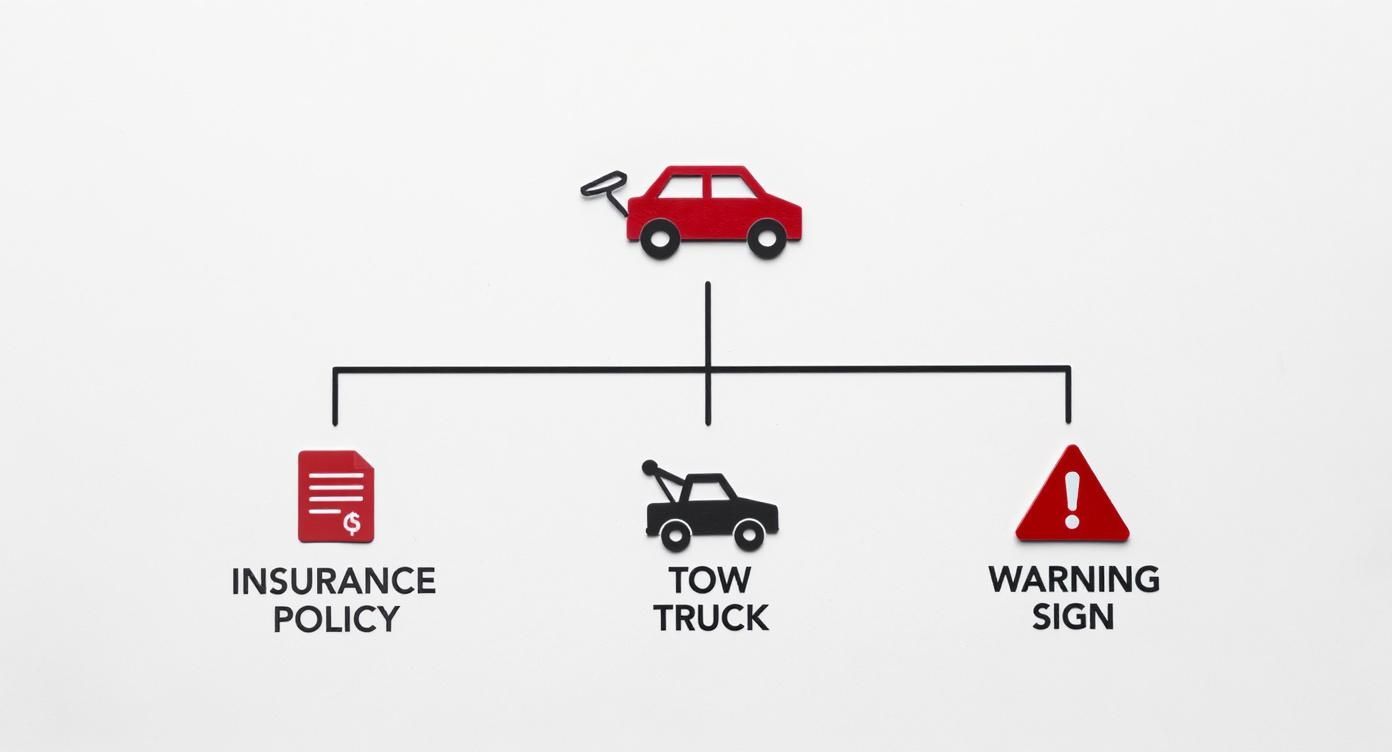
As you can see, the most straightforward and budget-friendly route is nearly always a specialist service. It cuts out the extra steps, potential insurance headaches, and the very real risks of a DIY disaster. Taking these first few steps correctly is the single best thing you can do to control the situation and keep that final bill as low as possible.
Your Misfuelling Questions Answered
That sinking feeling after you've put the wrong fuel in your car is often followed by a flood of questions. How much will this cost? Is my insurance going to help? Let's clear up some of the most common worries you might have.
Will My Car Insurance Cover The Wrong Fuel Cost?
It's highly unlikely. Most standard UK car insurance policies see misfuelling as a preventable mistake, so they won't cover the damage.
However, it's always worth checking the small print on your breakdown cover. Some of the more comprehensive plans do include assistance for misfuelling, which could at least cover the cost of the fuel drain itself.
How Long Does a Wrong Fuel Repair Take?
This all boils down to one critical question: did you start the engine?
If you realised your mistake at the pump and left the engine off, a mobile specialist can usually get you sorted right there on the forecourt in about 60-90 minutes. But if you started the car and drove it, even for a few yards, it's a different story. The car will need to be taken to a garage for a proper inspection, and that could mean you're without it for several days.
Is a Specialist Mobile Fuel Drain Service Worth It?
Absolutely. In nearly every situation, calling a mobile fuel drain expert is the smartest move. These technicians live and breathe this exact problem; they have the right equipment on their vans to handle it safely and quickly wherever you are.
It’s almost always faster and cheaper than getting towed to a main dealership. A dealer will perform the same initial drain but will likely charge a premium for it, on top of the towing fee.
Think of a specialist service as the direct route out of trouble. It cuts out the middleman, gets you back on the road faster, and is often the most sensible option for your wallet, especially if you haven't started the engine.
Will Putting Wrong Fuel in My Car Void My Warranty?
No, putting the wrong fuel in won't scrap your entire vehicle warranty. But, and this is a big but, the warranty definitely won't cover any damage caused by the fuel mistake.
You'll be on the hook for the full wrong fuel in car cost to repair or replace any parts that have been damaged as a result.
If you're stuck in Suffolk and need help right now, don't panic. Misfuelled Car Fixer runs a 24/7 emergency service designed to get you sorted and safely back on your journey. Give us a call at https://www.misfuelledcarfixer-suffolk.co.uk.


