



How to Handle a small amount of petrol in diesel car: Quick Guide
- Misfuelled Car Fixer
- Jan 3
- 12 min read
That sinking feeling at the pump… we’ve all been there, or at least had the nightmare about it. You’ve just put a small amount of petrol in a diesel car, and your stomach drops. The single most important thing to remember is this: do not start the engine.
Don't even be tempted to turn the key to the 'on' position to listen to the radio. On many modern cars, that simple action primes the fuel pump, which is the first step in sending that damaging petrol-diesel mix circulating through your fuel system.
Your First Move After Putting Petrol in a Diesel Car
Realising your mistake on the forecourt can trigger a wave of panic, but what you do in these first few seconds is absolutely critical. A calm head now can be the difference between a simple, straightforward fix and a repair bill that runs into the thousands. Your one and only priority is to stop that contaminated fuel from ever reaching the engine.
This flowchart lays it out perfectly – the decision you make right now determines what happens next.
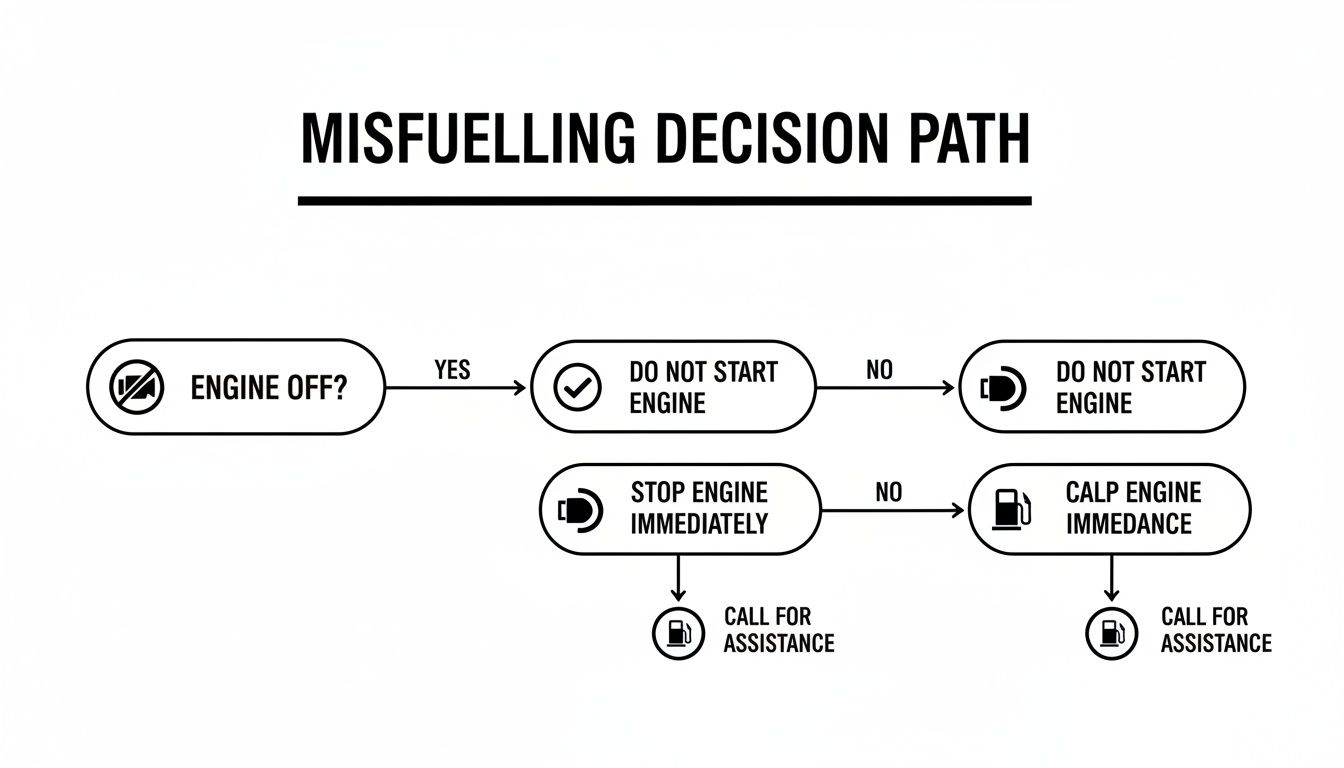
As you can see, keeping the engine off is the safest and, by far, the cheapest path to take.
Taking Action at the Petrol Station
Right, take a deep breath. The first thing to do is make the car safe. Pop the gearstick into neutral. If you're able, get a hand from the station staff or a kind passer-by to help you push the car to a safe parking bay, well away from the pumps. This not only clears the area for other drivers but also moves your vehicle to a spot where a professional can work on it safely.
Once the car is moved, let the petrol station staff know what’s happened. They see this more often than you’d think and are trained to handle it. They can cone off the area if needed and might even have the number for a trusted local fuel drain specialist.
The most common and expensive mistake we see is drivers thinking, "It's only a little bit, I'll just run it through." This is precisely what causes catastrophic damage to the high-pressure fuel pump and injectors.
Correct Actions vs Costly Mistakes
It's easy to make a bad situation worse in a moment of panic. The key is to stop and think, not react. Here’s a quick rundown of what you should do versus the common errors that lead to eye-watering repair bills.
What to Do Immediately | What to Avoid at All Costs |
|---|---|
Leave the engine completely off. No exceptions. | Starting the engine to "see what happens". |
Put the car in neutral. | Turning the key to the ignition or accessory mode. |
Push the car to a safe, out-of-the-way spot. | Attempting to siphon the fuel yourself (it's dangerous and often ineffective). |
Let the forecourt staff know what's happened. | Topping up with diesel to "drown out" the petrol. |
Following these initial steps is half the battle. The goal is simple: keep the problem contained within the fuel tank. By doing so, you make the solution far simpler and much, much cheaper. For a more detailed look at the damage that occurs when you put petrol in a diesel car, understanding the 'why' can help solidify why these first steps are so important.
How A Little Petrol Can Wreak Havoc On A Diesel Engine
It’s an easy mistake to make, and one often followed by the thought, "It was only a splash, surely it won't do any harm?" Unfortunately, when it comes to modern diesel engines, that couldn't be further from the truth. Even a small amount of petrol can set off a catastrophic and costly chain reaction. The problem has nothing to do with combustion and everything to do with lubrication.
Think of diesel fuel as having two jobs. Its main role is to provide power, but its oily nature is also critical for lubricating the incredibly fine-tuned components in your fuel system, like the high-pressure pump and injectors. These parts are engineered to microscopic tolerances and rely completely on that film of diesel to prevent metal grinding against metal.

The Solvent Effect: Petrol vs. Lubrication
Petrol is the polar opposite of a lubricant; it’s a powerful solvent. As soon as it hits the diesel in your tank, it gets to work stripping away the protective, oily coating from every part of the fuel system it touches. This isn't a slow process—it happens almost instantly, leaving those vital components exposed and vulnerable.
Without lubrication, friction takes over. The high-pressure fuel pump, a part that can easily cost over £1,500 to replace, begins to destroy itself. As the metal components grind together, they shed tiny metal filings, often called "swarf." This metallic dust is then carried along with the contaminated fuel, essentially turning it into liquid sandpaper that scours its way through your fuel lines, filters, and injectors.
You don't need much for this process to begin. A contamination of just 5% petrol to 95% diesel is enough to drastically reduce the fuel's lubricating properties. In an average 55-litre family car, that’s less than three litres of the wrong fuel.
The most crucial takeaway is that the damage isn't gradual; it's immediate. The moment that contaminated fuel starts circulating, the wear and tear begins. Even a short drive to "see how it goes" can exponentially increase the final repair bill.
The damage escalates with frightening speed. A UK-specific analysis from the Green Flag breakdown service, covering 2023-2025 data, found that driving just 5-10 miles after misfuelling can cause engine damage. In fact, this affects up to 70% of cases where the driver started the car after putting in the wrong fuel.
Understanding The Destructive Chain Reaction
The damage from petrol in a diesel engine follows a depressingly predictable path. Once you grasp this sequence of events, it becomes crystal clear why keeping the keys out of the ignition is the single most important thing you can do.
Here’s a breakdown of how it all goes wrong:
Lubrication is Stripped: The petrol instantly thins the diesel, removing its oily properties.
Pump Starts to Fail: The high-pressure fuel pump, now running dry, begins to wear and create metal fragments (swarf).
Contamination Spreads: These particles are pumped at high pressure through the entire fuel system.
Injectors Get Clogged: The tiny, precise nozzles in the injectors are blocked or destroyed by the swarf, causing misfires and poor performance.
Catastrophic Failure: In the worst-case scenario, the damage is so extensive that it leads to complete engine failure.
Beyond the direct harm to your engine, running on the wrong fuel mix also kills your vehicle's efficiency. Learning about maintaining optimal fuel economy highlights just how sensitive modern engines are to the right fuel. For a more detailed look at the internal damage, you can read our guide on what happens if you put petrol in a diesel engine.
Spotting the Signs You've Put Petrol in Your Diesel Car
If you’ve pulled away from the forecourt and only just had that sinking feeling, your car is about to let you know something is wrong. Very quickly. Even a small amount of petrol in a diesel car will create problems you can’t ignore. Knowing what to look for is crucial so you can pull over safely before the damage gets any worse.
The very first thing you'll likely notice is a major drop in performance. The car will feel sluggish and weak, struggling to accelerate as if you’re trying to drive up a steep hill in the wrong gear. This happens because petrol ignites much more erratically than diesel, throwing the engine's smooth, powerful combustion cycle completely out of whack.
Almost at the same time, the engine will likely start to sputter and hesitate. You’ll feel it jerk and misfire as it tries, and fails, to properly burn the contaminated fuel. It makes for a very rough and worrying drive.
Alarms from Your Engine and Exhaust
Some of the most obvious clues that you've misfuelled will come directly from what you can hear and see. Keep your senses peeled for any unusual sounds or smells—they’re often the most immediate giveaways.
Engine Knocking: This is a hard one to miss. It's a sharp, metallic rattling or 'pinking' sound coming from under the bonnet. This alarming noise is the sound of petrol detonating inside the diesel engine cylinders instead of burning in a controlled way. It puts enormous strain on your engine’s internal parts.
Excessive Exhaust Smoke: A quick glance in your rearview mirror might reveal thick, white, or even greyish smoke pouring out of the exhaust. This isn’t just normal condensation; it’s a clear sign that unburnt, contaminated fuel is being forced through the system.
Think of these signs as your car screaming for help. Pushing on and hoping it will "clear itself" is the worst thing you can do. Every second you keep driving, you're causing more damage.
The second you notice any of these symptoms—especially if you have a combination of power loss, smoke, and that horrible knocking sound—you have one job: find a safe spot to pull over, turn the engine off immediately, and call for professional help.
Dashboard Warning Lights
Your car’s brain—the Engine Control Unit (ECU)—will almost certainly have clocked the problem too. The most common alert will be the engine management light (EML), that little engine-shaped symbol, lighting up on your dashboard. This light is a catch-all for serious faults, and misfuelling is about as serious as it gets for the fuel system.
You might also see other lights join the party, like a flashing glow plug light (the little coil symbol) or a general "check engine" message. These dashboard warnings are the final confirmation. Don’t be tempted to see if they go away on their own. The only way to prevent costly, potentially permanent damage is to kill the engine right away.
How Should You Get Your Misfuelled Car Fixed?
So, you’ve realised there’s petrol in your diesel tank. The next decision you make is critical – it’s the difference between a quick fix and a wallet-emptying ordeal. You really have three choices, but frankly, one of them is a terrible idea that we’d never recommend.
First, let's get the dangerous option out of the way: a DIY fuel drain. Trying to siphon petrol yourself is incredibly risky. It’s a highly flammable substance, and the simple act of siphoning can generate static electricity, creating a very real fire hazard. Even if you manage that, you’re stuck with a container full of contaminated fuel – a hazardous material. Disposing of it illegally could land you with fines running into thousands of pounds. It's just not worth it.
Your Professional Options: Specialist vs. Main Dealer
With the DIY route firmly crossed off the list, your choice comes down to two professionals: the main dealer for your car’s make, or a specialist mobile fuel drain service. Both can get the job done, but the experience you'll have in terms of speed, cost, and sheer convenience couldn't be more different.
Calling the main dealer usually means one thing first: getting your car towed to their workshop. That’s an immediate cost and a significant delay before anything even happens. Once your car arrives, it’s added to their job list. Depending on how busy they are, you could be waiting hours, or even a couple of days, before a mechanic even looks at it.
On the other hand, a mobile fuel drain specialist comes directly to you. It doesn't matter if you're stranded on the forecourt where it happened, pulled over on the side of the road, or have made it home. A technician can usually be with you in under an hour to sort the problem right there and then.
This on-the-spot service is the game-changer. No waiting around for a recovery truck, no wondering when the garage will get to your car, and no being without your vehicle for days. From the moment the technician arrives to you being back on the road, the whole thing often takes less than 60 minutes.
A Quick Look at Cost and Convenience
The price tag is, of course, a huge factor for most people, and this is where the gap between a dealer and a specialist widens considerably.
Factor | Mobile Fuel Drain Specialist | Main Dealer Garage |
|---|---|---|
Speed | On-site within an hour, fixed in under 60 mins. | Requires towing, then waiting in a workshop queue (hours to days). |
Cost | Much more affordable. No towing fees or massive garage overheads. | Far more expensive due to higher labour rates, overheads, and towing costs. |
Convenience | They come straight to you, wherever you are, 24/7. | You have to arrange recovery and find your own way home. |
Putting a small amount of petrol in a diesel car is an easy mistake to make, and it happens more than you might think. Data from National Highways and insurers like Aviva revealed a 25% spike in misfuelling incidents back in 2022. Over 70,000 cases were recorded across the country, with diesel cars making up 55% of them. You can explore more details on UK vehicle registration trends to see why this is a common issue.
Ultimately, opting for a mobile specialist like Misfuelled Car Fixer isn't just about saving a bit of cash. It's about turning a major drama into a minor inconvenience. It means a stressful, potentially multi-day problem is sorted out quickly and efficiently, letting you get on with your life. For almost every driver in this situation, the blend of speed, lower cost, and unbeatable convenience makes a mobile service the obvious and most sensible choice.
What a Professional Fuel Drain Actually Involves
The term 'fuel drain' can sound a bit intimidating, but when you've got a qualified professional on the job, it's a precise, safe, and surprisingly fast procedure. Let's pull back the curtain on what actually happens, so you can see why it’s the best call to make. The whole point is to be meticulous, making sure every last drop of petrol is gone.
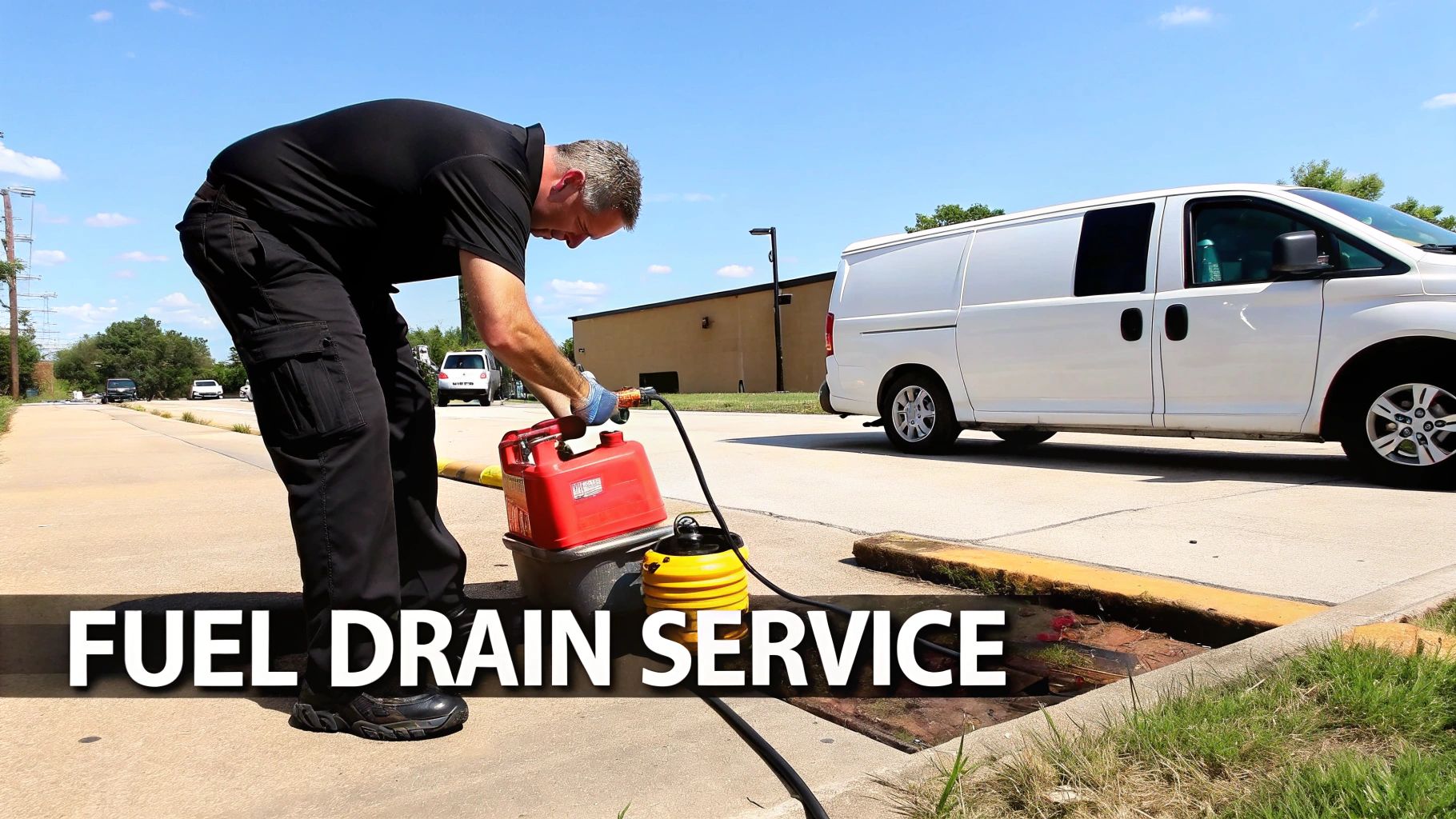
First things first, the technician needs to safely access and empty your fuel tank. They won't be using a bit of garden hose; this is a job for specialised, explosion-proof pumps. This equipment is designed to extract every bit of the contaminated fuel safely and completely.
It's All About the System Flush
Once the tank is bone dry, the most important part of the job begins: flushing the entire fuel system. Just emptying the tank isn't good enough. Even a small amount of petrol in a diesel car can leave a nasty residue coating the fuel lines, pump, and filter housing. This is where a professional's experience really shines.
The technician will push fresh, clean diesel through the whole system. This is the crucial step that purges any lingering petrol. It effectively washes away petrol's solvent-like residue and brings back the lubrication your high-pressure fuel pump and injectors need to survive. Skipping this flush is often why people run into expensive engine problems down the line, even after they thought the problem was fixed.
You're not alone in this, by the way. Misfuelling is a surprisingly common headache on UK roads. The AA reports between 50,000 and 60,000 incidents every year. Diesel cars are the usual victims, accounting for about 60% of cases—a trend we definitely see here in Suffolk with all the commercial vans and 4x4s around. For anyone interested in the future of diesel cars, there’s some good insight over at advanced-driving.co.uk.
Safe and Legal Disposal
Finally, with the system clean, what happens to the bad fuel? It's carefully transferred into a secure, purpose-built container inside the technician's van. We are legally required to handle and dispose of this hazardous waste correctly and in an environmentally friendly way. This means you don't have to worry about the legal or environmental fallout. To understand the rules better, have a look at our guide on how to drain a petrol tank safely and legally in the UK.
From the moment the technician arrives to you driving away, the whole process is usually done and dusted in under an hour. They’ll add a bit of fresh diesel to get you going, make sure the engine starts and runs smoothly, and then you're clear to head off. It’s a straightforward service designed to turn a potential disaster into a minor inconvenience.
Your Misfuelling Questions Answered
When you realise you’ve put the wrong fuel in your car, your mind starts racing. It’s a stressful moment, and a hundred questions pop up at once. We get calls about this every single day, so let's walk through the most common concerns to clear things up.
How Much Petrol in a Diesel Tank Is Too Much?
This is always the first question, and the blunt answer is that any amount is too much. Modern common rail diesel engines are precision-engineered and rely on the oily, lubricating properties of diesel fuel. Even a small splash of petrol acts like a solvent, stripping that essential lubrication away.
To put it in perspective, as little as 1 litre of petrol in a 50-litre tank (that’s just a 2% mix) is enough to cause problems. Once you hit a 5% contamination ratio, you're entering a real danger zone where serious damage to the high-pressure fuel pump and injectors is a very real possibility if you run the engine. The golden rule is simple: if you know you’ve misfuelled, don’t take a chance. Treat it seriously and get the tank drained.
Will My Insurance Pay for a Fuel Drain?
This is a bit of a lottery, and you’ll need to dig into the small print of your policy. Some fully comprehensive plans do offer "misfuelling cover," but many insurers see it as avoidable driver error and won't cover the cost at all.
Before you even think about calling your insurer, consider a couple of things:
Your Policy Excess: A professional fuel drain often costs less than the excess on your policy. If your excess is £250 and the drain is £200, you'll be paying the full amount yourself anyway.
Your No-Claims Bonus: Making a claim, even a small one, will almost certainly wipe out or reduce your no-claims bonus. This could mean paying higher premiums for the next few years, making it a very expensive fix in the long run.
Honestly, for most drivers, paying a specialist directly is quicker, cheaper, and saves a lot of hassle.
A common pitfall is assuming breakdown cover includes a free fuel drain. While your provider will send a patrol to tow you, the actual service of draining the fuel is nearly always an extra charge on top of your membership.
Can I Just Top It Up with Diesel to Dilute It?
I hear this one a lot. It's a tempting thought – just drown the petrol with a full tank of diesel and hope for the best. Unfortunately, this is one of the worst things you can do.
Petrol and diesel don't separate like oil and water; they mix together perfectly. Topping up the tank just creates a larger volume of contaminated, low-lubricity fuel. You haven't solved the problem, you've just made it bigger. Now, instead of draining 5 litres of bad fuel, a technician has to drain 50. It won't save your engine, and it will likely increase the time and cost of the repair.
If you've put even a small amount of petrol in a diesel car in Suffolk or the surrounding areas, don't risk it. Contact the experts at Misfuelled Car Fixer for a fast, professional, and affordable 24/7 mobile fuel drain service. Get immediate help by visiting Misfuelled Car Fixer Suffolk.