
.jpg)


Putting diesel into a petrol car: Quick Actions to Prevent Engine Damage
Updated: Feb 3
24/7 Hotline Nationwide: 0330 122 6640
National Wrong Fuel Rescue: https://www.misfuelledcarfixer.co.uk
If you found this page, we cover you in England!
It’s a surprisingly common mistake. That sinking feeling hits you the moment you realise you’re holding a diesel nozzle and standing next to your petrol car. Your first instinct might be panic, but the most important thing you can do right now is… nothing.
Do not start the engine. Seriously. This single decision is your best defence against turning a simple, fixable problem into a catastrophic and eye-wateringly expensive engine repair.
That Sinking Feeling: What to Do Immediately
Okay, you've realised the mistake at the pump. Take a deep breath. A calm and measured response is what's needed to keep the situation under control. The absolute priority is to stop that diesel from circulating through your car's fuel system and into the engine.
Even just turning the key to the 'on' position to listen to the radio can be enough to prime the fuel pump. That little whirring sound? That’s the pump starting to pull the contaminated fuel from the tank, and you definitely don't want that.
It happens more than you think. Imagine pulling into a busy petrol station in Ipswich after a long day, your mind elsewhere, and grabbing the wrong pump. You wouldn't be the first, and you certainly won't be the last. This exact scenario plays out for around 150,000 drivers across the UK every year. In fact, a staggering 29% of UK motorists have admitted to misfuelling their car at least once.
If you were to start the engine, the repair bill could easily shoot past £1,000 for a specialist fuel drain and engine flush. You can dig into more of these statistics on misfuelling in this detailed report from GB News.
To keep things simple, just follow these three golden rules.
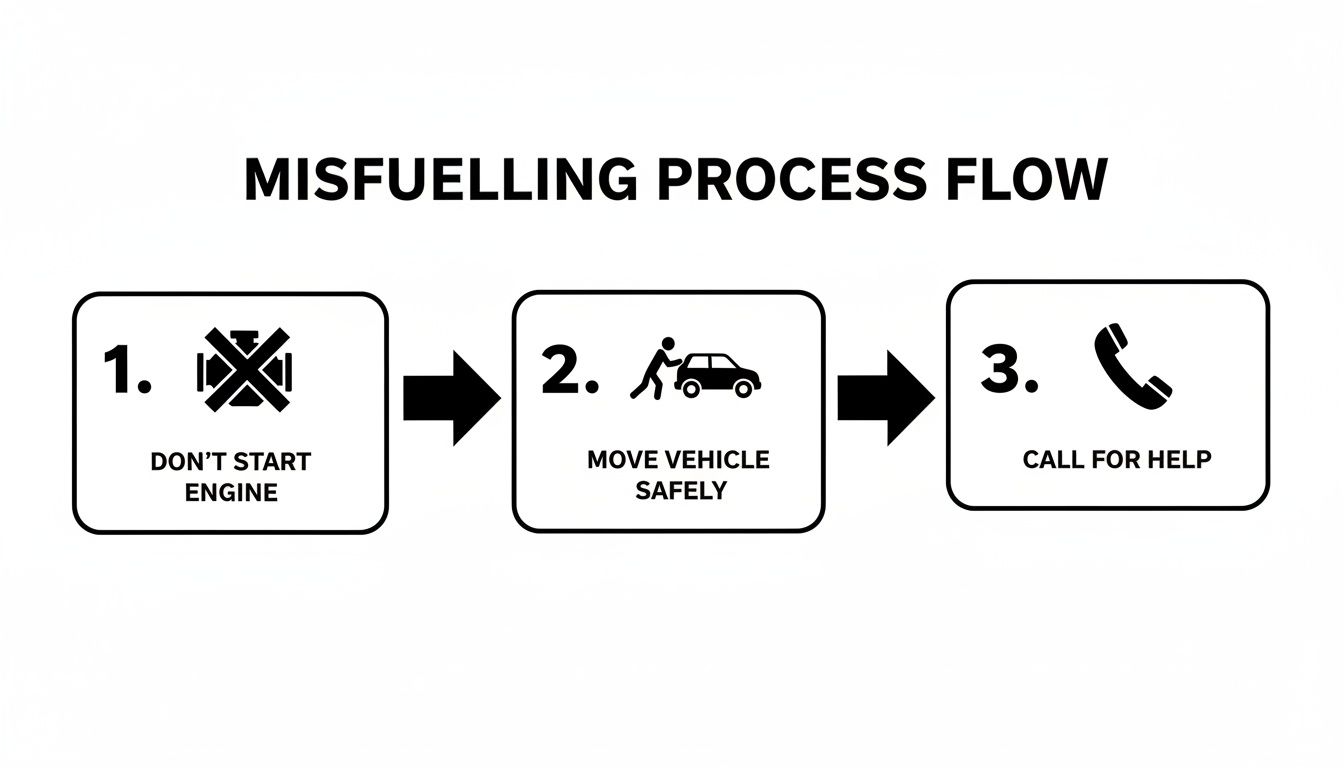
This guide nails it: keep the engine off, get the car to a safe spot, and call in the professionals. That's how you manage this situation effectively and without breaking the bank.
Your Immediate Action Plan
Once you've had that "oh no" moment, follow these clear steps to contain the problem right away.
To help you remember what to do (and what not to do), here's a quick reference table.
Immediate Actions After Putting Diesel in a Petrol Car
Action | Why It's Important |
|---|---|
DO NOT turn the key | This is the golden rule. Turning the key, even without starting the engine, can activate the fuel pump and start circulating the diesel. |
DO put the car in neutral | This will allow you to move the vehicle without needing to start the engine. |
DO tell the petrol station staff | They can close off the pump, help you push the car, and ensure everyone's safety. They've seen it all before. |
DO push the car to a safe place | Move it to a designated parking bay, away from the active pumps, to clear the way for other drivers. |
DON'T try to fix it yourself | Siphoning fuel is dangerous and often illegal. It requires specialist equipment to be done safely and completely. |
DON'T panic and drive away | Even a short distance can cause irreversible damage to your engine components. |
By following these simple steps, you keep the problem contained and manageable.
The golden rule is simple: the wrong fuel in your tank is a manageable problem. The wrong fuel in your engine is a disaster. Keeping the diesel contained within the tank is the difference between a quick fix and a hefty repair bill.
But what if you only put a little bit in? Don't be tempted to chance it. Even a small amount of diesel can cause issues, and it's never worth the risk to your engine. For more specific advice on this, check out our guide on what to do if you put a small amount of diesel in a petrol car.
Your next and final step is to call a mobile fuel drain specialist. We can come directly to you and get the problem sorted on-site, right there at the petrol station.
What Happens When You Put Diesel in a Petrol Car?
It’s a surprisingly easy mistake to make, but why is putting diesel in a petrol car so serious? It all boils down to how fundamentally different the two fuels are. Petrol is thin and evaporates easily, designed to be ignited by a spark. Diesel is the opposite – it’s a thick, oily substance that combusts under pressure, not with a spark plug.
Pouring this heavy oil into a system built for a fine, volatile mist of petrol is like trying to force treacle through a garden hose. It just won't work, and if you turn the key, the problems start almost immediately.
A Chain Reaction of Damage
The first part of your engine to feel the pain is usually the fuel filter. It’s designed to catch tiny impurities, but the thick consistency of diesel will clog it up in no time, starving the engine of fuel. This is often what causes the car to splutter and die.
If the diesel manages to push past the clogged filter, things get progressively worse and more expensive.
Coated Spark Plugs: Petrol engines need a clean spark to ignite the fuel. Diesel won't combust properly and instead leaves a greasy, black residue all over the spark plugs, making it impossible for them to create a spark.
Clogged Fuel Injectors: Your car's fuel injectors have incredibly fine nozzles designed to spray a perfect, atomised cone of petrol. Diesel is far too thick and will clog them, leading to misfires and rough running.
Failing Sensors: Modern cars are packed with sensors, like the oxygen (O2) sensor, that constantly monitor the exhaust to ensure the engine is running efficiently. Unburnt diesel will coat these sensors, sending faulty readings to the car’s computer and throwing the whole system out of whack.
Imagine this common scenario: a driver misfuels their car at a petrol station in Felixstowe. If they realise before starting the engine, it's a straightforward fuel drain. But if they drive away, that first splutter could be the start of a cascade failure—clogged filter, a seized fuel pump, fouled spark plugs—turning a simple fix into a repair bill that can easily exceed £1,000.
It's a mistake that happens more often than you'd think. In fact, studies show that over 29% of UK drivers have done it at some point. You can read more about the widespread impact of misfuelling from this MotorTradeNews report.
The damage isn’t a single event; it's a domino effect. To understand what to look out for, have a look at our guide to identify the symptoms of diesel in a petrol car.
What Our Professional Fuel Drain Service Will Do
The absolute best and fastest way to fix a misfuelling mistake is to call a mobile fuel drain specialist. Forget about the cost and hassle of getting your car towed to a garage. A trained technician comes right to you, whether you're stuck on the forecourt in Bury St Edmunds or pulled over on the side of a country lane.
So, what exactly happens during this roadside rescue?
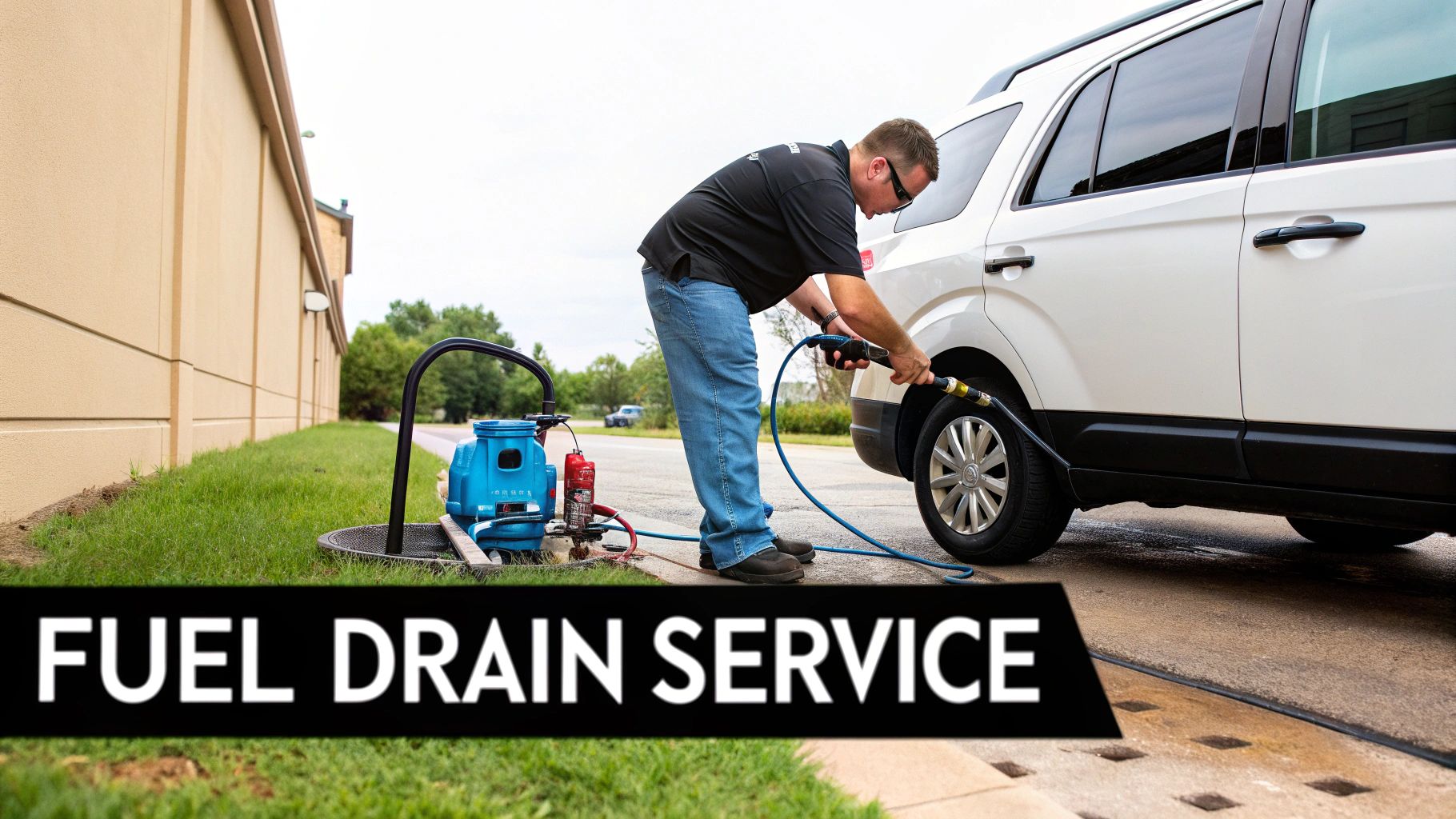
First things first, we need to get every drop of that contaminated fuel out of your tank. Our technicians use specialised, ADR-approved pumping equipment to do this safely, with no risk of sparks or spills. This is a serious bit of kit, not just a simple hose. We have to follow strict environmental and safety rules for handling hazardous waste, so the entire process is meticulously controlled.
Thoroughly Flushing the Fuel System
Getting the tank empty is only half the battle. The real problem is the oily diesel residue that’s now coating your car’s fuel lines, filter, and even the injectors.
To handle this, we flush the entire system with a small amount of clean, correct petrol. This is a crucial step. It dissolves and pushes out that greasy film, making sure no lingering contamination is left to cause mischief later on.
A professional fuel drain isn't just about emptying the tank. It's a methodical cleansing of the whole fuel system. This flushing process is what protects your engine from delayed damage that can pop up weeks later if any diesel is left behind.
Once the system is spotless, we'll put in a fresh supply of the correct petrol – usually around 5 to 10 litres. That’s just enough to get you safely on your way to the nearest petrol station to fill up properly.
Before we leave, we'll start your car and let it run for a few minutes. We're checking that the engine is running smoothly and that any dashboard warning lights have cleared. This final check is our confirmation that the problem is completely solved, right there on the spot.
If you ever find yourself in this tricky situation, knowing who to call makes all the difference. To get back on the road with total peace of mind, find out more about our wrong fuel in car service near you.
The Realities of Cost, Time, and Insurance
Once the initial panic of putting diesel in your petrol car subsides, two questions always pop up: "How much is this going to cost me?" and "How long will I be stuck here?" The good news is, if you haven't started the engine, the answers are probably a lot better than you're imagining.
Why a Mobile Fuel Drain is Your Best Bet
Calling out a mobile fuel drain service is, nine times out of ten, the most sensible and cost-effective route to take. You’re looking at a cost of roughly £150 to over £300 for a roadside specialist to come out and sort the problem on the spot.
That might seem like a lot for a simple mistake, but let’s put it in perspective. The alternative involves a tow truck, which costs money, followed by a trip to a garage. There, you'll be paying their labour rates on top of the fuel drain service. It's not uncommon for that total bill to soar past double the cost of a mobile call-out.
Time is the other major factor. A mobile service is incredibly efficient. From the moment you make the call to the technician driving away, the whole affair is usually wrapped up in about 60 to 90 minutes. You're back on your way with minimal fuss.
Will My Insurance Cover This?
It’s a fair question, but unfortunately, the answer is almost always no. Most standard car insurance policies won't cover misfuelling. It’s generally seen as driver error, something that falls under the policy's exclusions.
Don't assume you're covered. While some high-end policies might have misfuelling as an add-on, it's very rare. Checking your policy is wise, but waiting for an insurance decision could leave you stranded and ultimately still facing the full bill.
If you've started the engine and caused serious damage, the situation can escalate. In a worst-case scenario where the engine is ruined, you might be looking at a write-off. Knowing the ins and outs of handling car insurance for a totaled car becomes crucial at that point to ensure you're treated fairly.
Let's break down the two main choices with a simple comparison.
Cost and Time Comparison Misfuelling Solutions
The numbers really speak for themselves when you see them side-by-side.
Solution | Estimated Cost | Estimated Time Off Road |
|---|---|---|
Mobile Fuel Drain | £150 - £300+ | 60-90 Minutes |
Garage/Dealership (with tow) | £400 - £800+ | 1-2 Days |
As you can see, opting for a mobile service isn't just a little cheaper; it's a completely different scale of cost and inconvenience. It's the difference between a minor hiccup in your day and a major, multi-day problem.
A Few Simple Habits to Avoid Misfuelling
Let's be honest, misfuelling can happen to the best of us. A moment's distraction is all it takes. But the good news is, a few simple habits can all but guarantee it never happens to you. Prevention, as they say, is always better than the cure.
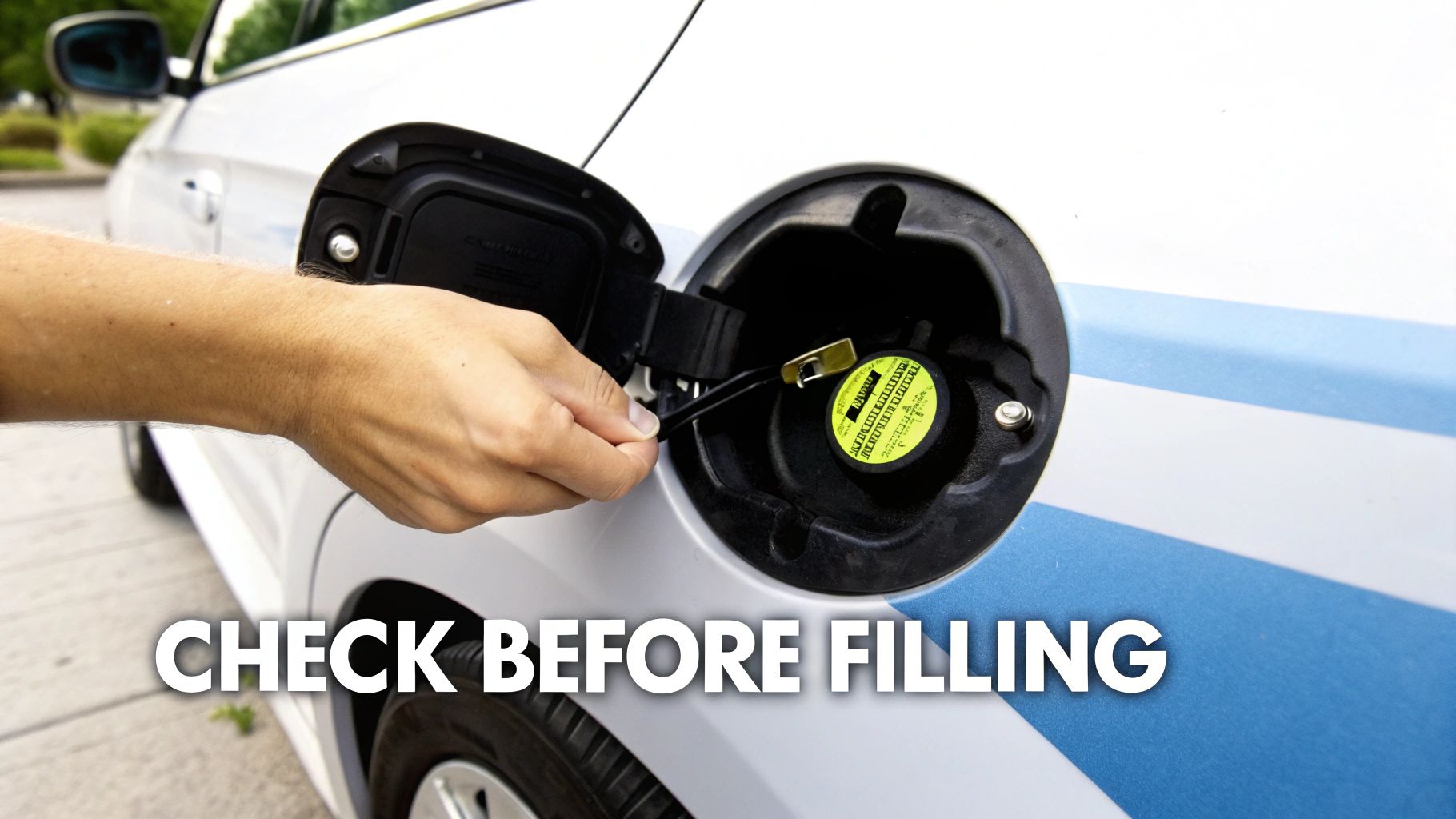
The number one culprit? Distraction. You’re on the phone, thinking about your next meeting, or just in a massive rush. Before you know it, you've grabbed the wrong nozzle. The single best thing you can do is make a conscious effort to focus for the 30 seconds it takes to choose the pump and start fuelling.
Get into the habit of a quick double-check before the nozzle even goes near your car. First, check the colour of the pump handle – typically black for diesel and green for petrol. Then, double-check the label on the pump itself. Finally, glance at the sticker inside your car's fuel flap. This simple three-second routine is your best line of defence.
A moment of mindfulness at the pump can save you hours of hassle and a hefty bill. It's a trade-off well worth making.
Creating Your Own Reminders
If you’re constantly swapping vehicles – maybe you drive a petrol car at the weekend but a diesel van for work – then visual cues are an absolute lifesaver.
Here are a couple of practical tips I've seen work time and again:
Fuel Flap Stickers: Stick a brightly coloured "PETROL ONLY" or "DIESEL" sticker right inside the fuel flap. It's impossible to miss when you go to fill up.
Keyring Cues: Use a different coloured keyring for each set of keys. This acts as a physical, tactile reminder before you even get out of the vehicle.
For anyone managing a fleet of vehicles, this is even more critical. Protecting your assets and preventing vehicle downtime is paramount. Insist on clear, large-print fuel labels next to every filler cap. Making this a mandatory part of the driver's daily pre-journey inspection can save your business thousands in repair costs and lost work hours.
Answering Your Questions About Putting Diesel in a Petrol Car
That sinking feeling at the pump is often followed by a flood of questions. What have I just done? How bad is it? We get these calls all the time, so let's walk through the most common concerns and get you some straight answers from the experts.
How Much Diesel in a Petrol Car Is Too Much?
Honestly, any amount is a problem. You might be surprised to learn that as little as 5% diesel mixed in with your petrol is enough to stop the engine from starting or, if it does, cause it to run terribly.
Diesel is an oil, and it simply won't combust properly in a petrol engine. It clogs everything from the fuel filter to the injectors. The only real solution is to get it all out, no matter if you put in a splash or a full tank.
Will My Insurance Cover This Mistake?
It’s a fair question, but unfortunately, the answer is almost always no. Most standard UK car insurance policies see misfuelling as driver error, so it's not typically covered.
Some top-tier comprehensive plans might have it as an optional extra, but you’d have to check your policy documents to be sure. In nearly every case, calling a specialist mobile fuel drain service is the fastest and most cost-effective way to get back on the road.
I've heard a few dangerous myths over the years, but the worst is the idea you can just "top up" the tank with petrol to dilute the diesel. This is a terrible idea. Diesel is heavier than petrol and won't mix properly, so you're just guaranteeing that oily, damaging substance gets pumped through your engine.
Is This Worse Than Putting Petrol in a Diesel Car?
Both are bad news, but putting diesel in a petrol car is often the lesser of two evils—if you haven't started the engine. The diesel will clog the system, but it's less likely to cause the immediate, catastrophic failure you see with the opposite mistake.
Putting petrol into a modern diesel engine, on the other hand, is a recipe for disaster. Petrol acts like a solvent, stripping away the essential lubrication from the high-pressure fuel pump and injectors. This causes metal parts to grind against each other, quickly destroying the entire fuel system and leading to a repair bill that can run into the thousands.
If you're stuck on a forecourt in Suffolk with the wrong fuel in your tank, don't take a chance on starting the car. The team at Misfuelled Car Fixer provides a fast, 24/7 mobile service to drain the fuel and get you moving again. For immediate expert help, visit our Misfuelled Car Fixer Suffolk website.


