



Petrol in a diesel car small amount: What to Do and How to Avoid Damage
- Misfuelled Car Fixer
- Feb 1
- 12 min read
Updated: Feb 4
24/7 Hotline Nationwide: 0330 122 6640
National Wrong Fuel Rescue: https://www.misfuelledcarfixer.co.uk
If you found this page, we cover you in England!
It’s a mistake anyone can make, but putting even a small amount of petrol in a diesel car is a situation that needs handling with care, and fast. Get it right, and it can be a relatively straightforward fix. Get it wrong, and you could be looking at a repair bill stretching into four figures. The golden rule? If you realise what you've done at the pump, do not start the engine.
Petrol In a Diesel Car Small Amount

It’s a moment of pure, gut-wrenching panic. You're standing on the forecourt, maybe at a busy station in Ipswich or Felixstowe, you hang up the nozzle, and then you spot it—the green handle of the unleaded pump in your hand. Your heart plummets. Before you let the panic set in, take a breath. This is a far more common slip-up than you might think.
If you've found yourself in this exact spot, you're in good company. A 2023 survey revealed that an astonishing 29% of UK motorists have put the wrong fuel in their car at least once. It seems to be a rite of passage for newer drivers, with 54% of those aged 18-24 admitting they've done it. You can see more on these statistics in the full report on misfuelling trends.
Why Petrol Is Poison for a Diesel Engine
To really grasp the urgency, you need to understand that diesel isn’t just fuel; it’s also a lubricant. It has an oily quality that’s absolutely essential for keeping the high-pressure components of your engine, like the fuel pump and injectors, running smoothly.
Petrol does the exact opposite. It's a solvent. Think of it like a cleaner that strips away grease and oil. When it gets into a diesel system, it begins to wreak havoc almost immediately:
It strips away lubrication: Petrol dissolves the vital oily film that protects critical engine parts.
It causes friction: Without that protective layer, sensitive metal components start grinding against each other.
It leads to rapid damage: This friction can quickly cause catastrophic wear and tear, potentially destroying your fuel pump and injectors from the inside out.
Even a small quantity of petrol can compromise the integrity of the entire fuel system. This is precisely why your immediate actions—or rather, your inaction—are so important. Turning the ignition key is the single worst thing you can do, as it primes the fuel pump and starts circulating that destructive petrol-diesel cocktail through your engine's veins.
Why Even a Little Petrol Can Wreck a Diesel Engine
To get your head around why a splash of petrol in a diesel car is such a big deal, you need to see diesel for what it really is. It’s not just fuel; it's also a vital lubricant. Its thick, oily nature keeps the incredibly complex, high-pressure parts of your engine running smoothly and safely.
Petrol is the polar opposite. It’s a solvent. Think of it like a cleaner designed to cut through grease and evaporate in a flash. It has none of the lubricating qualities your diesel engine desperately needs to survive. The moment petrol hits your diesel tank, it starts dissolving that essential oily film.
The Lubrication Problem in a Nutshell
Putting petrol in a diesel engine is a bit like swapping your engine oil for sandpaper. You’re introducing massive, destructive friction where there shouldn't be any.
Modern diesel fuel systems, particularly the high-pressure pump and injectors, are miracles of engineering, operating under huge pressures with razor-thin tolerances. They’re built to be constantly coated in that protective layer of diesel fuel.
When petrol washes that protective film away, it's game over for lubrication. You get metal grinding directly on metal. This creates a huge amount of friction and heat, far more than these precision parts were ever designed to withstand.
This friction doesn't just cause wear and tear; it can cause the fuel pump to completely seize up. But the damage doesn't stop there. As the metal parts grind together, they shed tiny metallic particles, or swarf. You can get a deeper understanding of the crucial differences between petrol and diesel fuel in our guide.
How the Damage Spreads Like Wildfire
Once that swarf is created, the contaminated fuel mix acts as a delivery system, pumping it through every part of your fuel system. It gets sent down the fuel lines, chokes the filter, and—worst of all—shreds your injectors.
The chain reaction of potential damage is terrifying:
Fuel Pump Failure: The intense wear can destroy the pump from the inside out. This isn't a cheap fix; you're often looking at a bill running into thousands of pounds.
Injector Damage: The swarf can easily block or ruin the delicate nozzles on your fuel injectors, causing the engine to run rough, misfire, and eventually require a full set of expensive replacements.
System-Wide Contamination: These tiny metal flakes get everywhere—the tank, the lines, the filter. The only way to fix it is a complete, time-consuming, and costly system flush.
This is exactly why the single most important thing you can do after misfuelling is to not turn the key. Keeping the engine off prevents the fuel pump from starting its destructive work of circulating that damaging petrol-diesel cocktail.
Recognizing the Warning Signs of Misfuelling
It’s an easy mistake to make. Maybe you drove away from the forecourt completely unaware, or perhaps a nagging doubt is only just starting to creep in. If that contaminated fuel has started to work its way through the system, your car will almost certainly start sending out distress signals.
Knowing what to look for is the key to catching the problem early and stopping any serious damage in its tracks.
The signs can be subtle at first, but they quickly become more obvious depending on how much petrol is mixed in with the diesel. One of the very first clues is often a struggle to get the engine started. It might crank for longer than usual, or just refuse to fire up altogether. This happens because petrol messes with the diesel's combustion quality, making it much harder to ignite under compression.
Common Symptoms You Might Experience
If you did manage to get the car started and are on the road, the problems will soon become impossible to ignore. The engine's performance will take a nosedive, usually with a handful of tell-tale signs that something is very wrong with the fuel.
Here are the most common red flags that you've put a bit of petrol in your diesel tank:
Excessive White Smoke: Look in your rearview mirror. Seeing clouds of white smoke billowing from the exhaust is a classic sign. This is unburnt fuel turning to vapour in the hot exhaust, a direct result of petrol's inability to burn correctly in a diesel engine.
A Knocking Sound: This is a serious one. If you hear a loud, metallic rattling or 'knocking' noise coming from under the bonnet, it’s a major warning. In a diesel engine, fuel is supposed to ignite under pressure. Petrol, however, can ignite erratically and violently, causing this dangerous sound.
Loss of Power: Does the car feel sluggish and weak when you put your foot down? This lack of oomph happens because the engine isn't getting the right fuel to generate power. You might notice jerky acceleration or a general feeling that the car is struggling.
Engine Misfiring or Running Erratically: The engine might stutter, idle roughly, or even cut out entirely, especially when you're stopped at a junction. This points to unstable combustion as the engine desperately tries to run on the wrong fuel mix.
Illuminated Warning Lights: Your dashboard is designed to warn you. Expect the check engine light or another engine management symbol to light up. The car’s onboard computer has detected that something is critically wrong with how the engine is running.
Every one of these symptoms boils down to two fundamental issues: a lack of lubrication and incorrect combustion. Petrol acts like a solvent, washing away the vital oily film that protects your fuel pump and injectors. At the same time, it ignites at the wrong time, disrupting the finely-tuned cycle a diesel engine depends on. You can learn more about the specific symptoms of petrol in a diesel car in our detailed article. If you notice any of these signs, find a safe place to pull over and switch the engine off immediately.
Your Immediate Action Plan After Misfuelling
That sinking feeling when you realise you’ve grabbed the wrong nozzle is a common one, but what you do next is what truly matters. Reacting calmly and correctly can mean the difference between a simple inconvenience and a wallet-busting repair bill. Think of this as your practical, no-nonsense guide to getting things sorted.
The golden rule, the one thing you must remember above all else, is do not start the engine. Seriously. Don’t even be tempted to turn the key to the 'on' position to check the radio. The moment you do, the fuel pump can kick in, sending that damaging petrol-diesel mix circulating through your engine’s delicate fuel system.
Essential First Steps
With the engine off, you've already dodged the biggest bullet. Now, let's secure the scene and figure out your next move.
Tell the Petrol Station Staff: Give the staff on the forecourt a heads-up. They've seen this happen countless times and can help cone off the pump to keep the area safe for everyone.
Get to a Safe Spot: Pop the car into neutral and ask for a hand to push it to a safe parking bay, well away from the pumps. Whatever you do, don’t start the engine just to move it a few feet.
Gauge the Situation: Try to work out how much petrol you’ve put in. Grab your car’s handbook to find its total fuel tank capacity. This little bit of maths helps you understand the severity. For instance, if you've added 5 litres of petrol to a nearly empty 50-litre tank, you're looking at a very risky 10% contamination.
The chart below gives you a clear visual of just how different the outcomes can be depending on whether that key was turned.
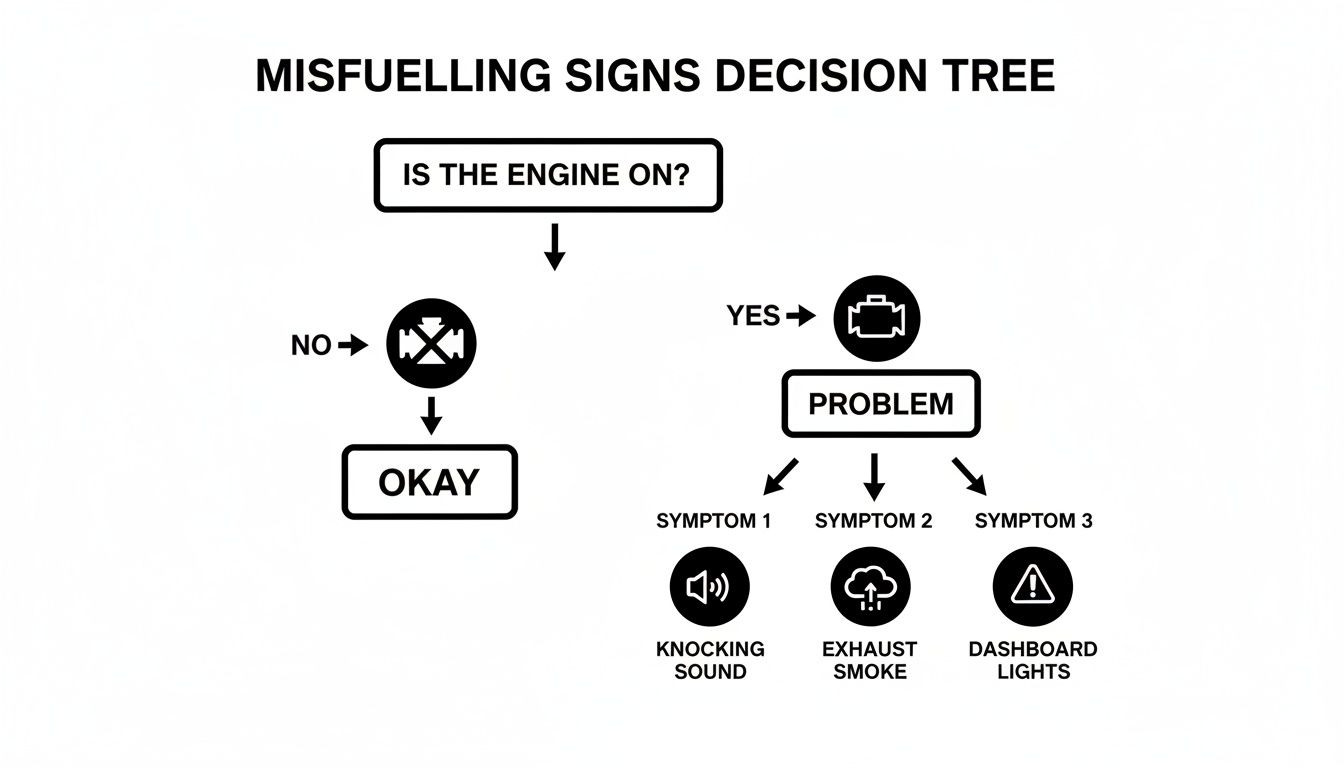
As you can see, leaving the engine off keeps you on the safe path. Starting it, however, opens the door to a whole host of nasty symptoms that signal real trouble.
Understanding Contamination Level and Potential Risk
This table gives you a rough idea of the risk level based on how much petrol has been mixed in with your diesel. It’s a quick way to assess just how serious the situation might be.
Contamination Level (Petrol in Diesel) | Risk if Engine is NOT Started | Risk if Engine IS Started |
|---|---|---|
Up to 5% (e.g., 2.5 litres in a 50L tank) | Low. A full system drain is essential to prevent long-term wear. | High. Immediate risk of damage to the fuel pump and injectors. |
5% to 10% (e.g., 5 litres in a 50L tank) | Low to Moderate. Damage is unlikely, but a professional drain is non-negotiable. | Very High. Severe damage is almost certain. Expect engine failure. |
Over 10% (e.g., more than 5 litres in a 50L tank) | Moderate. The fuel is now highly corrosive. A full drain and flush are critical. | Extreme. Catastrophic failure of the entire fuel system is imminent. |
No matter the percentage, the safest course of action is always a professional fuel drain. Don't take a chance by trying to "dilute" the mix with more diesel.
Calling for Professional Help
Now for the most important step: getting an expert on the line. You might think of your breakdown provider or main dealer first, but a dedicated mobile wrong fuel drain service is, without a doubt, your best bet.
A mobile fuel drain service is a specialist team equipped for this exact emergency. They come to you, wherever you are, drain the contaminated fuel, flush the system, and have you safely on your way—often in less than an hour.
This is a far quicker and more cost-effective solution. Main dealers will almost always insist on towing your car to their workshop, which adds a lot of time and money to the bill before they even lift a spanner. By calling a service like Misfuelled Car Fixer, you're choosing the fastest, safest, and most economical fix right there on the spot.
How a Professional Fuel Drain Saves Your Engine
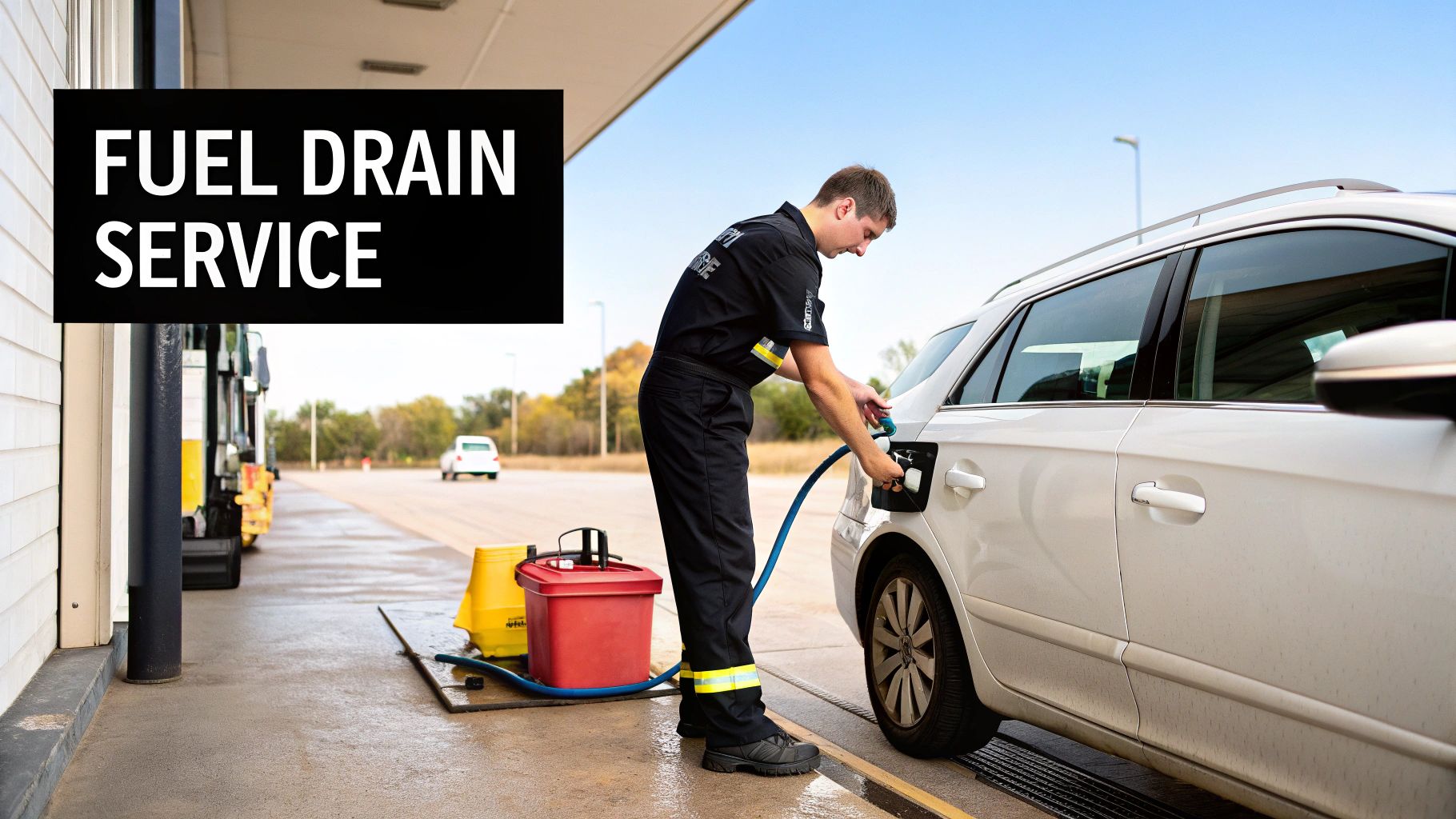
That sinking feeling you get when you realise you’ve put petrol in your diesel car is horrible, but the fix is actually quite simple and incredibly effective—as long as you call in the professionals. Getting a mobile wrong fuel drain service like us at Misfuelled Car Fixer is, without a doubt, the fastest and safest way to get back on the road and avoid thousands in damage.
Forget the hassle of a garage visit. A specialised mobile unit comes directly to you, whether you're stranded at a petrol station in Bury St Edmunds or parked up at home in Lowestoft. The whole service is built around getting you sorted with minimal fuss.
What to Expect During the Fuel Drain Process
The procedure is thorough, safe, and usually much quicker than people think. Our technicians follow a precise, step-by-step process to make sure every last drop of contaminated fuel is removed from your car's system, giving it a clean slate.
Here’s a breakdown of what a typical fuel drain looks like:
Safe Draining of the Fuel Tank: First things first, the technician uses certified, explosion-proof pumping equipment to safely drain the entire mixture of petrol and diesel from your tank. This isn't just poured away; it's transferred into a secure container for environmentally compliant disposal.
Flushing the Fuel System: Emptying the tank is only half the battle. Next, the technician flushes the fuel lines, filter housing, and pump with fresh, clean diesel. This is a vital step to get rid of any stray petrol residue that could still cause problems with lubrication.
Refuelling and System Priming: With the system now clean, a small amount of the correct diesel is added to the tank. The system is then primed, which means we make sure the new, clean fuel is flowing properly right through to the engine before we even think about turning the key.
Engine Start and Diagnostics: Finally, the moment of truth. The technician will start your car and let it run for a few minutes. While it's running, they’ll carry out diagnostic checks to ensure the engine is happy and there are no warning lights on the dashboard.
The entire process from arrival to departure is usually done and dusted in under an hour. It means a situation that feels like a complete catastrophe can be sorted out quickly, getting you on your way without needing a tow truck or a long wait at a garage.
The Key Benefits of a Mobile Service
Opting for a professional mobile service is more than just convenient; it's a savvy financial move. It is the definitive way to handle putting petrol in a diesel car, even if it's just a small amount. You can learn more about what to do in our emergency guide for a fuel drain near you.
The advantages really speak for themselves:
Prevents Costly Repairs: A fuel drain stops the kind of catastrophic engine damage that can lead to repair bills hitting well over £5,000.
Cost-Effective: It's far cheaper than going to a main dealer, where you’ll often face towing fees and much higher labour charges.
Environmentally Compliant: We handle and dispose of all contaminated fuel according to strict environmental laws.
Fast and Convenient: We come to you, saving you the time and stress of arranging for your car to be recovered.
Your Misfuelling Questions Answered
That sinking feeling you get when you realise you’ve put the wrong fuel in your car is usually followed by a wave of questions. What now? How bad is it? Let's clear up some of the most common worries right away.
I Only Put a Little Bit In – Is Less Than 5% Petrol a Problem?
Yes, unfortunately, it is. Even a small splash of petrol in a diesel tank can cause serious headaches down the line. Think of it this way: diesel fuel is oily and acts as a lubricant for critical parts of your engine, like the high-pressure fuel pump. Petrol, on the other hand, is a solvent – it strips that lubrication away.
So, while a contamination of less than 5% might not cause your engine to grind to a halt instantly (especially if you haven't started it), it immediately starts to wear down those finely-tuned components. The only truly safe move is to get the tank drained, no matter how little petrol you think went in.
If there's one thing to remember, it's this: no amount of petrol is genuinely 'safe' for a modern diesel engine. The potential cost of replacing a fuel pump far outweighs the cost of a professional fuel drain.
Will My Car Insurance Cover This?
It's a real mixed bag, so don't count on it. Many standard insurance policies see misfuelling as an avoidable mistake and explicitly exclude it from their cover. You might find some comprehensive policies that do include it, but you'll need to read the fine print.
Before you even think about making a claim, consider this: calling a specialist fuel drain service is almost always cheaper than your insurance excess. Plus, it means you won’t have to make a claim, protecting your precious no-claims discount and saving you money for years to come.
I’ve Already Driven It a Short Way – Is the Damage Done?
Not necessarily, but you need to act fast. The very second you realise what’s happened, find a safe place to pull over and switch off the engine. The absolute golden rule is do not turn it back on.
Every moment the engine runs, that contaminated fuel is being forced through the entire system, increasing the risk of expensive damage. Call an emergency fuel drain service immediately and tell them you've driven the car. They'll know to perform a more thorough system flush. Quick thinking here gives you the best chance of dodging a massive repair bill.
If you've put a small amount of petrol in your diesel car, stay calm and, most importantly, don't turn the key. For fast, 24/7 help across Suffolk and the surrounding areas, give the team at Misfuelled Car Fixer a call. We’ll get you sorted and safely back on your journey. https://www.misfuelledcarfixer-suffolk.co.uk