
.jpg)


What is the Diesel Exhaust Fluid? A Clear Guide for UK Drivers
If you drive a modern diesel car, you've almost certainly come across AdBlue. It's a non-toxic, colourless liquid that's become essential for just about every diesel vehicle on the road today.
But what exactly is it? It's crucial to understand that AdBlue is not a fuel additive. You don't mix it with your diesel. Instead, it's a separate fluid that works within your exhaust system, acting as a clever cleaning agent to help your car meet strict environmental laws.
So, What's in AdBlue?
At its heart, AdBlue is a surprisingly simple mixture: 32.5% high-purity urea and 67.5% deionized water. That precise ratio is the magic ingredient for a process called Selective Catalytic Reduction, or SCR for short. This technology is standard in almost every diesel vehicle made since 2014.
Think of your car's SCR system like a sophisticated filter. As your diesel engine runs, it produces harmful pollutants called nitrogen oxides (NOx), a major cause of air pollution and smog. The SCR system sprays a fine mist of AdBlue into the hot exhaust gases. This triggers a chemical reaction that transforms the nasty NOx into two completely harmless substances:
Nitrogen Gas: Which already makes up about 78% of the air we breathe.
Water Vapour: Just plain old H₂O.
That’s it. A simple, elegant solution to a serious pollution problem.
For a quick reference, here’s a breakdown of the key facts about AdBlue.
AdBlue at a Glance Key Facts
Characteristic | Description |
|---|---|
Composition | A precise mix of 32.5% high-purity urea and 67.5% deionized water. |
Function | Used in Selective Catalytic Reduction (SCR) systems to neutralise harmful nitrogen oxides (NOx). |
Appearance | A clear, non-toxic, and colourless liquid. |
Vehicle Type | Mandatory for nearly all diesel cars, vans, and lorries manufactured since September 2014 to meet Euro 6 emissions standards. |
Storage | Stored in a separate tank, usually with a blue-capped filler next to the main diesel filler. |
Performance Impact | Reduces harmful NOx emissions by up to 90%. Running out will cause the vehicle to enter a limited performance or 'limp' mode. |
Handling | Non-hazardous but can be corrosive to paintwork and certain metals. Always handle with care and wash off any spills immediately. |
Freezing Point | Freezes at -11°C. Vehicle tanks are equipped with heaters to thaw it, so this isn't an issue during normal operation. |
This table helps illustrate just how specific and vital this fluid is for your vehicle's health and legal compliance.
Why Is AdBlue So Important Now?
The widespread use of AdBlue isn't just a manufacturer's choice—it's the law. The introduction of the Euro 6 emissions standards back in September 2014 made SCR systems a legal requirement for every new diesel vehicle sold in the UK.
This change turned AdBlue from a niche product into an everyday essential for drivers, taxi operators, and fleet managers across Suffolk and the entire country. The technology has proven its worth, capable of slashing harmful nitrogen oxide emissions by up to an incredible 90%, making modern diesel engines far cleaner than their predecessors.
Simply put, AdBlue is the key that allows your modern diesel car to run efficiently while protecting the environment and staying on the right side of the law. Without it, your vehicle's performance will be severely restricted, and eventually, it won't even start.
While AdBlue is vital for cleaning up emissions, it's a world away from the fuel that powers your engine. If you're curious to learn more about fuels, our guide on the difference between diesel and petrol is a great place to start.
How AdBlue Cleans Your Car's Exhaust
Ever wondered what AdBlue actually does inside your car? It's not as complex as you might think. Imagine a clever little chemistry set built right into your exhaust system, working away to clean up the gases your engine produces.
When your diesel engine runs, it creates exhaust fumes packed with nasty pollutants, particularly nitrogen oxides (NOx). These are the compounds responsible for a lot of that hazy smog you see over cities and a key ingredient in acid rain. Before these gases can make it out of your tailpipe, your car’s computer system steps in, spraying a precisely measured mist of AdBlue into the hot exhaust stream.
The heat is the key. Temperatures in the exhaust can easily top 200°C, and this intense heat immediately causes the AdBlue to break down. The urea and water in the fluid transform into ammonia (NH₃) and a bit of carbon dioxide (CO₂). It's this ammonia that does all the heavy lifting.
The Role of the SCR Converter
Now that we have ammonia in the mix, the exhaust gases continue their journey into a special component called the Selective Catalytic Reduction (SCR) converter. This isn't just an empty box; it's a bit like a honeycomb, made of a ceramic material coated with precious metals that act as catalysts. These catalysts are like tiny matchmakers for molecules—they speed up chemical reactions without getting used up themselves.
Inside the SCR converter, the magic happens. The ammonia created from the AdBlue reacts directly with the harmful nitrogen oxides. This reaction completely neutralises the NOx, converting it into two things that are perfectly harmless:
Nitrogen (N₂): The same inert gas that makes up about 78% of the air we breathe every day.
Water Vapour (H₂O): Just plain old water, released as a clean, harmless vapour.
The process might sound complicated, but the composition of AdBlue itself is beautifully simple.
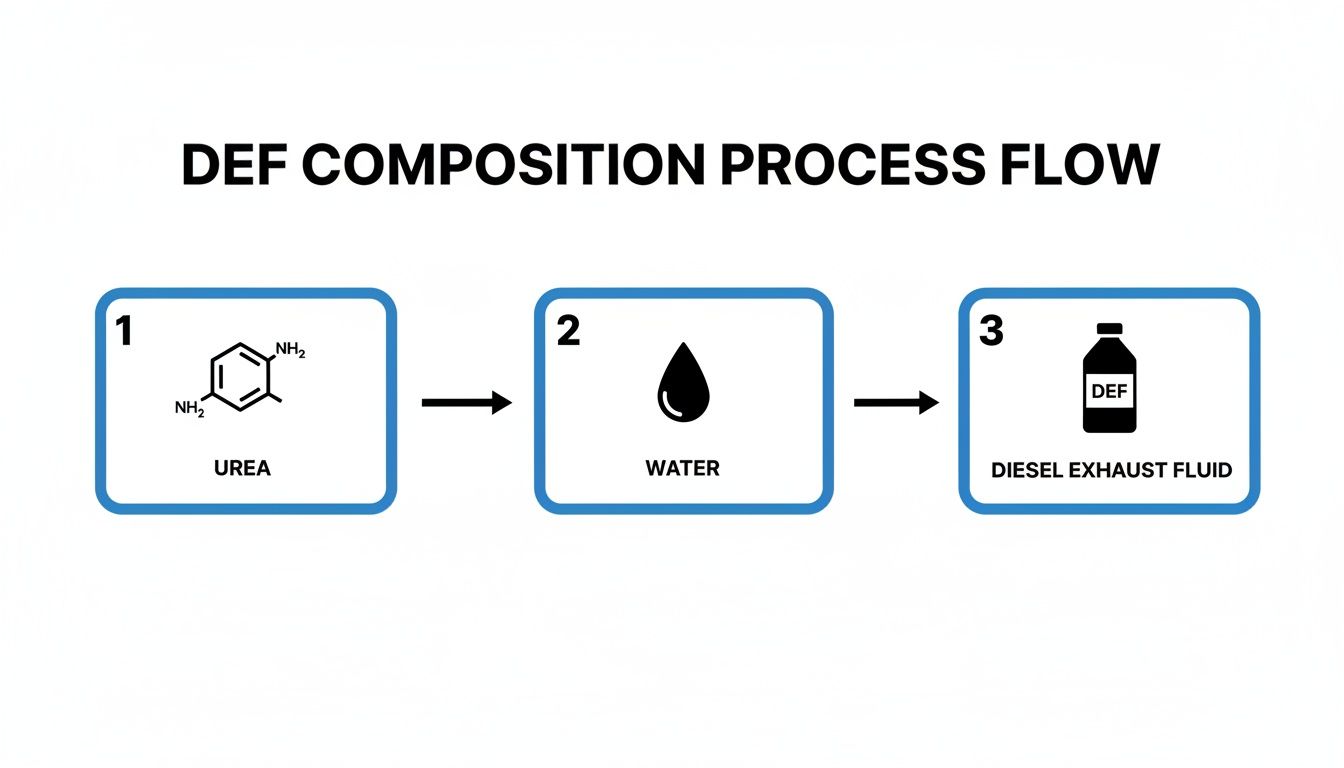
As you can see, it's just a carefully controlled mixture of high-purity urea and deionised water. It’s an incredibly effective system, too. A modern SCR system can scrub up to 90% of NOx emissions from a diesel engine’s exhaust.
It's crucial to remember that AdBlue is a post-combustion treatment fluid, not a fuel additive. It never even comes into contact with your engine or your diesel fuel. Its entire job happens in the exhaust, turning pollutants into fresh air. This is a common point of confusion, and you can learn more about the liquids that do go in your tank in our guide on what fuel additives are and how they work.
Why You Legally Need AdBlue in the UK
You might think of AdBlue as just another fluid to top up, but it’s actually a legal requirement baked into UK and European law. This isn't just a manufacturer's recommendation; it's a direct result of the Euro 6 emissions standard.
These strict regulations were brought in to tackle air pollution, especially the smog hanging over our towns and cities. To meet these new rules, carmakers had to fit Selective Catalytic Reduction (SCR) systems to practically every new diesel vehicle sold since 2014. And those systems can't work without AdBlue.
The whole point was to slash the amount of harmful nitrogen oxides (NOx) pumped out by diesel engines. It's had a huge impact, too. Since Euro 6 became the law of the land in 2015, we've seen a staggering 68% drop in NOx emissions from heavy-duty diesels compared to the older Euro 5 models.
That's a major reason why nationwide NOx pollution fell from 1.2 million tonnes in 2014 to just 0.38 million tonnes by 2023. So, for drivers everywhere from Stowmarket to Ipswich, this means cleaner air to breathe. But it also means you have a responsibility to keep that system working. You can dig deeper into how these changes have affected drivers by reading the full report on the diesel exhaust fluid market.
What Happens If You Ignore the Law?
So, you see the warning light, but what if you just keep driving and let the AdBlue tank run dry? Your car's computer is designed to make sure you can't ignore it for long. The penalties get progressively worse, and they’re designed to make you take notice.
Limp Mode: The first thing you'll notice is a serious drop in performance. Your car's engine management system will kick into 'limp mode', cutting power and speed dramatically.
No Restart: Once you switch the engine off, it’s not starting again. The system will lock you out until you refill the AdBlue tank. This isn’t a breakdown; it’s a built-in feature required by law.
Guaranteed MOT Failure: If your SCR system isn't working correctly, it's an instant MOT fail. Your vehicle simply doesn't meet the emissions standards it was designed for.
Big Fines: Try driving in London's Ultra Low Emission Zone (ULEZ) or other Clean Air Zones without a working AdBlue system, and you could be hit with daily fines of up to £300.
AdBlue is not an optional extra. It is a fundamental component of your vehicle's emissions control system, and keeping it topped up is a legal duty for every diesel driver on UK roads.
Running out of AdBlue isn't just bad for the environment; it can literally leave you stranded and hit your wallet hard. It’s simply part of owning a modern diesel car.
Common AdBlue Mistakes That Can Wreck Your Vehicle

While AdBlue is a brilliant piece of technology, a simple mistake can lead to some truly eye-watering repair bills. Knowing what diesel exhaust fluid is is one thing, but knowing how to handle it correctly is what will save you a world of trouble. A moment of distraction at the pump can easily spiral into a four-figure nightmare.
These mistakes happen more often than you'd think, usually from a simple mix-up or not quite understanding what the fluid does. Let's walk through the most common pitfalls so you know what to avoid.
Ignoring the Warning Lights
This is by far the most common slip-up: seeing the AdBlue warning light pop up on the dashboard and just… carrying on. Your car gives you plenty of notice—usually well over 1,000 miles—before the tank actually runs empty. Don't be tempted to push your luck.
Once the tank is completely dry, your car will switch into a "limp mode" with severely reduced power. Here's the critical part: the next time you turn the engine off, it will not restart. This isn't a mechanical fault; it's a built-in safety measure to ensure the vehicle complies with emissions laws. You'll be completely stranded until you top up the AdBlue.
Pouring AdBlue into the Diesel Tank
This is one of the most destructive misfuelling mistakes you can make. AdBlue is essentially a urea solution, which is highly corrosive to many of the metals, seals, and plastics used in your fuel system.
If you make this mistake and then start the engine, you’re circulating that corrosive fluid through the entire system. It will attack everything from the fuel lines to the injectors and the pump. The result is almost always a complete system flush and the replacement of multiple expensive parts, landing you with a bill that can run into thousands.
Never, ever start the engine if you even suspect you've put AdBlue in your fuel tank. That one action is the difference between a manageable fix and a financial catastrophe. Call for professional help immediately.
Putting Diesel into the AdBlue Tank
This is just as bad, if not worse. The SCR system is incredibly delicate and is calibrated to handle only the precise AdBlue formula. Diesel is an oily contaminant that will completely ruin it.
The oily film coats the tank, pump, and injector, but the real damage happens when it reaches the SCR catalyst. It clogs it up and renders it useless. Fixing this requires replacing the entire SCR system, a complex job that can easily cost upwards of £5,000. This is not a DIY job.
Using Non-Compliant Fluid or Water
Trying to save a few quid by using a cheap, non-certified AdBlue substitute or, even worse, just topping up with water, is a recipe for disaster. The SCR system is engineered to work with a precise 32.5% urea concentration. Anything different will cause the urea to crystallise.
These crystals form hard deposits that block the fluid lines and the injector, leading to system failure. Contamination issues like this are a growing headache for UK drivers. In fact, research shows 15-20% of breakdowns are linked to impure AdBlue, which can increase repair costs by 300% when crystals clog the system. The RAC alone deals with around 28,000 AdBlue-related callouts every year, many stemming from these simple mix-ups. You can learn more about these common diesel exhaust fluid issues.
To help you understand the severity of these mistakes, we've put together a quick comparison of the most common misfuelling scenarios.
AdBlue Misfuelling Scenarios and Their Consequences
Misfuelling Scenario | Immediate Symptoms | Potential Damage & Cost |
|---|---|---|
AdBlue in the Diesel Tank | Engine may not start or will run very poorly with smoking. Engine warning lights will illuminate. | Corrodes fuel pump, injectors, lines, and filters. Requires full system flush and parts replacement. Cost: £2,000 - £6,000+. |
Diesel in the AdBlue Tank | SCR system warning light will activate. The vehicle may enter limp mode. | Contaminates and destroys the entire SCR system, including the tank, pump, injector, and catalyst. Cost: £3,000 - £5,000+. |
Wrong Fluid (e.g., Water) | SCR warning light appears. Fluid may freeze or cause urea to crystallise, blocking the system. | Clogs injectors, lines, and damages the SCR catalyst over time. Can lead to full system replacement. Cost: £1,000 - £4,000. |
As you can see, a simple mistake at the pump can have serious financial consequences. The key takeaway is to be mindful when refilling and, if you do make a mistake, to stop immediately and call for professional assistance.
What to Do Immediately After an AdBlue Misfuelling

It’s that sinking feeling. That moment of pure panic when you realise the nozzle in your hand was the wrong one. Whether it's AdBlue in your diesel tank or diesel in the AdBlue reservoir, the very next thing you do is the most important. It's the action that will decide whether this is a manageable hiccup or a truly catastrophic repair bill.
The single most critical instruction is this: DO NOT START THE ENGINE. Don’t even put the key in the ignition or press the start button.
Why is this so vital? Starting the engine primes the fuel pump, and that’s the point of no return. It immediately begins circulating the contaminating fluid through your vehicle's intricate fuel system or the highly sensitive SCR system. What was a simple contamination problem contained in one tank instantly becomes a full-blown system crisis.
Your Immediate Action Plan
If you find yourself in this situation, take a breath. Stay calm and follow these steps precisely to prevent any further damage and get you back on the road with the minimum of fuss and expense.
Do Not Start the Engine: It bears repeating. We can't stress this enough. Take the keys out of the ignition completely to remove any chance of an accidental start.
Move the Vehicle Safely: If you're at a busy petrol station, don't be tempted to just drive to a parking bay. Ask for help to push the vehicle to a safe spot.
Call for Emergency Assistance: This is not a DIY job. You need a specialist who has the right equipment to safely drain and flush the contaminated system.
The decision to not start your engine is what saves you from thousands of pounds in damage. An engine that hasn't been started allows a technician to simply drain the incorrect fluid from the tank. Once started, the fluid circulates, requiring a far more complex and costly decontamination process.
Why You Need a Specialist Service
Putting diesel in your AdBlue tank or vice versa is a genuine emergency that needs immediate, professional help. A specialist mobile service like Misfuelled Car Fixer is equipped to handle this exact situation on-site, wherever you are in Suffolk and the surrounding areas.
Calling a mobile technician has some major advantages over getting towed to a garage. A rapid-response team can:
Get to you quickly, whether you’re stuck on a forecourt, at home, or on the side of the road.
Use specialist equipment to safely drain the entire tank of the mixed fluids.
Thoroughly flush the whole system to get rid of any harmful residue.
Provide the correct fluid to get your vehicle running safely again.
This on-the-spot service doesn't just save you a world of time and hassle, it can also be up to 50% cheaper than what a main dealer or garage might charge. By tackling the problem there and then, you stop the corrosive damage that turns a simple mistake into a financial nightmare. If you want a deeper dive into the kind of havoc this can cause, you can learn more about what happens if you put AdBlue in your diesel tank in our detailed guide.
Getting to Grips with AdBlue: Storage, Handling, and Refilling
Understanding what AdBlue is gets you halfway there, but knowing how to handle it properly is what really protects your car and your bank balance. It’s not complicated, but cutting corners can lead to contaminated fluid, a damaged SCR system, and a whole lot of hassle. Just treat it like any other essential fluid in your car—a bit of care makes all the difference.
The secret to AdBlue's success is its purity. Your number one rule should be to always buy high-quality fluid from a trusted source. Make sure the packaging is clearly marked as meeting the ISO 22241 standard. This is your guarantee that you're getting the precise 32.5% urea concentration your car’s SCR system is designed for.
Storing Your AdBlue the Right Way
Where you keep your AdBlue is just as important as where you buy it. The urea solution doesn't play well with extreme temperatures or direct sunlight, both of which can cause it to break down and become useless.
To keep it in prime condition, just follow these simple guidelines:
Keep It Cool and Out of the Sun: Find a well-ventilated spot to store your AdBlue, away from direct sunlight. A garage or shed is usually ideal.
Watch the Temperature: The sweet spot for storage is between -11°C and 30°C. If it gets too hot, its shelf life can plummet.
Use the Right Containers: Stick to the original packaging or a dedicated, sealed plastic or stainless-steel tank. This is key to preventing contamination and corrosion.
While AdBlue isn't officially a hazardous material, it is mildly corrosive to metals like copper and aluminium. It can also do a number on your car's paintwork if you spill it, so it pays to handle it carefully.
Tips for a Spill-Free Refill
Topping up your AdBlue tank is straightforward, but a moment of distraction can be an expensive mistake. The filler cap is almost always blue and located right next to the diesel cap to avoid mix-ups, but spills are still a risk.
Always use a funnel or spout designed specifically for AdBlue containers when refilling. This simple step helps prevent any splashes from getting onto your car's bodywork.
If a spill does happen, don't panic. Just wipe it up immediately with a damp cloth and give the area a good rinse with water. This stops the fluid from drying and potentially leaving a stain on your paint. A little bit of prevention here can save you from needing an emergency call-out down the line.
Your AdBlue Questions Answered
We’ve covered the technical side of what diesel exhaust fluid is, but what does it all mean for you behind the wheel? Let's tackle some of the most common questions drivers have about AdBlue. This should clear up any lingering confusion and help you feel more confident managing your car's system.
How Often Will I Need to Top Up the AdBlue?
There's no single answer here – it really boils down to your specific car, the size of its AdBlue tank, and even your driving style. A typical passenger car can often travel thousands of miles on a single tank.
The good news is you won't be left guessing. Your car will give you plenty of warning when the fluid level drops, usually flashing a notification with at least 1,000 miles of range left. To find out the exact capacity and expected range for your model, your vehicle's handbook is always the best place to look.
Is AdBlue Dangerous or Toxic?
Thankfully, no. AdBlue is officially classed as a non-toxic and non-hazardous fluid. However, it can be slightly corrosive to certain metals and will stain your car’s paint if you spill it and don't wipe it up promptly. It might also cause mild skin or eye irritation, so it's a good idea to just rinse your hands after you've handled the bottle. With a little care, it's perfectly safe to manage.
The real danger isn't the AdBlue itself, but what happens when you put the wrong fluid into the AdBlue tank. The SCR system is incredibly precise and will immediately detect anything that isn’t the correct chemical mix.
Can I Still Drive If I Run Out of AdBlue?
The short answer is no. By law, modern diesel cars have to meet strict emissions standards. If the AdBlue tank runs empty, the engine management system is designed to intervene. First, it will likely put the car into a 'limp mode,' which severely restricts power and speed.
Then, the next time you turn the engine off, it’s programmed not to restart at all until the AdBlue tank is refilled. This isn't a fault; it's an intentional design to ensure the car stays emissions-compliant.
What If I Just Fill the Tank with Water Instead?
Putting water in your AdBlue tank is one of the most serious and costly mistakes you can make. The SCR system is calibrated for a very specific 32.5% urea solution to do its job. Water completely throws off that balance, making the system useless for cleaning up NOx emissions.
Your dashboard will light up with warnings, and worse, you risk causing urea crystals to form in the lines, which can clog and destroy expensive components like the pump and injector. It's a recipe for a very hefty repair bill.
If you've realised you've put water, diesel, or anything else into the AdBlue tank, the most important thing to do is not to start the engine. Call the experts at Misfuelled Car Fixer immediately. We offer 24/7 assistance across Suffolk, and our mobile team can come directly to you. We'll drain, flush, and reset the system on the spot, preventing permanent damage and saving you a fortune.
For fast, professional help, visit Misfuelled Car Fixer Suffolk right away.


