
.jpg)


What to do about a small amount of diesel in petrol car
It's a sinking feeling we've all dreaded at the pump. You've just put the nozzle back, and then you see it – the green handle, not the black one. Even a splash of diesel in your petrol car is enough to cause a headache, but the severity of the problem really boils down to one simple action.
The single most important thing you can do is do not, under any circumstances, start the engine. Don't even turn the key to the 'on' position to check the radio. This one decision is the difference between a relatively straightforward fuel drain and a potentially wallet-busting repair job.
What Happens When Diesel Mixes with Petrol?
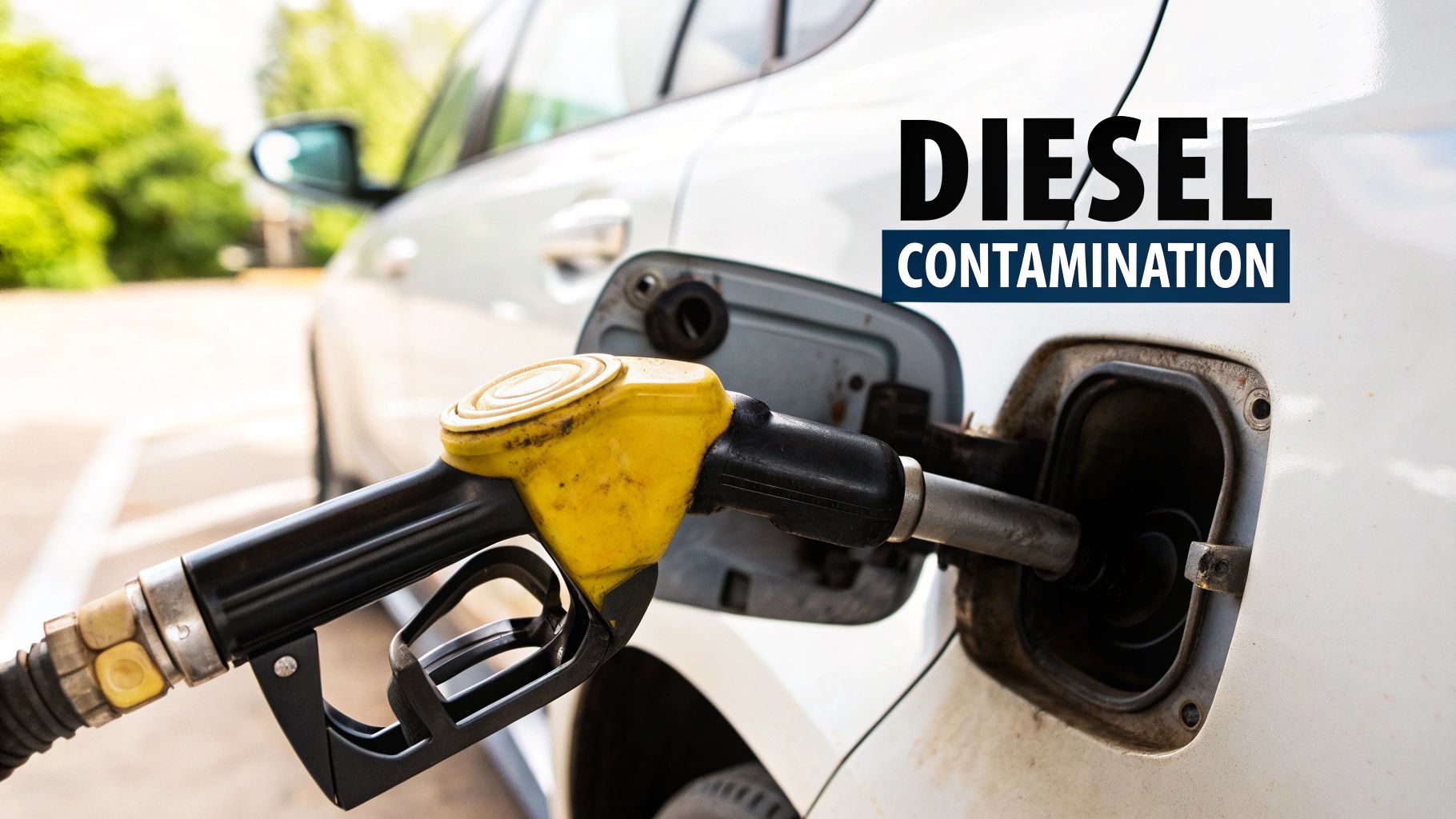
This kind of misfuelling mistake is incredibly common. You're definitely not the first person to do it. Data from the RAC shows that their patrols attend thousands of misfuelling incidents every year. Understanding what’s actually happening inside your engine helps explain why keeping that key out of the ignition is so vital.
Petrol and diesel just aren't built the same way. They have completely different jobs to do.
Diesel is an Oil, Not a Solvent
The easiest way to think about it is that diesel is a light, lubricating oil, whereas petrol is a thin, volatile solvent. A petrol engine is designed to ignite a fine mist of petrol and air with a spark.
When diesel gets into the mix, it acts like, well, an oil. It coats the spark plugs with a greasy film, which stops them from creating the spark needed for ignition. The engine will misfire, struggle, or simply refuse to start at all.
It Clogs Everything Up
The trouble starts long before the fuel even gets to the engine. Diesel is much thicker than petrol, and it almost immediately starts to block up the delicate components of your fuel system. The first victim is usually the fuel filter, which is designed for a much thinner liquid.
The most immediate impact of diesel contamination is on the fuel delivery system. The diesel’s oily residue can clog the tiny nozzles on your fuel injectors, which are meant to spray a precise, atomised mist of petrol for smooth running.
This blockage effectively starves the engine of the correct fuel. If you've already started the car, you'll notice the symptoms almost instantly – spluttering, hesitation, and a dramatic loss of power as the contaminated mix works its way through.
At the end of the day, it's about two different systems. A petrol engine needs a spark to create combustion, while a diesel engine uses high compression. Throwing a lubricant like diesel into a spark-ignition system is like pouring treacle into a Swiss watch. It gums up the works and brings everything to a halt, which is exactly why not turning that key saves you a world of trouble.
Recognising the Symptoms of Misfuelling

If you've already turned the key, your car is going to tell you pretty quickly that something isn't right. The signs of diesel contamination in a petrol engine are hard to miss, and they tend to get worse the longer you drive. Spotting these symptoms early is absolutely key to limiting the damage.
Sometimes, the first sign is that the car won't start at all. You might hear the engine trying to turn over, but it just won't catch. That's because the oily diesel can foul the spark plugs, stopping them from creating the spark needed to ignite the fuel.
Even if it does manage to fire up, it won't be a smooth ride.
Telltale Signs on the Road
Once you get moving, the problems become much more obvious as the bad fuel mix makes its way through the system. Pay close attention to how your car feels and sounds; you're looking for these classic red flags:
Excessive Exhaust Smoke: This is a big one. You might see clouds of thick, white, or even greyish smoke pouring from your exhaust. It's essentially the unburnt diesel oil turning to vapour as it hits the hot engine components.
Sudden Loss of Power: The car will feel sluggish and weak. You'll put your foot down, but the acceleration just won't be there. Trying to go up even a slight incline can become a real struggle.
Engine Spluttering and Knocking: Listen out for strange noises. The engine will likely cough, misfire, and sound very rough. A distinct knocking or 'pinking' noise is also common, which is a clear sign the fuel isn't burning correctly.
A petrol engine is a finely tuned machine that relies on a precise fuel-air mixture ignited by a spark. When diesel is introduced, this balance is completely thrown off, leading to poor combustion that manifests as hesitation, knocking, and an eventual stall.
Inevitably, the engine will cut out. It's the car's self-preservation kicking in to prevent catastrophic damage. As soon as you notice any of these symptoms, pull over as safely as you can, switch off the engine immediately, and turn on your hazard lights. Every second you continue to drive pushes more of that damaging mixture through the system.
Knowing what to look for is half the battle. For a more in-depth look, you can learn how to identify diesel in petrol car symptoms and figure out what to do next. Acting fast can be the difference between a simple fix and a wallet-busting repair bill.
What's the Real Damage and How Much Will it Cost?
Understanding what's actually happening inside your engine after you've put diesel in a petrol car helps you grasp the urgency and make a smart call. The financial hit can be anything from a minor headache to a major wallet-wrecker, and it all hinges on one simple question: did you start the engine?
If you spotted your mistake on the forecourt and haven't touched the ignition, breathe a sigh of relief. You're in the clear. The diesel is just sitting in the fuel tank, completely isolated. The solution is straightforward – a professional simply needs to drain the tank, flush out the lines, and get you topped up with the right stuff. It's the cheapest and quickest fix by a long shot.
Starting the engine, however, is a whole different story.
From a Simple Fuel Drain to a Full-Blown Repair Job
The moment you turn that key, the fuel pump whirs into life and starts sending that damaging diesel-petrol cocktail on a tour of your entire fuel system. This is where the problems really start. Diesel is thick and oily, and it immediately starts to gum up components designed for clean, thin petrol.
The longer the engine runs, the worse it gets. Here’s what’s happening in real-time:
Blocked Fuel Filter: This is usually the first casualty. The heavy diesel clogs the filter's fine mesh, choking the engine of fuel and causing it to judder, cough, and eventually cut out.
Clogged Fuel Injectors: Modern petrol injectors are precision instruments with tiny nozzles designed to spray a fine mist. Diesel's greasy nature blocks these microscopic holes, meaning they'll need a professional clean or, more often than not, a complete replacement.
Fouled Spark Plugs: The oily soot from burning diesel coats the tips of your spark plugs, smothering the spark they need to create. This will cause misfires or stop the engine from starting altogether.
In the worst-case scenarios, running the engine for too long can burn out the fuel pump as it strains to force the thick liquid through the system. You also run the risk of damaging expensive parts like oxygen sensors and the catalytic converter, which are highly sensitive to the unburnt gunk left behind by diesel.
A Sobering Look at UK Repair Costs
So, what’s the damage to your bank account? It varies massively. Across the UK, misfuelling costs motorists and businesses tens of millions of pounds every year in call-outs, repairs, and lost time. For one driver, the bill can land anywhere from £200 to well over £1,000, all depending on how far the diesel got and what parts are now fried.
For a more detailed look, have a read of our complete guide to the wrong fuel in car cost.
A basic roadside fuel drain – where the engine was never started – will typically set you back between £200 and £300. That price usually includes the call-out fee, the safe removal and disposal of the bad fuel, and a bit of fresh petrol to get you back on the road.
Once the engine has been run, the costs start creeping up. On top of the drain, you’re now paying for the extra labour to flush the entire system. If parts like the fuel filter or spark plugs have to be replaced, you could be looking at a bill of around £400-£600.
If you've been particularly unlucky and the fuel pump or injectors have been damaged, the total repair cost can sadly sail past the £1,000 mark. This is especially true for modern cars with complex fuel systems where the parts alone can be incredibly expensive.
Your Action Plan for Fixing a Misfuelled Car
That sinking feeling when you realise you’ve grabbed the wrong nozzle is a horrible one, but what you do in the next few minutes makes all the difference. The single most important rule? Do not start the engine. Seriously. If you catch the mistake right there at the pump, you’ve just sidestepped 90% of the potential damage and saved yourself a world of expensive hassle.
First things first, let the petrol station staff know what’s happened. They can close off the pump and help manage the situation. Your car is now blocking a busy area, so it needs to be moved to a safe spot.
Moving Your Vehicle Safely
Whatever you do, resist the urge to start the engine, even just to roll it forward a few feet. Pop the car into neutral and ask for a hand to push it into a parking bay or out of the way. This keeps the contaminated fuel isolated in the tank, well away from your car’s sensitive fuel lines and engine components.
With the car safely parked and the handbrake firmly on, it’s time to call in the professionals. A DIY fuel drain might seem tempting, but I strongly advise against it. Modern fuel systems are complex and often pressurised. Handling fuel is inherently dangerous and requires specialist equipment to do it safely and legally. Our guide on how to drain a petrol tank safely and legally in the UK dives deeper into why this is a job best left to the experts.
Contacting a Professional Service
Your next call should be to a mobile fuel drain specialist or your breakdown provider. To get help to you as quickly as possible, have this information ready:
Your precise location (the petrol station's name and address is perfect).
Your car’s make, model, and registration number.
A rough idea of how much diesel you added and how much petrol was in there to begin with.
The crucial bit: confirm whether you’ve started the engine or not.
This decision is the critical fork in the road, as this simple chart shows.

As you can see, keeping that engine off leads straight to a simple fuel drain, completely bypassing the expensive route of damaged parts.
A good mobile service can usually get to you in under an hour. They’ll arrive with everything needed to drain the tank, flush the system clean, and give you enough fresh petrol to get you moving again.
By calling a professional immediately and not starting the car, you are choosing the fastest, safest, and most cost-effective solution. This simple action transforms a potential disaster into a manageable inconvenience, often resolved in under an hour right there on the forecourt.
Right, so you’ve dealt with the immediate stress of a misfuelling mishap. The car is sorted, your wallet is a bit lighter, and you’ve sworn "never again." Now, let's make sure that's a promise you can keep.
It's easy to say "just pay more attention," but life isn't that simple. We get distracted. We’re in a rush, driving a hire car, or our mind is a million miles away. The real trick is to build a few simple, unbreakable habits that short-circuit those autopilot moments at the pump.
Create a Quick Fuelling Ritual
Before you even reach for a pump handle, make it a rule to physically touch and read the label on your car’s fuel filler cap. This tiny action forces a conscious pause and snaps you out of that "just get it done" mindset.
Never, ever trust the colour of the pump handle alone. Yes, in the UK they're generally standardised—green for petrol, black for diesel—but colours can fade, and standards can be completely different if you're driving abroad.
Make the Forecourt a No-Distraction Zone
Let's be honest, most misfuelling incidents happen because our attention is elsewhere. That's why the pump needs to be a strict no-phone zone. That text message or last bit of a phone call can absolutely wait for the few minutes it takes to fill up. If you've got kids or chatty passengers, just let them know you need a moment to focus.
Think of it as your own pre-flight check. It's quick, but it's crucial.
Check the Cap: Read the label inside your fuel flap.
Check the Pump: Read the label on the pump itself. Say it out loud if it helps: "Unleaded."
Check the Nozzle: One last look at the label on the nozzle before it goes anywhere near your tank.
This three-step glance takes all of five seconds, but it's the best insurance policy you can get against a four-figure repair bill. It's a tiny investment of your time to avoid the nightmare of putting even a small amount of diesel in a petrol car.
A Foolproof Failsafe: Misfuelling Prevention Devices
If you want an extra layer of security, or perhaps you manage a fleet of vehicles and can't risk employee error, look into a misfuelling prevention device. These are simple but brilliant gadgets that replace your standard fuel cap.
A misfuelling prevention device is essentially a purpose-built cap with an opening sized specifically for a petrol nozzle. It physically blocks the wider diesel nozzle from ever being inserted into your car’s filler neck. Simple, effective, and foolproof.
You can pick one up for between £20 and £40, and they're usually a simple DIY fit. It's a passive safety net that works every single time, no matter how tired or distracted you might be. For fleet managers, it’s a no-brainer—a tiny outlay to prevent costly downtime and repair invoices.
By combining a solid routine with a physical safeguard like this, you can pretty much eliminate the risk of misfuelling for good.
Got Questions About Misfuelling? We've Got Answers
Standing on a petrol station forecourt after that sinking feeling of grabbing the wrong pump, your mind is probably racing with questions. It's a common mistake, and we've heard them all. Here are the answers to the most frequent queries we get from drivers who've put a bit of diesel in their petrol car.
Is Misfuelling Damage Covered By My Car Insurance?
This is a real grey area, and it all comes down to the small print in your policy. Some fully comprehensive plans do offer ‘misfuelling cover’, sometimes as standard, other times as an add-on you have to pay extra for.
Unfortunately, many insurers see it differently. They often class misfuelling as negligence on the driver's part, not an accident, which means they won't pay out. You'd then be left covering the full cost of the fuel drain and any repairs yourself. The only way to know for sure is to dig out your policy documents or give your insurer a call.
Can't I Just Top It Up With Petrol To Dilute The Diesel?
This is a dangerous myth that just won't go away. It’s advice that might have held some water for a clunky old carburettor engine from the 70s, but it's a recipe for disaster in a modern car. Today’s engines are finely tuned machines with incredibly sensitive, computer-managed fuel injection systems.
Trying to "water down" the diesel by adding more petrol is the worst thing you can do. It just forces that oily, damaging mixture through every part of your fuel system. You’re practically guaranteeing it will clog up your fuel filter, gum up the injectors, and potentially wreck your catalytic converter.
Expert Tip: The only proper fix is to get the contaminated fuel professionally drained. Don't even think about diluting it – you'll just turn a simple problem into a very expensive one.
How Much Diesel Is Too Much For a Petrol Car?
Honestly? Any amount. There really is no "safe" quantity of diesel to put in a modern petrol car. We've seen significant running problems from contamination levels as low as 5%. That's just 2.5 litres of diesel in a typical 50-litre tank.
You have to remember, diesel is an oil. Its thick, lubricating nature is the enemy of a petrol engine's precise fuel injectors. It also burns at a completely different temperature, which can cause engine knocking, misfires, and serious performance issues.
The golden rule is simple: treat any amount of diesel contamination as a major problem that needs a full fuel drain. Whatever you do, don't start the engine.
Put the wrong fuel in your car? Stay calm and, most importantly, don't turn the key. Call the experts at Misfuelled Car Fixer for a rapid, 24/7 mobile fuel drain service. We’ll sort the problem on the spot and get you safely back on your way. Get in touch now at https://www.misfuelledcarfixer-suffolk.co.uk.


