
.jpg)


What to Do: what to do when car won't start — A Practical Guide
That gut-wrenching moment when you turn the key and get… nothing. Every driver has been there. Before you start picturing expensive repair bills, take a deep breath. A few quick checks can often tell you whether you’re dealing with a simple fix or something more serious. The first move is always about safety, followed by listening to the clues your car is giving you.
Initial Checks When Your Car Refuses to Start
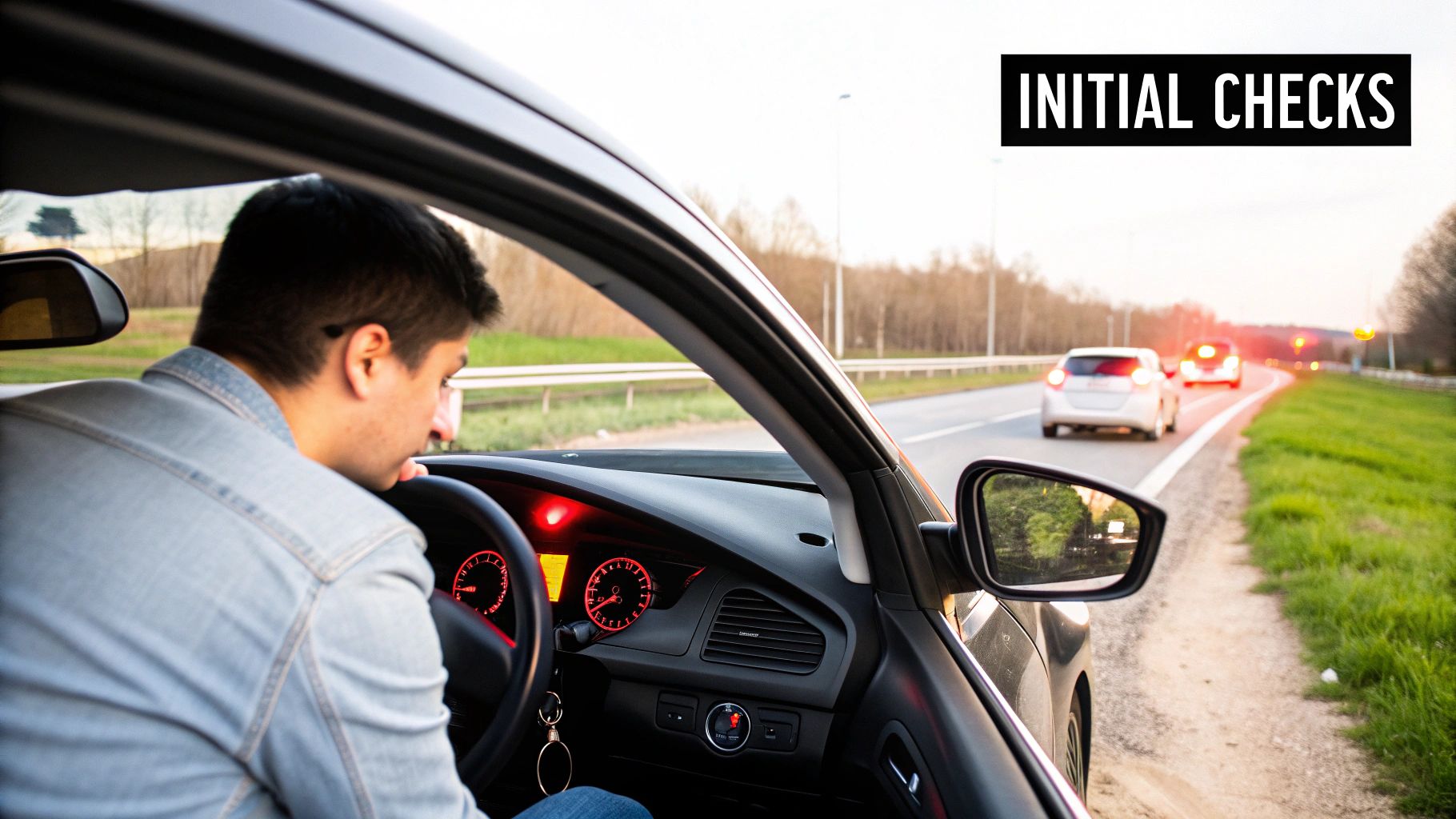
If your car dies on a busy Suffolk road like the A12 or A14, your immediate priority is safety. Flick on your hazard lights straight away to make sure other drivers can see you. If you’re in a dangerous spot, it's often safest to stay in your vehicle with your seatbelt fastened until help arrives.
Once you’re out of harm's way, you can try some basic troubleshooting. The sounds your car makes—or doesn't make—are your best diagnostic tool right now. Listen carefully when you turn the key.
Listen to the Sounds Your Car Is Making
Hear a frantic, rapid-fire clicking sound? That’s the classic sign of a dead or dying battery. It’s the sound of the starter solenoid trying its best to engage but not getting enough juice to actually turn the engine over.
On the other hand, a single, heavy "clunk" or a loud "click" often points to a problem with the starter motor itself. This usually means power is getting to the starter, but the component has failed. And if you hear complete silence? That could mean the battery is completely flat or there’s an issue with the ignition system.
A weak battery is one of the most common reasons a car won't start. Getting familiar with the warning signs can save you a lot of hassle, so it's worth understanding how to know if your car battery is failing and what to look out for.
Expert Tip: Don't overlook the obvious! If you drive an automatic, double-check that the gear selector is pushed firmly into 'Park' or 'Neutral'. It’s a simple safety feature, but it catches people out all the time.
Visual Checks You Can Do Instantly
Your dashboard is your next port of call. Pay attention to what the warning lights do when you turn the ignition on.
Bright Lights, No Crank: If all the dashboard lights come on strong and bright but the engine doesn't even attempt to turn over, the fault could lie with your starter, ignition switch, or immobiliser.
Dim or Flickering Lights: If the lights are noticeably dim, flicker, or die completely the moment you try to start the car, that’s a very strong indicator of a weak battery.
Finally, if it’s safe, pop the bonnet and have a quick peek at the battery itself. Look for a build-up of white or greenish corrosion around the terminals, as this can easily block the electrical connection. Give the battery cables a gentle wiggle – a loose connection is sometimes all it takes to prevent your car from starting.
Diagnosing Common Non-Start Problems Yourself
Alright, you've done the initial safety sweep, so now it's time to put on your detective hat. The good news is that you can often figure out why a car won't start without needing a garage full of specialist tools. It’s usually a process of elimination, and knowing the difference between the sound of a dead battery and the silence of a fuel problem can save you a lot of hassle.
Is It the Battery or the Alternator?
This is a classic head-scratcher. A dead battery won't have the juice to get things going, while a failing alternator is responsible for recharging that battery as you drive. They're closely related, but the symptoms have a key difference.
Think about it like this: if you manage to jump-start the car, but it sputters and dies again as soon as you disconnect the jump leads, your alternator is the likely culprit. It's just not doing its job of keeping the battery topped up.
Your headlights are another great clue. Before you even try to turn the key, switch them on.
Bright, then suddenly dim: If they look strong but fade the moment you try to start the engine, the battery has some power, just not enough to turn the engine over.
Weak and dim from the start: If they're barely glowing, your battery is almost certainly flat.
Electrical gremlins can be frustrating to track down. If you're keen to dig a bit deeper, this guide on how to diagnose car electrical problems offers some excellent, more detailed advice.
Listening for Starter Motor and Immobiliser Clues
Pay close attention to what you hear—or don't hear. The sounds your car makes when you turn the key are one of the best diagnostic tools you have.
If you hear a single, solid "click" or "clunk" when you turn the key, it's a good sign. It means the battery is trying to send power, but the starter motor itself isn't playing ball. This almost always points to a problem with the starter motor or its solenoid.
On the other hand, what if the engine turns over just fine—whirring away energetically—but never actually catches and fires up? This is often a sign of an immobiliser issue. Your car key has a tiny chip that talks to the car's computer. If that signal gets lost or scrambled, the immobiliser kicks in and stops the fuel from flowing as an anti-theft measure. The simplest fix? Try your spare key. It often works.
Checking for Fuel-Related Issues
When the engine cranks but just won't start, the problem is almost always down to a lack of fuel or spark. The first thing to check, and don't feel silly for doing it, is the fuel gauge. You'd be amazed how many people run out of petrol without realising it.
If there's plenty of fuel in the tank, the issue could be a blockage. A clogged fuel filter or a failing fuel pump can stop petrol or diesel from getting to the engine. A tell-tale sign of this is if the car was spluttering or losing power before it finally gave up. If you've had ongoing performance issues, you might even be looking at blocked injectors. We have a separate guide that goes into the symptoms of bad fuel injectors in diesel engines, which is well worth a read.
Car Won't Start Symptoms and Likely Causes
To help you narrow things down quickly, I've put together this simple table. Use this quick guide to match what you're hearing and seeing to the most likely problem with your vehicle.
Symptom | Possible Cause | What to Check First |
|---|---|---|
Rapid, fast clicking sound | Dead or very weak battery | Are the dashboard lights dim or off? |
A single, loud "click" or "clunk" | Faulty starter motor or solenoid | Check that battery terminals are clean and tight. |
Engine cranks but won't start | Fuel or immobiliser issue | Is the fuel gauge on empty? Try your spare key. |
Complete silence, no lights or sounds | Completely flat battery or main fuse | Check the main battery connections first. |
Car starts with a jump, then dies | Failing alternator | Does the battery warning light stay on? |
This little checklist covers the most common non-start scenarios we see every day. It's a great starting point before you decide whether you need to call in a professional.
The Misfuelling Nightmare: What to Do (and What Not to Do)
That sinking feeling at the petrol pump is all too familiar for many drivers. You’ve been distracted, you're driving a different car, and suddenly you realise you’ve put the wrong fuel in. It's a surprisingly easy mistake to make, but your next move is absolutely critical. What you do in the next few minutes can mean the difference between a simple fix and a repair bill that runs into the thousands.
There’s one golden rule, and if you remember nothing else, remember this: DO NOT start the engine. Don’t even turn the key to light up the dashboard. The moment you turn that key, the fuel pump kicks in and starts sending the contaminated fuel through the lines and into the engine. Keeping that key firmly in your pocket is the single best way to prevent serious damage.
Your Immediate Action Plan
If you catch the error while you’re still on the forecourt, you're in the best-case scenario. Here’s what to do, right away:
Keys Out, Engine Off: I can't say it enough. Leave the car completely off.
Tell the Staff: Let the petrol station attendant know what’s happened. They can help cordon off the pump and make the area safe for other drivers.
Push, Don't Drive: Pop the car into neutral. If it’s safe, get a hand to push it to a designated parking spot, well away from the busy pumps.
With the car safely out of the way, it’s time to call in the experts. A standard breakdown service often isn't equipped for this; you need a specialist who can perform a full fuel drain.
If you're unsure whether it's fuel or something else, listening to the car can offer clues. This chart helps diagnose what different sounds (or silence) might mean when your car refuses to start.
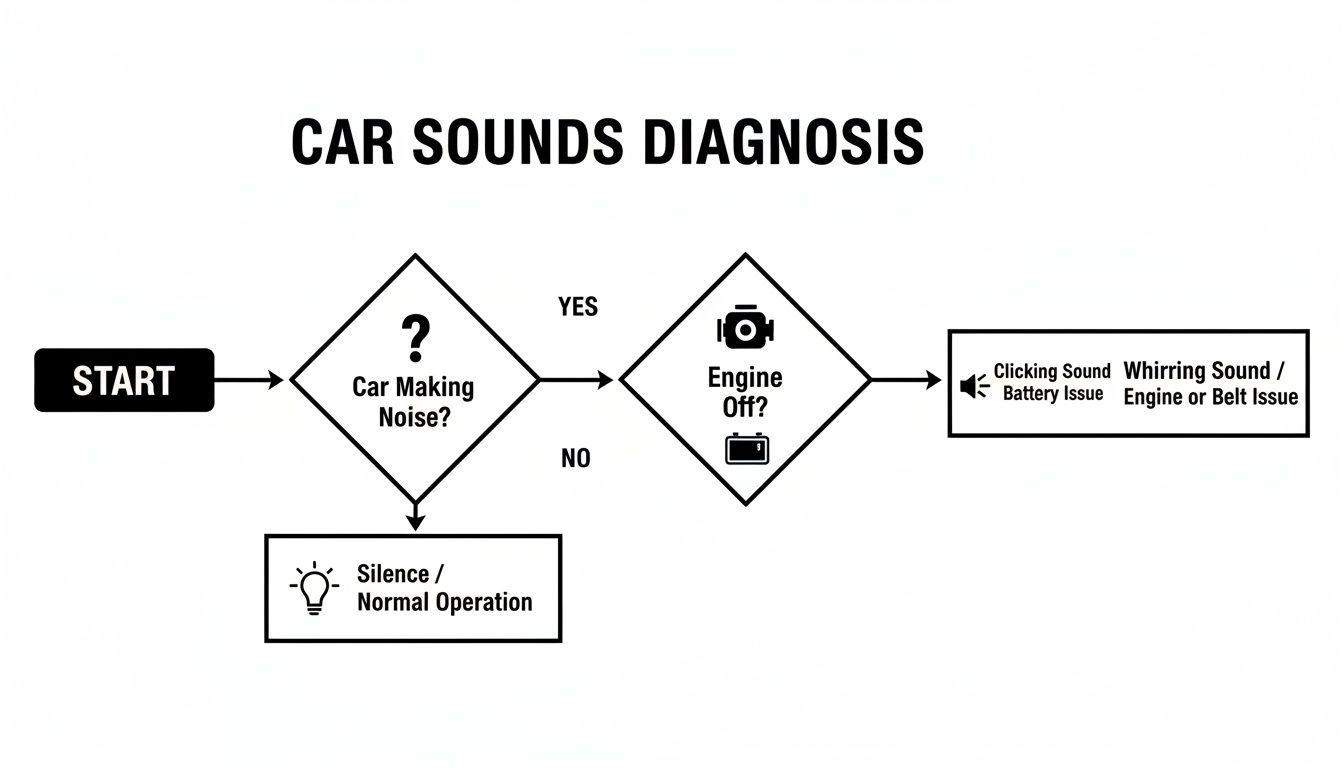
As you can see, a dead silence points to a very different problem than a rapid clicking sound, helping you figure out what might be wrong before you even pick up the phone.
What if I've Already Driven Off?
Sometimes, the penny doesn't drop until you’re back on the road. If you’ve driven away, you’ll soon notice some pretty alarming symptoms.
Putting diesel in a petrol car will cause it to struggle badly. Expect a loud, knocking sound from the engine, a lot of smoke from the exhaust, and a dramatic loss of power before it eventually judders to a halt. On the other hand, putting petrol in a diesel engine will cause it to run erratically and misfire before it, too, cuts out completely.
A Costly Mistake: This is far from a rare problem. The RAC reports that wrong fuel incidents make up around 5% of all its callouts, which is more than 100,000 cases across Britain every year. Starting the engine can escalate the repair bill to as much as £5,000. If you even suspect you've made this error, find a safe place to pull over and switch the engine off immediately. You can find more data on how misfuelling impacts UK drivers and understand the potential consequences.
Understanding AdBlue and Other Fuel Contamination Issues
It’s not just about putting petrol in a diesel tank anymore. With modern diesel cars, a new and particularly nasty problem has cropped up: AdBlue contamination. If this fluid, which belongs in a separate tank for the exhaust system, gets into your diesel tank, you're looking at a serious, time-sensitive issue.
AdBlue is essentially a urea solution, and it’s incredibly corrosive to the seals, plastics, and sensitive metals inside your fuel system. We’re talking about the fuel pump, injectors, and filters—all of which can be ruined very quickly. Unlike petrol, which thins diesel out, AdBlue can form hard crystals that clog everything up. If you try to run the engine, it can lead to complete, catastrophic failure.
The Critical Mistake: AdBlue in the Diesel Tank
The second you realise AdBlue has gone into the fuel tank, stop. The single most important thing you can do is nothing at all. Don't put the key in the ignition. Don't turn on the electronics. And whatever you do, do not try to start the engine.
Just turning the key can prime the fuel pump, which is enough to pull the corrosive mixture into the lines and start the damage. We've seen firsthand how a few seconds of running the engine can be the difference between a simple drain and a write-off of the entire fuel system. It's a growing problem, and you can get the full, gritty details in our guide on what happens if you put AdBlue in your diesel tank.
Crucial Takeaway: An AdBlue mix-up isn't a job for a DIY enthusiast or a general garage. It demands a specialist fuel drain. You need someone with the right pumps and flushing equipment to get every last drop out before it crystallises and causes thousands of pounds worth of damage.
Other Serious Fuel Contamination Scenarios
Putting diesel into a petrol car is another, less common, but equally frustrating reason your car won't start. The symptoms are unmistakable and happen fast. Diesel is much heavier and oilier than petrol, so it will almost immediately clog the spark plugs and foul up the fuel injectors, making ignition impossible.
If you managed to drive even a few yards before it conked out, you probably noticed a few things:
Lots of Smoke: We're talking thick, black smoke pouring out of the exhaust. It's a dead giveaway.
Rough Running: The engine will sound awful, misfiring and juddering as it tries to burn the wrong fuel.
Engine Cut-Out: Eventually, it will just give up, lose all power, and refuse to restart.
Fuel mix-ups are a surprisingly big issue on UK roads. In fact, DVSA data shows that 150,000 vehicle recovery callouts are linked to fuel errors. The advice is always the same: pull over somewhere safe and call a specialist immediately. With AdBlue contamination incidents jumping by 22% last year alone, it’s a growing concern. Trying to "run it through" can turn a simple fix into a repair bill of £3,000-£8,000. You can discover more insights about vehicle production and related industry trends on smmt.co.uk.
When You Need a Professional Fuel Drain Service
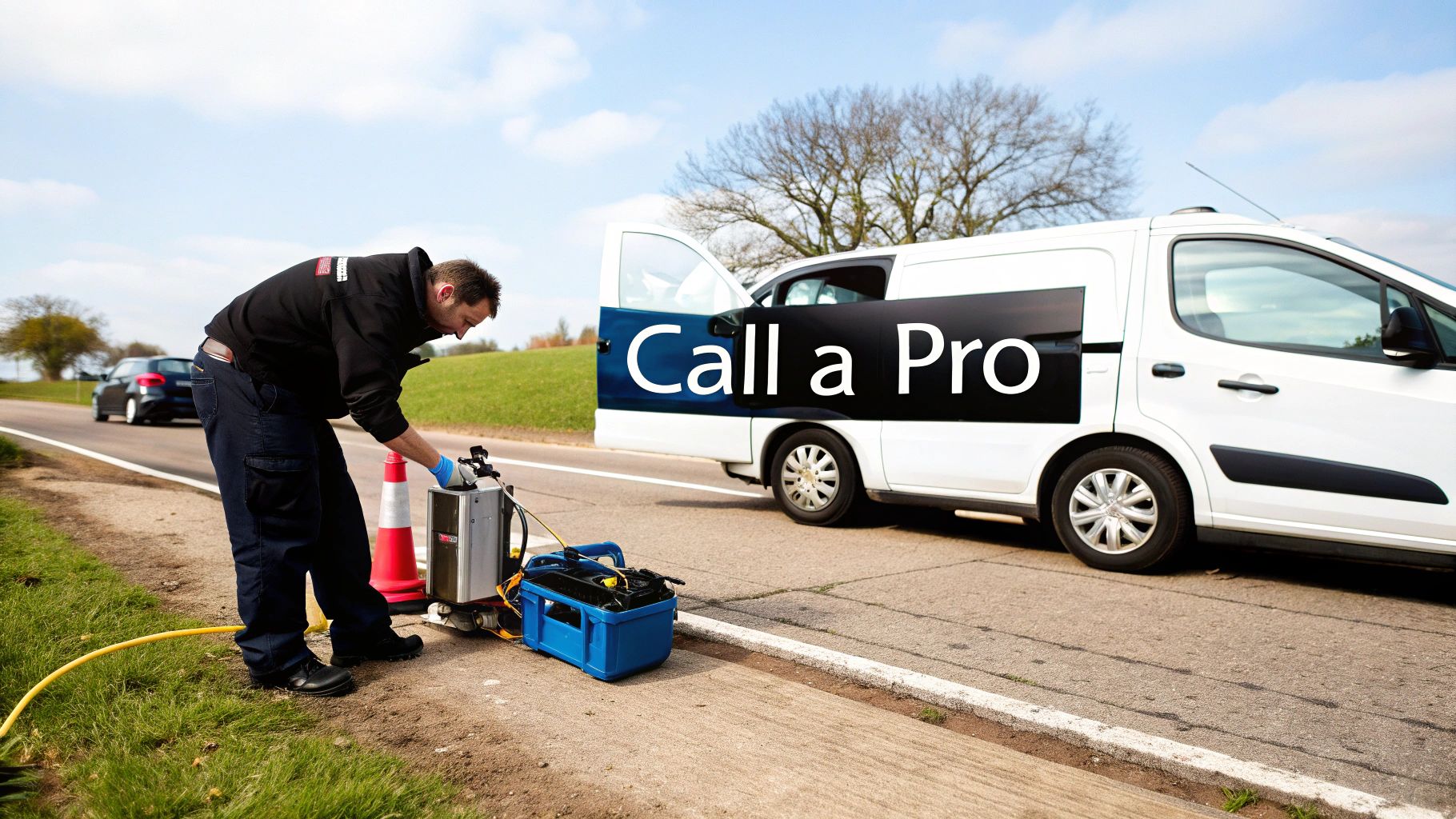
It’s one thing to deal with a dead battery using a set of jump leads, but it's crucial to know your limits. When the problem is fuel-related—especially if you've put the wrong fuel in—you’ve entered territory where a DIY fix is out of the question. This is the moment to call in a specialist. It’s not just a good idea; it’s the only safe and sensible path forward.
Your first thought might be to call your regular breakdown service. The trouble is, they’re usually kitted out for recovery, not for complex fuel system work. They often lack the specialist pumps, sealed tanks, and flushing equipment needed for a thorough and safe fuel drain. More often than not, their solution is to tow you to a garage.
Why Avoid the Dealership Delay
Going straight to a main dealer might seem like the official route, but be prepared for a long wait and a hefty bill. You'll likely be charged for the tow, workshop labour, and then they’ll often recommend replacing parts like fuel filters and pumps. This can quickly send the final cost soaring.
On top of the expense, the process can take days, leaving you stranded without a car. This is precisely where a dedicated mobile fuel drain service comes into its own. Instead of you going to the garage, the garage comes to you.
The Mobile Advantage: A specialist mobile service is designed for one job and one job only: to solve your fuel problem on the spot. Technicians arrive with a fully equipped van to drain the tank, flush the system, and get you back on the road, often in under an hour.
The On-the-Spot Solution in Suffolk
Whether you’re stuck at a petrol station in Lowestoft or on your driveway in Stowmarket, a 24/7 mobile team is your fastest, most cost-effective solution. Misfuelling stats show that for fleet managers in Bury St Edmunds or a driver at Felixstowe docks, an urgent response is vital to minimise downtime.
A specialist service like Misfuelled Car Fixer has a strong local focus in Suffolk and can typically dispatch a technician to you in just 30-60 minutes. The numbers speak for themselves:
Cost-Effective: Their pricing is often half the market rate—around £400 for vans, compared to typical £900 dealer quotes.
Highly Efficient: They boast a 95% same-day recovery rate.
Proven Experience: In Suffolk alone last year, they handled over 1,800 jobs, preventing an estimated £7.5 million in potential engine damage.
You can get a better idea of how their roadside service works on YouTube. The entire focus is on getting you moving again with minimal disruption. The contaminated fuel is handled and disposed of according to strict environmental regulations, making the process as safe as it is swift.
This on-the-spot service means you can avoid the hassle and expense of being towed. If you're currently facing this problem, you might also find our detailed UK guide on how to drain a fuel tank safely useful.
Your Questions Answered: What to Do When Your Car Won't Start
That sinking feeling when you turn the key and nothing happens is a familiar one for many drivers. Your mind immediately races – what’s wrong? Is this going to be expensive? We get these questions all the time, especially when a fuel mix-up is the culprit. Here are some straight answers to help you figure out your next move.
I've Put the Wrong Fuel in but Haven't Started the Engine – What Now?
First off, take a breath. This is the best possible situation in a misfuelling scenario, and catching it early is a huge win. The absolute most important thing to do right now is… nothing. Don't turn the key. Don't even switch on the electrics to listen to the radio.
Keeping the ignition off prevents the fuel pump from kicking in and sending the wrong fuel through the lines and into your engine. That simple act can save you from a much bigger, more expensive problem.
Here’s your action plan:
Engine off, keys out. Simple as that.
Let the staff at the petrol station know what's happened. They've seen it all before.
If you can, pop the car in neutral and push it to a safe spot out of the way.
Call a specialist fuel drain service right away.
Since the contaminated fuel hasn't circulated, the fix is usually quick and straightforward. We can typically drain the tank, flush the system, and get you ready for the right fuel, all by the roadside, in about an hour.
How Do I Know if It’s Just a Dead Battery?
When it comes to a non-starter, your ears are your best diagnostic tool. The sounds the car makes (or doesn't make) can tell you a lot. A classic sign of a dead battery is a rapid-fire clicking sound when you turn the key. That’s the starter solenoid trying to engage, but there just isn't enough juice to turn the engine over.
On the other hand, a single, heavy "clunk" often points to a problem with the starter motor itself. Total silence? That could be a completely flat battery, but it might also be a major fuse or a connection issue. If your dash lights up brightly but the engine won't even try to turn, you could be looking at an immobiliser fault.
A Quick Tip from Experience: If the engine is turning over at its normal speed but just won’t catch and fire up, you can probably rule out the battery and starter motor. The problem is almost certainly a lack of fuel or a lack of spark.
Is It Cheaper to Call a Mobile Fuel Drain Service Than a Garage?
Yes, almost without exception. A mobile service is not only more affordable but also miles faster than having your car recovered to a garage or main dealer. Think about it: a garage has to arrange a tow truck, which adds a hefty cost and a long wait before they even start looking at it.
Once your car is in their workshop, you're paying full garage labour rates. They'll often insist on replacing parts like fuel filters and other components as a 'precaution', which bumps the bill up even further. A mobile specialist drives to you, whether you're on your driveway in Ipswich or stuck on the side of the A14. We do the job right there and then. This approach typically ends up costing about half of what a dealership would charge, saving you a massive amount of hassle, time, and money.
If you've put the wrong fuel in your car in Suffolk or the surrounding areas, don't panic and definitely don't start the engine. Get in touch with Misfuelled Car Fixer for immediate, 24/7 help. Our expert mobile technicians will get you safely back on your journey in no time. Learn more by visiting our Misfuelled Car Fixer Suffolk website.


