



Adblue in diesel tank by mistake? Quick steps to prevent costly damage
- Misfuelled Car Fixer

- Dec 23, 2025
- 13 min read
It’s a moment of pure dread. You’ve just finished filling up, you hang the nozzle back on the pump, and then you see it—the bright blue AdBlue cap next to the diesel filler neck you just used. Your stomach sinks.
It’s a surprisingly common mistake, but what you do in the next few seconds is absolutely critical.
Your First Move After an AdBlue Misfuelling Mistake
The number one, golden rule is simple: DO NOT START THE ENGINE.
I can't stress this enough. Don't even turn the key to the first position to listen to the radio. Modern diesel engines often prime the fuel pump the moment the ignition is switched on, and that's all it takes to suck the AdBlue contamination out of the tank and into the delicate fuel system.
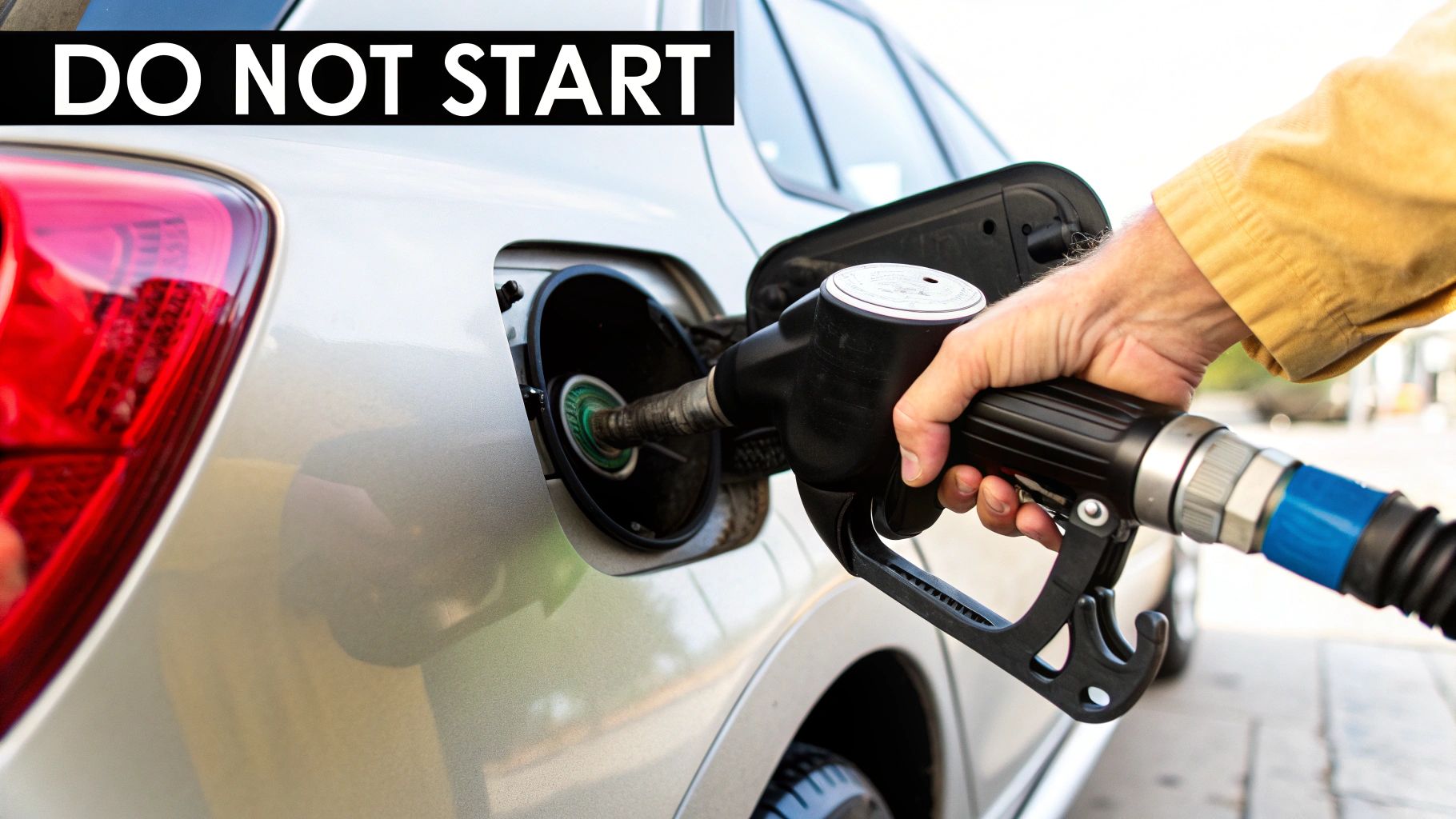
Staying calm right now can save you thousands of pounds. AdBlue is essentially a solution of urea and 67.5% de-ionised water. It has zero lubricating properties and is corrosive to many of the metals found in a high-pressure diesel fuel system. If it starts circulating, it can quickly wreck the fuel pump, injectors, and filters.
And you're not alone in this. As more diesel cars with Selective Catalytic Reduction (SCR) systems hit the roads, these incidents have shot up. The AA reported dealing with over 23,000 AdBlue-related breakdowns in a single year, which was almost double the figure from the year before.
Securing Your Vehicle and Seeking Help
Your immediate priority is to make sure you and your vehicle are safe. If you’re still at the pump, leave the car exactly where it is. Resist the urge to move it to a parking bay.
Just flick on your hazard lights. This alerts other drivers and lets the station staff know there's a problem.
Next, pop inside and let the petrol station attendant know what’s happened. They've seen this before and can cone off the area to keep everyone safe.
Key Takeaway: The second you realise you've misfuelled with AdBlue, freeze. Don't touch the keys, don't start the car, and definitely don't try to dilute it by adding more diesel. Your only goal is to keep the contamination isolated within the fuel tank.
With the car secured, your next call should be to a professional wrong-fuel recovery service. This isn't a task for your standard breakdown patrol or a local garage that will just tow you. You need a specialist who has the right equipment to perform a complete fuel drain right there on the forecourt. Our guide on finding an emergency fuel drain near you explains exactly what to look for.
Immediate Actions Checklist
In a stressful situation like this, a simple checklist can be a lifesaver. Here are the crucial first steps to take.
Action to Take Immediately | Why It's Crucial |
|---|---|
Do Not Start the Engine | This is the most important step. It prevents the corrosive AdBlue solution from circulating and destroying the fuel pump, lines, and injectors. |
Put on Hazard Lights | This alerts other drivers and station staff that your vehicle is stationary and there is an issue, ensuring everyone's safety. |
Inform Petrol Station Staff | They can help secure the area and often have procedures in place to assist you until a specialist arrives. |
Call a Specialist Fuel Drain Service | This ensures a technician with the correct equipment can safely drain and flush the system on-site, saving you significant time, money, and stress. |
Following these steps methodically turns a potential catastrophe into a manageable problem. A professional fuel drain technician can resolve the issue on the spot, getting you back on the road safely.
Why Putting AdBlue in Your Diesel Tank Is a Catastrophic Mistake
You might be thinking, "It was only a little bit of AdBlue, can it really be that bad?" The short answer is a resounding yes. It’s crucial to understand that AdBlue isn't a fuel additive; it’s a contaminant. Pouring it into your diesel tank is like tipping saltwater straight into your engine. It's a mixture of urea and de-ionised water, which is completely alien to the finely-tuned components of a diesel fuel system.
Unlike diesel, which is an oil, AdBlue provides absolutely zero lubrication. Your high-pressure fuel pump and injectors rely on the natural lubricating properties of diesel to function. When AdBlue gets in there, it strips that lubrication away instantly. Suddenly, precision-engineered metal parts are grinding against each other, leading to incredibly fast wear and, ultimately, catastrophic failure.
A Vicious Cycle of Corrosion and Crystals
The damage doesn't end with a lack of lubrication. The water in AdBlue is highly corrosive to many of the metals found in your fuel system, like copper, brass, and various alloys. It starts rusting and eating away at your fuel lines, pump, and injectors from the inside out.
At the same time, the urea in AdBlue causes another massive headache. When it mixes with diesel, it begins to form hard, white crystals. Think of it like limescale, but much, much worse. These stubborn deposits rapidly clog everything in their path:
Fuel filters: This will starve the engine of fuel.
Fuel lines: Creating total blockages and stopping fuel from getting through.
Injectors: Jamming up the tiny nozzles and wrecking their spray pattern.
This one-two punch of corrosion and crystallisation is an engine’s worst nightmare. If the engine is started, the AdBlue (which is heavier than diesel) gets sucked straight into the fuel pump. It destroys the pump's lubrication and causes the injectors to fail in spectacular fashion. We've seen it time and again; this corrosive gunk clogs lines and filters so badly that the only fix is a full professional drain and flush. Ignoring it can lead to average repair bills of over £1,800, and often much higher. A report on AdBlue contamination highlights these exact safety concerns.
Expert Insight: I always tell people to think of AdBlue crystals in your fuel system like cholesterol in an artery. A tiny amount might not seem like a big deal at first, but it quickly builds up, restricts flow, and leads to a sudden, total system failure that needs immediate and invasive work to fix.
Why the Two Systems Can Never Mix
Modern diesel engines, especially Common Rail systems, are feats of engineering. They run at immense pressures—often over 2,000 bar (or 30,000 psi)—and are built with microscopic tolerances to deliver perfectly timed bursts of fuel. Throwing a watery, crystal-forming liquid into that high-stakes environment is a guaranteed recipe for disaster. If you're curious about how it's all supposed to function, our diesel driver's guide to AdBlue explains the basics.
The bottom line is simple: AdBlue and diesel are meant for completely different ends of your car. One goes in the tank, the other is for the exhaust. When they meet, they trigger a destructive chemical reaction that only a specialist can put right.
How We Fix the Problem: The Professional Fuel Drain Process
So, you’ve done the right thing and haven’t touched the ignition. You’ve called us, and one of our mobile technicians is on the way. What actually happens when we get there? It’s a lot more than just sticking a hose in the tank; it's a meticulous process to make sure every last drop of that damaging AdBlue is gone for good.
Some people are tempted to try a DIY drain, but this is one of those jobs where that's a seriously bad idea. You simply can't get all the contaminated fuel out without specialist pumps, and any AdBlue left behind will start to crystallise, leading to some eye-watering repair bills down the line. We use powerful, industry-approved pumping systems to empty the tank completely and safely.
This is exactly what we're trying to prevent – a chain reaction of damage that starts the moment AdBlue enters your fuel system.
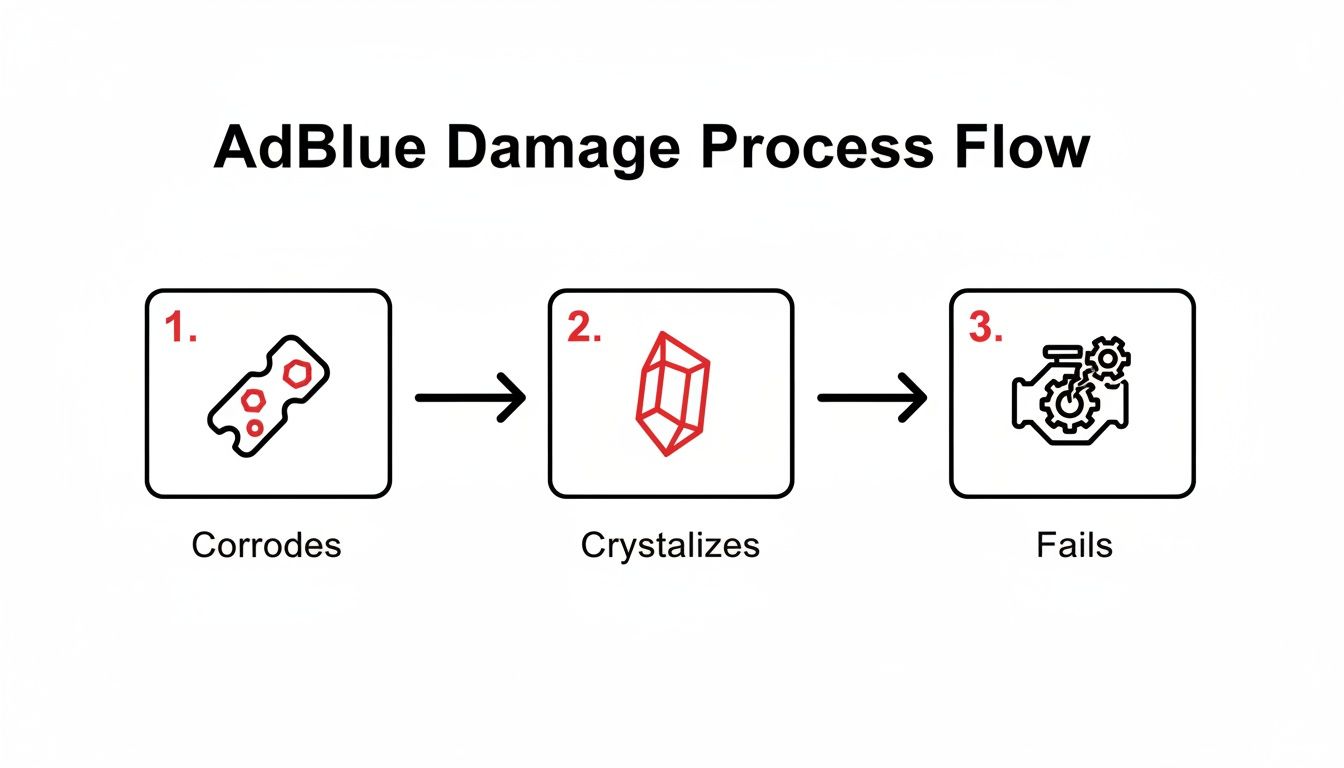
As you can see, it corrodes metal, forms hard crystals, and eventually causes major parts to fail. Our job is to stop this process in its tracks.
It's More Than Just the Tank
Getting the tank empty is just the first step. The real skill is in flushing the entire fuel system to hunt down and eliminate any traces of the AdBlue. Even a tiny amount can wreak havoc on your engine's sensitive components.
Our technicians follow a strict, systematic cleaning procedure, targeting key areas:
Fuel Lines: We push a cleaning solution through the lines that run from the tank right up to the engine, clearing out any hidden pockets of contamination.
Fuel Filter Housing: This part of the system is a natural trap for gunk. We take out the old filter, meticulously clean the housing, and then fit a brand-new filter.
Injectors and High-Pressure Pump: This is the critical part. We use a special cleaning mix with fresh diesel to prime and flush the entire system. This dissolves any crystals before they get a chance to form a blockage.
This comprehensive flush is absolutely non-negotiable. I've personally seen cars that had a "quick flush" elsewhere, only to end up with injector failure weeks later. The driver thought they were in the clear, but the damage was already done. If you're curious about the complexities, our guide on how to drain a fuel tank safely breaks down why this is a job for the pros.
The Final Checks to Get You Back on the Road
Once the system is spotless, we’ll add a good amount of clean, fresh diesel to your tank. We then prime the fuel system to get rid of any airlocks before starting the engine. We don’t just start it and leave, though. We'll let it run for a while, making sure everything sounds and feels exactly as it should.
Our Promise: A proper technician never just drains your tank and disappears. We run diagnostic checks to ensure your vehicle is running perfectly before we even think about calling the job done. We also take care of disposing of the contaminated fuel legally and safely, so you don't have to worry about it.
This methodical, expert approach is the only way to truly protect your vehicle from the severe damage AdBlue can cause. It turns a potential nightmare scenario into little more than a roadside inconvenience, letting you drive away with total peace of mind.
The Financial Reality of an AdBlue Error
Let's cut to the chase. The first thought that rockets through your mind when you realise you've put AdBlue in a diesel tank by mistake is always, "How much is this going to cost me?" And honestly, the answer can be anything from a frustrating inconvenience to a financial nightmare. It all hangs on one simple, crucial factor: whether or not you started the engine.
If you caught the mistake right there at the pump and haven't so much as touched the ignition, you can take a deep breath. It's not great, but it's manageable. The problem is contained, trapped in the fuel tank for now. In this best-case scenario, you're likely looking at the cost of a professional roadside fuel drain and system flush, which is a world away from the price of major mechanical surgery.
When the Engine Has Been Started
Things get a lot more serious if you've turned the key. The moment that engine fires up, the AdBlue is pulled from the tank and begins its destructive journey through the high-pressure fuel system. At this point, the costs don't just climb; they skyrocket. What was a simple call-out fee now has the potential to become a genuinely ruinous garage bill.
It's shocking how little it takes to cause chaos. Recent industry research showed that the average repair bill for AdBlue contamination hit £1,800 in 2023. Even more sobering, a staggering 22% of those cases needed major engine work that sent costs spiralling past £5,000. We've seen firsthand how just 100ml of AdBlue can clog a fuel filter by 80%, and a mere 200ml can utterly destroy a high-pressure fuel pump in less than 20 miles. You can read more about how even a small amount of AdBlue in your diesel tank causes severe damage on our blog.
A Word of Warning: Don't assume your car insurance will bail you out. Most standard policies have specific exclusions for misfuelling damage. They typically classify it as driver negligence, not an insurable accident, leaving you to foot the entire bill.
Estimated Repair Costs Scenario Comparison
To put it in black and white, here's a look at the two very different paths this mistake can take. The financial gap between them is huge.
Scenario | Typical Actions Required | Estimated Cost Range (£) |
|---|---|---|
Engine Not Started | Mobile fuel drain, system flush, new fuel filter. | £200 - £400 |
Engine Has Been Run | Full fuel system drain, replacement of fuel pump, injectors, filters, and potentially SCR system components. | £1,500 - £7,000+ |
As you can see, that one decision—to start the car or not—can literally save you thousands of pounds. It's the difference between a frustrating afternoon and a financial crisis. The upfront cost of a professional fuel drain is a small price to pay to avoid the astronomical expense of rebuilding your vehicle's entire fuel and emissions system.
How to Avoid Making the Same Mistake Twice
Once you’ve dealt with the stress and expense of a misfuelling incident, the last thing you want is a repeat performance. Let's be honest, it's usually a simple moment of distraction that catches us out – maybe you’re in a rush, taking a call, or just at an unfamiliar petrol station. That’s all it takes to accidentally put AdBlue in a diesel tank.

The good news is that you can make this a one-time mistake. Car manufacturers have tried to help; the AdBlue filler neck is much smaller than a standard diesel nozzle, so you can't put diesel in the AdBlue tank. The problem is, it doesn't work the other way around. The slim AdBlue nozzle fits perfectly into the wider diesel filler neck, and that's where the trouble starts.
Creating a Fail-Safe Fuelling Routine
The best way to protect yourself is to build a solid mental checklist that you run through every single time you open that fuel flap. It takes seconds, but it can save you thousands.
Spot the Blue Cap: First thing’s first. Before you even touch a pump, open your car's fuel flap and consciously look for the bright blue cap of the AdBlue tank. Seeing it and acknowledging it helps your brain separate it from the main diesel filler.
Check the Nozzle Colour: This is your biggest visual clue. In the UK, diesel pump nozzles are almost always black, and AdBlue nozzles are blue. A quick glance to confirm you're holding the black one is a simple, foolproof step.
Read the Labels: Don't just go on autopilot. The pump and your car's fuel cap are clearly marked. Take that extra second to actually read the word "DIESEL" or "AdBlue" before you put the nozzle anywhere near the hole.
When you combine these three small habits, you create a powerful defence against a very simple slip-up.
Pro Tip for Shared Cars: If you share your car with a partner or family member, the risk of a mix-up is much higher. A brightly coloured, unmissable sticker inside the fuel flap saying "DIESEL ONLY – NO BLUE NOZZLE" can be a surprisingly effective reminder for everyone.
For businesses running a fleet, the stakes are even higher. I heard about a logistics firm in Manchester that had five separate AdBlue-in-diesel incidents over just six months. The total repair bill came to a shocking £12,000, and it was all put down to a lack of proper driver training. You can read more about the costly impact of staff misfuelling mistakes to see how quickly it adds up.
Ultimately, it all boils down to being mindful. Just slow down for five seconds at the pump. That's all it takes to turn this expensive mistake into a one-time lesson instead of a recurring nightmare.
Frequently Asked Questions About AdBlue Misfuelling
That sinking feeling when you realise you’ve just poured AdBlue into your diesel tank is often followed by a flood of questions. Panic can easily take over, but what you need right now are clear, no-nonsense answers. As specialists who deal with this exact problem day in and day out, we’ve heard every question in the book. Here are the answers to the most common ones we get from drivers in your situation.
I Only Put a Tiny Bit of AdBlue In. Is It Still a Problem?
Yes, it's a huge problem. This is probably the number one thing people ask, hoping for good news. Unfortunately, the answer is always an emphatic yes.
Even a tiny amount of AdBlue – we’re talking as little as half a litre in a full tank – is more than enough to cause thousands of pounds in damage if you start the car.
AdBlue is essentially a water-based solution, and it has zero lubricating properties. Your diesel fuel system, particularly the high-pressure pump and injectors, depends entirely on the natural oiliness of diesel to stay lubricated. When AdBlue gets in there, it’s like replacing oil with water. Metal components start grinding against each other almost instantly. On top of that, it’s corrosive and will start eating away at sensitive parts of your fuel system.
The urea in AdBlue also crystallises when it meets diesel, forming hard, abrasive clumps. These crystals will quickly block your fuel filter and injectors, starving the engine of fuel and causing it to fail.
Can I Just Top Up with Diesel to Dilute It?
Absolutely not. It’s a common thought, but it’s a dangerous one that will only guarantee damage. AdBlue and diesel don’t mix like squash and water.
Because AdBlue is mostly de-ionised water, it's much denser than diesel. It sinks straight to the bottom of the fuel tank. And guess where the fuel pickup pipe is? Right at the bottom.
What Really Happens: When you add more diesel, you're just putting it on top of a concentrated puddle of AdBlue sitting at the bottom of the tank. The moment you turn the key, that pure, corrosive AdBlue solution is the very first thing your fuel pump will suck up. Dilution is a myth in this scenario; complete removal is the only fix.
This isn't just a minor inconvenience; it's a major safety issue. A European-wide report by ESTA highlighted widespread engine failures linked to AdBlue contamination, with most incidents leading to vehicles breaking down on the road. You can discover more about these safety findings on cranebriefing.com to understand why cutting corners is never worth the risk.
How Long Does the Repair Process Take?
This all boils down to one simple question: did you start the engine? Your answer changes everything.
If the Engine Was NOT Started: You're in luck. If you realised the mistake at the pump and didn't touch the ignition, the fix is relatively quick. A mobile fuel drain technician can usually sort everything out at the roadside in about 60 to 90 minutes. We’ll drain the contaminated fuel, flush the lines, and get you going again with fresh diesel.
If the Engine HAS Been Started: The situation is far more serious. If you’ve run the engine, even for a minute, your car will almost certainly need to be towed to a garage for major repairs. The job could involve replacing the entire fuel system—pumps, injectors, lines, and filters. This can take anywhere from several days to over a week, depending on how quickly the garage can get the parts.
Your first move after the misfuel is the one that counts. A quick call to a professional will save you a world of time, money, and stress.
Made the mistake of putting AdBlue in your diesel tank in Suffolk or the surrounding areas? Don't panic and don't start the engine. Call Misfuelled Car Fixer immediately for 24/7 emergency roadside assistance. We’ll get you safely back on the road. Visit us at https://www.misfuelledcarfixer-suffolk.co.uk.


