



AdBlue in Fuel Tank by Mistake? A Suffolk Driver's Guide
- Misfuelled Car Fixer

- Jan 16
- 13 min read
It’s a heart-sinking moment every diesel driver dreads: you’ve just put AdBlue into your fuel tank by mistake. Your very next action is absolutely critical and can be the deciding factor between a simple fix and a repair bill running into the thousands.
What you do in the next five minutes makes all the difference.
AdBlue in Fuel Tank by Mistake | The First Five Minutes: What To Do After An AdBlue Mistake
That sudden realisation at the pump can easily spark panic, but how you react will determine whether this is a minor inconvenience or a total financial disaster. There's one golden rule that you absolutely cannot break: do not start the engine. Don't even turn the key in the ignition.
So, why is this so important? AdBlue is a water-based solution, which makes it heavier than diesel. It will immediately sink to the bottom of your fuel tank, which is exactly where your fuel pump draws from. The moment you start the car, that corrosive fluid gets pulled directly into the delicate and expensive components of your fuel system.
Your Immediate Action Plan
First things first, take a deep breath and stay calm. Panicking won't help. Take your keys completely out of the ignition to remove any chance of accidentally starting the car.
If you're at a petrol station, let the staff know what's happened. They've seen it all before and can help by coning off the pump to keep other drivers safe.
Next, you need to move the car. Pop it into neutral. If you have someone to help you and it's safe to do so, push the vehicle to a designated parking spot, well away from the busy pumps. Whatever you do, resist the temptation to start it, even just to move it a few feet.
The most crucial thing to remember is this: if the engine hasn't been started, the AdBlue is still contained within the fuel tank. Once that engine runs, even for a few seconds, you've circulated the problem through the entire fuel system. That's when the potential for serious damage skyrockets.
This simple decision-making process is the key to managing the situation effectively.
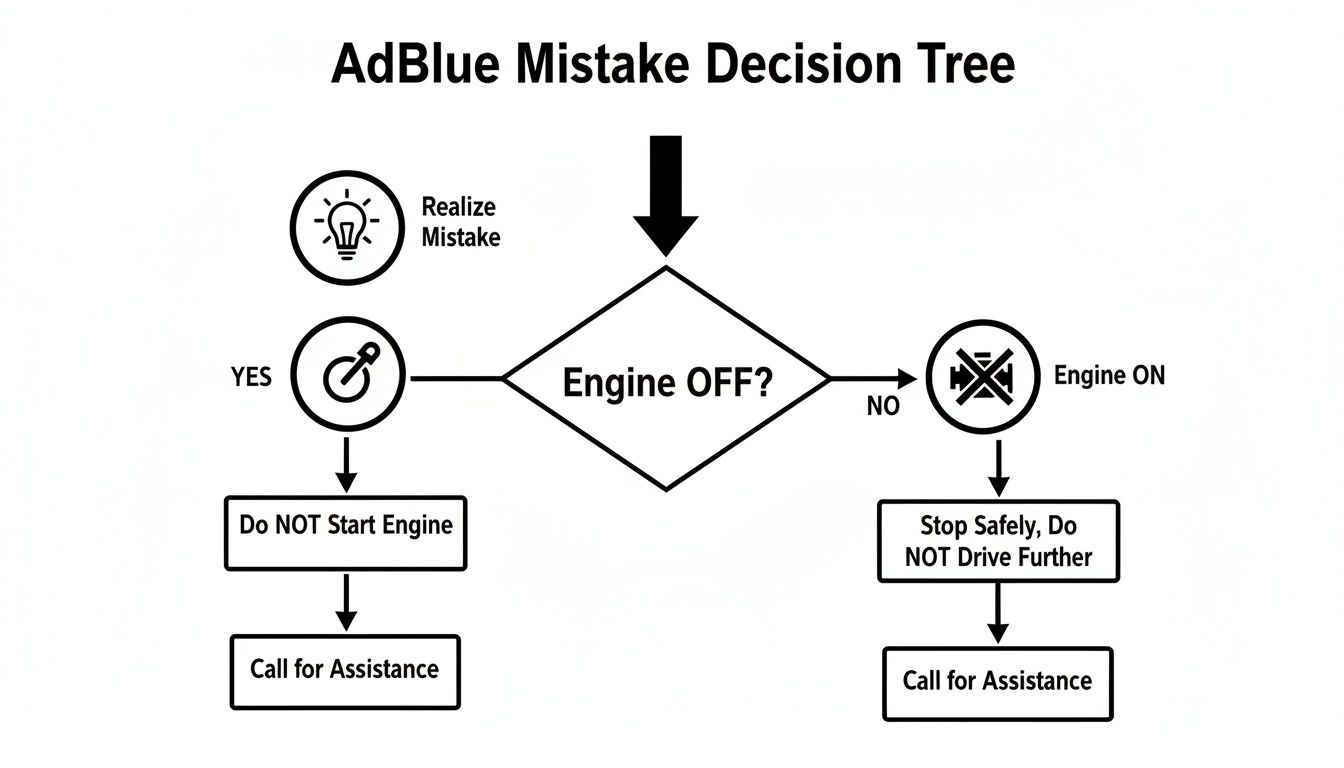
As you can see, keeping the engine off is your safest and most direct path to getting professional help without risking your engine's health.
For a quick reference, here's a simple table summarising what you should and shouldn't do.
Immediate Do's and Don'ts for AdBlue Contamination
Action (DO) | Why It's Important | Action to AVOID | Why It's Dangerous |
|---|---|---|---|
Stay calm and remove keys. | Prevents accidental engine starts and allows clear thinking. | Starting the engine. | Circulates corrosive AdBlue through the entire fuel system, causing severe damage. |
Inform petrol station staff. | Ensures the area is made safe for others and prevents further use of the pump. | Turning on the ignition. | Can prime the fuel pump, pulling the AdBlue into the fuel lines. |
Put the car in neutral. | Prepares the vehicle to be moved without engine power. | Trying to 'flush' it out. | Driving with AdBlue in the tank will only make the damage far worse. |
Push the car to a safe place. | Clears the fuel pump and moves you out of a high-traffic area. | Ignoring the problem. | AdBlue will corrode metal components in the tank and fuel system over time. |
Following these steps minimises the risk and sets you up for the most straightforward solution: a professional fuel drain.
A Growing Problem on UK Roads
Believe it or not, this mistake is becoming increasingly common. AdBlue-in-diesel mix-ups now account for a massive 22% of all misfuelling call-outs. It’s a trend we've seen rise sharply across Suffolk, particularly in areas like Ipswich and Bury St Edmunds. With millions of modern diesel cars now requiring AdBlue, and the two filler caps often located side-by-side, it's an easy mistake to make when you're in a hurry.
Once your vehicle is in a safe spot, the next step is to call a professional. Have your location, vehicle make, and model ready to go—this will help them get to you faster. A specialist mobile fuel drain service is the only correct way to sort this out. They can come to you and fix the problem on the spot.
If you want to understand the full process, take a look at our guide on how to safely drain a fuel tank after misfuelling. Acting fast and getting the right help is your best bet for avoiding long-term damage and getting back on the road.
How AdBlue Wrecks a Modern Diesel Engine
To really get your head around why putting AdBlue in your fuel tank is so disastrous, you need to stop thinking of it as just mixing two liquids. It’s more like a full-scale chemical assault on your engine. Modern diesel engines are incredibly precise pieces of engineering, built to operate with hair's-breadth tolerances. Diesel fuel does more than just burn; it's also a vital lubricant for high-pressure parts like the fuel pump and injectors.
AdBlue completely throws that system into chaos. At its core, it’s just 32.5% urea and 67.5% deionised water. Neither of those ingredients has any lubricating properties at all. The moment that watery solution gets sucked out of the tank, the damage begins.
The Two-Stage Attack on Your Fuel System
The whole destructive process happens in two brutal phases. The first is instant and mechanical, while the second is a slower chemical reaction that really seals the deal.
1. Immediate Lubrication FailureThink of your high-pressure fuel pump as the heart of the engine, forcing diesel into the injectors at pressures that can top 2,000 bar. It’s designed to be constantly bathed in the oily film of diesel fuel to keep all its metal parts moving without tearing each other apart.
When AdBlue hits the pump, that protective film is gone in a flash. You get metal grinding on metal, which immediately causes severe wear and sends a shower of tiny metal fragments down the fuel lines toward your injectors.
2. Destructive CrystallisationHere’s where the long-term, wallet-emptying damage happens. As the AdBlue solution sits in the fuel lines or cools down after the engine is off, the urea starts to form hard, abrasive crystals. It’s like pouring fine sand directly into your fuel system.
These microscopic crystals wreak havoc from one end of the system to the other:
Clogging Fuel Filters: They’ll choke the fuel filter in no time, starving the engine of diesel and causing it to judder to a halt.
Scouring Injectors: The abrasive crystals blast the delicate nozzles of the fuel injectors, ruining the fine spray pattern needed for proper combustion. This leads to rough running, a lot of smoke, and ultimately, total injector failure.
Contaminating the Entire System: These crystals will line the fuel tank, the pump, and every single fuel line. A simple drain just won’t cut it; the entire system needs to be professionally flushed to get them out.
The bottom line is this: AdBlue is fundamentally incompatible with every single component of a diesel fuel system. It replaces a crucial lubricant with a corrosive, crystal-forming contaminant. This is exactly why running the engine for even a few seconds can turn a straightforward roadside drain into a repair bill running into thousands of pounds.
We see the aftermath of this all the time on callouts across Suffolk. A driver who realised their mistake and never turned the key might be looking at a few hundred pounds for a proper tank drain and flush. By contrast, we recently helped a driver who’d made it just down the road from a petrol station in Ipswich. That short journey was enough to require a new fuel pump, a full set of injectors, and a complete system clean, pushing the bill well over £4,000.
To get a better handle on what this fluid is actually for, you can read our guide on what AdBlue is for diesel drivers, which explains why it absolutely must go in its own, separate tank.
Spotting the Telltale Signs of AdBlue Contamination
So, what happens if the penny doesn't drop until you're already back on the road? If you've put AdBlue in your fuel tank by mistake and started driving, your car isn't going to suffer in silence. It will give you some very clear, and very urgent, signals that something is seriously wrong.
These symptoms pop up because the engine is being starved of the lubricating diesel it needs. Instead, it’s being fed a corrosive, watery solution that it simply can't handle. Recognising these signs immediately is your best shot at pulling over safely and stopping the damage from spreading right through the fuel system.

What to Look for While Driving
The first signs can show up within minutes, sometimes just seconds, after pulling away. How bad it gets often depends on how much AdBlue is mixed in with the diesel, but the symptoms are usually unmistakable and they get worse fast.
Keep an eye—and an ear—out for any of these classic signs:
The engine struggles or won't start at all. If you stopped briefly after fuelling and then tried to restart, the engine might just turn over weakly or refuse to catch.
A major loss of power. The car will feel sluggish and completely unresponsive, almost like you're trying to drive with the handbrake on. Acceleration will feel like a distant memory.
The engine cuts out completely. This is the scary one. The vehicle might judder violently and then the engine just dies, often while you're moving. It’s incredibly dangerous, especially on busy roads like the A14 or A12.
Rough, erratic idling. When you’re stopped at a light, the engine might shake or sound incredibly uneven as it tries and fails to burn the contaminated fuel.
Thick white smoke from the exhaust. This isn't your normal puff of vapour on a cold morning. AdBlue contamination can produce huge, white plumes as the water-based solution gets vaporised in the hot engine.
These aren't subtle hints. They are your car's emergency flares, telling you to act immediately.
Understanding the Dashboard Warnings
Along with the physical symptoms, your dashboard is going to light up like a Christmas tree. While the exact symbols can differ between manufacturers, a few warning lights are universal signs of a critical engine problem.
We recently helped a delivery driver near Felixstowe who felt his van losing power just as the engine management light started flashing. He pulled over straight away. That quick reaction saved him from a catastrophic engine failure, turning a potential £5,000 bill into a simple roadside fuel drain.
You'll almost certainly see one or more of these:
The Engine Management Light (EML): That familiar amber light shaped like an engine block. It’s your car’s primary way of saying "I have a serious problem."
AdBlue System Warnings: Modern diesels often have specific alerts for their emissions systems. You might get a message like "AdBlue System Fault," which can be confusing because the issue is contamination, not an empty AdBlue tank.
Flashing Glow Plug Light: On many diesel models, a flashing glow plug light is another common signal for a major fuel system error.
If you see any of these lights or feel any of those symptoms right after filling up, there's only one thing to do: find a safe place to stop, turn off the engine, and call for professional help.
Of course. Here is the rewritten section with a more natural, human-expert tone.
Why a Professional Fuel Drain Is the Only Real Solution
When you’re stuck on the side of the road after putting AdBlue in the diesel tank, it’s tempting to think about a quick DIY fix. You might figure you can just siphon out the contaminated fuel, pour in some fresh diesel, and be on your way. I've heard this a few times, but honestly, it’s a terrible idea – one that’s not just ineffective but genuinely dangerous.
Dealing with a diesel-AdBlue mix isn’t like tipping out a bucket of water. You're handling a flammable, toxic liquid that’s also an environmental hazard. Calling in a professional isn’t a luxury; it's the only way to ensure your safety, stay on the right side of the law, and properly protect your vehicle from serious damage.
The Dangers of a DIY Fuel Drain
Trying to drain the tank yourself is fraught with risk. The biggest and most immediate danger is from static electricity. Using standard plastic containers and a bit of hose from a DIY shop is a recipe for disaster. The friction can build up a static charge, creating a spark – and around diesel fumes, a single spark is all it takes for a fire or even an explosion.
Beyond the fire risk, a simple siphon will never get all the contamination out. AdBlue is denser than diesel, meaning it sinks and settles at the bottom of the tank. You’ll always leave behind a corrosive residue that’s just waiting to crystallise and get sucked into your fuel pump the second you turn the key.
A DIY siphon for an AdBlue mistake is like trying to perform surgery with a kitchen knife. You might think you’re solving the problem, but you’re causing far more internal damage and completely missing the critical issues that only a specialist can see and fix.
Specialised Equipment Makes All the Difference
The gear we use on our mobile units across Suffolk is specifically designed for this job. It's not something you can just buy off the shelf at a motor factors.
Our vans are equipped with:
Intrinsically Safe Pumps: These are certified spark-proof pumps, which completely removes the risk of ignition when we're working around flammable fuel.
Anti-Static Hoses and Grounding: Every piece of our equipment is properly grounded to stop any static electricity from building up while we work.
Dedicated Waste Fuel Tanks: The contaminated fuel is pumped directly into a secure, sealed tank on our vehicle, ready for safe, legal disposal.
But it’s not just about draining the tank. A proper professional service includes a multi-stage flush. Once the tank is empty, we circulate clean diesel through the fuel lines, injectors, and filters to dissolve any urea crystals that have already started to form. This crucial step ensures every last trace of AdBlue is gone before we re-prime the system and get your engine running again.
What Happens to the Contaminated Fuel?
This is the part everyone forgets: what do you do with 50-odd litres of contaminated diesel? You can’t just pour it down a drain or stick it in the bin. That mixture is officially classified as hazardous waste, and its disposal is covered by strict UK environmental laws.
As a licensed and insured service, we handle all of that for you. We take the contaminated fuel to a registered waste management facility where it's processed correctly. Trying to dispose of it yourself can land you with heavy fines and cause real harm to the local Suffolk environment. When you look at it that way, calling a professional is the only sensible choice to protect your vehicle, your safety, and your wallet.
Our Roadside Rescue Process in Suffolk
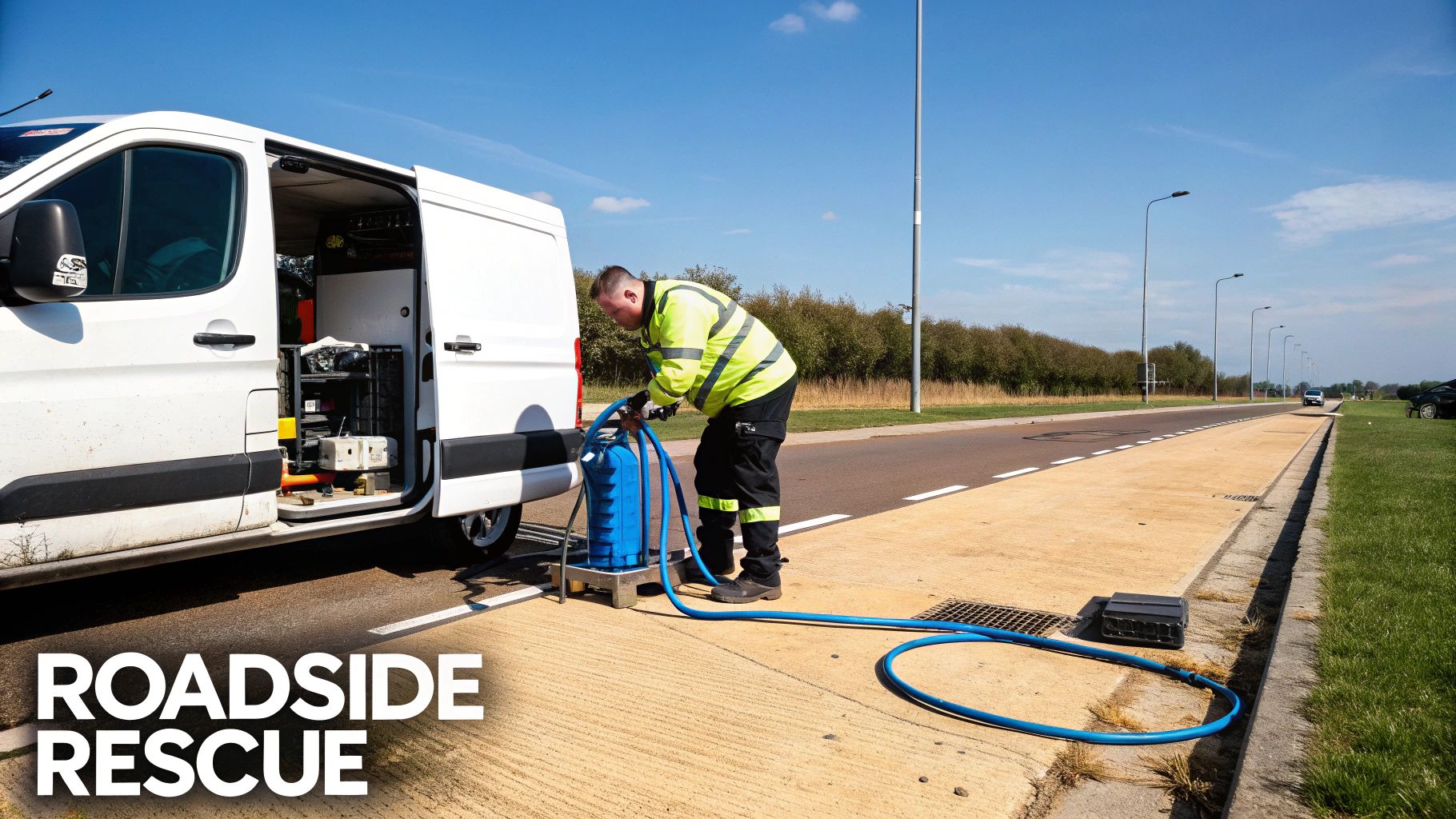
When you're stranded at the roadside, understanding what happens next can make all the difference. That feeling of dread after realising you've put AdBlue in your fuel tank is awful, but knowing a clear, professional plan is swinging into action brings immediate peace of mind. Here’s exactly how our mobile rescue team in Suffolk gets you sorted out.
The moment you call us, our first job is to get the essential details. We'll need to know precisely where you are, whether that's a petrol station forecourt in Ipswich or a lay-by on the A12. We'll also ask for your car's make and model, and of course, the big question: have you started the engine? This info allows us to dispatch the right technician with the correct kit, without any delay.
What to Expect When We Arrive
We'll always give you a realistic and honest ETA. We know you’re in a hurry to get moving again, so we don't make promises we can't keep. Our mobile units are strategically positioned across Suffolk, meaning we can usually get to you surprisingly quickly.
Once our technician is with you, their first priority is to make the area safe for you and for them. They'll then explain exactly what they're going to do, so you’re never left in the dark. The process starts with a complete, professional drain of the contaminated fuel from your tank using our specialised, spark-free pumping equipment.
After the tank is completely empty, we're only halfway there. The next, and most critical, step is to flush the entire system. We use fresh, clean diesel to circulate through and clean the fuel lines, filter, and pump. This is absolutely vital for getting rid of any lingering AdBlue and dissolving the damaging urea crystals that may have already started to form—a common side effect of putting AdBlue in a fuel tank by mistake.
Our approach is built on doing the job right, first time. We don't just drain the tank; we meticulously decontaminate the entire fuel system. This thoroughness is what separates a proper, professional fix from a quick patch-up that could lead to bigger problems down the road.
Finally, we’ll put a good amount of clean diesel back into your tank and get the fuel system primed. Before we even think about packing up, we'll run the engine and carry out final checks to make sure everything is running smoothly and safely. For anyone in Suffolk searching for a dependable "fuel drain near me," knowing this detailed process is being followed should offer total reassurance.
The whole on-site procedure is designed to be as quick and clean as possible. Our goal is to get you back on your journey with minimal fuss, often at a fraction of the cost you'd face at a main dealer.
Common Questions After an AdBlue Misfuelling Mistake
When you’re stuck on the side of the road, heart pounding, your mind will be racing with questions. We get it. We’ve handled countless calls from stressed-out drivers across Suffolk who’ve accidentally put AdBlue in their diesel tank, so we've heard just about every question there is. Here are some honest, no-nonsense answers to the most common ones we hear.
Can I Just Top Up the Tank with Diesel to Dilute It?
It’s a logical thought, and one we hear a lot, but unfortunately, it’s one of the worst things you can do. Topping up the tank won't dilute the AdBlue in any meaningful way.
Because AdBlue is mostly water, it’s denser than diesel. It sinks straight to the bottom of the fuel tank, forming a concentrated, corrosive puddle right where your fuel pump’s intake sits. Trying to dilute it just means we have to pump out and safely dispose of even more contaminated fuel, which ultimately adds to the time and cost of the job.
How Much AdBlue Does it Take to Cause Serious Damage?
Honestly, even a tiny amount can be a disaster if the engine is switched on. You don't need to have poured in half a bottle; just one litre is enough to strip the lubrication from a high-pressure fuel pump and start the damage.
The real problem isn't the quantity you've added, but the corrosive nature of the fluid itself.
The second any of that water-based solution gets drawn from the tank, the damage begins. It’s not about how much is in there; it’s about making sure none of it ever leaves the tank.
On top of that, the urea in AdBlue crystallises when it dries, which means even small amounts can completely block sensitive injectors and filters, leading to system-wide failure.
Will My Car Insurance Cover This Kind of Mistake?
This is a real grey area and depends entirely on your specific policy. Some fully comprehensive plans do include "misfuelling cover," but it's far from standard. It's something you absolutely need to check.
Before you call your insurer, think about these points:
Read the Small Print: Dig out your policy documents (or check your online portal) and search for the term "misfuelling."
What's Your Excess? Often, the cost of a professional fuel drain, especially if you haven't started the engine, is actually less than the excess on your policy.
Protect Your No-Claims: Making a claim will almost certainly impact your no-claims bonus, potentially costing you more in higher premiums over the next few years.
While it's always worth knowing what you're covered for, calling a dedicated mobile fuel drain service is usually the quickest and most cost-effective solution. The price of a straightforward drain and flush is often much lower than the long-term financial hit of an insurance claim.
If you've put AdBlue in your fuel tank anywhere in Suffolk, stay calm and keep the keys out of the ignition. Call the experts at Misfuelled Car Fixer for a rapid, 24/7 roadside rescue. Get in touch right away at https://www.misfuelledcarfixer-suffolk.co.uk for a fast, professional, and affordable fix.
Comments