



Emergency Guide: adblue to diesel for UK drivers
- Misfuelled Car Fixer

- Dec 4, 2025
- 12 min read
Putting AdBlue in your diesel tank is one of those heart-sinking moments, but the next thing you do is absolutely critical. There's one golden rule: do not, under any circumstances, start the engine.
Don't even turn the key to the 'on' position to check the radio. The moment you do, the fuel pump will prime, and that’s when a simple drainage job turns into a potential four-figure repair bill.
What's Really Happening Inside Your Engine?
It’s easy to think AdBlue is just another fluid, maybe some kind of super-additive. It's not. It's basically a mix of urea and de-ionised water, engineered to clean up exhaust gases, not to power your engine. When it gets into your diesel tank, it wages a two-front war on your vehicle's fuel system.
First, AdBlue is corrosive to some of the specific metals and plastics used in fuel lines, pumps, and injectors. But the much bigger, more immediate problem is that it has zero lubricating properties. Think of it like this: your high-pressure diesel pump and injectors are miracles of engineering, with components machined to microscopic tolerances. They rely entirely on the natural oiliness of diesel to keep them running smoothly without grinding themselves to bits. AdBlue, being mostly water, strips that vital lubrication away in an instant.
The Grinding Halt: Mechanical Damage
As soon as that contaminated mixture is pulled from the tank, the fuel pump starts to self-destruct. Without lubrication, metal grinds against metal, shearing off tiny particles. These metallic filings, known as swarf, are then fired at high pressure down the fuel lines, straight into your injectors.
This process essentially sandblasts your entire fuel system from the inside out. It’s a fast and brutal end for some very expensive parts.
At its core, the problem is a battle of opposites. Your fuel system is designed for oil, which lubricates and protects. You've just introduced a water-based solution that cleans, corrodes, and offers no protection whatsoever. They simply can't share the same space without causing catastrophic failure.
The Silent Killer: Crystallisation
If the immediate mechanical damage wasn't enough, a slower, more insidious process is also getting started. When AdBlue is exposed to air and heat inside the fuel system, the urea it contains begins to form hard, white crystals.
These crystals are bad news. They’ll clog your fuel filter, gum up your fuel lines, and completely block the tiny, precise nozzles on your fuel injectors.
This is why just draining the tank isn't enough. A professional flush is the only way to be certain that no crystal residue is left behind to cause running problems weeks or even months down the road. With the UK AdBlue market valued at around $8.26 billion in 2023, it's clear how many vehicles are now at risk of this common and costly mistake. You can read more about the UK's AdBlue market growth to understand just how widespread its use has become.
Your First Moves After Putting AdBlue in Diesel
That sinking feeling in your stomach when you realise the blue nozzle went into the black hole… it’s a moment of pure panic. But what you do in the next 60 seconds is absolutely crucial. It’s the difference between a manageable headache and a repair bill that could run into the thousands.
The single biggest mistake you can make is starting the engine. Don't even turn the key. The second you turn that ignition, the fuel pump kicks in. It’ll start dragging that corrosive AdBlue and diesel cocktail from the tank and force it through the entire fuel system – the pump, the lines, the injectors. That's when the real damage begins.
Picture this: you're at a busy fuel station, maybe the BP on the A14 near Bury St Edmunds. You’ve just made the error, and your first instinct is to quickly move the car out of the way for the next person. Fight that urge. Stay put, take a breath, and think clearly.
Your Immediate Action Plan
Right now, your only goal is to keep the contamination confined to the fuel tank. Inside the tank, it's just a bad mix. Once it gets into the engine, it's a catastrophe.
The moment you realise the mistake, it's time to act—or rather, not act. Here’s a quick-glance guide to get you through those critical first minutes.
Immediate Actions for AdBlue in Diesel Contamination
Action (DO) | Mistake to Avoid (DON'T) |
|---|---|
Take the key completely out of the ignition. | Don't start the engine or even turn the key to the 'on' position. |
Pop the car into neutral. | Don't try to "dilute" the mix by adding more diesel. |
Politely tell the petrol station staff what's happened. | Don't feel pressured to move the car by starting it. |
Ask for help to push the car to a safe spot. | Don't attempt to drain the tank yourself without proper gear. |
By sticking to the 'DO' column, you've already saved yourself a potential fortune. The problem is contained and, at this stage, 100% fixable with a straightforward fuel drain.
This flowchart really brings home just how critical that one decision is.
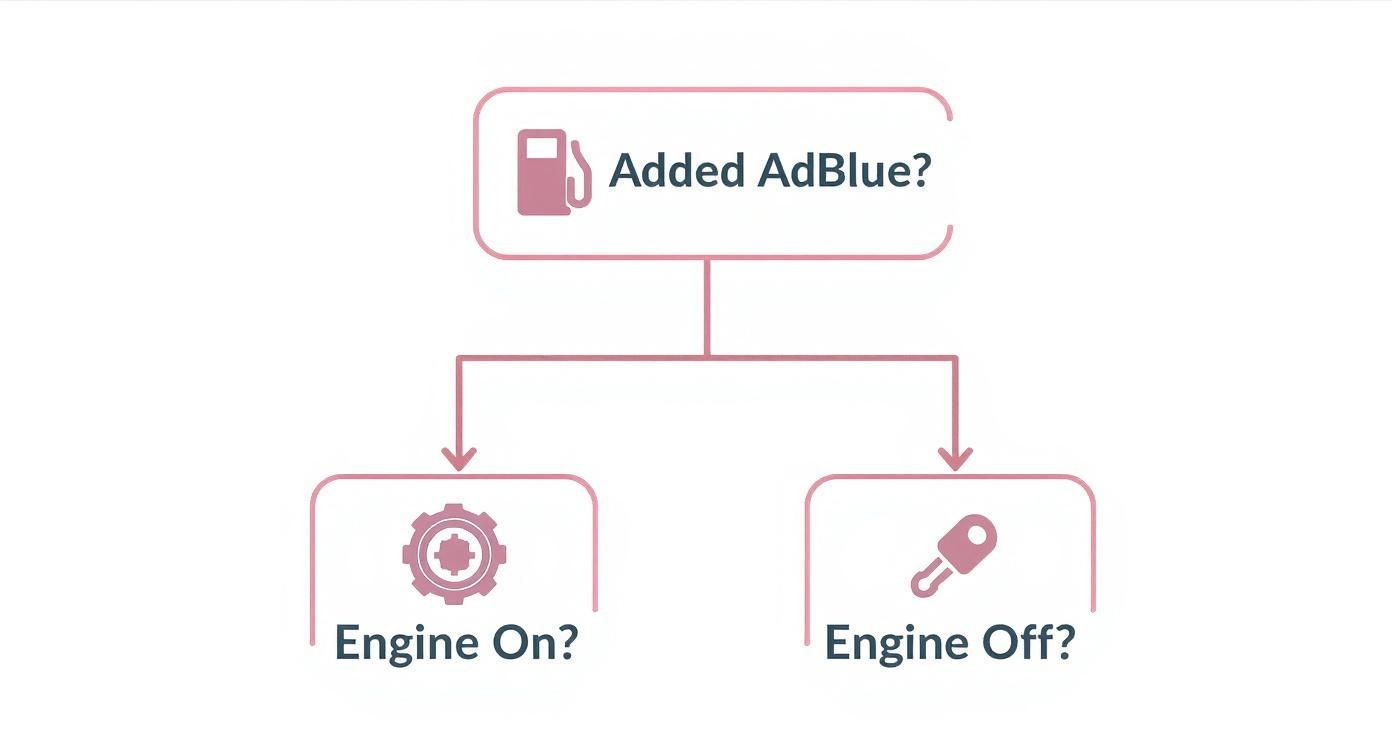
As you can see, keeping the engine off is your ticket to a simple solution. Turning it on? That's when things get complicated and expensive.
What to Avoid at All Costs
In a moment of panic, people try all sorts of things. A common one we hear is trying to top up the tank with diesel to "water down" the AdBlue. It sounds logical, but it doesn't work. All it does is give us more contaminated fuel to drain out, costing you more time and money.
The most important thing to remember is this: the damage from AdBlue in diesel isn't done at the pump. It’s done when the key turns. By keeping the engine off, you hold all the cards.
Once your vehicle is safely out of the way, the next step is to call in a professional. A mobile fuel drain service is exactly who you need – we have the specialist pumps, tanks, and knowledge to handle this safely. If you're stuck somewhere in Suffolk and searching for a fuel drain near me, you'll want a team that can get to you fast. A pro will make sure the contaminated fuel is completely removed and disposed of correctly, getting you back on your way with no lasting damage to your car.
Spotting the Telltale Signs of a Contaminated Engine
So, what happens if you didn't catch the mistake at the pump? It’s a common scenario: you add the AdBlue, start the car, and drive off, completely unaware. The first clue that something is seriously wrong often comes when the vehicle’s performance suddenly drops off a cliff.
Knowing what to look for can make the difference between a simple fuel drain and catastrophic engine damage.

Often, the very first alert you’ll get is the engine management light (EML) flickering to life on your dashboard. This is your car's brain telling you it has detected a major issue with the fuel or exhaust system. Never, ever ignore it. The physical symptoms will almost certainly follow close behind.
How Your Car Will Behave
Once that AdBlue mixture starts making its way through the fuel lines, the engine will start to complain, loudly. You're effectively feeding it a watery solution instead of the lubricating diesel it desperately needs. The signs escalate quickly and are impossible to miss.
Here’s what to watch out for:
Spluttering and Rough Running: The engine will sound uneven and sick, almost as if it's gasping for air. This is the water-based AdBlue solution wreaking havoc on the combustion process.
A Sudden Loss of Power: You’ll hit the accelerator, and it will feel like nothing is happening. The car will become sluggish and unresponsive as the fuel injectors can no longer provide the right mix. Many modern cars will force themselves into a protective "limp mode."
The Engine Cutting Out: In a lot of cases, the engine will just stall and die, especially when you're stopped at a light or moving slowly. It’s the car’s last-ditch effort to prevent further harm.
White Smoke from the Exhaust: This is a classic symptom. The white smoke is essentially steam, created as the water from the AdBlue gets boiled off in the hot exhaust system.
These are not just random glitches; they are direct consequences of the contamination. The urea crystals start clogging the fuel filter, while the water attacks the delicate high-pressure pump and injectors. To get a deeper dive into the science, have a look at our guide on what contaminated diesel fuel drivers need to know.
The second you notice any of these signs after leaving a petrol station, your first thought must be safety. Get your indicator on, find a safe place to pull over, and kill the engine immediately. Every moment it stays running is racking up a potentially bigger repair bill.
With around 11 million diesel cars still navigating UK roads, topping up AdBlue is a routine job for many drivers. A typical AdBlue tank will see you through 5,000 to 8,000 miles, meaning refills are a fairly regular part of modern diesel ownership. If you're interested in the latest trends, you can discover more insights on RAC.co.uk.
What Our Technicians Do to Fix AdBlue in Your Diesel Tank
Calling in a professional when you've misfilled with AdBlue isn't admitting defeat—it's the single smartest move you can make. It's easy to feel a bit embarrassed, but trust me, we've seen it all. Understanding what a qualified fuel technician actually does on the roadside will show you why trying to fix this yourself is a really bad idea. The whole process is a well-oiled machine, designed to be safe, clean, and get you moving again without any lingering damage.
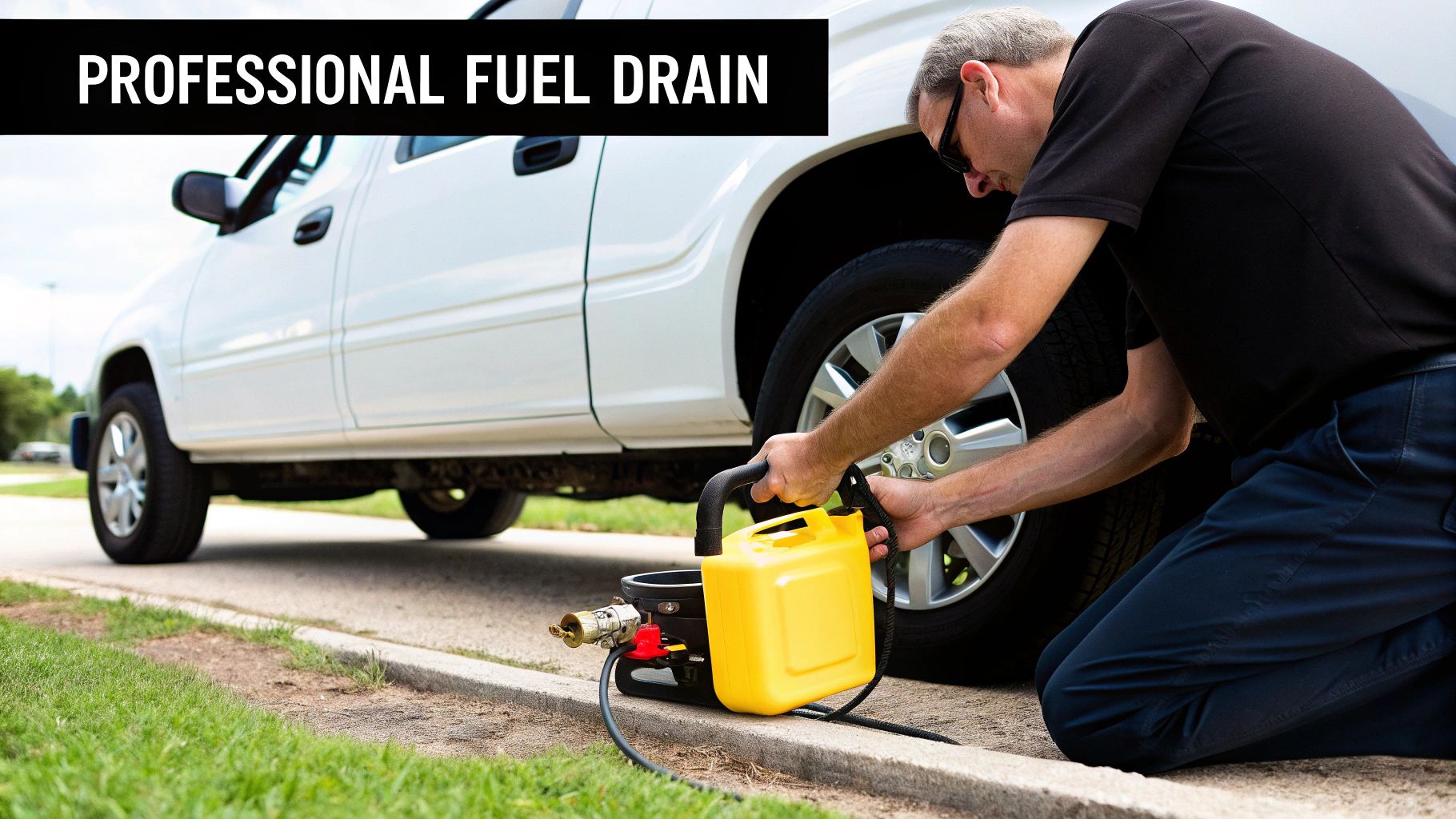
First things first, a technician will secure the area. That means setting up safety cones, identifying any potential ignition sources, and making sure they can get to your fuel tank without any hassle. They won't just rock up with a bit of hose and a bucket; they use specialised, ATEX-approved pumping gear built specifically for handling flammable liquids safely.
The Fuel Drain and System Flush
The main event is, of course, getting every last drop of the contaminated adblue and diesel mix out of your tank. Using a powerful, purpose-built pump, the technician drains the entire contents into a secure container. This is far more than a simple syphon; the equipment is designed to get right into the nooks and crannies of the tank to pull out as much of the contaminant as possible.
But the job is far from over once the tank is empty. This is where real expertise comes into play. The technician then flushes the fuel system from top to bottom with clean diesel. This is absolutely vital, as it forces out any residual AdBlue lurking in the fuel lines, pump, and filter housing. It’s this step that stops those destructive urea crystals from forming later on.
A professional fuel drain is a complete decontamination process. We don't just empty the tank; we systematically clean your vehicle's entire fuel delivery system, from the filler cap to the engine, making sure no harmful residue is left to cause trouble down the road.
Checking Key Parts and Handling the Waste
With the system flushed, the focus shifts to a critical component: the fuel filter. AdBlue contamination almost always wrecks the filter by clogging it with solid crystals. Any decent fuel drain service will include replacing the old, contaminated filter with a brand-new one. This guarantees a clean, unrestricted flow of fuel to your engine.
Before putting fresh diesel in, the technician will also give the accessible components a quick visual check for any obvious signs of corrosion or damage from the AdBlue. Finally, they'll add a bit of clean diesel and prime the system, making sure it’s all running as it should before giving you the all-clear.
So, what about all that contaminated fuel? It's taken away and disposed of following strict environmental laws. This isn't just a box-ticking exercise; it's a crucial part of the service that protects the local environment. Considering that over 80% of heavy-duty diesel trucks in the UK now depend on AdBlue systems, the safe handling of this common mistake is more important than ever. You can discover more about the rise of AdBlue in commercial vehicles to see just why professional, responsible disposal is so critical.
What's This Going to Cost Me? A Look at Repair Bills and Downtime
Once the initial shock of putting AdBlue in your diesel tank wears off, your mind will naturally turn to two things: how much this will cost, and how long you'll be off the road. The answer to both questions hinges on one crucial action: whether or not you started the engine.
Scenario 1: You Haven't Turned the Key
If you caught the mistake at the petrol station and left the ignition off, you can breathe a huge sigh of relief. You've just saved yourself a fortune. This is the best-case scenario, and the fix is a straightforward mobile fuel drain.
A specialist technician will come out to you, whether you're stuck at a Tesco pump in Ipswich or pulled over on the A14 near Bury St Edmunds. They'll perform a full decontamination, which involves much more than just emptying the tank. It’s a complete flush of the fuel system, followed by a fresh filter.
For a standard car or van in this situation, you can expect the cost for a professional fuel drain to be somewhere between £200 and £400. The final price tag can depend on a few things:
Where you are: A call-out to a remote rural location might cost a bit more than one in a town centre.
Your vehicle: A commercial truck with a massive tank will take longer to flush than a family car.
When you call: Expect to pay more for an emergency call-out on a Sunday night or a bank holiday.
The good news is that the whole job is usually done and dusted within 60 to 90 minutes of the technician arriving. You’ll be back on your way with no long-term damage to your vehicle.
Scenario 2: You've Started the Engine
This, unfortunately, is where the story gets much more expensive. Running the engine, even for a moment, pumps the corrosive AdBlue and diesel mixture through the entire high-pressure fuel system. The potential for catastrophic damage is real, and the repair bill can be eye-watering.
The financial difference is staggering. A simple roadside drain is an inconvenience that costs a few hundred pounds. Starting the engine can turn into a workshop repair bill easily topping £5,000 to £10,000 for a full fuel system rebuild—enough to write off many older vehicles.
If you’ve run the engine, your vehicle can't be fixed at the roadside. It will need to be recovered to a garage for a major strip-down. A mechanic will have to inspect every component the contaminated fuel touched. Repairs will likely involve replacing some or all of these critical parts:
High-pressure fuel pump
All fuel injectors
Fuel rail and pipes
The fuel tank itself
The downtime is also a massive factor here. A roadside drain is over in an hour or so. This kind of workshop repair can take days, or even weeks, especially if there are delays in getting the right parts. For any Suffolk-based fleet manager or self-employed driver, that lost time means lost revenue and a serious hit to your business operations.
Your AdBlue Questions, Answered
Once the initial shock of a misfuelling blunder wears off, the practical questions start flooding in. It’s a nerve-wracking situation, and I find that getting straight, honest answers is what helps people the most. Having dealt with countless cases of AdBlue contamination across Suffolk, these are the questions I get asked time and time again.
Will My Car Insurance Cover This?
This is usually the first thing people ask, and unfortunately, the answer isn't great. Most standard car insurance policies do not cover misfuelling damage, whether it’s putting AdBlue in the diesel tank or petrol. It’s almost always seen as a self-inflicted mistake, not a typical accident.
That said, some comprehensive policies or premium breakdown cover packages do include misfuelling assistance as an add-on. It's always worth digging out your policy documents or giving your provider a quick call to be certain. Just don't assume you're covered.
What If I Only Put a Small Amount In?
You’d think a tiny splash of AdBlue in a full tank of diesel wouldn’t be a big deal, but you'd be wrong. AdBlue is fundamentally different from fuel, and even a very small quantity can start to crystallise and strip the essential lubricating qualities from your diesel.
We’ve seen cases where even half a litre of AdBlue in a full tank has been enough to wreck a high-pressure fuel pump the moment the ignition was turned. It's a risk you really don't want to take.
No matter how little went in, the only safe option is to get a professional to drain and flush the system completely. Trying to "water it down" by topping up with more diesel is a common thought, but it absolutely will not work. To get a better handle on why AdBlue is so problematic, it’s worth reading our guide on what AdBlue is for diesel drivers.
Can't I Just Drain the Tank Myself?
The temptation to save a bit of cash with a DIY drain is understandable, but trust me, it’s a terrible idea. First off, you're dealing with diesel—a hazardous and flammable liquid. You need proper, anti-static pumping equipment to handle it safely and make sure there are no sparks.
Second, you'll never get it all out with a simple hose from the shed. Modern fuel tanks are designed with anti-syphon devices and internal baffles, meaning you’ll inevitably leave a dangerous amount of the contaminated mix sloshing around at the bottom.
And finally, what on earth do you do with 60 litres of contaminated diesel? It's classed as hazardous waste, and you can’t just pour it down the drain or take it to the local tip. As professionals, we have the licenses and proper procedures to dispose of it legally and without harming the environment.
How Can I Stop This from Happening Again?
The old saying is true: prevention is always better than cure. The best way to avoid a repeat performance is simply to slow down and be more mindful at the fuel pump. The AdBlue filler cap is almost always blue and smaller than the main diesel one, but when you're in a rush or distracted, mistakes happen.
Here are a few habits I recommend getting into:
Check the nozzle: The AdBlue nozzle is typically blue. Make it a deliberate habit to glance at its colour before you pull the trigger.
Pause for a second: Take an extra five seconds to double-check you've got the right nozzle lined up with the right filler hole. It sounds simple, but it works.
Fit a preventative device: For peace of mind, you can buy specially designed caps that physically block the smaller AdBlue nozzle from ever fitting into your diesel tank's filler neck.
A little bit of routine and awareness can easily make sure this costly mistake is a one-off.
If you've put AdBlue in your diesel tank anywhere in Suffolk, stay calm and, most importantly, don't start the engine. Call the professionals at Misfuelled Car Fixer for immediate, 24/7 roadside help. We'll sort everything out safely and get you moving again. Contact us now at https://www.misfuelledcarfixer-suffolk.co.uk.
Comments