



How to Drain a Gas Tank Safely After Misfuelling
- Misfuelled Car Fixer

- Dec 8, 2025
- 15 min read
It’s a mistake that makes your stomach drop. That moment of distraction at the pump, and now your car is filled with the wrong fuel. Before you let the panic set in, what you do next is absolutely critical.
The most important rule, the one thing you must remember, is this: do not start the engine. Don’t even turn the key to the ignition position. This single action is what keeps the wrong fuel from circulating and causing serious, wallet-busting damage.
Realised You've Misfuelled Your Car? What to Do Right Now
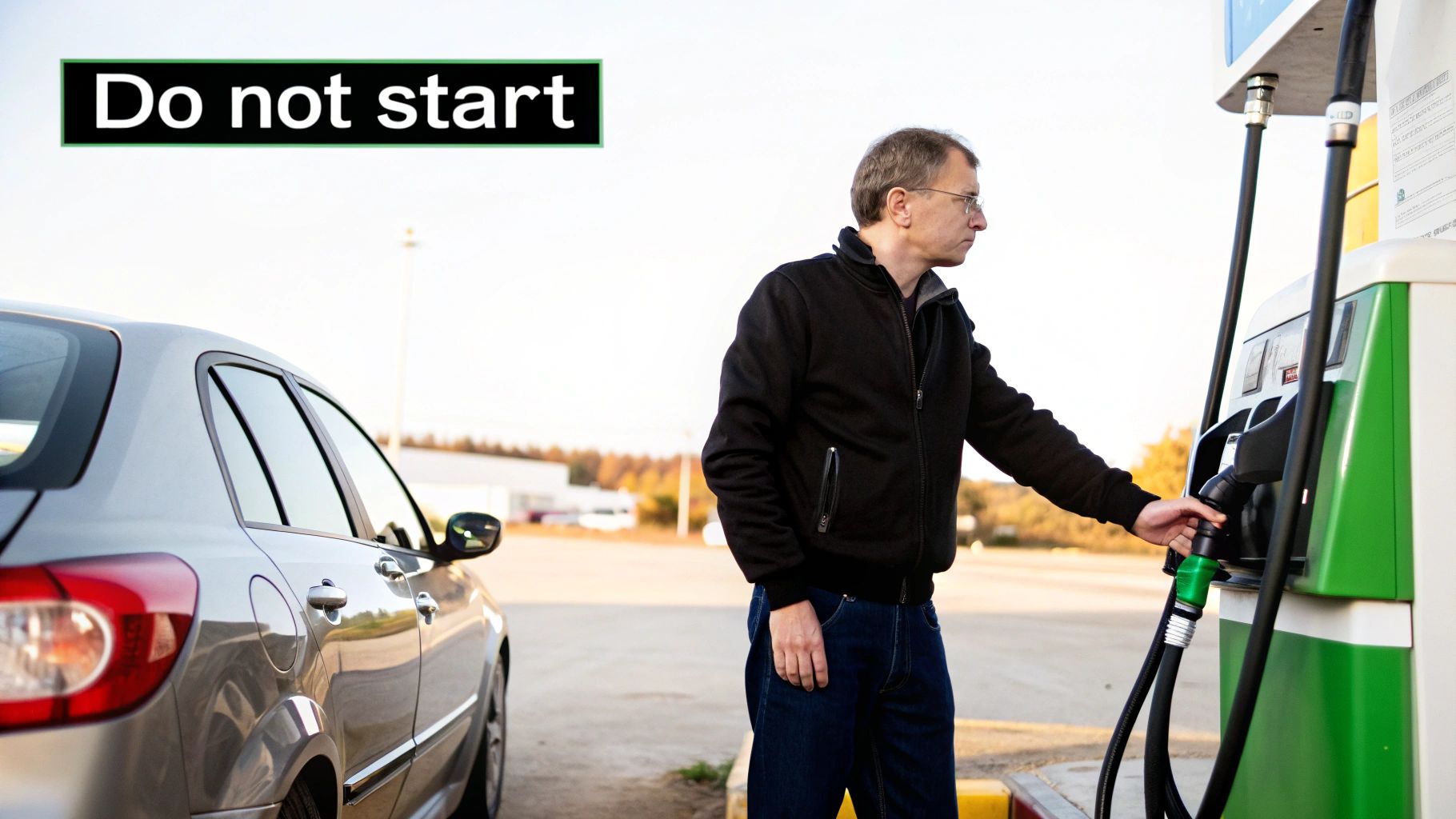
We've all been there—or at least know someone who has. The good news is that if you act quickly and correctly from this moment on, you can almost always avoid any lasting harm to your vehicle. This isn't just a guide on how to drain a fuel tank; think of it as your emergency response plan for these first crucial minutes.
Your top priority is containment. Keeping the wrong fuel safely isolated in the tank is the secret to a simple, affordable fix. The moment you start the engine, you send that incorrect fuel coursing through your car's veins—the fuel pump, lines, and injectors. It's especially damaging if you've put petrol in a diesel car, because diesel fuel acts as a lubricant for these parts, a property that petrol completely strips away.
Misfuelling Emergency Checklist: Immediate Actions
To avoid turning a simple mistake into a mechanical nightmare, here’s a quick-reference checklist. These are the immediate dos and don'ts that can save you thousands.
Action To Take | Why It's Critical | What You Must Avoid |
|---|---|---|
Do NOT turn the key. | This keeps the fuel pump from priming and sending wrong fuel into the engine. | Starting the car, even for a second. |
Inform petrol station staff. | They can help make the area safe and are used to this happening. | Panicking or trying to hide the mistake. |
Put the car in neutral. | This allows you to move the vehicle without engine power. | Engaging the engine to move the car. |
Push the car to a safe spot. | Frees up the pump for others and gets you out of harm's way. | Leaving the car blocking the fuel pump. |
Call a professional fuel drain service. | They have the specialist gear to resolve the issue safely and correctly. | Attempting a DIY drain or calling a general mechanic. |
Following these steps turns a potential disaster into a manageable inconvenience. It's the difference between a quick roadside fix and a costly trip to the garage.
How Different Scenarios Play Out
Where you are when you realise the mistake can change how you feel, but not what you need to do.
Imagine you're at a busy service station on the A14 near Ipswich during the evening rush. It might feel embarrassing to push your car, but it’s the right call. The staff can usually pop some cones around you while you wait for a technician.
Now, picture a quiet, rural petrol station near Stowmarket late at night. The pressure is off, giving you a bit more breathing room to think clearly. But the golden rule is the same, no matter the location or time of day: do not start the car.
Crucial Takeaway: The real damage doesn't happen when the wrong fuel goes into the tank. It happens the moment that fuel gets pumped through the engine. By keeping the ignition off, you hold all the power.
It also helps to know the specifics of your mix-up. For instance, understanding what to do when you've put diesel in a petrol car can be reassuring, as it’s often a less damaging scenario than the other way around.
A professional will arrive with all the right equipment to safely drain the contaminated fuel, flush the entire system, and get you back on your journey without any long-term effects. It’s the only truly safe and effective solution, ensuring your vehicle is handled properly so you can move on from this all-too-common slip-up.
Don't Even Think About a DIY Fuel Drain – Here’s Why
It’s tempting, I get it. You’ve misfuelled, you feel a bit silly, and a quick search online shows dozens of videos that make draining a fuel tank look like a simple weekend task. But trust me, what those videos don't show you is the enormous risk you're taking with your safety, your car, and your wallet.
Modern cars aren't like the old bangers we used to tinker with. Their fuel systems are complex, pressurised networks. Trying to tackle it yourself with a bit of hose and a jerry can is a recipe for disaster.
The Elephant in the Room: Fire
Let's be blunt: the single biggest danger here is a massive fire. Petrol is incredibly dangerous stuff. Its vapour is what’s truly terrifying—it’s invisible, heavier than air, and ridiculously explosive. To put it in perspective, the vapour from just one litre of petrol can have the explosive force of more than 10 sticks of dynamite.
That vapour will creep along the ground, just waiting for something to set it off. And a spark can come from places you'd never expect:
A fleece jumper: The static electricity from your own clothing can be enough.
Dropping a tool: A metal spanner clattering on a concrete floor can create a spark.
The wrong pump: Using a standard water pump or, even worse, a household vacuum cleaner is practically begging for an explosion. Their motors are not sealed and will ignite fumes in a heartbeat.
This is exactly why professionals use ATEX-approved (Atmospheres Explosibles) gear. It's specialist equipment that's certified as "intrinsically safe," meaning it’s engineered to be completely non-sparking. It’s the only equipment that’s legally and safely allowed for mobile fuel draining. If you're going to attempt this yourself, you have to understand the basic principles of fire risk assessment to even begin to grasp the dangers involved.
Damaging Your Health and Your Car
Even if you manage to avoid a fire, the dangers don't stop there. Getting petrol or diesel on your skin can cause nasty chemical burns and irritation. Breathing in the concentrated fumes will leave you dizzy, sick, and with a splitting headache.
Then there’s the car itself. Almost any vehicle made in the last 20 years has an anti-siphon device in the filler neck. It's usually a mesh screen or a rollover valve designed to stop fuel from gushing out in a crash. It also does a very good job of stopping you from shoving a hose down there.
A Word From the Trenches: We see it all the time. Someone tries to force a cheap siphon hose past the anti-siphon valve. They end up either breaking the valve and dropping it into the tank, or worse, puncturing the tank itself. Suddenly, a simple misfuel has turned into a hazardous leak and a repair bill that’s ten times higher.
If you somehow get past that, you risk wrecking the delicate fuel pump, the sender unit, or the fuel lines. It’s a minefield of expensive components.
The Legal and Insurance Nightmare
Let's say you avoid injury and major damage. You still have two massive problems: what to do with the contaminated fuel and what your insurance company will think.
Contaminated fuel is legally classified as hazardous waste in the UK. You can't just pour it down the drain or take it to the local tip—that’s illegal, terrible for the environment, and carries some hefty fines. A professional service is licensed to transport and dispose of this waste correctly and will give you the paperwork to prove it.
And your insurance? Forget it. Most policies have clauses that exclude damage you cause yourself while carrying out repairs. If your DIY attempt leads to a fire or destroys your engine, you'll be on your own, facing the full cost. Calling in a certified professional means the job is done right, creating a clear paper trail that protects you. The few quid you might save by "having a go" is nothing compared to the catastrophic financial risk you’re taking on.
How Professionals Drain and Flush Your Fuel System
So, you've realised the mistake at the pump, and that sinking feeling has hit. When you call in a mobile fuel drain service, it might seem a bit mysterious what we actually do. Let me pull back the curtain. It’s a lot more involved than just sticking a hose in the tank; it's a precise, safety-critical procedure that gets you back on the road without a trace of the wrong fuel.
The whole job relies on specialist, professional-grade gear. The absolute centrepiece of our kit is an ATEX-approved pumping system. This certification isn't just a nice-to-have; it's a legal requirement. It guarantees the equipment is intrinsically safe and won't create a spark, which is vital when you're working with a tank full of volatile fuel vapour.
The Initial Fuel Drain Process
When a technician arrives, the first job is always to make the scene safe. That means parking our van correctly, setting up a perimeter, and making sure there are no ignition sources anywhere nearby.
Next, we get access to your fuel tank. Sometimes we can use the filler neck, but more often than not, we'll go in through the fuel sender unit's access port, usually under a back seat or in the boot. This gives us a much better angle to get every last drop out.
Using the ATEX pump, we carefully transfer all the contaminated fuel from your tank into a secure, specially designed container in our van. This is a million miles from a DIY siphon and a jerry can—it’s a sealed, controlled process that stops spills and prevents you from breathing in nasty fumes.
This is exactly why you don't try this yourself. The risks are incredibly high, as this graphic shows.
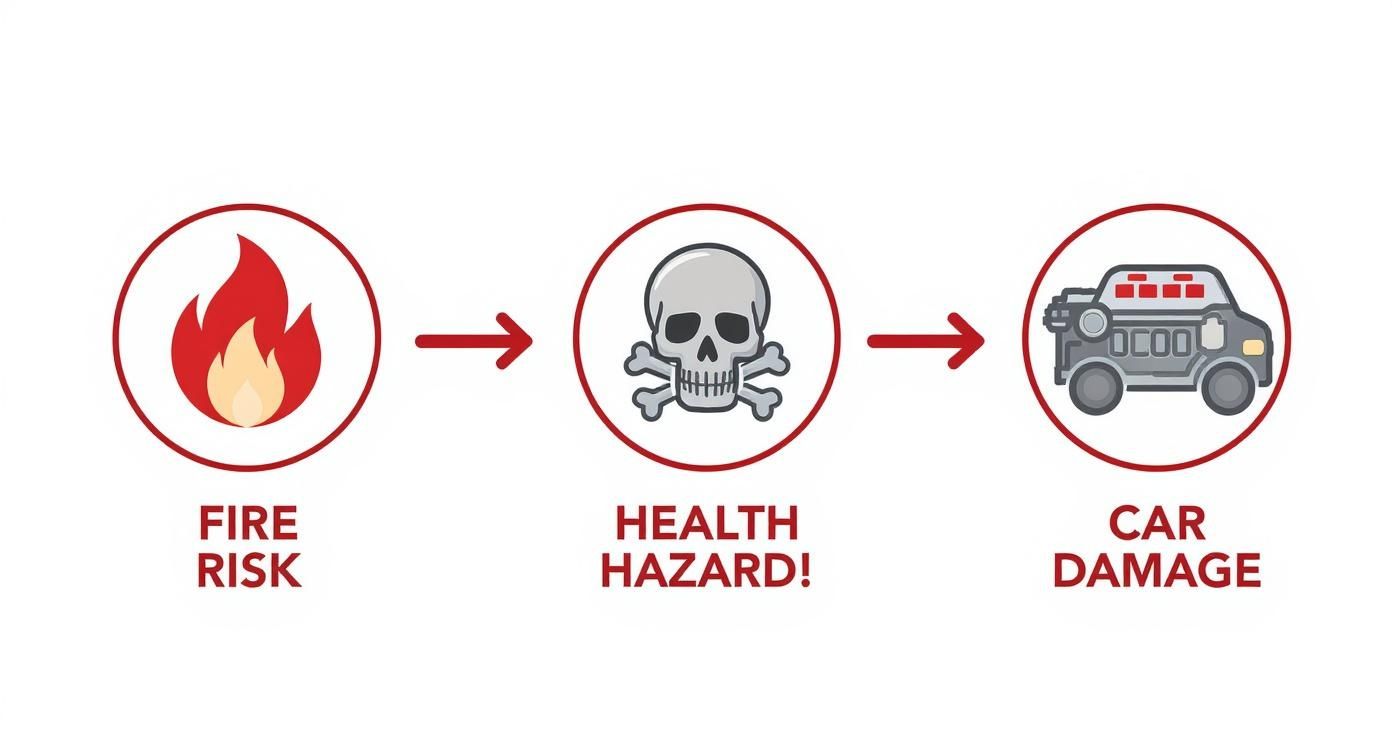
As you can see, it's a chain reaction of potential disasters. Fire, serious health risks, and catastrophic damage to your car are all on the table, which is why our procedures and equipment are designed to manage every single one of those dangers.
Why a System Flush Is So Important
Just draining the tank is only half the story. The real danger lies in the residue left behind in the rest of the fuel system. That's where the flush comes in, and it's arguably the most critical part of the job.
Expert Insight: I can't stress this enough. Leaving even 1% of petrol in a modern diesel system can lower the diesel's flashpoint to dangerous levels. It completely compromises your engine's safety and performance. A thorough flush isn't just good practice; it’s essential.
We'll add a small amount of the correct, fresh fuel back into the tank. We then circulate this clean fuel through the entire system, using it to chase out any lingering contamination from all the nooks and crannies:
Fuel Lines: The thin pipes that snake their way from the tank to the engine.
Fuel Filter: Its job is to catch debris, so you can bet it's trapped a lot of the wrong fuel.
Injectors or Carburettor: These are the delicate, precision-engineered parts that actually deliver fuel into the engine cylinders.
We'll repeat this flushing process until we're absolutely certain that every last millilitre of the wrong fuel has been purged. This attention to detail is what prevents future headaches like engine stuttering, poor performance, or long-term damage to expensive components.
Final Checks and Getting You Moving Again
Once the system is sparkling clean, we'll put a good amount of the correct fuel back in—usually around 5 to 10 litres. That’s more than enough to get you safely to the nearest petrol station for a proper top-up.
But we're not done yet. Before we pack up, we perform final system checks. We’ll start the car and let it run for a few minutes, listening to the engine and making sure it sounds healthy. We'll also scan the dashboard for any warning lights and might even plug in a diagnostic tool to ensure no fault codes have been triggered.
Every step we take is guided by strict UK safety regulations. Handling flammable fuels, especially in a roadside environment, requires adherence to codes that dictate everything from safe working distances to ventilation requirements. It's all about preventing vapour build-up and eliminating any risk of fire.
Now you know exactly how professionals drain a fuel tank, it's easy to see why it's a job best left to the experts. If you're stuck and need help right now, our guide on finding a reliable fuel drain near me has some great localised tips.
What Happens to the Drained Fuel? The Rules for Safe and Legal Disposal
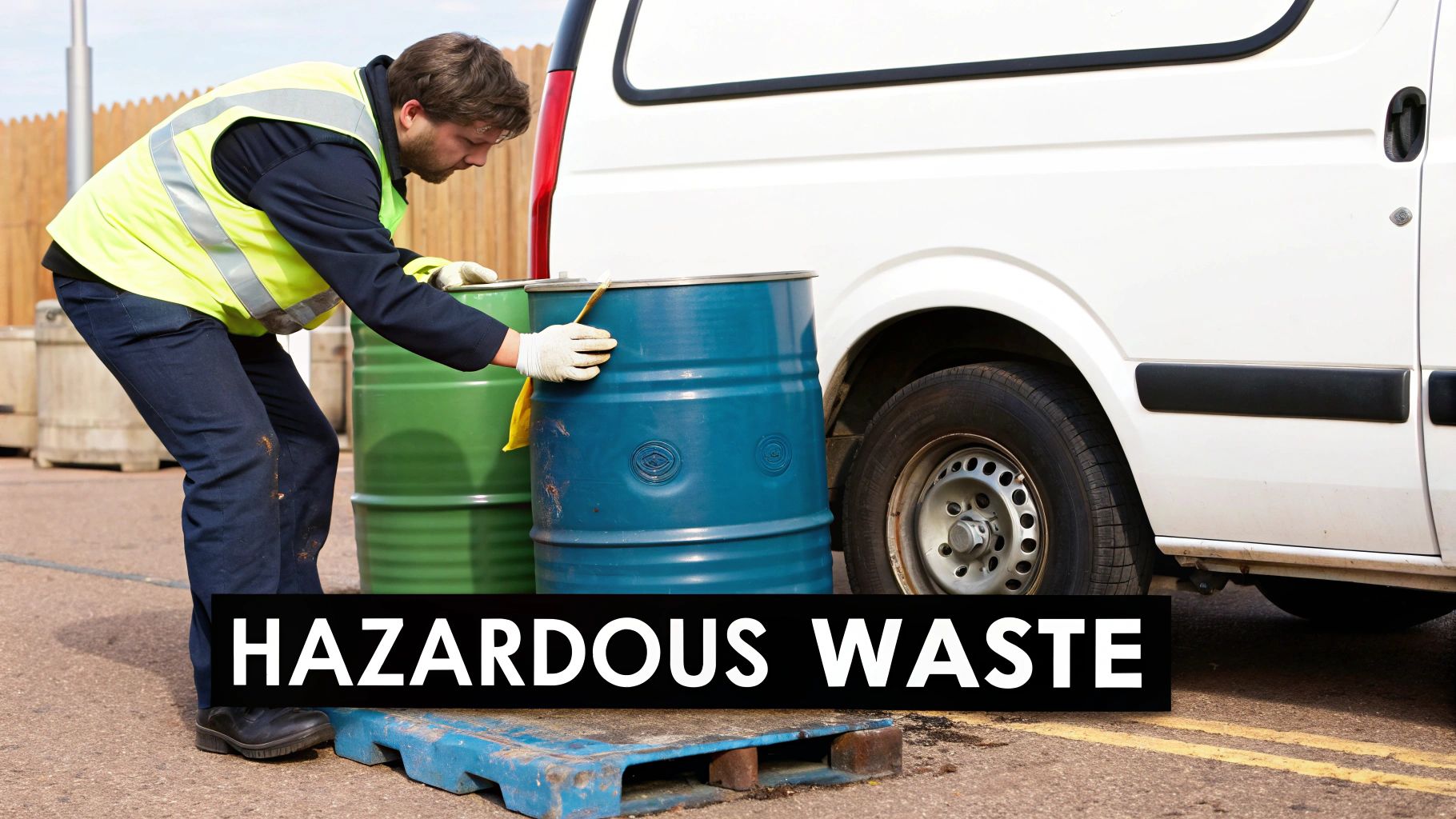
So, you've managed to get the wrong fuel out of your car. That's the first major hurdle cleared, but what you do next is just as important. That mix of petrol and diesel in the container isn't just unwanted fuel; it's officially classed as hazardous waste.
You absolutely cannot pour it down a drain, dump it on a patch of wasteland, or even stick it in your household bin. Doing so isn't just bad for the environment—it’s a criminal offence.
Why It's a Legal Minefield
The UK has incredibly strict laws, enforced by bodies like the Environment Agency, to stop toxic substances from poisoning our land and water. A petrol-diesel mix is a volatile, harmful cocktail that can cause real damage.
If it gets into the water system, it can overwhelm treatment plants and devastate aquatic life. On land, it seeps into the soil and can contaminate the groundwater we rely on for drinking. The potential for long-term ecological harm is huge, and the penalties reflect that.
Crucial Point to Remember: Anyone caught illegally dumping hazardous waste faces massive fines—we’re talking thousands of pounds—and in the most serious cases, even a prison sentence. The authorities take a zero-tolerance approach to environmental crime.
This is precisely why a professional fuel drain service is about so much more than just getting your car running again. It’s about ensuring the entire messy situation is resolved legally and responsibly. For a deeper dive into the specifics, check out our guide on how to drain a petrol tank safely and legally in the UK.
How We Handle Disposal Professionally
When you call out a certified service like Misfuelled Car Fixer, you're not just paying for an expert to empty your tank. You're guaranteeing the entire process, from suction to final disposal, is handled by the book.
Our technicians follow a strict, legally mandated procedure for every job. We are licensed to carry and transport hazardous waste, and the process is meticulously tracked.
Secure Containment: First, the contaminated fuel is pumped directly into specialised, sealed containers on our vans. This prevents any risk of spills during transport.
Licensed Transport: We hold a valid waste carrier licence, a legal must-have for moving hazardous materials on UK roads.
Authorised Disposal Facility: The fuel is then taken to a licensed hazardous waste management site. These facilities have the proper equipment to safely process, recycle, or dispose of the fuel without harming the environment.
Your Proof of Compliance: The Waste Transfer Note
Here’s the most important part for you as the customer: the paperwork. Once we’ve safely disposed of the contaminated fuel, we provide you with a Waste Transfer Note.
This official document is your legal proof that the hazardous waste from your vehicle has been managed and disposed of correctly, in line with all UK environmental regulations. It’s a simple piece of paper that confirms:
Who collected the waste (our company details)
What kind of waste it was (contaminated fuel)
Where it was taken for disposal (the registered facility)
This note is your protection. It absolves you of any legal responsibility for that waste. Without it, if an unlicensed operator were to collect your fuel and then fly-tip it, you could still be held accountable. It’s the final, critical step that closes the loop on your misfuelling mishap, ensuring everything is handled cleanly and legally from start to finish.
What to Expect: Cost and Time

If you're stuck on a petrol station forecourt or the side of a road, two questions are probably racing through your mind: "How much is this going to set me back?" and "How long will this take?" The not-knowing can often be more stressful than the mistake itself. Let's get you some clear answers.
Hiring a professional mobile fuel drain service is almost always the cheapest and fastest way to solve the problem. You get a single, transparent fee to get you moving again. It’s a world away from the potentially massive, spiralling costs of garage repairs if the wrong fuel circulates and damages your engine.
How Much Does a Fuel Drain Cost?
There isn't a single flat rate for a mobile fuel drain in the UK, but the price usually falls within a predictable range. The final quote you get will depend on a few things.
Type of Vehicle: Draining a large 4x4 or a van with a huge tank is a bigger job than a small hatchback. It simply takes more time and effort to get every last drop out.
Your Location: Where you are matters. If a technician has to travel a long way to a remote part of rural Suffolk, it might cost a bit more than if you're stranded in central Ipswich.
Time of Day: An emergency call-out in the middle of the night or on a bank holiday will often have a slightly different rate compared to a standard daytime job.
If You've Started the Engine: If you realised your mistake before turning the key, it's a relatively simple drain and flush. If you've driven the car, the job becomes more complex and takes longer.
Even with these variables, the cost is just a fraction of what you'd be looking at if you had the car towed to a main dealer. The best way to think about it is an investment to prevent a repair bill that could easily climb into the thousands for a new fuel pump, injectors, and filters.
The Bottom Line: A professional fuel drain is a controlled, one-off cost. Taking a chance by driving on or attempting a DIY fix opens the door to uncontrolled, and potentially astronomical, repair bills.
How Long Until You're Back on the Road?
When you’re stranded, your time is just as precious as your money. The beauty of a mobile service is that it's designed for exactly this situation – it’s all about speed and efficiency. We know you’ve got places to be, and our entire process is built to get you out of this jam as quickly as possible.
For anyone in and around Suffolk, our 24/7 service is geared for a rapid response. Once you ring us, we can often have a fully-equipped technician with you in under 60 minutes.
The fuel drain itself is surprisingly quick, too. From the moment our technician arrives, the whole job – draining the tank, flushing the lines, and running all the safety checks – is usually done in about 60 to 90 minutes. This means from that first panicked phone call, you could be safely on your way in less than two hours.
This efficiency comes from pure experience and having the right tools for the job. Our technicians do this every single day and have a system for every make and model. That's a huge contrast to a general garage, where your car could end up sitting in a queue waiting for a mechanic to free up.
Proper, safe fuel handling is also a top priority, echoing the strict standards used in large-scale industries. It's a serious business; in the UK, around 85% of large fuel facilities follow professional draining procedures because nearly 10% of fuel pollution incidents are caused by improper removal. You can find out more about the stringent regulations that govern hazardous substance management in the UK.
Your Misfuelling Questions Answered
That sinking feeling when you realise you’ve used the wrong pump is usually followed by a frantic rush of questions. It's a stressful, high-pressure moment, and you need clear answers, fast. We get calls from drivers all over Suffolk every day, and these are the most common worries we help them with.
Getting the right information right away is the key to sorting this out without a massive headache or a huge bill. Let's tackle some of the biggest concerns you probably have right now.
I've Already Started The Engine – Is It Too Late?
Not necessarily, but you need to act fast. The absolute most important thing is to pull over safely and switch the engine off the second you realise your mistake. Don't touch that ignition again.
The longer the engine runs, the more the wrong fuel gets pulled through the system, reaching sensitive and expensive parts like injectors and the fuel pump. Whatever you do, resist the urge to restart it just to "check if it's still working". In most cases we see, even if you've driven a mile or two, a thorough professional fuel drain and flush can prevent any lasting damage.
Will This Mess Up My Car Insurance or Warranty?
This one's a bit of a grey area, unfortunately. Many standard insurance policies see misfuelling as driver error and won't cover the cost of repairs. Some fully comprehensive plans might include misfuelling cover, but you'll have to dig into your policy documents to be sure.
Likewise, your car's manufacturer warranty is very unlikely to cover damage caused by using the wrong fuel. One thing is crystal clear, though: any damage you cause by attempting a risky DIY drain yourself will almost certainly not be covered. Calling in a professional gives you proof that the problem was handled correctly, which is always your safest option.
Expert Tip: Misfuelling sits in a tricky spot for insurance and warranties. Damage from a DIY fix, however, is almost never covered. A professional service is the best way to protect your car and your wallet.
Do I Really Need a Full System Flush, Or Can I Just Drain The Tank?
Just draining the tank is only half the job, and it’s the half that leaves your car at risk. A simple drain will always leave behind contaminated fuel in the lines, filter housing, and right up to the engine's injectors.
A full system flush is what's needed. Think about it – even a small residue of petrol in a diesel engine is enough to strip away the lubrication it needs, causing premature wear and tear. A professional service doesn't just empty the tank; we push clean, correct fuel through the entire system, making sure every last drop of the bad stuff is gone. It gives your engine a completely fresh start.
What’s Worse: Petrol in a Diesel Car or Diesel in a Petrol Car?
Hands down, putting petrol in a diesel car is far more damaging. It's a costly mistake. Diesel fuel isn't just a fuel; it's also a lubricant for the incredibly precise components in a high-pressure fuel system. Petrol is a solvent, so it does the exact opposite—it washes that lubrication away. This can cause metal-on-metal friction that quickly destroys the fuel pump and injectors, leading to repair bills that can run into the thousands.
Putting diesel in a petrol car isn't good, but it's generally less catastrophic. The thicker diesel oil will clog up spark plugs and cause the engine to smoke, splutter, and eventually stop. However, it doesn't usually cause the same kind of destructive mechanical damage. In most cases, a professional drain and flush will get the car running perfectly again with no long-term harm.
Stuck on the side of a road in Suffolk with the wrong fuel in your tank? Don't risk it and don't panic. Misfuelled Car Fixer provides a 24/7 mobile fuel drain service to get you safely back on your journey. Get in touch with our Suffolk team now.


