



How to Handle adblue in diesel tank: Quick actions and cost tips
- Misfuelled Car Fixer

- Dec 20, 2025
- 16 min read
Updated: Dec 21, 2025
Right, you’ve just put AdBlue in your diesel tank. That sinking feeling in your stomach is completely normal, but your next move is absolutely critical. The most important thing you can do right now is… nothing. Don’t start the engine. Don't even put the key in the ignition. This one simple action can be the difference between a simple fix and a bill for thousands of pounds.
That Sinking Feeling: What to Do Immediately

It’s a moment of pure panic. You see the blue AdBlue nozzle in your hand, the diesel filler cap open, and the realisation hits like a tonne of bricks. What you do in the next few minutes will determine whether this is a manageable hiccup or a financial nightmare for your vehicle.
The golden rule is non-negotiable: do not start the engine. Seriously. Don’t even turn the key to the 'on' position to check the dash or listen to the radio. Most modern diesel cars prime their fuel systems the moment you do that, and the low-pressure pump will immediately start sucking the corrosive AdBlue solution out of the tank and into your fuel lines.
Your Immediate Action Plan
Once you've made sure the engine stays off, take a breath. The situation is still under control. Now it's about making the car safe and getting the right help on the way.
Here’s exactly what you need to do:
Keep It Parked: Don't try to move the car unless it’s in a dangerous spot. If you absolutely have to shift it, get someone to help you push it with the ignition completely off.
Tell the Petrol Station Staff: Let an attendant know what’s happened. They can cone off the pump to keep everyone safe and might even have a number for a local specialist.
Call a Specialist Fuel Drain Service: This isn't a job for your regular breakdown service or a local garage. You need a mobile technician who deals with wrong fuel situations every day.
A specialist has the proper equipment to not only drain the tank but also flush the entire system safely, right there on the forecourt. This is crucial for getting every last trace of AdBlue out before it does any lasting damage.
When you ring for help, have a few details ready. The technician will ask for your exact location, the make and model of your vehicle, and a rough idea of how much AdBlue went in. This helps them come prepared and give you a more accurate ETA. You can find more tips in our guide on what to do when you need a professional for a fuel drain near you in an emergency.
Why Starting the Engine Is So Catastrophic
It’s worth understanding why that 'don't start' rule is so important. AdBlue is essentially a water-based urea solution, and it has zero lubricating properties. Your diesel fuel system, especially the high-pressure pump and injectors, relies entirely on the oiliness of diesel to stay lubricated.
The moment AdBlue gets circulated, it strips away that lubrication. You get metal grinding on metal, which rapidly destroys those incredibly expensive, precision-engineered parts. Worse still, AdBlue is corrosive to many seals and metals in the fuel system and can crystallise as it dries, causing blockages that starve the engine of fuel.
By keeping the engine off, you contain the problem to the fuel tank, making it a much simpler, faster, and cheaper problem to solve.
Immediate Actions vs Costly Mistakes
To make it crystal clear, here’s a quick-glance table of what to do versus what to avoid at all costs.
What You Must Do Right Now | What You Must Never Do |
|---|---|
Keep the engine completely off. | Do not start the car, even for a moment. |
Move the car to a safe place by pushing it, if necessary. | Do not put the key in the ignition or turn on the electrics. |
Alert the petrol station staff about the situation. | Do not attempt to drain the tank yourself. |
Call a professional, mobile fuel drain service immediately. | Do not assume a small amount of AdBlue will be harmless. |
Following the left column keeps the damage minimal and the cost down. Any action from the right column could unfortunately lead to a much more expensive repair.
Right, let's break down exactly what happens when AdBlue ends up in your diesel tank, and why it's one of the most destructive mistakes a driver can make. It’s a bit like putting sand in a Swiss watch.
To get your head around the problem, you need to remember what diesel and AdBlue actually are. Diesel isn't just fuel; it's a light oil that lubricates every part of the fuel system it touches. AdBlue is the polar opposite. It's mostly de-ionised water (67.5%) with a high-purity urea solution (32.5%) mixed in.
Think what happens when you pour water into oil – they refuse to mix. It’s the same inside your fuel tank. Because AdBlue is heavier and denser than diesel, it sinks straight to the bottom. This is a critical problem because the bottom of the tank is exactly where the fuel pump's pickup pipe sits, ready to suck up the first thing it finds.
The moment you turn that ignition key, even if you don't start the engine, the vehicle's low-pressure fuel pump kicks in to prime the system. It immediately starts pulling in the pure, corrosive AdBlue solution. From that point on, it’s a race against time as this destructive liquid begins its journey through your engine's most sensitive components.
The Trail of Destruction Through the Fuel System
Modern diesel engines are incredible feats of engineering, with components built to microscopic tolerances and operating under mind-boggling pressure. They are designed to run on one thing and one thing only: oily, lubricating diesel fuel. Pumping a water-based, corrosive fluid through them is catastrophic.
The low-pressure pump is the first part to suffer, as it pushes the AdBlue towards the engine. But the real carnage happens when it hits the high-pressure fuel pump. This vital component, which can generate pressures over 2,000 bar (that’s nearly 29,000 psi), relies entirely on diesel for lubrication. Without it, the pump essentially eats itself, sending tiny shards of metal down the fuel lines.
These metal particles, now suspended in the AdBlue solution, get blasted towards the fuel injectors. Injectors have incredibly fine nozzles designed to spray a perfect mist of diesel. The abrasive metal fragments and the corrosive AdBlue solution quickly block and ruin these delicate parts, which inevitably leads to total engine failure.
The Double Whammy: Crystallisation
The damage isn't just from corrosion and abrasion. When the water in AdBlue evaporates, the urea is left behind, forming hard, white crystals. As this stuff works its way through your fuel lines, filter, and injectors, these crystals start building up.
It’s like cholesterol in an artery. The crystals create blockages, choking the fuel supply. The fuel filter gets clogged first, starving the engine. Then, the injectors, already damaged from the metal fragments, get completely sealed shut by these solid deposits.
The dual attack of corrosion and crystallisation is why simply draining the tank is never enough if the engine has been turned on. The entire fuel system needs a professional flush to get rid of both the liquid contamination and the solid crystals that have formed.
AdBlue became a common sight on garage forecourts after stricter emissions laws came into play. Manufacturers started fitting Selective Catalytic Reduction (SCR) systems to meet Euro 6 standards from September 2015. Now, almost half the diesel cars on UK roads use AdBlue to control NOx emissions, which unfortunately makes this kind of misfuelling a much more common problem. You can find out more about AdBlue's role on UK roads and its history if you're interested.
Warning Signs If You've Started the Engine
If you’ve accidentally started the engine, the symptoms will be fast and severe. Knowing what to look for can help you grasp just how serious the situation is.
Engine Spluttering and Losing Power: As the fuel pumps fail and injectors clog, the engine is starved of fuel. You'll feel it stuttering and hesitating, with a very noticeable drop in power.
Loud Knocking or Grinding Sounds: This is the horrifying sound of the high-pressure fuel pump tearing itself apart without lubrication. It’s a definite sign that major mechanical damage is happening.
Dashboard Lights Up Like a Christmas Tree: You’ll see the engine management light (EML), the diesel particulate filter (DPF) warning, and possibly other alerts as the car's computer registers catastrophic faults.
Billowing White Smoke: As the engine tries and fails to combust the contaminated mix, you’ll likely see clouds of white smoke pouring from the exhaust. This is a mix of unburnt fuel and steam.
Eventually, the engine will cut out and refuse to restart. By then, the damage is done. This is why the golden rule, the one thing you must remember, is to never, ever start the engine.
What Actually Happens When We Come to Fix It?
When you call us out to somewhere in Suffolk after an AdBlue mishap, you’re not just getting a tow truck. You’re getting a mobile specialist who follows a very precise, methodical process designed to stop catastrophic damage before it starts. It’s a world away from just siphoning out the bad fuel; it's a systematic cleanse that tackles the unique problems AdBlue creates.
First things first, safety. Whether we're on a busy petrol station forecourt or a quiet country lane, working with fuel is always risky. Our first job is to secure the area, check for proper ventilation, and get out the right gear. We only use intrinsically safe, Atex-certified equipment—specialist explosion-proof pumps and tools built for handling flammable liquids. This is a critical safety standard that the pump in your local garage simply won't meet.
The Drain and First Look
Once the scene is safe, we get to work on the tank. This isn't as simple as sticking a hose down the filler neck. Modern cars are fitted with anti-siphon devices, so we use specialist tools to bypass them and connect our pumping gear directly to the tank.
Our high-powered pump then drains the lot—the diesel, the AdBlue, and the nasty cocktail they've created—into a sealed, secure container in our van. We take our time with this. It’s absolutely vital to get every last drop out, especially since the dense, watery AdBlue sinks to the bottom, right where your car’s fuel pickup sits.
At this point, we've effectively stopped the damage process in its tracks, preventing the corrosion and crystallisation from getting any worse.

As you can see, that initial mix quickly leads to corrosive damage and the formation of hard crystals. This is exactly why a swift, complete drain is non-negotiable.
Flushing the Entire Fuel System
With the tank bone dry, the real work begins: cleaning the fuel system itself. Just draining the tank is never enough. If you've so much as turned the ignition on, that AdBlue mixture has already been pulled into the fuel lines, the filter, and maybe even the high-pressure pump.
To get rid of it, we perform a full system flush. This involves:
Putting a small amount of clean diesel into the empty tank.
Disconnecting the fuel line before it reaches sensitive engine parts.
Pumping this clean diesel all the way through the lines to wash out any leftover AdBlue, catching it before it can do any harm.
This is the only way to remove the stubborn traces of the water-based solution clinging to the inside of pipes and components. Skip this, and you’re just inviting corrosion and crystallisation problems later on. For a deeper dive into the mechanics, you can read our guide on how professionals perform a safe and effective fuel tank drain.
Why The Fuel Filter Has To Be Changed
During the flush, there's one part we always replace: the fuel filter. Think of it as the final gatekeeper for your engine. AdBlue soaks the paper element inside, clogging it with the watery solution and any crystals that have formed.
A contaminated filter is a ticking time bomb. It will starve the engine of fuel and can slowly bleed trapped AdBlue back into the system. That’s why a professional service will always insist on replacing the fuel filter. It’s not an upsell; it's a crucial part of doing the job right.
A professional fuel drain isn't just about removing the mistake from the tank; it’s about erasing every trace of it from the entire fuel delivery system, from the filler cap right up to the engine.
Safe Disposal and Final Checks
Finally, with the system flushed and a fresh filter in, we refill the tank with enough clean diesel to get you going. We'll then prime the fuel system to get rid of any air pockets before starting the engine. We don’t leave until we’ve run the car and performed a few checks to be sure everything is running as it should.
That contaminated mix we drained earlier? It's now classed as hazardous waste. We take it away and ensure it's transported to a licensed facility for disposal, following strict Environmental Agency regulations. This isn't just about being green; it’s about protecting you from the legal headache of improper waste disposal. This complete, multi-stage process is what you’re paying for—not just a quick drain, but total peace of mind.
Understanding the Costs and Repair Time
Let's talk about what this is going to cost. An unexpected bill is the last thing anyone wants, but knowing what you're up against can take a lot of the stress out of the situation. When you've put AdBlue in your diesel tank, the cost of the fix is probably your first thought after the initial panic subsides.
The good news? If you haven't started the engine, the solution is much, much cheaper than you might be imagining. A professional roadside fuel drain is a specialist job, and the price tag reflects that, but it's a drop in the ocean compared to replacing engine parts. A decent service will always be upfront about what goes into the final bill.
Key Factors That Influence the Cost
The quote you get isn't just a number plucked from thin air; it’s based on a few key things about your specific situation.
Your Vehicle: It stands to reason that draining a big Ford Transit van is a different job to a little VW Golf. Larger tanks mean more contaminated fuel to handle, and commercial vehicles sometimes have trickier systems to work on.
How Much Went In: Did you put in a full 10-litre bottle, or was it just a small splash? The more AdBlue in the mix, the more thoroughly we need to flush everything out to make sure it's all gone.
Where You Are: We cover all of Suffolk, but if you're in a particularly remote spot, the quote might be slightly higher to cover the technician's travel time.
Time of Day: Like any emergency service, a call-out at 2 AM on a Sunday is going to cost more than one on a Tuesday afternoon. Our technicians are on standby 24/7, and the pricing reflects that.
The biggest decider for the final cost, bar none, is whether you've run the engine. If the contaminated mix has been pulled through the system, the job becomes far more involved—and expensive—as we have to clean out fuel lines, pumps, and filters.
Estimating How Long It Takes
For most drivers we help out in Ipswich, Bury St Edmunds, or anywhere else in Suffolk, the whole process is surprisingly quick. Once our technician is with you, you can expect to be back on your way in about 60 to 90 minutes.
In that time, they'll work through a tried-and-tested process: setting up a safe area, draining the tank completely, flushing the lines, swapping out the fuel filter (this is vital), and then adding some fresh diesel to get the engine running smoothly again.
This is exactly why calling a mobile specialist is the best move. It gets you sorted on the spot, rather than waiting for a tow truck and then leaving your car at a garage for days. For a more detailed breakdown, have a look at our guide on the cost of dealing with wrong fuel.
An Investment, Not an Expense
Try to think of the call-out fee as an investment. You're not just paying to fix a mistake; you're investing in preventing a catastrophic engine failure. A few hundred pounds for a roadside drain is a much easier pill to swallow than a bill for several thousand to replace your fuel pump, injectors, or even the whole engine.
Most drivers only top up their AdBlue every 5,000 to 8,000 miles, so it's not a regular task. This infrequency is often why the mistake happens in the first place—it's easy to get distracted. By acting fast and calling in a pro, you're not just fixing the problem; you're choosing the smartest and most cost-effective way out of a bad situation.
Simple Habits to Avoid a Costly Mistake
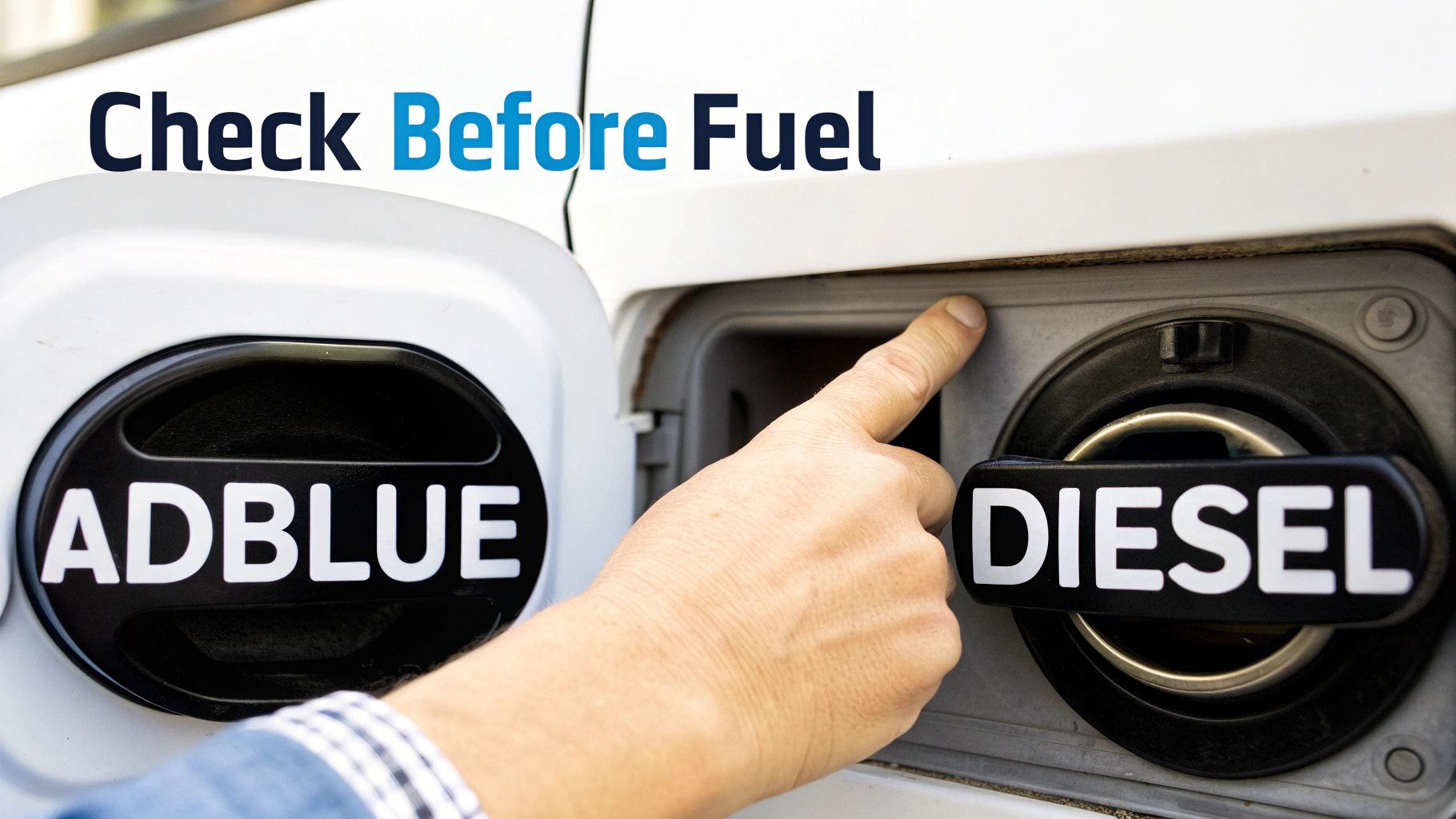
The best repair job is the one you never need. While we’re always on call to help drivers across Suffolk, avoiding the problem in the first place is far kinder to your schedule and your wallet. The good news is, preventing an AdBlue in diesel mix-up usually just comes down to forming a few solid habits.
Mistakes like this almost always happen when we're rushed, distracted, or at an unfamiliar petrol station. That single moment of inattention is all it takes. By building a quick mental checklist, you can stop this costly error dead in its tracks.
Tips for Every Diesel Driver
For the everyday motorist, prevention is all about creating a deliberate routine at the pump. It might feel a bit slow at first, but it soon becomes second nature and is guaranteed to save you a world of pain later on.
Pause and Look. Before you even touch a nozzle, open your fuel flap and take a proper look at the filler caps. Consciously register the black or green diesel cap and the smaller, distinct blue AdBlue cap. This simple visual check grounds you and focuses your mind on the task.
One Thing at a Time. Never, ever open both filler caps at once. Finish with one fluid completely before even thinking about the other. This creates a physical barrier that stops you from grabbing the wrong nozzle in a moment of distraction.
Feel the Fit. AdBlue pump nozzles are deliberately designed to be smaller than diesel ones. If a nozzle feels loose or just doesn't sit right in the filler neck, that's a massive red flag. Stop what you’re doing and double-check what you're holding.
Best Practices for Fleet Managers
If you're running a fleet of diesel vehicles, a single misfuelling incident doesn't just affect one driver. It throws delivery schedules into chaos, risks client commitments, and hits your bottom line. Being proactive isn't just a good idea; it's essential.
A consistent, company-wide prevention strategy is the most effective tool a fleet manager has to eliminate downtime caused by misfuelling. It turns individual responsibility into a shared, professional standard.
Mandatory driver training is the perfect place to start. Never assume everyone understands the risks. A quick briefing on the serious damage and eye-watering costs of AdBlue contamination will definitely stick in their minds. You can then back this up with some practical, on-vehicle solutions.
Consider these tried-and-tested tactics:
High-Visibility Labels: Stick clear, colour-coded, and weatherproof labels around both the diesel and AdBlue filler ports. This is an invaluable visual cue, especially for drivers who switch between different vehicles in the fleet.
Invest in Misfuelling Devices: For topping up, supply drivers with non-spill AdBlue bottles or specialist adaptors. Many of these have a unique connector that physically won't fit into a standard diesel filler neck, making a mix-up almost impossible.
The UK's AdBlue market is huge, driven by emissions laws covering the massive number of diesel commercial vehicles. One report valued the UK market at around USD 1.69 billion, with growth set to continue. You can read more about the European AdBlue market dynamics and see just how common it is. This really highlights how many vehicles are at risk every day, reinforcing the need for tough prevention measures within commercial fleets.
A Quick Note for Petrol Station Staff
Forecourt attendants are often the last line of defence. If you spot a driver looking hesitant or trying to put the blue-handled nozzle into the main fuel filler, a polite interruption could save their day—and their engine.
A simple, "Just checking, is that for the AdBlue tank?" can prevent a catastrophe. Your expert eye can make all the difference.
Your AdBlue Questions Answered
That sinking feeling you get when you realise you’ve put AdBlue in the diesel tank is quickly followed by a flood of questions. It's a horrible situation, but you're not the first person in Suffolk to do it, and you won't be the last.
Let's cut through the confusion and get you some straight answers to the most common queries we hear from stranded drivers.
Will Putting AdBlue in My Diesel Tank Void My Warranty?
This is a big one, and unfortunately, the answer is almost always yes. Vehicle warranties are there to cover manufacturing defects, not accidental damage. Misfuelling, no matter how genuine the mistake, falls into that second category.
But don't despair just yet. While the manufacturer won't cover it, your own car insurance might. Many comprehensive policies have clauses for accidental damage that can include misfuelling. Your first port of call should be to check your policy wording or give your insurer a quick ring to clarify where you stand.
When you call a professional fuel drain service like ours, we provide a full, detailed invoice and a report of the work done. This paperwork is exactly what you'll need to support an insurance claim and show you took the right steps to prevent further damage.
I Only Added a Tiny Bit. Is It Still a Big Deal?
In a word, yes. It's a common misconception that just a splash won't do any harm, but even a small amount of AdBlue is a huge problem for a diesel engine. Because AdBlue is mostly deionised water, it's denser than diesel and sinks straight to the bottom of the tank.
Guess where the fuel pump pickup is? Right at the bottom.
So, even if you’ve only poured in half a litre, that highly corrosive solution is the very first thing your fuel pump will suck through the lines the moment you turn the key. The risk of immediate corrosion and crystallisation in your high-pressure pump and injectors is just as real with a small amount as it is with a full tank.
There is no "safe" amount of AdBlue in a diesel tank. The only way to guarantee you won't cause catastrophic damage is to keep the engine off and call a specialist for a complete drain.
Can I Just Siphon the Tank Myself?
It might seem like a tempting way to save a bit of money, but trying to siphon a modern fuel tank yourself is a non-starter for a couple of critical reasons.
Firstly, almost every vehicle built in the last couple of decades has an anti-siphon device fitted in the filler neck. It’s a physical barrier designed specifically to stop people from doing this. You simply won't get a hose down into the tank without specialist equipment.
More importantly, it's a massive safety risk. You're dealing with flammable liquid without the correct, earthed, explosion-proof pumping gear. Then there’s the next problem: what do you do with 50 litres of contaminated fuel? That mixture is classified as hazardous waste. You can't just pour it down the drain or put it in your council bin. Professionals are licensed to transport and dispose of it legally, saving you from a potential fine and a lot of hassle.
Is AdBlue in Diesel the Same as Diesel in AdBlue?
They’re two sides of the same coin – both are serious, costly mistakes, but they damage completely different parts of your vehicle.
Putting AdBlue in the diesel tank attacks the engine's high-pressure fuel delivery system. It corrodes the fuel pump and clogs the injectors, striking right at the heart of the engine.
Putting diesel in the AdBlue tank is a different kind of disaster. It contaminates and destroys the entire Selective Catalytic Reduction (SCR) system. The oily diesel ruins the delicate catalyst and the specialist AdBlue pump and injector. Oddly enough, fixing a contaminated SCR system can often be even more expensive than a fuel system flush, with bills running into thousands for a full replacement.
Both mistakes demand immediate professional help, but they are very different problems.
If you've put AdBlue in your diesel tank in Suffolk or the surrounding areas, don't panic and don't start the engine. Call Misfuelled Car Fixer immediately for 24/7 emergency assistance. Our mobile technicians will come to you and safely resolve the issue on the spot, saving you time, money, and stress. Contact us now at https://www.misfuelledcarfixer-suffolk.co.uk.


