



Important: diesel in adblue tank - Immediate steps to prevent engine damage
- Misfuelled Car Fixer

- Dec 10, 2025
- 16 min read
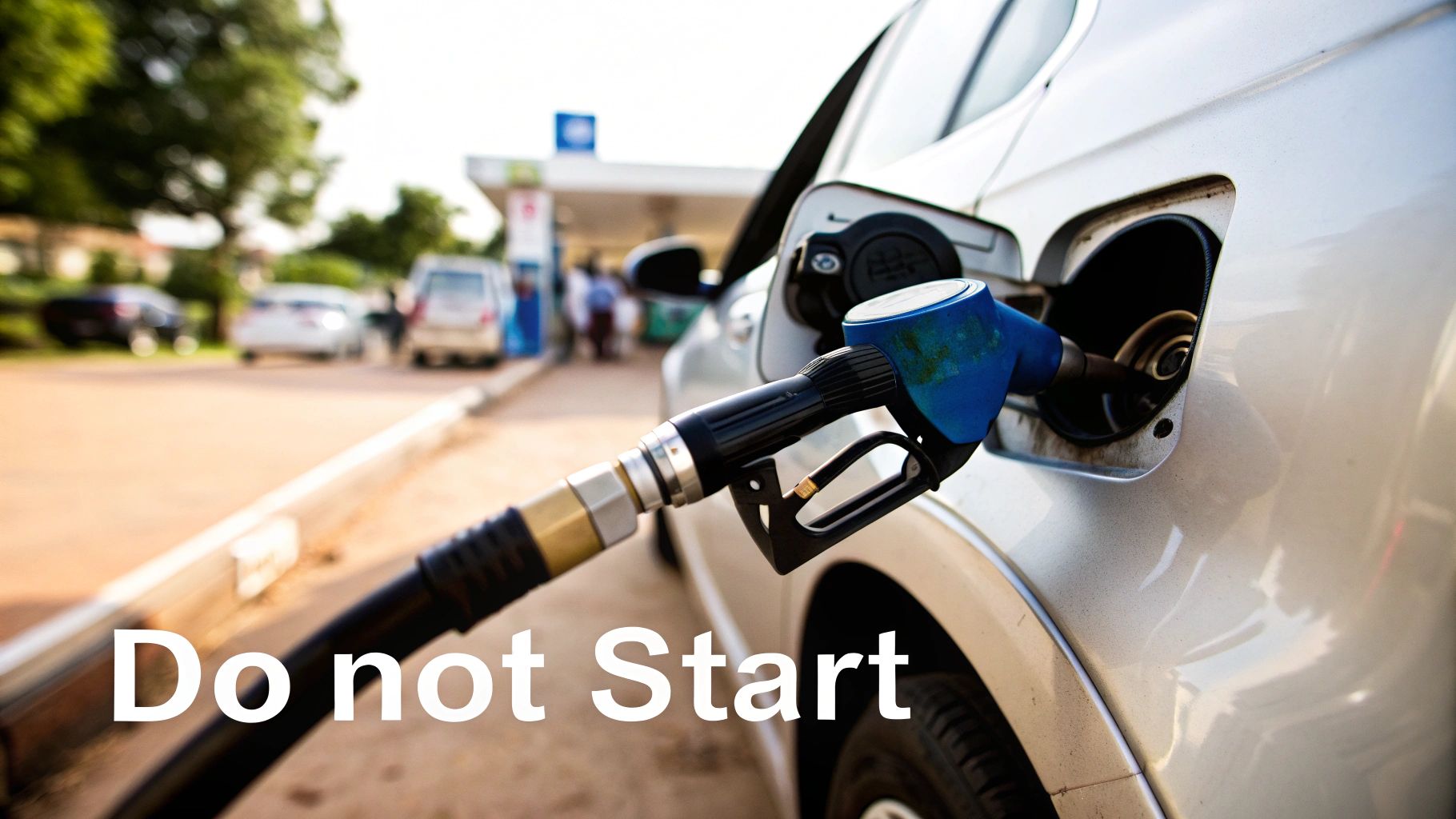
It’s a heart-sinking moment at the fuel station. You've been on autopilot, grabbed the wrong nozzle, and now diesel is sloshing around in your AdBlue tank. It’s a serious mistake, but it's absolutely fixable if you follow one golden rule: DO NOT start your engine.
Turning that key is the difference between a simple drain-out and a repair bill that could easily spiral into thousands of pounds. When the engine stays off, the problem is contained. The moment it starts, the oily diesel gets pumped into your vehicle's highly sensitive emissions system, and that's when the real damage begins.
What Happens When You Put Diesel in Your AdBlue Tank
So, what’s actually going on inside the tank? It all comes down to basic chemistry. Your car's Selective Catalytic Reduction (SCR) system is designed for AdBlue, a pure, non-toxic mix of 32.5% urea and 67.5% de-ionised water. It has the consistency of, well, water.
Diesel, on the other hand, is an oil. When oil and water meet, they don't play nice. Instead of mixing, they react and form a thick, sticky, crystalline gunk.
Imagine pouring cooking oil into your Nespresso machine instead of water. The oil would instantly coat the heating element, clog the fine pipes, and completely ruin any chance of it working properly. It's the same disastrous principle at play in your car, only the components are far more intricate and expensive to replace.
A Cascade of Expensive Failures
The real trouble starts the second you turn the ignition. Diesel is less dense than the water-based AdBlue, so it floats on top. Unfortunately, the AdBlue pump is designed to draw fluid right from the top of the tank.
If the engine runs, even for a moment, this sludgy, oily mess gets sucked into the SCR system, triggering a domino effect of damage:
Pump Failure: The AdBlue pump is a delicate piece of kit, built to handle a low-viscosity fluid. The thick diesel mixture forces it to work too hard, causing it to seize up and fail.
Clogged Lines and Sensors: The contaminated sludge coats everything in its path. It blocks the narrow fluid lines and fouls the system's sensors, leading to false error codes and complete operational failure.
Blocked Injector: The AdBlue injector sprays a precise, fine mist into the exhaust. The sticky residue from the diesel will quickly block it solid, making it completely useless.
Poisoned Catalyst: This is the worst-case scenario. If the contamination makes it all the way to the SCR catalyst, it can permanently coat the precious metals inside, destroying it. The catalyst is often the single most expensive part of the entire emissions system.
This quick guide shows the critical first steps to take and what to avoid at all costs.
Immediate Actions: Do This, Not That
Action | Correct Step (Do This) | Incorrect Step (Avoid This) |
|---|---|---|
Ignition | Leave the keys out of the ignition. Do not turn the engine on for any reason. | Don't start the engine to "see what happens" or try to move the vehicle. |
Positioning | If safe, put the vehicle in neutral and ask for help to push it to a safe spot. | Do not drive the car off the forecourt to a nearby parking space. |
Information | Take a note of how much diesel you think you put in the AdBlue tank. | Don't try to top it up with AdBlue, hoping to dilute the diesel. It won't work. |
Assistance | Call a specialist mobile misfuelling service immediately. | Don't assume it will be okay to drive a short distance. It won't. |
Following the "Do This" column keeps the contamination isolated to the tank, making the fix much simpler and more affordable.
A Surprisingly Common Problem on UK Roads
With the big push for lower emissions, this kind of misfuelling is becoming more and more common. Millions of modern diesel vehicles in the UK rely on SCR technology. In fact, the UK AdBlue market was valued at an astonishing £8.26 billion in 2023, showing just how widespread this technology has become.
With around 11 million diesel cars still on UK roads, the chances of this simple slip-up happening are higher than ever. To get a better feel for how the system works and why it's so important, have a read through our straightforward diesel driver's guide to AdBlue. The little blue filler cap helps, but when you're in a hurry or driving an unfamiliar car, it's an easy mistake to make.
Why Starting the Engine Turns a Simple Mistake into a Financial Nightmare
That moment you turn the key in the ignition is the single most critical point in this whole situation. What was a simple, containable mistake is about to become a catastrophic and eye-wateringly expensive mechanical failure.
It doesn't even take the engine firing up. Just turning the key to the 'on' or 'accessory' position is often enough to prime the AdBlue pump. That one click starts a chain reaction that's incredibly difficult and costly to undo.
The AdBlue pump immediately whirs into life, doing exactly what it's designed to do: draw fluid from the tank. The trouble is, the lighter, oil-based diesel is floating right on top. The pump unknowingly sucks up this greasy concoction instead of the pure, water-based solution it was built for.
This oily fluid is instantly sent coursing through the veins of your vehicle’s highly sensitive Selective Catalytic Reduction (SCR) system. In seconds, the entire network of delicate pipes, sophisticated sensors, and precise injectors gets coated in a sticky film it simply can't handle. The damage starts immediately, and with every second the ignition stays on, the problem gets exponentially worse.
The Mechanical Domino Rally Kicking Off in Your Vehicle
Once diesel gets into the SCR system, it’s not just a blockage; it's a full-blown systemic breakdown. The initial contamination triggers a cascade of failures, each one more complex and expensive to sort out than the last. Picture a line of dominoes, with the AdBlue pump being the very first one to fall.
The pump itself, engineered for the thin consistency of a water-like urea solution, struggles to force the thicker, oily diesel through the lines. It’s put under immense strain, causing it to overheat and, in many cases, burn out completely. This is often the first major casualty, and replacing it can easily run into hundreds of pounds.
From there, the contaminated mess is pushed further down the system, crippling everything it touches. This isn't a problem that will just go away. It’s an invasive contamination that requires a specialist to fix.
What Actually Breaks and Why It Matters
As this diesel-AdBlue sludge circulates, it systematically takes out key components of the SCR system. Each part has a crucial role in managing your vehicle’s emissions, and as they fail, you’ll see warning lights pop up on the dash before the vehicle likely puts itself into a protective 'limp mode' or refuses to start at all.
Here are the components we see damaged time and time again:
The AdBlue Injector: This part is designed to spray a super-fine, atomised mist into the exhaust. Diesel residue clogs its tiny nozzle completely. What should be a precise mist becomes a useless dribble, if it works at all. A blocked injector means the entire SCR system is dead in the water.
Level and Temperature Sensors: Your AdBlue tank is fitted with sensitive sensors to monitor fluid levels and temperature. The oily film from diesel coats them, sending junk data to the vehicle's main computer (the ECU). This leads to persistent error codes that can be a real pain to clear, even after the mechanical parts are replaced.
The SCR Catalyst: This is the heart of the system and, unfortunately, the most expensive component. If the oily diesel reaches the catalyst, it can permanently poison the precious metals inside in a process called 'fouling'. A fouled catalyst can't be cleaned or repaired. It has to be replaced, a job that can cost well over £1,500 on its own.
We see it all the time in the field. Contamination from foreign fluids like diesel is a leading cause of premature failure in SCR systems. The repair bills for these jobs are consistently among the highest for any emissions-related fault.
In the end, all this damage, cost, and stress comes down to one simple action: turning the ignition on. If you don't start the engine, the problem stays inside the tank. It’s a relatively straightforward fix—a professional drain and flush.
But if you do, you guarantee a long and expensive journey of component replacement. You turn a simple fuelling error into a major financial headache.
Your Immediate Emergency Recovery Plan
That sinking feeling when you realise you’ve put diesel in the AdBlue tank is something no driver wants. It’s easy to panic, but what you do in the next few moments is absolutely vital. A calm head now can turn a potential catastrophe into a manageable problem. The entire goal is to contain the mistake before it gets any worse.
First things first: stay with your car. Don't just leave it on the forecourt, as it could become a hazard for others. Your immediate job is to keep yourself, and everyone else, safe.
If you’re lucky enough to be in a quiet, safe spot, great. But if your car is blocking a pump or in a dodgy position, resist every urge to start the engine to move it. Instead, pop it into neutral, take off the handbrake, and ask someone for a hand to push it into a safer parking bay.
Make Your Vehicle Safe and Visible
Once your car is safely parked, you need to make sure other drivers can see it clearly. This is especially true if you're at a busy petrol station or, worse, on the roadside. You don't want a simple mistake to cause an accident.
A couple of quick but essential actions will do the trick:
Hit the Hazard Lights: Flick on your hazard warning lights right away. It’s the universal sign for "I'm stopped and something's wrong."
Use Your Warning Triangle: If you have one and it’s safe to get out (never on a motorway), place it on the road a good way behind your vehicle. The rule of thumb is at least 45 metres (about 147 feet) back to give others plenty of warning.
Making your car visible prevents a bad situation from spiralling. With the scene secured, your next move is to call in the right professional help.
Who to Call for an AdBlue Contamination Emergency
Right, this is where many drivers make their second critical error. Instinct might tell you to ring your usual breakdown service, but they often aren't the right people for this very specific job. This isn't a flat tyre; it's a chemical contamination issue.
You need a specialist mobile fuel drain service. These technicians are trained for misfuelling incidents, including diesel in the AdBlue system. They carry the specific pumps, flushing gear, and—most importantly—the proper licenses to handle and dispose of the contaminated mixture legally and safely.
Calling a fuel drain specialist directly is nearly always the quickest and cheapest route. A standard recovery service will likely just tow you to a garage, which adds extra cost, time, and hassle. A mobile specialist fixes the problem right where you are.
When you ring them, they'll ask for a few key details to give you an accurate ETA and price. Having this info handy will make the whole process go much more smoothly.
Information to Have Ready for Your Call
Before you pick up the phone, just take a breath and gather these details. It’ll help the technician know exactly what they’re dealing with.
Your Exact Location: Be precise. Use your phone's map app, give the petrol station's name and address, or mention the nearest major road or landmark.
Vehicle Details: Know the make, model, and registration of your car. Something like, "It's a 2019 Volkswagen Tiguan, reg AB19 CDE."
The Contamination Details: Explain exactly what happened. Be clear: "I've put diesel in the AdBlue tank," and confirm that the engine has not been started since.
Estimated Amount: Try to remember roughly how much diesel went in. Was it just a quick splash, or did you put in several litres? This gives the technician a good idea of the job's scale.
Having this information ready turns a panicked phone call into a clear, professional request for help. It’s the first real step to getting you sorted and back on your way. For a bit more on what to expect from roadside help, our guide to finding a wrong fuel rescue service near you has some great pointers.
What to Expect from a Professional Fix – And What It'll Cost
So, you’ve made the smart call and got a mobile fuel drain specialist on the way. You’re probably wondering what happens next and, more importantly, how much this mistake is going to set you back. Getting your head around the repair process shows you exactly why keeping that engine off was the best decision you could have made. These technicians aren't just mechanics; they're specialists trained to handle this exact kind of hazardous mix-up safely and on the spot.
Once the technician arrives, their first job is to get a clear picture of the situation. They'll quickly confirm what you told them on the phone – diesel’s in the AdBlue tank, and crucially, the ignition hasn’t been touched. The whole process is designed to be a roadside fix, meaning you avoid the hassle and cost of a tow truck to a garage.
The main task is to get every last drop of that contaminated mixture out of your AdBlue tank. It’s not a simple case of siphoning it out. The pros use powerful, specialised pumps to extract the oily sludge, which is then stored in secure, legally-compliant containers for proper disposal.
Draining, Flushing, and System Checks
Getting the tank empty is only half the battle. The really critical part is the flush. A technician will circulate a special cleaning solution through the AdBlue tank and any lines they can safely access. This isn't just a rinse; the agent is formulated to break down the stubborn oily film that diesel leaves behind, stopping any leftover contamination from causing trouble down the line.
With the system properly cleaned, it’s time for a fresh refill of clean, new AdBlue. To finish the job, the technician will usually plug a diagnostic tool into your vehicle’s computer. This lets them scan for any error codes thrown up by the SCR system and clear them. It’s the final all-clear, confirming your vehicle is ready to go.
This flowchart really brings home the importance of that first decision you made.

As you can see, keeping the engine off leads to a straightforward fix. Turning that key, however, sends you down a path of complicated and very expensive repairs.
Counting the Cost: The Financial Damage
Right, let's get to the question every driver is asking: how much does putting diesel in an AdBlue tank cost? The answer hinges almost entirely on one thing – whether you started the engine.
Best-Case Scenario (Engine Off): If you haven't turned the key, the problem is contained. It's a simple, albeit urgent, fix: a professional drain, flush, and refill. For this kind of mobile service, you should budget for a cost somewhere in the region of £200 to £450. This figure typically covers the call-out, the technician's time, the use of their specialist gear, and the safe disposal of the contaminated waste.
The whole on-site job for a drain and flush is usually done and dusted in 60 to 90 minutes. You're back on your way with minimal fuss and a relatively small dent in your wallet. It's a tiny price compared to the alternative. To see how this stacks up against other fuel mishaps, have a look at our complete UK guide to wrong fuel costs.
When Things Get Expensive: Engine Contamination
If the engine was started, even for a moment, the cost starts to climb – fast. The diesel and AdBlue mix gets pumped through the system, and that's when it begins to wreck expensive components.
Here’s a rough idea of what you could be facing:
Moderate Damage: If you're lucky and only the AdBlue pump and a few sensors are fried, you're likely looking at a bill of £800 to £1,500. This includes the initial drain and flush plus the cost of the replacement parts and labour.
Severe Damage: In the worst-case scenario, the mixture reaches and ruins the SCR catalyst. Now, the repair bill can easily jump past £3,000, and on some premium models, it can be much, much higher.
This is no longer a quick roadside job. Your vehicle will have to be recovered to a garage and could be out of action for days waiting for parts to be ordered and fitted. The damage is real, and the costs are eye-watering.
How to Make Sure This Never Happens Again
After the headache and expense of getting diesel in your AdBlue tank sorted, you’ll want to make sure it’s a one-time mistake. The good news is that preventing it is surprisingly simple. It’s all about creating a solid routine at the fuel station, so you’re running on autopilot in the best possible way.
Putting a few practical safeguards in place can save you a world of trouble down the line.
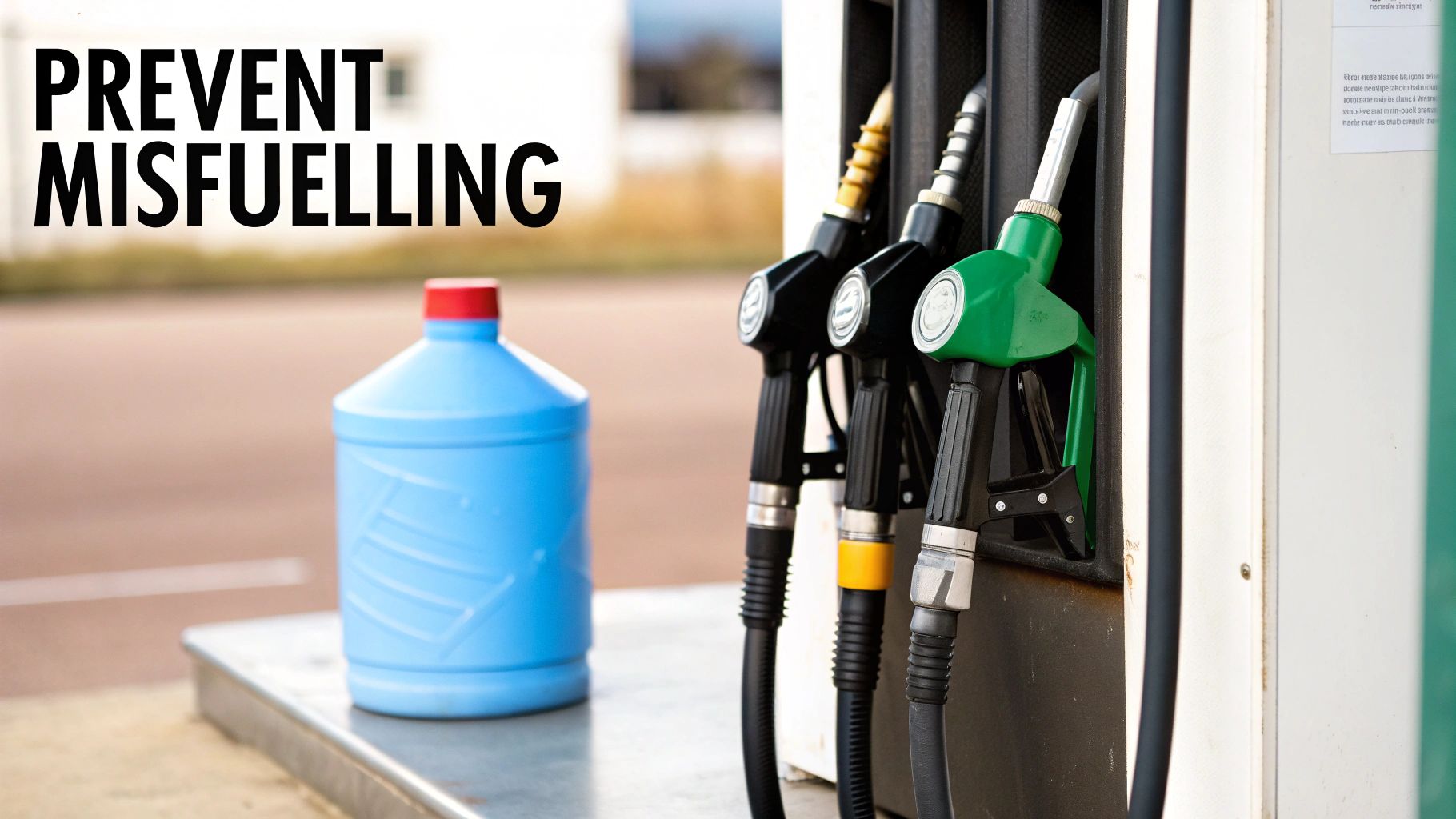
The single best piece of advice I can give anyone is to just slow down. Seriously. When you pull up to the pump, take a breath. Deliberately check the labels on the pump handles and the filler caps on your vehicle before you even touch a nozzle. This tiny moment of mindfulness is the difference between a normal day and a bill for hundreds, if not thousands, of pounds.
Car manufacturers have tried to engineer this problem away. The standard diesel pump nozzle is physically larger than an AdBlue filler neck, making it a tight squeeze or impossible to insert. But let’s be honest, mistakes still happen—especially when we’re in a rush, distracted by the kids, or driving an unfamiliar hire car.
Building a Foolproof Fuelling Routine
You can't always rely on nozzle design to save you, particularly if you’re refilling AdBlue from a can at home. The spout on a jerry can will slide into an AdBlue tank with no resistance at all. The real key is to build your own system of checks that becomes second nature.
Here are a few practical habits that make misfuelling almost impossible:
Colour-Code Your Thinking: AdBlue caps and pump nozzles are almost always blue. Diesel nozzles are typically black. Drill this into your head: blue cap, blue nozzle. It's that simple.
Talk About It: If anyone else drives your car – a partner, a family member, a colleague – make sure they know it needs AdBlue. Point out the correct filler cap and briefly explain just how catastrophic a mix-up can be.
Dedicate Your Gear: If you top up AdBlue from bottles or containers, buy a dedicated funnel just for that job. Don't leave it with your oil and fuel funnels; store it separately to avoid any cross-contamination.
By making these small adjustments, you create several layers of protection against a very simple but very costly error.
A scenario we see all the time involves fleet vans or shared family cars. The main driver knows the routine inside out, but someone who borrows it for the weekend makes the mistake. A quick chat beforehand is one of the most effective prevention tools there is.
Proactive Gadgets and Final Checks
For that extra peace of mind, you could look into a misfuelling prevention device. These are specially designed caps or inserts that create a physical barrier, blocking the wrong nozzle from ever entering the tank. They’re a great back-up for those moments when you're tired or distracted.
Finally, get into the habit of glancing at your receipt before you leave the forecourt. It will clearly state what you’ve just pumped. Spotting you’ve bought diesel when you only meant to top up the AdBlue gives you one last chance to catch the mistake before turning the ignition.
Taking these small, deliberate steps will give you the confidence that putting diesel in your AdBlue tank remains a thing of the past.
Your AdBlue Contamination Questions Answered
After dealing with the immediate stress of putting diesel in your AdBlue tank, you’re bound to have some questions. It’s a nerve-wracking mistake, and we find that getting clear, honest answers helps put drivers' minds at ease.
We’ve heard every query imaginable over the years. Below, we've gathered the most common ones to give you the straightforward information you need to understand the situation and feel confident about your car's recovery.
How Much Diesel Is "Too Much" to Cause a Problem?
This is the number one question we get: "I only put a tiny splash in, surely that's okay?" The blunt answer is, unfortunately, no. There is no safe amount.
Even a few millilitres of diesel will contaminate the entire tank. Because diesel is an oil and less dense than the water-based AdBlue solution, it floats right on the top. The moment you turn the key, that's the very first thing the system's pump will suck in.
The delicate components of your vehicle's Selective Catalytic Reduction (SCR) system are built to handle pure AdBlue and nothing else. Don't be tempted to "dilute" the problem by topping up with more AdBlue—it won't work and just makes the situation worse. The only solution is a complete, professional drain and flush to avoid thousands in repair bills.
Will My Car Insurance Cover This?
Whether your insurance policy will cover the cost of an AdBlue contamination fix is a bit of a grey area. It really comes down to the fine print of your specific contract.
Some fully comprehensive policies do include "misfuelling cover" as an optional add-on, but it's not always standard. You might also find the policy wording is vague, often focusing on the more traditional petrol-in-diesel mix-up rather than mentioning AdBlue specifically.
Here’s what you need to do:
Read Your Policy: Grab your documents and look for any mention of "misfuelling," "fuel contamination," or "driver error."
Phone Your Insurer: This is the most direct route. Explain what’s happened and ask them point-blank if you're covered.
Watch for Exclusions: Be prepared for the fact that many insurers classify this as negligence, meaning they won't pay out.
Never assume you're covered. It's always best to check first. Remember that making a claim could affect your no-claims bonus and increase your premiums, so calling a mobile drain specialist often works out cheaper and faster in the long run.
Can't I Just Drain the AdBlue Tank Myself?
It’s easy to find a video online for just about any car repair, which makes a DIY drain seem like a tempting way to save some cash. We strongly advise against it unless you’re a trained mechanic with the right specialist gear.
For starters, getting to the AdBlue tank on many modern cars is a real challenge. You might have to remove bumpers, wheel arch liners, or other components just to access it. Then you need the correct type of pump to safely extract the contaminated fluid without causing a spark or damaging the tank.
The biggest hurdle, however, is waste disposal. The diesel and AdBlue mixture is classed as hazardous waste. You can't just pour it down a public drain or stick it in your bin—it's illegal and carries hefty fines. A professional service like ours is equipped to do the job safely and holds the necessary licenses to dispose of the contaminated fluid correctly, keeping you on the right side of the law.
What Happens If I Put AdBlue in My Diesel Tank?
Putting AdBlue in your diesel tank is the other side of the coin, and it's just as bad—if not worse. AdBlue is corrosive to the seals, gaskets, and metal alloys used throughout a diesel fuel system.
Worse still, its primary ingredient is deionised water, which is a disaster for a high-pressure diesel engine that relies on the lubricating properties of diesel fuel.
The advice is identical: DO NOT START THE ENGINE. Firing it up will send that corrosive, water-based fluid surging through your fuel pump, lines, and injectors. The damage is often catastrophic and can write off the entire fuel system. You need an immediate fuel drain to stand any chance of saving it.
If you've put diesel in your AdBlue tank or made any other fuel mistake in Suffolk or the surrounding areas, don't panic. The expert team at Misfuelled Car Fixer is available 24/7 to provide a rapid, professional, and affordable mobile fuel drain service. Call us immediately, and we'll get you safely back on the road. Find out more at https://www.misfuelledcarfixer-suffolk.co.uk.


