



Petrol in diesel car small amount: What to Do Next
- Misfuelled Car Fixer

- Dec 16, 2025
- 12 min read
We've all had that heart-stopping moment at the pump. You hang up the nozzle, look down, and realise you've grabbed the green one instead of the black. If you've just put a small amount of petrol in your diesel car, take a deep breath. The single most important thing to do right now is simple: do not start the engine.
Seriously, don't even turn the key to light up the dashboard. Doing so can prime the fuel pump, which is enough to start sending that damaging petrol-diesel mix into your car's very sensitive fuel system.
What to Do in the First Five Minutes | Petrol in diesel car small amount
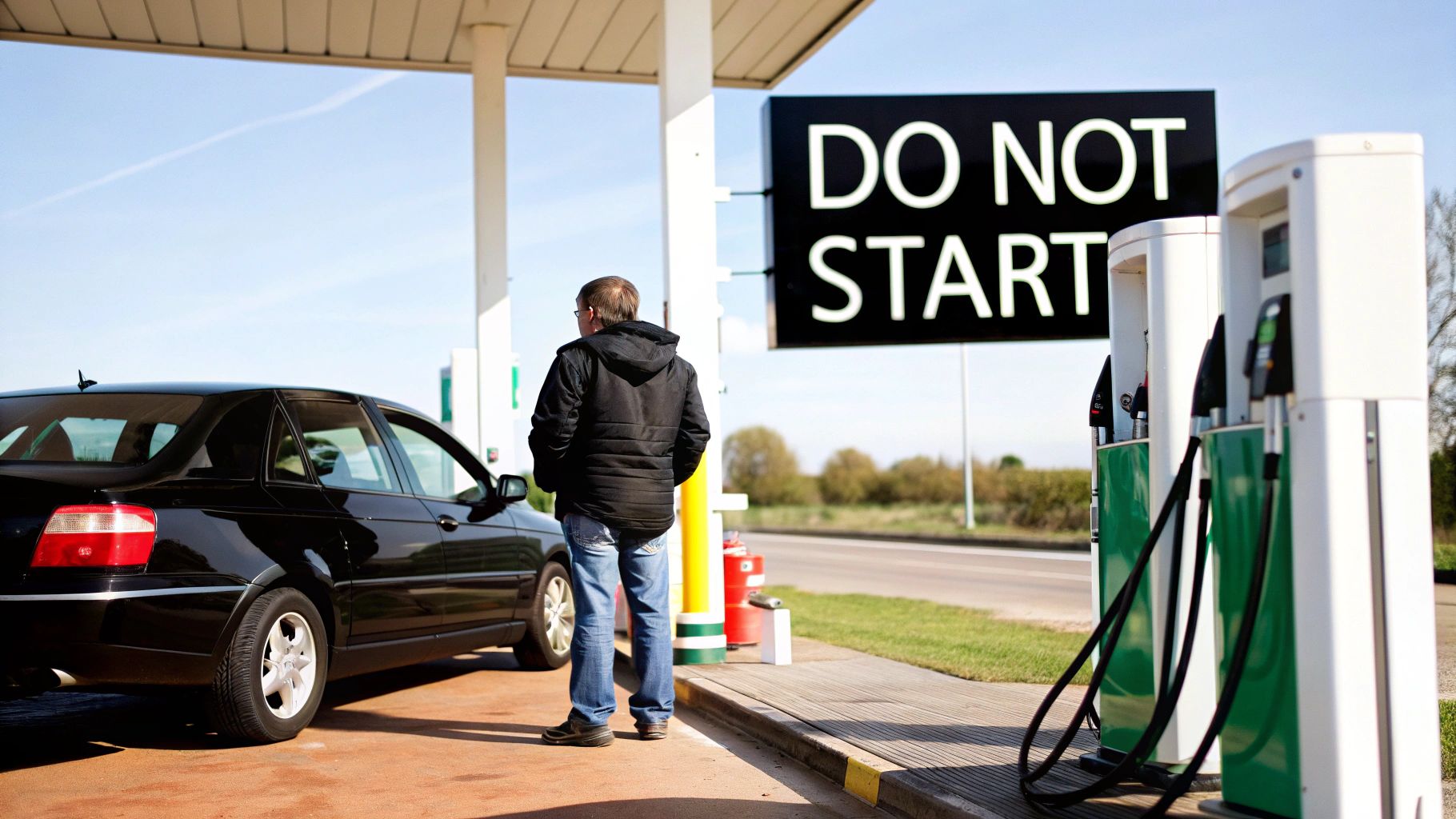
Catching the error at the petrol station can feel like a nightmare, but what you do next can be the difference between a simple, on-the-spot fix and a four-figure repair bill. Your actions in these first few minutes are absolutely crucial.
Picture it: you're at a busy Tesco in Ipswich or a service station along the A14, your mind is elsewhere, and you've just put £10 of unleaded into your diesel tank before the penny drops. The natural impulse is to panic, maybe even start the car to "just get it home" before anyone notices. That's the worst thing you could possibly do.
Your Immediate Action Plan
Petrol is a solvent, and it strips away the lubricating qualities of diesel fuel. Modern diesel engines are high-pressure, precision-engineered systems that depend on that lubrication to protect vital parts like the fuel pump and injectors. Running the engine forces this contaminated fuel through the system, causing rapid wear and potentially catastrophic damage.
Here's a quick reference guide for what to do—and what to avoid.
Immediate Do's and Don'ts for Misfuelling
Action | Do | Don't (And Why) |
|---|---|---|
Engine | Keep the engine OFF. Don't even turn the key to the 'on' position. | Don't start the engine. This circulates the petrol, causing friction and damage to the fuel pump and injectors. |
Vehicle | Put the car in neutral. Ask for help to push it to a safe place like a parking bay. | Don't drive it, even a short distance. Every metre increases the risk of severe, expensive engine damage. |
Fuel Tank | Leave it as it is. The less contaminated fuel, the better. | Don't try to "dilute" it by topping up with diesel. This just makes the fuel drain more difficult and doesn't solve the problem. |
Assistance | Tell the petrol station staff what’s happened. Then, call a professional fuel drain service. | Don't call a standard recovery service first. They'll likely just tow you to a garage, adding time and cost. A mobile specialist can fix it on-site. |
Following these simple steps keeps a manageable problem from spiralling into a major one.
Misfuelling is a surprisingly common mistake, with over 150,000 drivers in the UK doing it every year. By staying calm and not starting the engine, you are already handling the situation better than many.
Understanding what happens when a diesel car runs on petrol really drives home why these steps are so vital. The entire fuel system is built for the specific properties of diesel. Introducing even a small amount of petrol completely disrupts that delicate balance, risking immediate and long-term harm if it's allowed to circulate.
Why Even a Little Petrol Wrecks a Diesel Engine
It’s an easy mistake to downplay. "I only put a fiver's worth in," you might tell yourself, "that can't do any real damage, can it?" When it comes to putting a small amount of petrol in a diesel car, that’s probably the most dangerous assumption you can make. The problem isn't the quantity; it's the chemistry.
You have to think of diesel as more than just fuel. It's a thick, oily lubricant. Key components in your car’s high-pressure fuel system, like the pump and injectors, rely on a constant bath of this oil to function. It’s what stops sensitive metal parts from grinding themselves to pieces.
Petrol does the complete opposite. It's a solvent. Think of it as a powerful degreaser poured straight into your engine's veins. The moment it hits the diesel system, it starts stripping away that crucial lubricating film, leaving delicate components completely exposed.
The Lubricity Problem Explained
It all boils down to a property called lubricity. Diesel fuel has high lubricity, which is essential for keeping the fuel pump and injectors working smoothly under incredible pressure. Petrol, on the other hand, has almost zero lubricity.
Adding even a small amount of petrol to your tank is like throwing sand into a finely-tuned machine. It immediately creates friction where there should be a smooth, oily glide.
This isn't slow, gradual wear and tear. The damage starts almost instantly. The metal-on-metal grinding inside the high-pressure fuel pump creates tiny metal particles, or swarf. These fragments are then blasted through the rest of your fuel system at high speed.
The immediate danger isn't the petrol itself, but the domino effect it triggers. The metal swarf it creates will clog your fuel filter, wreck your injectors, and can quickly lead to the complete failure of the fuel system. We're talking about repair bills that easily run into the thousands.
This destructive process kicks off the second that contaminated fuel starts to circulate.
From Friction to Total Failure
The path from a simple misfuel to catastrophic engine damage is scarily fast. A mix with just 10% petrol can start eroding the fuel pump's internal components in a matter of hours.
Diesel needs a lubricity level somewhere between 300-500 parts per million; petrol offers next to nothing. This huge difference causes those metal shavings to block filters and injectors, which in turn leads to misfiring, engine judder, and a spike in harmful emissions. The poor combustion it causes is so bad, it actually mimics the effects of illegal 'defeat devices' and contributes to the kind of air pollution we see on UK roads. You can find more details on how fuel quality impacts vehicle emissions and public health.
The most important thing to remember is that the damage isn't proportional to the amount of petrol you put in. The real damage happens the moment you turn the key and let that contaminant loose in your engine.
Recognizing the Signs Your Engine Has the Wrong Fuel

Sometimes the mistake isn't obvious at the pump. You might drive away, perhaps heading down the A12 towards Felixstowe, before your car starts to complain. If you've driven off after putting even a small amount of petrol in a diesel car, your engine will send out some pretty clear distress signals.
Ignoring these warnings is the quickest way to turn a fixable slip-up into a catastrophic failure. Catching the signs early means you can pull over safely and prevent the kind of severe damage that comes with a hefty repair bill. Listen to your car; it's trying to tell you something is seriously wrong.
Common Misfuelling Symptoms
These symptoms pop up because petrol, which acts like a solvent, doesn't combust properly in the high-pressure environment of a diesel engine. Worse, it starts stripping away the essential lubrication your fuel pump and injectors rely on to survive.
A Loud Knocking Sound: This is often the first and most alarming sign. Diesel ignites under compression, but petrol is far more volatile. It can detonate too early from the heat, creating an audible "knocking" or "pinking" sound from the engine bay.
Sudden Loss of Power: Does your car feel sluggish or like it's holding back? This hesitation during acceleration is a classic sign. The contaminated fuel mix just can't deliver the energy the diesel engine is designed for, resulting in a noticeable drop in performance.
Excessive Exhaust Smoke: Look in your rearview mirror. If you see thick, white, or greyish smoke billowing out, that’s a major red flag. It’s unburnt fuel being pushed through the system—a direct result of poor combustion.
These are just the first warnings. For a deeper dive into what to watch for, check out our detailed breakdown of the common petrol in diesel car symptoms and what to do now in our comprehensive guide.
Engine Trouble and Warning Lights
The longer the wrong fuel circulates, the worse things get. You can almost guarantee the engine management light will pop up on your dashboard as sensors detect major problems with combustion and fuel pressure.
From there, the engine will likely start to idle roughly before cutting out altogether. Often, it will then refuse to restart. This isn't just a breakdown; it's the car's self-preservation system kicking in to prevent itself from being completely destroyed.
Crucial Action: The moment you notice any of these signs—the knocking, the smoke, the loss of power—indicate and pull over to a safe place as soon as you can. Turn off the engine immediately and do not try to restart it. The less time the engine runs on the wrong fuel, the better your chances of avoiding permanent damage.
Right, so you’re stuck. Maybe you’re on the side of the A14 near Bury St Edmunds, or you've just realised your mistake in a busy supermarket car park in Felixstowe. What's the next move? Knowing how to sort out your car after putting petrol in the diesel tank is crucial, and in Suffolk, you generally have two paths you can take.
Your decision really boils down to one simple question: did you start the engine? If you caught the error at the pump before turning the key, a mobile fuel drain is almost certainly your best bet. It's faster and far kinder on your wallet. If you've driven the car until it sputtered to a halt, a garage inspection might be on the cards.
How to Get Your Car Fixed in Suffolk
So, what are your real-world options? You can either call a specialist mobile fuel drain service to come out to you, or you can arrange for your vehicle to be towed to a local garage. Each has its place.
Mobile Fuel Drain vs. a Trip to the Garage
Think of a mobile wrong fuel specialist as the emergency service for this exact problem. A technician drives out to wherever you are—be it a petrol station forecourt, your driveway, or the roadside—with everything they need to fix the car on the spot. They’re fully equipped to handle contaminated fuel safely and get you moving again in no time.
Towing to a garage, however, adds a few more hurdles. First, you need a recovery truck. Then, you're at the mercy of the garage's schedule. This could mean waiting hours, or even days, for a mechanic to free up, adding extra time, stress, and potential storage fees to the whole ordeal.
It's worth remembering that the vast majority of misfuelling incidents—over 95%—where the engine hasn't been run can be completely sorted at the roadside. A mobile technician can save you the time and expense of a garage visit.
This on-the-spot solution is exactly why so many drivers across Suffolk depend on mobile assistance when they find themselves in this predicament.
What Does a Mobile Technician Actually Do?
When the technician arrives, you'll see they have a very efficient and thorough process. They do a lot more than just empty the tank.
First things first, they make the area safe. This is especially important if you're at a busy fuel station or on a narrow country lane.
Next, they drain the tank. Using specialised, approved pumping equipment, they'll remove every drop of the contaminated fuel. It’s all transferred into a secure container for environmentally safe disposal.
Then comes the system flush. This is a critical step. They'll flush the fuel lines, filter, and injectors with clean diesel to get rid of any lingering petrol.
Finally, they replenish and restart. A small amount of fresh diesel goes in, they'll prime the system, and start the engine. They won't leave until they're sure everything is running smoothly.
The whole job usually takes about an hour from the moment they pull up. If you want to see how quickly you can get help, it’s worth looking into finding wrong fuel in car assistance near you to understand the full service.
Costs and Response Times in Suffolk
Let's talk numbers. For drivers in Suffolk, knowing the potential cost and waiting time is key. Generally, calling out a mobile service is significantly cheaper than going through main breakdown clubs or a garage for this specific issue.
To give you a clearer picture, here’s a quick comparison of the options available.
Comparing Misfuelling Repair Options
Solution | Best For | Average Cost (Suffolk) | Average Time |
|---|---|---|---|
Mobile Fuel Drain | Engine not started; roadside or home | £150 - £300 | 30-60 min response + 1 hour fix |
Garage Repair | Engine started and driven | £300 - £500+ (plus towing) | 2-48 hours, depending on workload |
As you can see, the mobile option is not only more affordable but also drastically faster. Response times for a mobile unit in places like Ipswich, Lowestoft, or Stowmarket are usually very quick—often under an hour. This rapid service gets you back on your journey with the least amount of fuss and financial sting.
What Actually Happens During a Fuel Drain?
When you call a misfuelling specialist, you're not just getting your tank emptied. You're getting a meticulous, multi-step service designed to prevent catastrophic—and expensive—engine damage. Let's pull back the curtain on what our technicians do, so you can see why professional help is the only real choice, even if you only put a splash of petrol in your diesel tank.
The first priority is always safety. Especially if you're stuck at a busy Suffolk petrol station, the technician will secure the area to make sure there are no ignition risks. Petrol fumes are highly flammable, so this step is non-negotiable.
Next comes the main event: the fuel drain. Using specialised, ATEX-approved pumps, every last drop of the contaminated fuel is carefully removed from your tank. This isn't a job for a garden hose and a bucket; this is professional-grade equipment built to handle flammable liquids safely and efficiently.
Purging the Entire Fuel System
Just emptying the tank isn't enough. The real danger often lurks in the fuel lines, filter, and pumps, where residual petrol can still cause havoc.
The technician will then flush the entire system with clean diesel. This vital step forces any remaining contaminants out of the lines and injector rails, ensuring only pure fuel will reach your engine when it’s time to start it back up. As a standard part of the process, we'll also replace the fuel filter. It’s a small, inexpensive part that acts as the last line of defence, and swapping it out is cheap insurance against future problems.
A professional fuel drain is a complete system cleanse. It’s about more than just draining the tank—it's about meticulously flushing the entire fuel delivery pathway to stop hidden damage from appearing miles down the A12.
Final Checks and Engine Health
Putting petrol in a diesel car is so damaging because diesel fuel doubles as a lubricant for high-pressure parts like the fuel pump. Petrol, on the other hand, is a solvent. It strips away that vital lubrication, causing friction and metal-on-metal wear almost instantly, even with a contamination level as low as 5-10%.
Mechanics across the UK see this all the time, and it's a known contributor to poor engine performance and higher emissions. You can read more about how fuel quality impacts vehicle emissions on the GOV.UK website.
The journey from the forecourt back to the road is a clear, professional process.
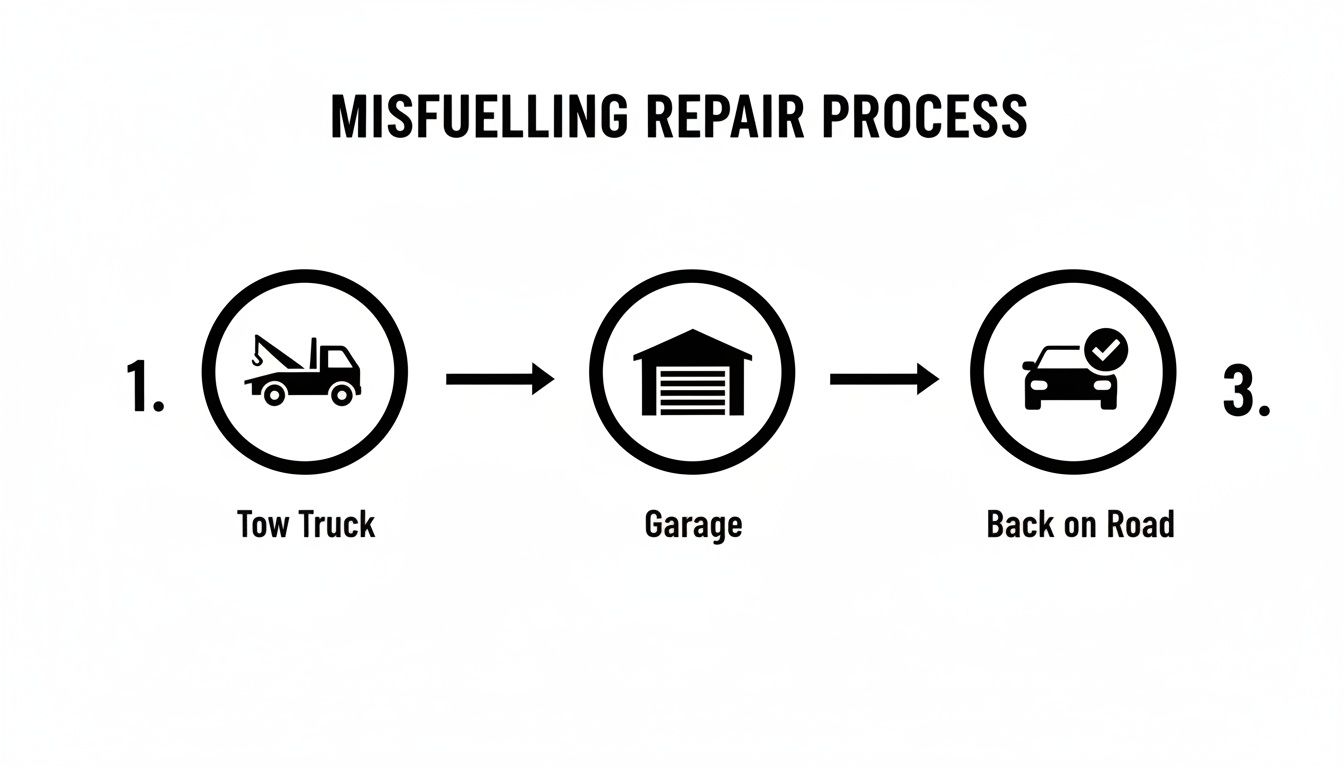
If you started the engine, the job becomes more complex. A mechanic will need to perform a deeper inspection at a garage to check for tiny metal filings (known as swarf) in the fuel system. This is the classic sign of a damaged fuel pump.
However, if you realised your mistake and didn't start the car, the final step is simply to add fresh, clean diesel, prime the system, and run the engine for a few minutes to make sure everything is running as it should.
Common Questions About Misfuelling Your Car
Even with a clear plan, realising you’ve just put petrol in your diesel car can send your mind racing. Questions about insurance, damage, and quick fixes start piling up. It’s a moment of panic we’ve seen countless times with drivers across Suffolk.
Let’s cut through the noise and get you some straight answers. Here, we'll tackle the most common questions and myths we hear on the job, so you can handle the situation with confidence and avoid turning a simple mistake into an expensive nightmare.
Will My Car Insurance Cover a Fuel Drain Service?
This is often the first thing people ask, and honestly, it all comes down to your individual policy. Most standard car insurance policies won't cover misfuelling, as it's usually classed as driver error rather than an accident.
However, don't lose hope just yet. Some fully comprehensive policies or premium breakdown cover options do include misfuelling assistance. The only way to be sure is to check your policy documents or give your insurer a quick call. Even if they don't cover the fuel drain itself, your breakdown service might still cover the cost of a tow to a safe spot or a local garage.
Is There a Safe Amount of Petrol I Can Put in a Diesel Tank?
In a word: no. There is absolutely no ‘safe’ amount of petrol you can mix with diesel without risking serious damage. Modern diesel engines are incredibly sophisticated and rely on the natural lubricating properties of diesel to keep high-pressure parts running smoothly.
Petrol acts like a solvent, immediately stripping away that vital lubrication. Even a small contamination of just 5% petrol is enough to start causing significant damage to your fuel pump and injectors the moment you turn the key. The only correct response is to treat any amount of petrol in a diesel car as a serious problem that needs a professional fuel drain.
The most dangerous myth out there is that a little splash of petrol won't do any harm. The truth is, the damage isn't about the quantity of petrol; it's about the destructive chemical reaction it triggers inside your fuel system.
Can I Just Top Up the Tank With Diesel to Dilute the Petrol?
This is another common, yet incredibly risky, piece of bad advice. Trying to dilute the petrol by filling the rest of the tank with diesel is a recipe for disaster. It simply doesn't work.
The petrol is still in there, and it will get pumped through your entire fuel system, stripping lubrication from every component it touches. This "solution" doesn't prevent damage—it just makes the eventual fuel drain more complex and time-consuming for the technician, which could end up costing you more. Never try to dilute contaminated fuel.
Putting the wrong fuel in your car is a stressful experience, but the right help is just a phone call away. For a fast, professional, and affordable 24/7 mobile fuel drain service anywhere in Suffolk, get in touch with Misfuelled Car Fixer. We'll get you back on the road safely and without delay. Find out more at https://www.misfuelledcarfixer-suffolk.co.uk.


