
.jpg)


wrong fuel in car near me: Quick help & mobile fuel drain

Updated: Nov 26, 2025
That sinking feeling in the pit of your stomach. The nozzle clicks, you hang it up, and then you see it. You've just put the wrong fuel in your car.
Whatever you do next, do not start the engine or even turn the key in the ignition. This is the single most important piece of advice you will ever get in this situation. Keeping the engine off prevents the contaminated fuel from circulating, which is what causes the really severe, costly damage. This one decision can save you thousands of pounds in repairs.
Wrong Fuel In Car Near Me | Your Immediate Action Plan After Misfuelling
It’s a surprisingly common mistake. A Go.Compare insurance study found that a staggering 29% of UK drivers have done the exact same thing, with younger drivers being the most likely culprits.
So, take a deep breath. The key is to stay calm and take the correct, clear-headed steps to protect your vehicle and minimise the stress. What you do in the next few minutes really matters.
Stay Put and Stay Safe
First things first, make sure your car isn’t a hazard. Absolutely do not start it to move it. If you're at a petrol station, leave it by the pump for now.
If you can, pop it in neutral and ask a member of the forecourt staff or another motorist for a hand to push it into a safe parking bay. Getting the car out of the way keeps you and everyone else safe while you get this sorted.
Once you’ve moved it, put the handbrake on and turn on your hazard lights. It’s also a good idea to let the staff know what’s happened so they can put a sign on the pump you used.
This graphic breaks down the essential safety steps to take.
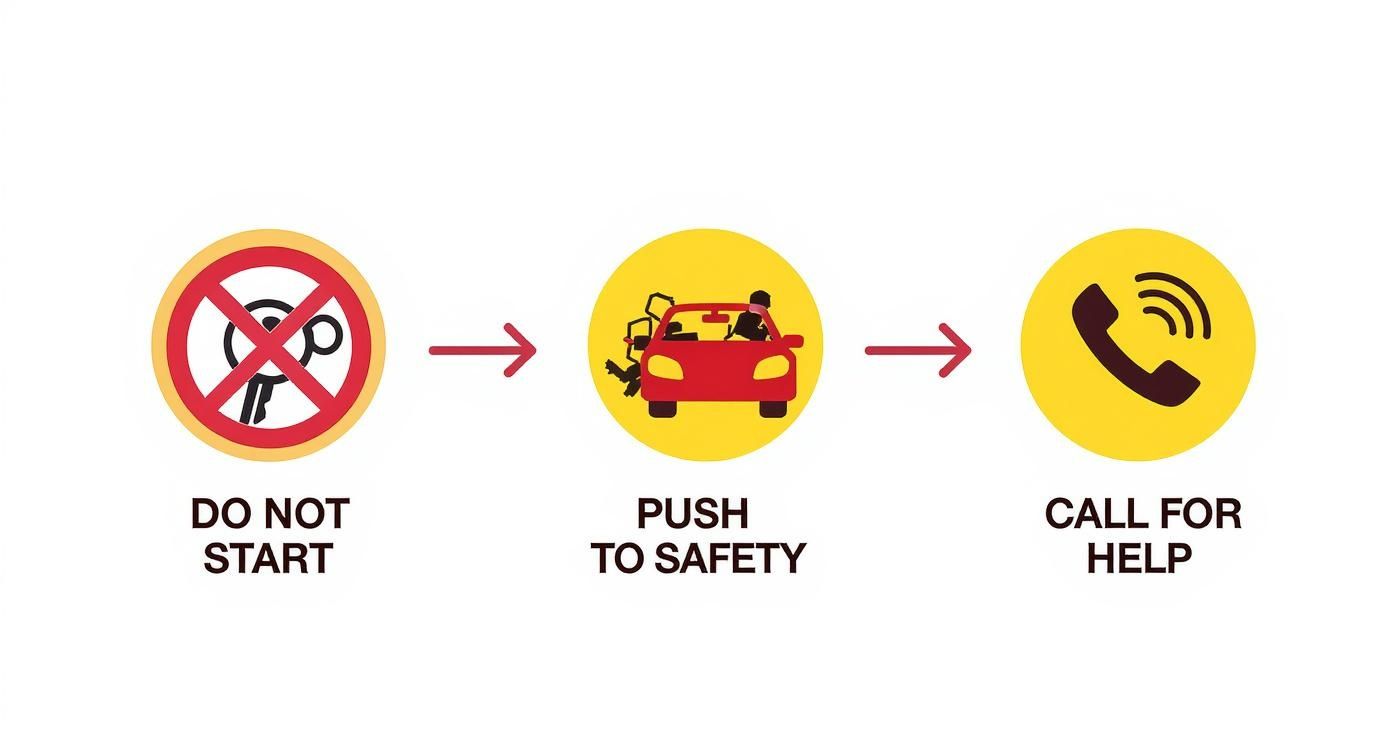
It’s a simple reminder that what you don’t do—like starting the car—is just as crucial as what you do.
Make the Right Call
With the car safe, it’s time to call for professional help. Your first thought might be your usual breakdown service, but hold on. That's often not the quickest or most cost-effective route. Misfuelling is usually classed as driver error, which many standard breakdown policies won't cover.
You need a specialist.
The best course of action is to search for a "wrong fuel in car near me" service. A mobile fuel drain technician has all the specialist gear to sort the entire problem out right where you are, saving you the hassle and cost of a tow to a garage.
These pros come directly to you, drain the contaminated fuel from the tank, flush the lines, and get you back on your way, often in about an hour. It’s the fastest way to turn a potential disaster into a minor inconvenience.
For a deeper dive into how these services work, take a look at our emergency guide to finding a fuel drain near you.
Recognising the Telltale Signs of Misfuelling
It’s a horrible sinking feeling. Sometimes you don't even realise the mistake at the pump. You might drive away, completely oblivious, only for your car to start acting up a few miles down the road. The symptoms can come on alarmingly fast, turning a normal journey into a stressful roadside breakdown.

Knowing what to listen and look for is your best defence. If you can spot the specific signs early, you can pull over safely and take action before the problem spirals into catastrophic engine damage. It’s all about diagnosing the issue quickly and confidently.
Symptoms of Petrol in a Diesel Engine
Putting petrol in a diesel car is by far the most common mix-up, and unfortunately, it's also the most damaging. Diesel fuel isn't just a fuel; it's a lubricant for critical components like the high-pressure fuel pump. Petrol, on the other hand, is a solvent. It strips away that vital lubricating film, causing metal parts to grind directly against each other.
If you've driven off after making this mistake, here's what you’ll likely notice:
A Loud Knocking Sound: As the petrol detonates too early under the engine's high compression, you'll hear a distinct and noisy 'knocking' or 'pinking' sound. It’s unmistakable.
Serious Power Loss: The car will feel incredibly sluggish and will struggle to accelerate as the engine fails to combust the incorrect fuel mixture properly.
Lots of Smoke: Keep an eye on your rearview mirror for plumes of white or greyish smoke billowing from the exhaust.
Warning Lights Galore: Your dashboard will probably light up like a Christmas tree. Expect the engine management light (EML) or the glow plug light to start flashing.
The second you experience any of these symptoms, your only job is to pull over as soon as it's safe. Pushing on will only accelerate the destruction of your fuel pump and injectors.
Symptoms of Diesel in a Petrol Engine
This is less frequent, mainly because the wider diesel nozzle usually won't fit into a modern petrol car's filler neck. But it still happens. Diesel is much thicker and oilier than petrol; it needs extreme compression to ignite, not a spark plug.
Because it won't burn correctly in a petrol engine, it will clog up the whole system. This leads to a different set of problems:
Engine Misfiring and Juddering: The car will run incredibly roughly, shaking and juddering as the spark plugs get coated in oily diesel residue and fail to create a spark.
Thick, Coloured Smoke: Look for excessive blue or black smoke coming from the exhaust. This is a dead giveaway that unburnt fuel is being pushed through the system.
The Engine Will Cut Out: More often than not, the car might start but will quickly stall and then refuse to restart once that thick diesel hits the engine.
Sometimes the symptoms can seem similar, so here’s a quick way to tell them apart.
Wrong Fuel Symptoms at a Glance
Symptom | Petrol in Diesel Engine | Diesel in Petrol Engine |
|---|---|---|
Engine Noise | Loud, metallic knocking or 'pinking' sound | Rough running, juddering, and misfiring |
Exhaust Smoke | Excessive white or grey smoke | Thick blue or black smoke |
Performance | Significant and sudden loss of power | Engine will likely stall and refuse to restart |
Warning Lights | EML and/or glow plug light will illuminate | EML will almost certainly come on |
This table is just a guide, but it covers the most common signs we see out on the road every day.
No matter which mistake you've made, the next step is always the same. As soon as you suspect a misfuelling issue, your number one priority is to stop the car safely, switch off the engine completely, and call for professional help. Don't ever be tempted to "drive through it"—that's a dangerous myth that quickly leads to four-figure repair bills. Finding a "wrong fuel in car near me" specialist on your phone is the only safe and effective way forward.
Why This Mistake Happens So Often in the UK
If you’ve just put the wrong fuel in your car, the first thing to know is you’re not alone. It’s a sinking feeling, but this is an incredibly common slip-up right across the UK. In fact, it happens here far more than almost anywhere else in the world, and there are some very specific reasons why.
It’s not just a simple case of being distracted at the pump. Our unique history with vehicle tax and fuel types has created the perfect storm for this exact mistake. Realising this helps take the sting out of it – and it’s why a whole industry of mobile fuel drain specialists exists to get you sorted.

The Legacy of UK Tax Policies
The root of the problem actually goes back to government tax policies from the early 2000s. Back in 2001, the government began offering tax breaks to encourage people to switch to diesel cars, which were believed at the time to be better for the environment due to lower CO2 emissions.
The incentive worked, maybe a little too well. The UK saw a massive boom in diesel car sales, and for years, the split between new petrol and diesel cars was almost 50/50. This is a situation you just don’t see in many other countries.
Suddenly, it was completely normal for a household to own one of each. You might use the petrol car for the school run and the diesel for a long motorway commute. This constant switching makes a mix-up at the forecourt almost inevitable, especially when you’re in a hurry or driving a car you’re not used to.
A Stark Contrast with Other Countries
To put it in perspective, think about the United States. Over there, diesel cars account for only about 1% of all vehicles on the road. The average American driver will rarely even see a diesel pump, so the chance of making this mistake is practically zero.
Here in the UK, it’s a totally different story. Nearly 30% of cars are still diesel. This huge number leads to an estimated 130,000 to 150,000 misfuelling incidents every single year. That’s one every few minutes. You can find more details on these statistical differences between UK and US drivers.
The sheer volume of diesel cars on UK roads is the single biggest reason our misfuelling rate is so high. When every other car takes a different fuel, the chances of a mix-up skyrocket, particularly if you’re tired, stressed, or in an unfamiliar vehicle.
This bit of history is precisely why specialist wrong fuel services are so common and necessary in Britain. They evolved to solve a uniquely British problem, born from decades of our motoring trends.
What Happens When the Mobile Fuel Drain Technician Arrives?
When you’re stuck on a forecourt or the hard shoulder with the wrong fuel in your car, the last thing you need is a long, drawn-out recovery process. Searching for "wrong fuel in car near me" puts you in touch with a specialist mobile service whose only job is to fix this exact problem, and fast. Forget waiting for a tow truck to haul you to a garage – a mobile technician brings the entire workshop directly to you.
It's a surprisingly efficient and safe operation. I can't stress this enough: it's a world away from someone trying to siphon fuel out of the tank with a bit of hose. That's not just dangerous; it's also illegal. A professional fuel drain is a self-contained, highly specialised procedure from the moment they arrive.
Arrival and Initial Assessment
Once the technician pulls up, which is usually within an hour of your call, their first job is to get a handle on the situation. They'll ask you a few quick questions to confirm what happened – petrol in a diesel, or the other way around – and, most importantly, whether you started the engine. This tells them how far the wrong fuel has travelled through your system.
Next, they'll make the area completely safe. This means positioning their van correctly, rolling out protective ground mats to catch any stray drips, and making sure there are no ignition sources anywhere near the vehicle. Every action is dictated by strict safety protocols to look after you, your car, and the environment.
The Draining and Flushing Process
Now for the technical bit. The technician will hook up an ADR-approved pumping system – a legal requirement for safely handling flammable liquids – to your car’s fuel tank. They can usually access it through the filler neck, but sometimes they might need to disconnect a fuel line to get the job done properly.
The contaminated fuel is then pumped directly from your tank into a secure, sealed container inside their van. This isn't a five-minute job. A typical family car can easily have over 60 litres of fuel to remove. But just emptying the tank isn't enough.
The next step is absolutely critical: flushing the system. The technician will circulate a small amount of clean, correct fuel through the lines and filters to purge any remaining contamination. This makes certain that no bad fuel can find its way to your engine when you turn the key.
If you’re interested in the specifics of the safety measures, we have a guide that explains the safe steps for draining a fuel tank in more detail.
Refuelling and System Checks
With the flush complete, the technician will put about 5-10 litres of the correct fuel back into your tank. It’s just enough to get you safely to the next petrol station to fill up completely.
The final step is the moment of truth. They’ll ask you to start the engine and will listen carefully to make sure it’s running smoothly, with no spluttering or odd noises. This final check is their green light that the job is done and your car is ready for the road. The whole on-site process, from arrival to you driving away, is usually wrapped up in under 90 minutes. While fuel drains are unique, the concept of on-demand vehicle care is becoming more common; you can get a better feel for it by understanding how mobile services operate in other sectors like detailing.
What’s This Going to Cost Me? Unpacking Your Options
The first question that inevitably pops into your head is, "How much is this going to set me back?" In that moment of panic, it's easy to imagine catastrophic repair bills, but take a deep breath. Understanding your options right now can save you a serious amount of money and stress.
Believe it or not, you're not the first person to do this today, and you won't be the last. It's an incredibly common slip-up. Motoring organisations deal with thousands of these incidents every year, and when you crunch the numbers, it's estimated that around 130,000 UK drivers make this mistake annually. That’s a collective £40 million spent on recovery and wasted fuel. You can read more about the surprising statistics behind UK fuel fiascos if you're curious.
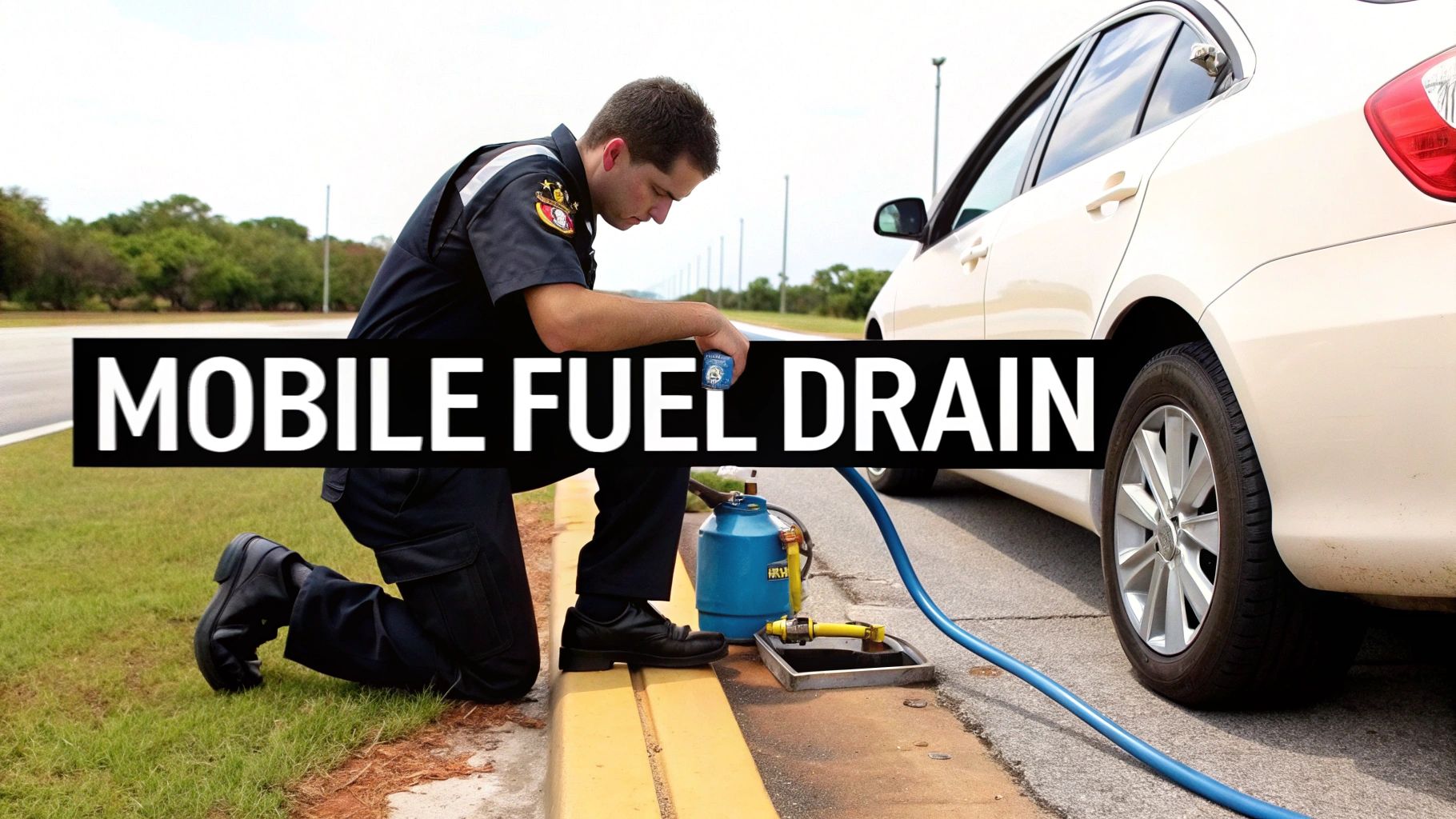
The good news? If you haven't started your engine, the fix is usually quick, simple, and far more affordable than you might think. Calling a specialist mobile fuel drain service is, without a doubt, your best and most cost-effective move.
Mobile Fuel Drain vs. Garage Repairs: A Quick Comparison
When you search for a solution, you'll find two main routes you can go down. The path you choose will have a big impact on your wallet and how long you're left stranded.
Mobile Fuel Drain Service: This is the direct approach. A technician comes straight to your location—be it the petrol station forecourt or your driveway. You’ll typically pay a fixed fee that covers everything: the callout, the technician's time, the fuel drain itself, a system flush, and the safe disposal of the contaminated fuel. For most cars, you’re looking at a cost somewhere in the £150 to £300 range. Better still, the whole job is usually done in under 90 minutes.
Garage or Main Dealer: This is the long way round. First, you'll need to arrange for your car to be towed, which adds an immediate cost. Once it arrives at the garage, you’re at the mercy of their schedule. Labour rates are almost always higher, and the final bill can easily creep up to £400 or more, even if all they do is a simple drain.
It’s worth remembering that if the engine has been run with the wrong fuel, the costs can escalate frighteningly quickly. We're talking potential repairs to injectors and high-pressure fuel pumps that can run into the thousands.
Will My Insurance or Breakdown Cover Help Me?
It’s a fair question, but unfortunately, the answer is usually no. The vast majority of standard car insurance policies and basic breakdown memberships do not cover misfuelling. They see it as 'driver error', which is often a specific exclusion in the small print.
Some top-tier breakdown packages might include misfuelling cover as an add-on, but it's not a standard feature. If you call your provider without this specific cover, their default solution is to tow you to a garage, leaving you to foot the bill for whatever the garage charges.
Calling a dedicated mobile fuel drain specialist directly is almost always the cheapest and fastest option. It bypasses towing fees, high garage labour rates, and potential policy excess charges, putting you back in control of the situation and your finances.
By making that one direct call, you get a clear, all-inclusive price and the quickest path back to your day. To get a more detailed breakdown of what to expect, take a look at our complete UK guide to wrong fuel in car costs.
Your Misfuelling Questions Answered
Standing on a forecourt with the wrong nozzle in your hand, it's natural for your mind to start racing. It's a horrible, sinking feeling, but getting clear answers can make all the difference.
We get calls from drivers in this exact situation every day. Based on years of experience, here are the answers to the questions we hear the most.
"I only put a little bit in. Will it really cause a problem?"
This is the first question on everyone's mind, and the answer, unfortunately, is a definite yes. Even a small amount of petrol in a modern diesel engine can spell big trouble. Petrol acts like a solvent, stripping the lubricating qualities from diesel fuel that your engine's components rely on.
Without that lubrication, you get metal-on-metal friction, which quickly damages sensitive, high-precision parts like the fuel pump and injectors. Putting five litres of petrol in a 50-litre diesel tank is less catastrophic than filling it to the brim, of course, but our professional advice is always the same: do not start the engine.
Even a contamination level as low as 5% can be enough to wreck your fuel system. A professional fuel drain is the only way to be certain you've dodged a repair bill that could easily run into thousands of pounds.
"How long will a mobile fuel drain actually take?"
One of the biggest reliefs for drivers is how quickly we can solve the problem. The whole point of a mobile service is to get you out of a jam fast. In most situations, the entire job—from the technician arriving on scene to you being ready to drive away—takes between 45 and 90 minutes.
Of course, the exact time can vary a bit depending on the car's make and model and how easy it is to get to the fuel tank. But for a typical car stuck at a petrol station, you can realistically expect to be back on your way in about an hour. It’s a world away from waiting for a tow truck and then hoping a garage can squeeze you in.
"Is my breakdown cover a cheaper option?"
It all comes down to the fine print of your policy. Your standard, basic breakdown cover often won't touch misfuelling, as it's classed as driver error. They might offer to tow you to a garage, but you'll be left to foot the bill for the drain yourself, often at inflated garage prices.
Some of the more premium breakdown plans do include misfuelling as an add-on, but if you don't already have that in place, calling a specialist fuel drain service is almost always the smarter, more direct route.
Think of it this way:
Standard Breakdown Cover: You pay for the tow, then you pay whatever the garage decides to charge for labour.
Specialist Mobile Service: You get a single, all-in quote for the complete job, done right there on the spot with no hidden surprises.
A dedicated service simply cuts out the middlemen, giving you a clear, upfront cost for a complete fix.
"What do you do with the bad fuel?"
We take this part very seriously. That mix of petrol and diesel is legally classified as hazardous waste, so you can't just dispose of it anywhere. A reputable fuel drain company will follow strict environmental regulations to the letter.
Here's how a responsible operator handles it:
The technician pumps the contaminated fuel from your tank into specially designed, sealed containers kept inside their van.
These secure containers are then taken to a licensed waste recycling facility.
At the facility, the fuel is processed in an environmentally safe and legally compliant way.
Choosing a professional service means your mistake doesn't end up harming the environment. It's one of the biggest signs you're dealing with a trustworthy company.
If you're in Suffolk or the surrounding areas and need help right now, don't wait. Misfuelled Car Fixer provides a 24/7 emergency mobile fuel drain service to get you back on the road safely and without fuss. Call us now for a fast, professional solution. Find out more about our Suffolk fuel drain services.


