



Put Diesel in an Unleaded Car? Here Is What to Do Next
- Misfuelled Car Fixer

- Dec 11, 2025
- 13 min read
It’s a moment of pure dread. You’ve just finished at the pump, looked down, and the horrible realisation hits you: you've put diesel in your unleaded car.
The first, most critical thing to do is take a deep breath and DO NOT start the engine. Don't even turn the key to the 'on' position. It’s a common mistake, but what you do in the next few minutes will determine whether this is a simple fix or a hugely expensive repair.
Why Is Diesel in an Unleaded Car So Bad?
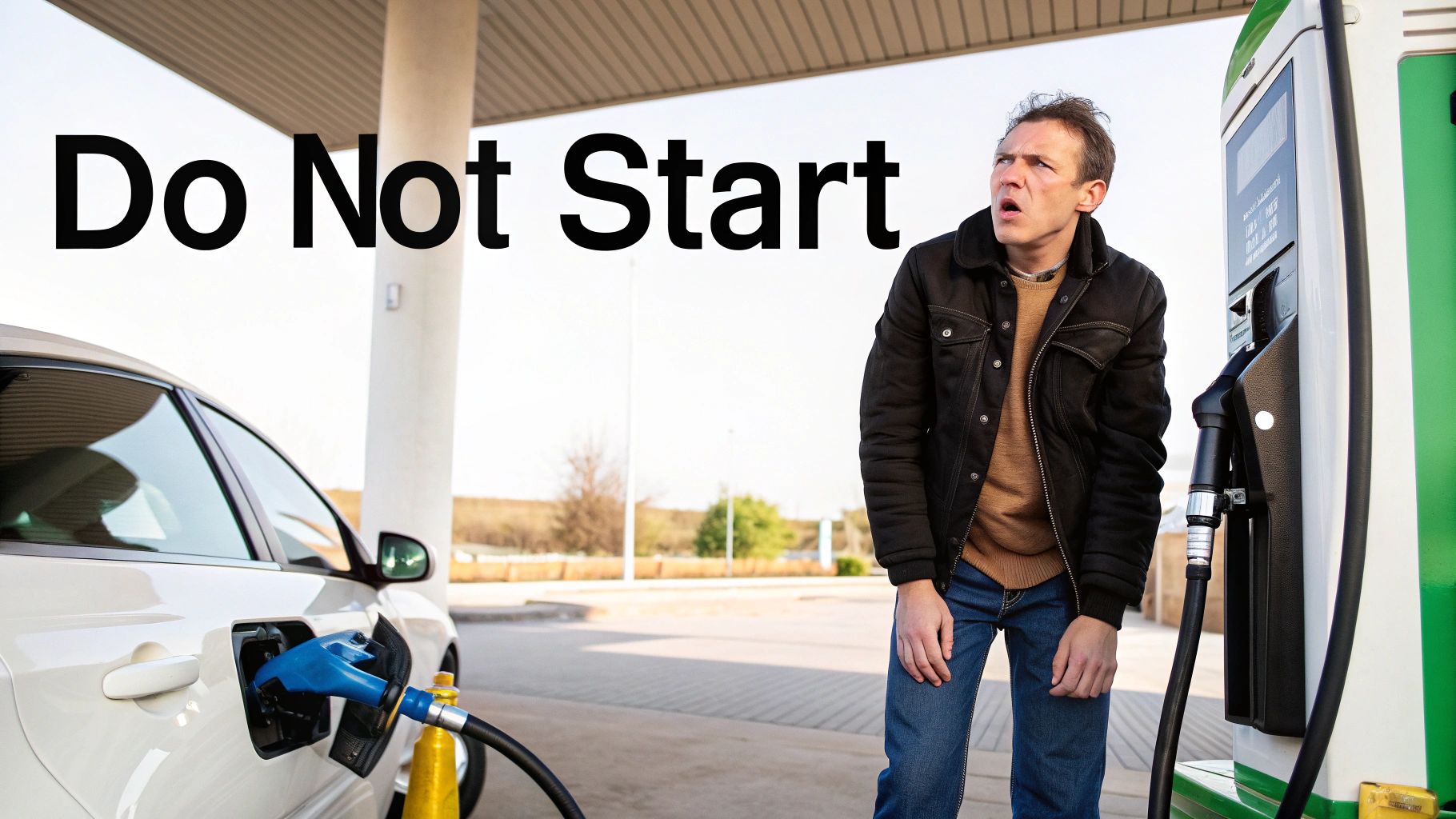
That panic you feel is understandable, but let's break down exactly why this is a problem. It’s not about an explosion; it's about two completely different types of fuel that work in fundamentally different ways. Your car’s engine is a finely tuned machine built for just one of them.
Think of petrol as a thin, highly flammable solvent that gets ignited by your spark plugs. Diesel is the opposite—it's a much thicker, oilier substance that combusts under high pressure, not with a spark.
The Problem of Oil vs. Solvent
When you pump diesel into a petrol system, you're swapping a thin solvent for a thick lubricant, and that's where the trouble begins. Several crucial parts of your fuel system are simply not designed to handle it.
Fuel Pump & Injectors: These components rely on the clean, thin nature of petrol to keep them lubricated and running freely. The thick, oily diesel will quickly clog them up, making the fuel pump work overtime until it burns out.
Spark Plugs: To get your engine running, spark plugs need to create a clean spark. Diesel coats the tips in an oily gunk, which stops the spark from ever happening. No spark, no ignition.
Engine Cylinders: Because diesel can't be ignited by a spark plug, it will just pool in the cylinders. This prevents proper combustion and will cause the engine to misfire, run very badly, or simply not start at all.
This quick guide lays out the immediate actions to take and why they are so vital for protecting your unleaded engine from serious damage.
Immediate Actions Versus Engine Risks
What to Do / What to Know | Why It's Critical for Your Unleaded Car |
|---|---|
DO NOT Start the Engine | Keeps the diesel contained in the fuel tank, preventing it from circulating. This is the single most important step you can take. |
Diesel is an Oil, Petrol is a Solvent | The oily diesel will clog delicate fuel injectors and coat spark plugs, preventing ignition. |
Your Fuel Pump is at Risk | The fuel pump is designed for thin petrol. Pumping thick diesel through it causes immense strain and can lead to complete failure. |
Call a Misfuel Specialist | A professional can safely drain the contaminated fuel from the tank, flush the lines, and get you back on the road without causing further damage. |
Following these steps ensures the problem remains a simple contamination issue rather than a catastrophic engine failure.
The most important thing to remember is that the real damage isn't caused by the misfuelling itself, but by starting the engine afterwards. By leaving the car off, you've kept the problem contained right there in the fuel tank.
Once you turn that key, the diesel is pulled through the entire system—the fuel lines, the pump, the injectors, and into the engine itself. This turns a straightforward draining job into a complex, and much more expensive, mechanical repair.
If you're wondering what signs to look out for if the engine has been started, you can learn more about how to identify diesel in petrol car symptoms and what to do next. But for now, resist that temptation to "just see what happens." It’s the best decision you can make for your car and your wallet.
What Happens if You Drive with the Wrong Fuel?
It's a sinking feeling, but if you’ve started the engine after putting diesel in your petrol car, you’ll know something is wrong almost straight away. Modern petrol engines just aren't built to handle the thick, oily consistency of diesel, and the signs of protest are hard to miss.
First, the engine will sound terrible. It will start to cough and splutter, juddering violently as if it’s on the verge of stalling. This is the diesel coating your spark plugs, smothering the spark needed to ignite the fuel. That smooth hum you’re used to will be replaced by a rough, clanking noise from under the bonnet.
Almost immediately, you'll feel a dramatic loss of power. Pushing the accelerator won't do much, if anything. Before you know it, the engine will likely cut out entirely, leaving you stranded.
The Tell-Tale Signs of a Misfuelled Engine
As your engine fights a losing battle to burn the diesel, the evidence will become very visible. One of the classic signs is thick, heavy smoke pouring from the exhaust. We’re not talking about the light puff of vapour you see on a cold day; this is dense, often white or grey smoke, which is literally unburnt fuel being forced through the system.
With every second the engine runs, things are getting progressively worse for its internal parts. The components in the immediate firing line are:
The Fuel Filter: This is designed to catch tiny particles in petrol. It stands no chance against thick diesel and will become completely clogged in no time.
The Fuel Pump: This component is built to move a thin liquid, not heavy oil. It will strain, overheat, and very likely burn out trying to pump the diesel.
Fuel Injectors: These are precision parts that spray a fine mist of fuel. Diesel will gum up their tiny nozzles, causing misfires and starving the engine.
While some newer cars have advanced vehicle health monitoring systems, they can't prevent the physical damage of misfuelling. This situation needs immediate, hands-on intervention.
The Long-Term Damage from Driving with Diesel
Even driving a few hundred yards can turn a simple mistake into a financial nightmare. The contamination doesn't just stay in the fuel lines; it spreads through your entire engine and exhaust system, wrecking expensive parts.
Take the catalytic converter. It’s designed to handle petrol exhaust fumes, but a coating of oily, unburnt diesel will ruin it. That’s an instant MOT failure and a repair bill that can easily run into four figures. Your lambda (oxygen) sensors, which are crucial for managing the fuel-to-air ratio, will also get fouled up by the soot, causing poor performance and higher emissions for good.
The longer the engine runs, the deeper the contamination spreads. What could have been a straightforward fuel drain job quickly spirals into a major mechanical failure that could cost you thousands to fix.
With diesel cars becoming less popular, it's an easier mistake to make. As of 2024, there are 2.8 million fewer diesel cars on UK roads than in 2019. Their mileage has also fallen by 13%, while petrol car use is almost back to normal. This means more of us are unfamiliar with the different nozzles, increasing the chance of a mix-up at the pump.
Ultimately, driving with diesel in a petrol car is the difference between a fixable problem and a potential engine write-off. The only sensible thing to do is pull over safely, switch off the engine, and call a professional.
Your Misfuelling Emergency Action Plan
Right, that sinking feeling in your stomach is completely normal. We’ve all had those moments. But what you do in the next ten minutes is absolutely critical. Once you realise you've put diesel in your unleaded car, the priority has to switch from panic to damage control. Following a clear, simple plan can stop a silly mistake from snowballing into a massive engine repair bill.
First things first, make the area safe. Let the petrol station staff know what’s happened straight away. They're trained for this sort of thing and will cone off the pump to stop anyone else from using it and help manage the situation on the forecourt.
How to Move Your Vehicle Safely
With the pump secured, the next job is to get your car out of the way. And this is the most important bit: do not, under any circumstances, start the engine. Not even for a second.
Pop the car in neutral and ask the staff or even a friendly passer-by for a hand to push it to a safe parking spot.
This one simple action keeps the contaminated fuel where it is – in the tank. The moment you turn that key, the fuel pump kicks in and starts sending that thick, oily diesel through fuel lines, injectors, and filters that were only ever designed for thin, clean petrol.
This flowchart shows just how quickly things can go wrong once the engine starts.
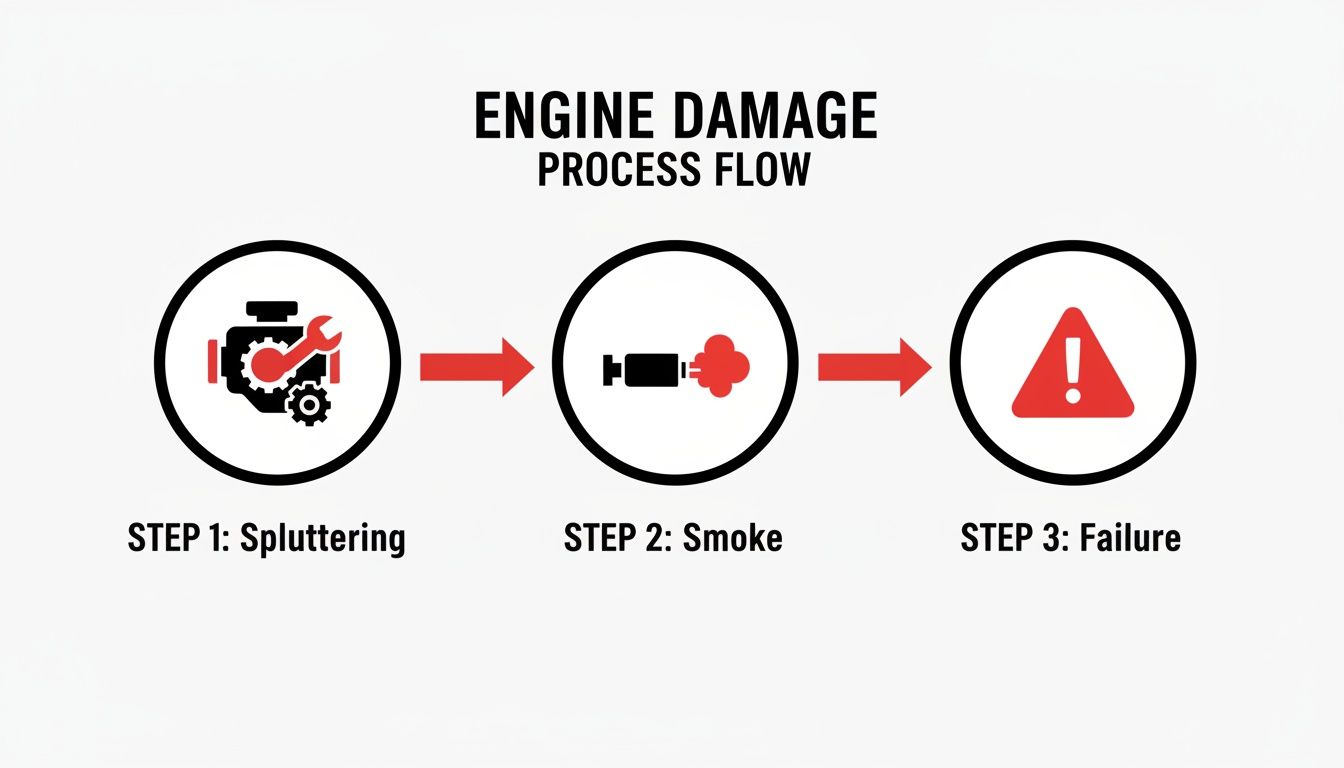
As you can see, it doesn't take long for the initial spluttering to become visible smoke and, if you keep going, catastrophic engine failure.
Seriously, Don't Try a DIY Fuel Drain
In a moment of panic, it’s tempting to search on your phone for a quick DIY fix. Trust me on this one – trying to drain the fuel yourself is a truly terrible idea. Here’s why:
It’s incredibly dangerous. Petrol fumes are massively flammable. A single spark from a metal tool, or even static electricity from your clothes, can ignite them. We use specialised, anti-static equipment for a reason.
You could cause even more damage. Modern cars have anti-siphon devices in the tank. Trying to force a hose past them can easily break internal parts. You’ll also almost certainly leave diesel residue behind in the fuel lines, which defeats the whole purpose.
It’s illegal and terrible for the environment. Getting rid of contaminated fuel isn't like tipping out old tea. It's a regulated process. Pouring it down a drain or onto the ground is against the law and can land you with a hefty fine.
Your best, safest, and frankly, only sensible option is to call a specialist mobile fuel drain service. It's what we at Misfuelled Car Fixer do all day, every day, right across Suffolk and the surrounding areas.
Why a Specialist Is Better Than a Tow Truck
Your first instinct might be to ring your breakdown provider and get towed to a garage. While it sounds logical, it’s often the slower and more expensive option. A garage might not be able to look at your car straight away, leaving you stranded for hours, and then they'll charge you workshop labour rates.
A mobile fuel drain technician, on the other hand, is a specialist who comes directly to you.
We can be at your location—whether it’s a busy petrol station forecourt, your driveway at home, or the side of the A14—often in under an hour. Our vans are basically mobile workshops, fully equipped to safely drain the tank, flush the entire system, and get you back on your way. It’s almost always faster and more cost-effective.
How a Professional Fuel Drain Service Works
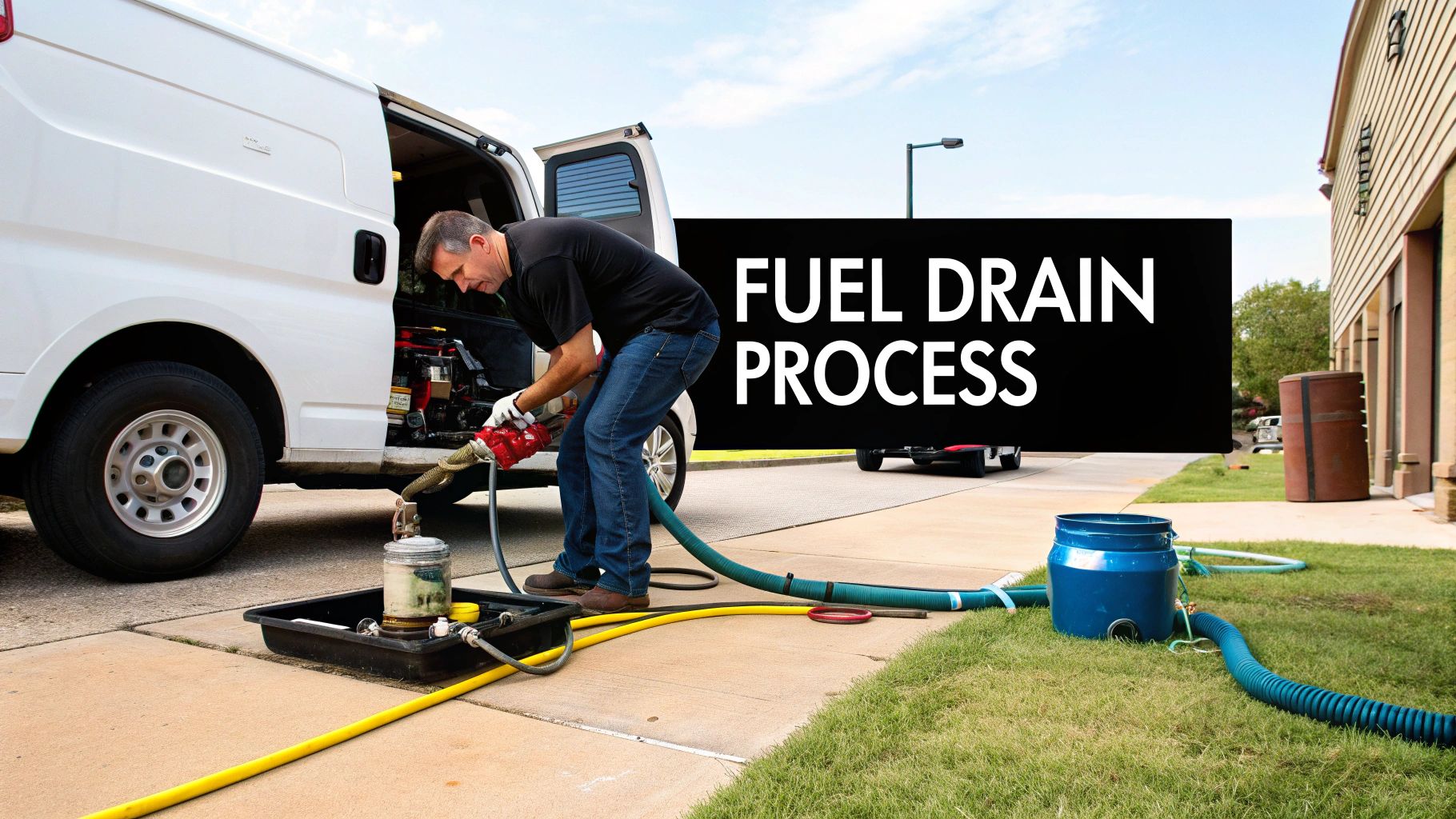
The thought of calling out a professional after misfuelling might seem like a huge ordeal, but in reality, it's a surprisingly slick operation. Mobile fuel drain specialists have this down to a fine art. They can turn what feels like a day-ruining disaster into a simple roadside fix. When our technician pulls up, their van is essentially a mobile workshop, kitted out with everything needed to sort the problem out safely and get you on your way.
Their first move is always safety. They'll secure the area around your car, making sure there are no ignition risks, before starting the job. The main task is to remove the contaminated fuel from your tank using specialised, ATEX-certified pumping equipment. This isn't just a basic hose and a prayer; it's a professional, sealed system designed to handle flammable liquids without any spills.
Draining and Flushing the System
Getting the tank empty is only half the battle. Next, the technician will push a small amount of clean petrol through your car's fuel lines. This is called a fuel system flush, and it's a crucial step. It's designed to clear out any of that thick, oily diesel residue that might be clinging to the fuel pump, lines, or injectors.
This flush makes sure that every last drop of the wrong fuel is gone, preventing any nasty running problems or damage later on. To finish, they'll put just enough fresh, correct unleaded petrol in the tank to get you safely to the next petrol station to fill up properly. It’s a highly efficient process, and it helps to understand how professional service companies track jobs and costs effectively to appreciate how they can be so quick.
What If You Started the Engine?
Okay, so what if you started the car? Don't panic. The job is a bit more involved, but it's nothing a trained technician can't handle at the roadside. As well as the standard drain and flush, they’ll need to clean the parts that have had diesel running through them.
This usually involves:
Cleaning the fuel rail and injectors to get rid of oily deposits.
Changing the fuel filter, which will almost certainly be clogged with diesel.
Checking and cleaning spark plugs that may have been fouled by the oily fuel.
The whole on-site job, for a car that hasn't been started, is usually done in less than an hour. This is the biggest reason to call a mobile service instead of getting towed to a garage, where you could be waiting days.
Any reputable fuel drain service, including us here at Misfuelled Car Fixer, will also deal with the contaminated fuel responsibly. It's stored in secure containers and taken to a licensed waste facility, so everything is handled in line with UK environmental laws. If you're stuck right now, our emergency guide on finding a fuel drain near you offers clear, immediate steps.
The Financial Side of a Misfuel: What to Expect
Let's get straight to the point. The first question that pops into anyone's head after misfuelling is, "How much is this going to cost me?" If you've caught the mistake before turning the key, breathe a sigh of relief. The fix is almost certainly cheaper than you're imagining.
Your decision at this moment, however, is crucial. It can be the difference between a straightforward, affordable fix and a bill that genuinely stings.
You’ve got two main routes: call a mobile fuel drain specialist or get the car towed to a garage. Instinct might tell you to go to a garage, but that's often the slower and more expensive path. Garages bill at standard workshop labour rates, which can be steep, and you might get hit with diagnostic fees before they even touch the fuel tank.
Mobile Fuel Drain vs. Garage: A Cost Comparison
A mobile fuel drain service, like us at Misfuelled Car Fixer, is designed for this exact emergency. We come directly to you, whether you're at the petrol station or stuck on your driveway. This immediately cuts out the towing fee.
Because this is our bread and butter, we have the specialist gear and the process down to a fine art. Our pricing is transparent and built for this specific job, not based on general hourly garage rates.
A garage, on the other hand, has to squeeze your car into their busy schedule of MOTs and services. You could be waiting a day or more, racking up labour costs all the while. A specialist call-out is a single, fixed fee that gets you back on the road right away.
The real savings come from preventing engine damage. A mobile fuel drain costs a tiny fraction of what you'd pay to replace a wrecked fuel pump, injectors, or a catalytic converter. Those repairs can easily spiral into the thousands.
Will My Insurance Pay for a Misfuel?
It's a question we hear all the time, and the answer, unfortunately, is almost always no. Most standard car insurance policies see misfuelling as a self-inflicted error, much like running out of fuel completely. It's always worth double-checking your policy wording, but don't count on it being covered.
Some top-tier breakdown recovery plans might include misfuel assistance as an optional extra, but it's rarely a standard feature. This is why paying for a professional, on-the-spot drain service is the most common and practical solution. For a more in-depth look at the numbers, check out our guide to the costs of putting the wrong fuel in your car.
The price of fuel itself is also a factor. Even with the UK government pushing the petrol and diesel ban back to 2035, diesel’s popularity has been on a long-term slide. As of April 2025, diesel was still around 7 pence per litre more expensive than petrol.
Ultimately, the smartest financial move you can make after putting diesel in a petrol car is to invest in a fast, specialist fix. It’s the most economical way to turn a potential disaster into a minor inconvenience.
Right, so you’ve been through the headache of putting diesel in your petrol car, and you’re keen to make sure it never, ever happens again. I don't blame you. The good news is that avoiding a repeat performance is mostly down to a bit of mindfulness at the pump.
Honestly, it’s almost always a simple lapse in concentration that causes it. You’re tired after a long day, stressed about a meeting, or maybe you’re driving a hire car you're not used to. It happens. The trick is to build a few simple habits that act as a safety net.
Think of it as a quick mental checklist every time you pull up to refuel. Before you even grab the pump, consciously look at the label and the trigger guard. Diesel handles are almost always black, and unleaded is green. That colour-coding is your first and best defence.
Then, there's the nozzle itself. Diesel nozzles are intentionally made with a wider spout than unleaded ones. In most modern cars, a diesel nozzle just won't fit comfortably into a petrol filler neck. If you feel like you have to force it in or angle it strangely, that's a massive red flag. Stop what you’re doing and double-check.
Building Smarter Fuelling Habits
Creating a solid routine is what really makes the difference, especially when you’re not on your usual schedule. We all make silly mistakes when we’re in a rush or our heads are elsewhere.
Here are a few things I always tell people to do:
The Final Glance: Just before you squeeze that trigger, take one last look at the pump display. Make sure it says "Unleaded." It takes a single second.
Ditch the Distractions: Put your phone down. End that conversation. Fuelling only takes a few minutes, and giving it your full attention is the easiest way to avoid a costly mistake.
The Hire Car Hack: If you’re in a rental, slap a sticky note on the dash or next to the fuel cap that says "PETROL ONLY." It’s a simple but surprisingly effective reminder.
This is more important than ever, actually. The number of new diesel cars being sold in the UK has fallen off a cliff, dropping from around 48% of the market in 2016 to just over 7.5% by 2023. With fewer diesels on the road, people are just less used to seeing them, which ironically can make a mix-up more likely. You can read more about the future of diesel cars in recent industry reports.
The goal is to make these checks automatic. It should be as ingrained as checking your mirrors before changing lanes. A quick glance at the pump colour and label should become second nature.
A Foolproof Physical Fix
If you frequently swap between petrol and diesel cars, or just want total peace of mind, you could get an aftermarket misfuelling prevention device. It’s essentially a special fuel cap that replaces your factory one.
These caps are designed with a clever mechanism that only opens for the slimmer unleaded nozzle. It physically blocks the wider diesel nozzle, making it pretty much impossible to put the wrong fuel in.
If you do find yourself stuck on a forecourt in Suffolk or the nearby areas with the wrong fuel in your tank, don't panic. The team at Misfuelled Car Fixer is on call 24/7. We offer a fast, professional fuel drain service to get you sorted and back on your journey with minimal drama. Get in touch with us at https://www.misfuelledcarfixer-suffolk.co.uk for immediate help.


