



Put unleaded in diesel car: How to minimize damage and costs
- Misfuelled Car Fixer

- Dec 15, 2025
- 13 min read
It’s a moment of sheer panic. That dawning realisation as you hang up the pump handle—you've just put unleaded in a diesel car. Your stomach drops, but before you let the panic take over, what you do in the next few minutes is absolutely crucial. Acting quickly and correctly can mean the difference between a simple fix and a wallet-emptying disaster.
Put Unleaded In Diesel Car | What to Do the Moment You Realise Your Mistake
First, take a deep breath. This happens more often than you think. The single most important thing to remember is this: do not start the engine. Seriously, don't even put the key in the ignition.
Leaving the engine off keeps the petrol contained in the fuel tank. The moment you turn that key, the fuel pump kicks in and sends the unleaded coursing through your car’s entire system. Petrol acts as a solvent, stripping away the essential lubrication that diesel provides, and it can quickly wreck sensitive components like the fuel pump and injectors.
If you’re blocking a pump at the petrol station, let the staff know right away. They’ve seen this happen countless times and can help you push the car into a safe parking bay.
It’s an easy mistake to make. A 2023 survey from Go.Compare found that a massive 29% of UK motorists have done the exact same thing. That's nearly one in three drivers, so you're certainly not alone in this.
Your First Steps After Misfuelling
Once your car is safely out of the way, your next steps are simple but vital. This isn't the time for DIY solutions or wishful thinking; it's time to call in the professionals.
Here’s what to do:
Tell the petrol station staff what’s happened. They can cone off the area if necessary and will have a procedure for this.
Call a specialist misfuel recovery service like us at Misfuelled Car Fixer. A mobile technician is the fastest and safest way to resolve this.
Find your locking wheel nut key, if your car has one. Our technician might need it to access certain components, so having it ready saves time.
This decision tree breaks down those critical first moments into a simple, clear visual guide.
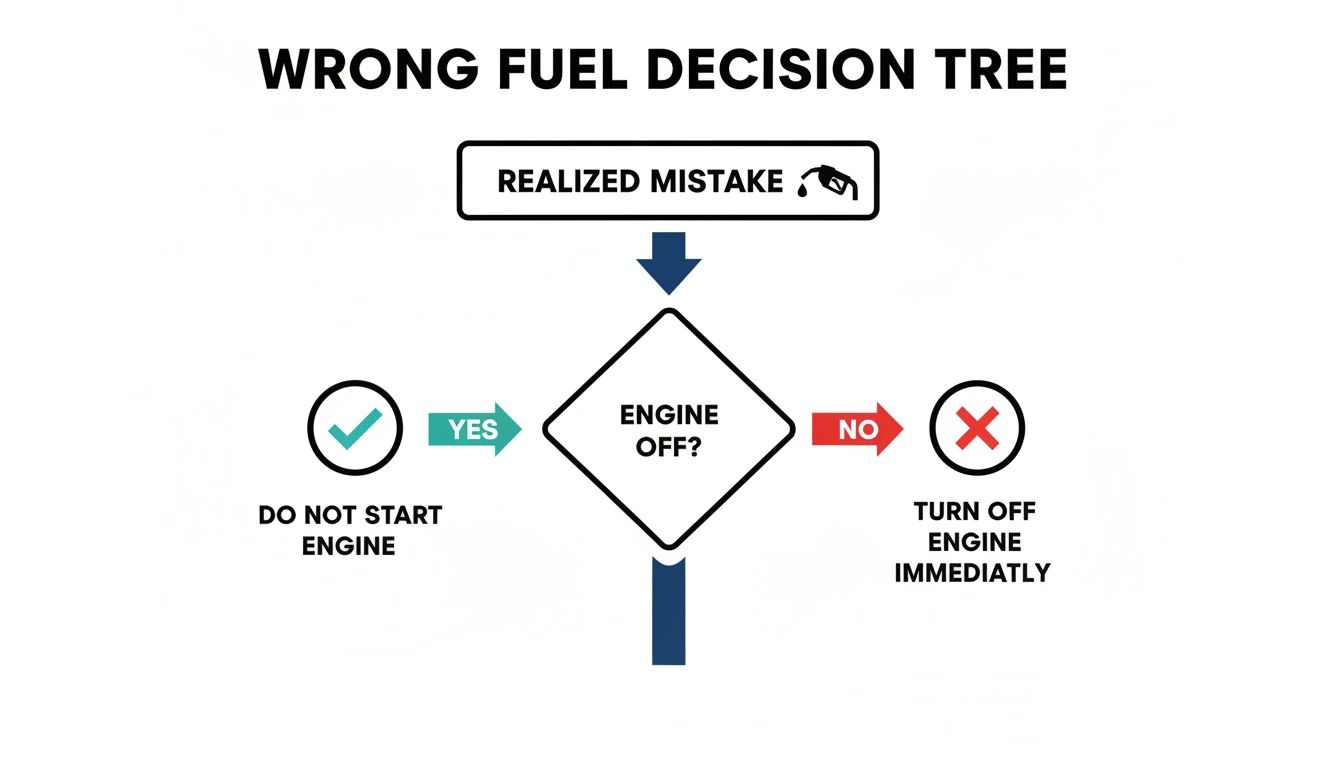
Whether you’ve brimmed the tank or only added a fiver's worth, the golden rule remains the same: keep the engine off and get professional help.
Immediate Dos and Don'ts After Misfuelling
To make it crystal clear, here’s a quick-reference table outlining what you absolutely should and shouldn’t do right after misfuelling.
Action (DO) | Why It's Important | Mistake (DON'T) | Why It's Dangerous |
|---|---|---|---|
Keep the engine OFF | Prevents petrol from circulating and causing major damage. | Don't start the car | Circulates the corrosive petrol, damaging the fuel pump and injectors. |
Inform station staff | They can secure the area and help you move the car safely. | Don't try to fix it yourself | Siphoning fuel is dangerous and you won't remove all contaminants. |
Push the car to a safe spot | Clears the pump for others and keeps you out of harm's way. | Don't drive "just a little way" | Even a few metres can cause thousands of pounds in damage. |
Call a professional | A specialist has the right equipment to drain and flush the system safely. | Don't just top up with diesel | Diluting the petrol won't make it safe and the damage will still occur. |
Following these simple dos and avoiding the don'ts is the best thing you can do for your vehicle's health and your own peace of mind.
Crucial Takeaway: Turning the engine on, even for a second, escalates the problem from a straightforward fuel drain to a potentially catastrophic and expensive engine repair. Petrol destroys the lubricating film that diesel components rely on, causing metal-on-metal friction and immediate damage.
Even a small splash of petrol can cause problems. If you're wondering about the thresholds, we have a detailed guide explaining how to handle a small amount of unleaded in a diesel car. But honestly, the only guaranteed safe bet is a professional fuel drain.
Why Petrol Wrecks a Diesel Engine
Understanding why you mustn't start your engine is the first step to grasping just how serious this mistake can be. Putting petrol in a diesel car isn't like grabbing the wrong type of milk; it's a chemical problem that triggers a chain reaction of mechanical destruction. The whole issue boils down to how fundamentally different the two fuels are.
Diesel, at its core, is an oil. That oiliness gives it a property we call lubricity, and it's absolutely vital for your engine's health. It acts as a lubricant for the incredibly sensitive, high-pressure parts of your fuel system, like the pump and injectors. We're talking about components working under immense force with tiny tolerances, and they count on the diesel fuel itself to keep them running smoothly without grinding together.
Petrol Acts Like a Stripper
Petrol is the polar opposite. It's a solvent. Think of it less like a fuel and more like a powerful degreasing agent. The moment it gets into your diesel system, it starts stripping away that crucial lubricating film from all the moving parts.
Without that protective oily layer, the metal components inside your fuel pump begin to grate against one another. This friction creates a huge amount of heat and, more importantly, shaves off tiny metal fragments. We call this metallic dust 'swarf', and it's the real villain of the story. Once created, the fuel pump sends this swarf on a tour of your entire fuel system.
The Point of No Return: A modern diesel fuel pump can operate at pressures well over 2,000 bar (or 29,000 psi). These parts are engineered to handle that force, but only with proper lubrication. Take that away, and they essentially eat themselves alive, firing destructive shrapnel down the fuel lines.
This contamination is what turns a simple problem into a nightmare. Once that swarf is circulating, just draining the tank won't cut it. The whole system is now polluted, from the fuel tank right up to the injectors. That’s when you start looking at repair bills that can easily climb into the thousands.
If you're curious about the technical details, we break it down further in our guide on what makes diesel and petrol so different.
The Domino Effect of Destruction
Once you turn that key, the damage starts instantly and spreads fast. Here’s a quick rundown of the destructive sequence:
The fuel pump, now starved of lubrication, begins to destroy itself.
Tiny metal particles (swarf) are produced and forced through the fuel lines.
These particles clog and ruin the delicate injectors.
Your fuel filter is quickly overwhelmed and can’t trap all the debris.
The entire fuel system is now contaminated with this metallic dust.
This is exactly why the most important piece of advice we can give is always the same: do not turn the key. Leaving the engine off keeps the petrol safely contained in the fuel tank, turning a potential catastrophe into a relatively simple and affordable fix.
What to Expect From a Misfuel Recovery Service
So, you’ve made the call after putting unleaded in your diesel car. Knowing what happens next can take a lot of the stress out of the situation. A professional mobile fuel drain isn't just about siphoning out the bad stuff; it's a precise, multi-stage process designed to safely clear every last drop of wrong fuel from your car's system.
When our technician arrives, their first priority is always safety. They'll quickly assess the scene, whether you're stuck on a busy petrol station forecourt or pulled over on a dark A-road. This means setting up safety cones, checking for any ignition sources, and getting their equipment ready. They'll also run through the details with you—what fuel you used, how much went in, and the all-important question: did you start the engine?
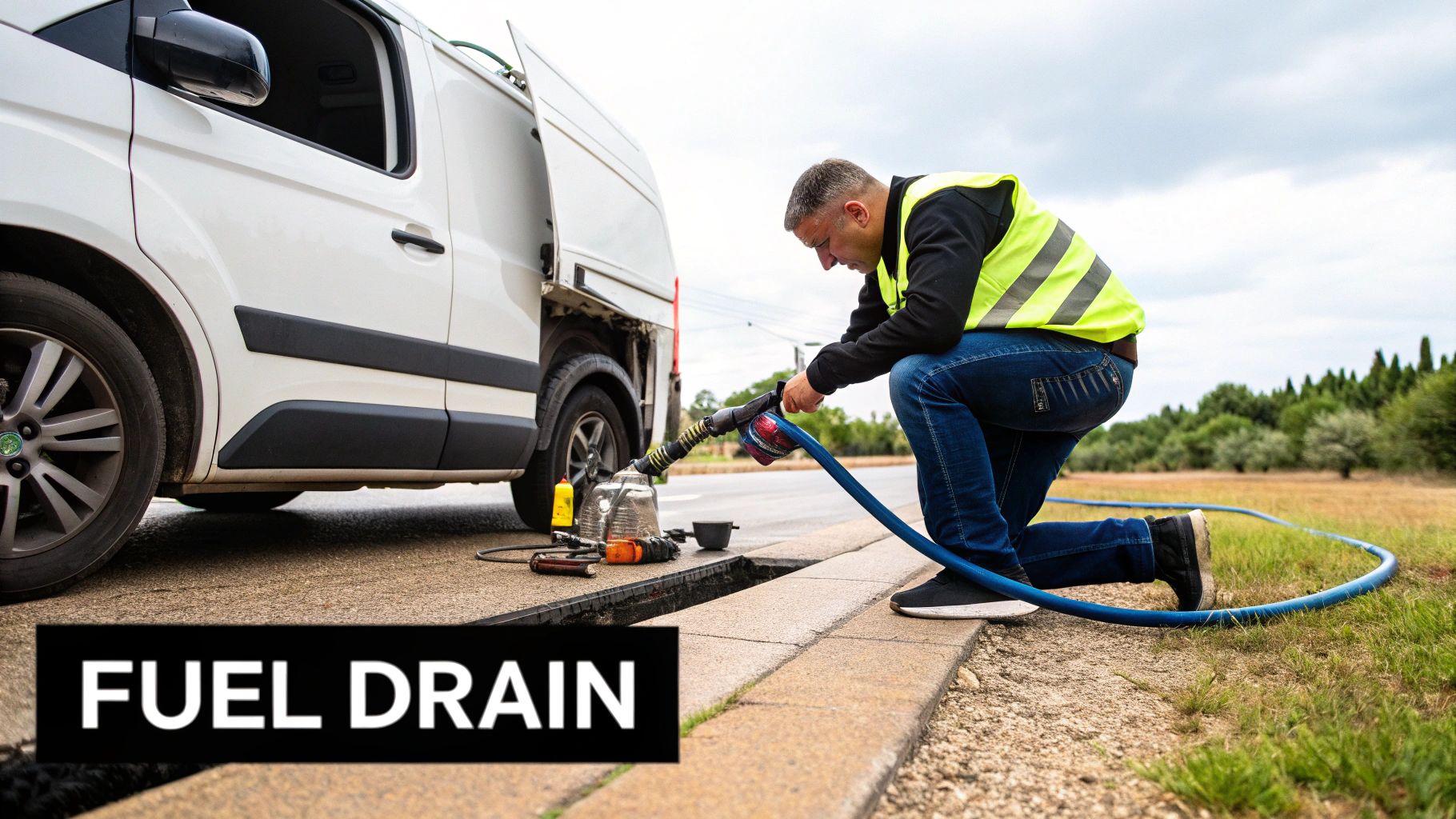
The Fuel Drain and System Flush
Once the area is secure, the real work begins. The technician uses specialised, ATEX-approved pumping equipment—this is absolutely critical, as it’s built to handle flammable fuels like petrol without creating sparks. The pump is connected directly to your fuel tank, and the entire mix of contaminated fuel is drained into a secure, purpose-built container inside their van.
But just emptying the tank isn't enough. Unleaded petrol is thin and gets everywhere, quickly entering the fuel lines, filter housing, and maybe even the high-pressure pump.
To tackle this, the technician performs a full system flush. This is what separates the pros from the amateurs.
They’ll pump a small amount of clean, correct diesel through the entire system to wash out any leftover petrol residue.
The fuel filter, which has likely trapped some of the contamination, will often be removed and replaced.
Finally, they ensure the fuel pump and injectors are clear before attempting to restart the engine.
Expert Insight: A huge part of the service is the safe and legal disposal of the mixed fuel. Our technicians are licensed to transport this hazardous waste and take it to a registered disposal facility. Trying to do it yourself leaves you with the dangerous and illegal headache of what to do with several gallons of contaminated fuel.
Getting You Back On The Road
With the drain and flush complete, the technician will add around 5-10 litres of fresh, correct diesel back into your tank. This is just enough to prime the system and get the engine running safely. They'll ask you to start the car while they listen to the engine and check for any warning lights or unusual noises.
In most cases where the engine wasn't run, the car will fire up and run smoothly right away. The technician's final piece of advice will be to drive straight to the nearest petrol station and fill the tank completely. This dilutes any final, tiny trace amounts of petrol to a harmless level.
While misfuelling is a very specific problem, the need for prompt, expert help is something it shares with other roadside emergencies, like when you need emergency roadside assistance for lost keys.
From the moment our van arrives to you driving away, the whole on-site process usually takes between 45 and 90 minutes. This speed is the biggest advantage of a mobile service, getting you moving again far quicker than waiting for a tow truck and a garage slot. If you'd like to learn more, our guide on finding a fuel drain near you has some great tips.
So, What's This Going to Cost Me? A Look at Your Wallet and Insurance
Once the initial "Oh no!" moment passes, the next thought is almost always about money. How much is this mistake actually going to set you back? The answer hinges on one crucial thing: whether or not you turned the key. That single action is the fork in the road between a manageable problem and a potentially massive bill.
If you caught the mistake at the pump and left the engine off, breathe a sigh of relief. The fix is relatively simple and won't break the bank. You’ll need a mobile fuel drain service to come out to you. In the UK, you can expect this to cost anywhere between £200 and £500. The final price depends on where you are, your vehicle model, and if it's the middle of the night. This service covers draining the wrong fuel, flushing the system clean, and putting in enough fresh diesel to get you to the nearest petrol station.
How Costs Can Spiral
Things get a lot more serious—and expensive—if you've started the car. The second that petrol gets pulled into the system, it starts to cause damage. Diesel acts as a lubricant for many parts of your engine, and petrol does the exact opposite, stripping that lubrication away from precision components.
Suddenly, a simple fuel drain can escalate into a major mechanical repair. Here’s what you might be looking at:
New Fuel Filter: This is often replaced as a precaution even in a basic flush, but it's an absolute must if it's been soaked in petrol.
Replacement Fuel Injectors: These are incredibly sensitive and can be quickly wrecked by petrol and the tiny metal filings (swarf) it creates.
New High-Pressure Fuel Pump: This is the big one. It’s one of the most expensive parts of the fuel system and relies entirely on diesel’s lubricating properties to survive.
Complete Fuel System Rebuild: In the worst-case scenario, the contamination is so bad that every single pipe, rail, and component has to be stripped out and replaced.
A standard fuel drain is an unexpected but manageable expense. But start that engine, and the bill can jump from a few hundred pounds to well over £5,000 if you need a full fuel system replacement—or even a new engine.
Will My Insurance or Breakdown Cover Help?
It’s a natural question, but unfortunately, the answer is usually no. Most people assume their comprehensive car insurance will sort it out, but misfuelling is almost always classified as driver error or negligence, which is a standard exclusion in most policies.
This isn't just a rare exception; it's the norm. A shocking 62% of standard insurance policies won’t cover you for misfuelling. With around 150,000 UK drivers making this mistake every year, and repairs for damaged fuel systems starting at £2,000, that’s a lot of people left out of pocket. GB News did a great piece on the real costs of misfuelling that dives into this further.
So, who can you call? Your best bet is likely your breakdown provider, but even that’s not a given. While premium breakdown policies often include misfuel assistance, many basic plans don't. The only way to know for sure is to dig out your policy documents and check the fine print now, before you ever need it. Look for phrases like "misfuel cover," "fuel drain," or "wrong fuel assistance." If you can't find them, it’s safe to assume you're not covered, and the full cost of the recovery and repair will be on you.
How to Make Sure Misfuelling Never Happens Again
Once you've dealt with the hassle and cost of putting unleaded in a diesel car, you'll want to make sure it's a lesson you only have to learn once. Thankfully, preventing it from happening again is pretty simple. It all comes down to breaking old habits and developing a more deliberate routine at the pump.
So many of these mistakes happen when we're distracted. You might be on the phone, mentally running through your to-do list, or just operating on autopilot after a long day. The best defence is to make refuelling a mindful moment. Just put your phone away, take a breath, and consciously double-check the pump nozzle and the label on your car's fuel cap. It sounds almost too easy, but that quick two-second check can genuinely save you from a bill running into the hundreds, if not thousands, of pounds.
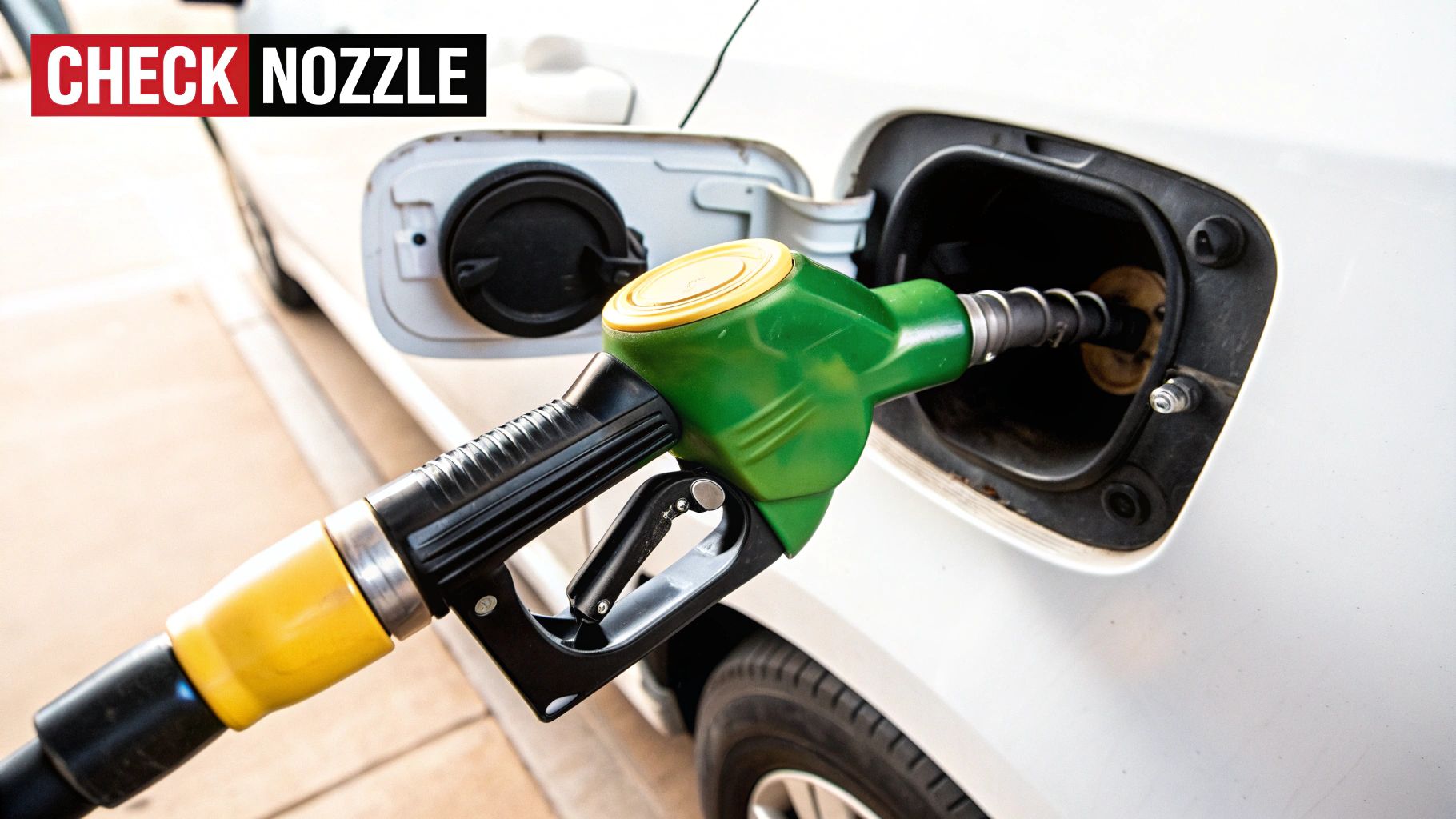
Your New Pump Routine
Getting a mental checklist dialled in is incredibly effective. Before you even lift the nozzle, just run through these points until they become automatic.
Check the Handle Colour: Here in the UK, diesel pump handles are almost always black, and unleaded petrol is green. This simple colour-coding is your first and best visual clue.
Read Your Fuel Cap: Your car manufacturer has put the correct fuel type right there for a reason. Make it a habit to glance at it every single time you open it.
Notice the Nozzle Size: A diesel filler neck is wider than an unleaded one. This is why a diesel nozzle won't physically fit into a modern petrol car. But the reverse isn't true—the slimmer unleaded nozzle slips into a diesel tank with ease, which is why this is by far the most common type of misfuelling.
A Quick Word of Warning: The risk of making a mistake goes way up if you regularly switch between driving petrol and diesel vehicles, like a personal car and a work van. If this is you, be extra careful and make that "check, check, check" routine non-negotiable.
Let Technology Be Your Safety Net
If you'd rather have a foolproof solution, there are some great gadgets out there that act as a final line of defence. Misfuelling prevention devices are specially designed caps or inserts that physically stop the wrong nozzle from ever entering the tank.
They typically work by replacing your existing filler cap with a clever mechanism that will only open when the correct, wider diesel nozzle is inserted. If you try to put a narrower unleaded nozzle in, it simply won't open the gate. It stops the mistake before a single drop of the wrong fuel can be pumped. They’re a relatively small investment that offers complete peace of mind, making them a brilliant way to turn a costly error into a valuable, one-time lesson.
Your Misfuelling Questions Answered
Putting the wrong fuel in your car is a moment of panic. Your mind starts racing with questions, and you need clear, straightforward answers from someone who's seen it all before. We get calls every day from drivers in your exact situation, and these are the most common things people ask.
"I Only Put a Little Bit of Petrol In. Surely I Don't Need a Fuel Drain?"
This is probably the number one question we hear, and the answer is always an emphatic yes. Think of it this way: a modern common-rail diesel engine is a finely tuned, high-pressure system. It relies on the natural oiliness of diesel to lubricate crucial parts like the fuel pump and injectors.
Even a small amount of petrol—as little as 5% of the tank's volume—is enough to strip away that essential lubrication. It acts like a solvent, causing metal-on-metal friction that can quickly lead to catastrophic damage. Trying to "dilute" it by topping up with diesel is a huge gamble; you're risking a multi-thousand-pound repair bill to save a couple of hundred pounds on a proper drain. The only safe solution is to get it all out.
"I've Already Driven Off. What Signs Should I Look For?"
If you've started the car before realising the mistake, your vehicle will usually let you know something is very wrong, and fast.
You're not imagining things if you suddenly notice:
The dreaded engine management light flickers on.
A very obvious loss of power—the car feels sluggish and won't accelerate properly.
The engine starts to judder, cough, or misfire.
An unusual amount of smoke puffing from the exhaust.
Eventually, the engine will probably just cut out and refuse to start again. The second you notice any of these symptoms after filling up, find a safe place to pull over, switch off the engine, and don't try to restart it.
Key Takeaway: Every second you continue to drive circulates more of the damaging petrol/diesel mix through your fuel system. Stopping immediately is the single most important thing you can do to minimise the damage and the cost.
"Will Putting the Wrong Fuel In Void My Car's Warranty?"
Unfortunately, it's almost certain that any damage caused by misfuelling will not be covered by your manufacturer's warranty. Warranties are there to protect you from faults in how the car was built, not from user error.
Putting the wrong fuel in is almost always classified as owner negligence. This means the financial responsibility for any repairs will fall squarely on your shoulders. It's always worth double-checking your warranty booklet, but it's best to assume it won't cover you in this situation.
"Can't I Just Drain the Fuel Myself and Save Some Money?"
We can't stress this enough: please do not attempt a DIY fuel drain. It’s not just a bad idea; it’s incredibly dangerous. Petrol is extremely flammable, and its vapour is explosive. Siphoning fuel without specialised, anti-static equipment creates a very real risk of a spark causing a fire.
On top of the safety risk, most modern cars have anti-siphon devices in the filler neck, making it impossible to get a simple hose in. Our technicians use specific pumps and have the correct safety training and equipment. They're also licensed to transport and dispose of contaminated fuel, which is a legal requirement. The risk to your personal safety just isn’t worth the potential saving.
If you've put unleaded in your diesel car and need immediate, expert help, don't hesitate. Contact Misfuelled Car Fixer 24/7 for a rapid mobile fuel drain service across Suffolk and beyond. Visit us at https://www.misfuelledcarfixer-suffolk.co.uk to get back on the road safely.
Comments