



What to Do If You Have adblue in diesel tank: Costs, Steps & Risks
- Misfuelled Car Fixer

- Jan 30
- 13 min read
24/7 Hotline Nationwide: 0330 122 6640
National Wrong Fuel Rescue: https://www.misfuelledcarfixer.co.uk
If you found this page, we cover you!
Realising you’ve just poured AdBlue in a diesel tank is a moment of pure panic, but what you do next can make all the difference. This is a serious mistake, but it's absolutely manageable if you act fast. The most critical rule, the one that can save you a bill running into the thousands, is this: do not start the engine. Don't even turn the key to the 'on' position.
What To Do The Second You Realise Your Mistake
That sinking feeling when the blue nozzle clicks off and you see it's in the diesel filler cap is a rough one. I've heard it from countless drivers. But take a deep breath, because the next few minutes are crucial. Your entire goal is to stop that AdBlue from ever reaching the fuel system. Just turning the ignition primes the fuel pump, which is enough to start pulling the corrosive mixture out of the tank and into very expensive, very delicate components.
This little flowchart breaks down the only three things you need to do. It’s that simple.
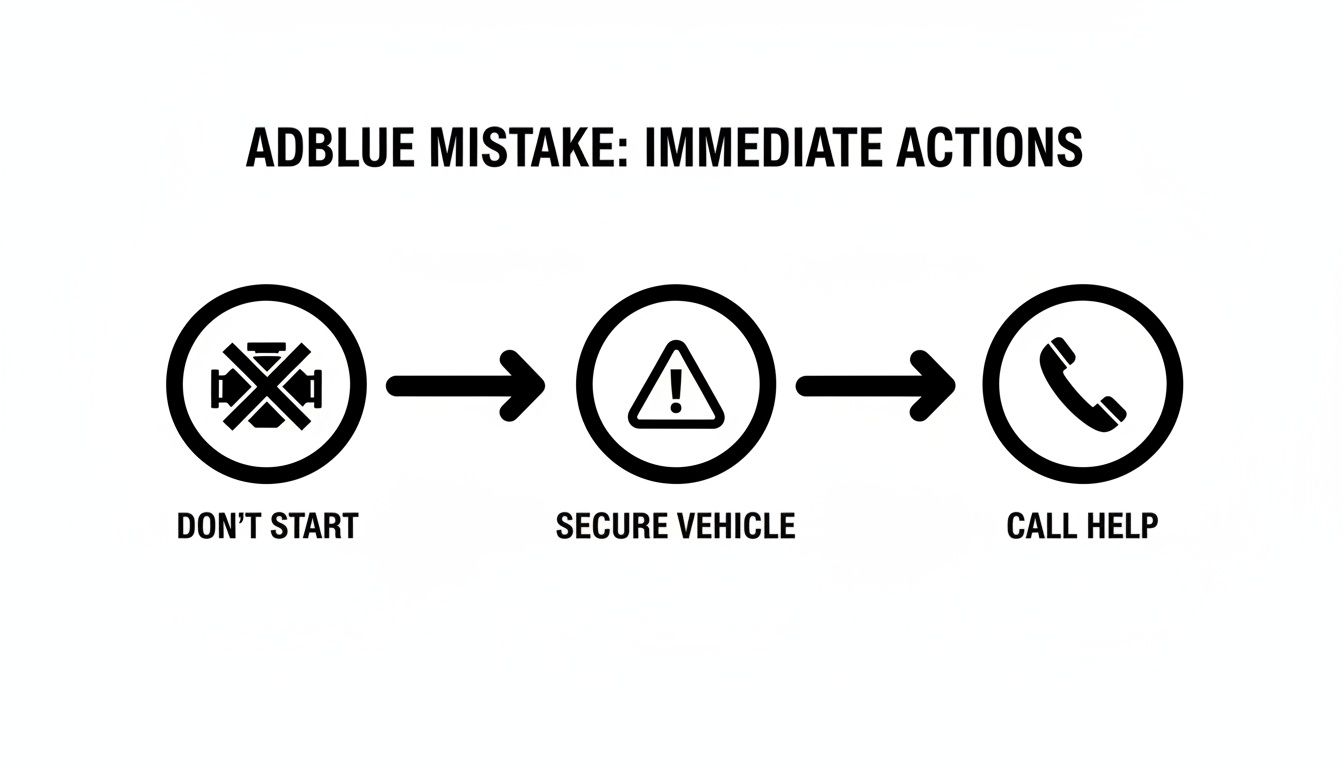
As you can see, it's a straightforward process: kill the engine, make sure the vehicle is safe, and then get a professional on the phone.
Securing Your Vehicle and Yourself
With the engine definitely off, your immediate priority switches to safety. If you're on a busy petrol station forecourt, leave the car where it is. Let the staff know what's happened right away. They'll know exactly what to do, coning off the pump to protect other drivers and helping to keep the scene safe. It happens more often than you think.
If you're stuck on the roadside, your personal safety is paramount. Here’s what to do to secure the area:
Get the hazards on. Make your vehicle as visible as possible.
Move to safety. If you can, push the vehicle onto the verge or into a lay-by. Whatever you do, don't start it to move it.
Put out your warning triangle. Place it about 45 metres (that's around 147 feet) behind you to give oncoming traffic plenty of warning.
The golden rule is not to start the engine – or even risk it by putting the key in the ignition. Call a breakdown recovery service immediately or a mobile fuel technician who will drain and cleanse the system.
Making the Right Phone Call
Once you and the vehicle are safe, it's time to call in the experts. It might be tempting to look up a DIY fix on YouTube, but trust me, this isn't the time for it. You need an emergency mobile fuel drain service. These technicians live and breathe this stuff; they have the specialised pumps, flushing gear, and knowledge to get the contaminated fuel out safely without wrecking your engine.
You can learn more about exactly what happens when you put AdBlue in a fuel tank by mistake, but calling a specialist is, without a doubt, the quickest and cheapest way to resolve this mess and get you moving again.
What Happens When AdBlue Goes in the Diesel Tank?
To really grasp why putting AdBlue in your diesel tank is such a disaster, you have to understand what it actually is. It's a common mistake to think it’s some kind of fuel additive. It’s not. AdBlue is a separate fluid, a mix of 32.5% urea and 67.5% deionised water, that’s meant to be injected into your exhaust system to clean up emissions. It has no business being anywhere near your engine.
Think of it like trying to mix oil and water; it just won't happen. Diesel is an oil, and AdBlue is mostly water. They are chemically incompatible. Because water is denser, the AdBlue doesn't just sit on top of the fuel—it sinks right to the bottom of the tank. And that's exactly where the real trouble begins.
The Immediate Chemical Breakdown
As soon as it hits the bottom of the tank, the urea in the AdBlue starts to react. It rapidly forms hard, abrasive crystals that look a bit like salt or sugar. This isn't a slow-motion problem; it happens almost instantly. These tiny crystals are the real villains, and they're about to go on a destructive tour of your fuel system.
Your car’s fuel pump is designed to pick up fuel from the very bottom of the tank—right where this corrosive, crystal-filled sludge is now sitting. The moment you turn that key, the pump will start sucking it all up.
It's a mistake we see all the time. In fact, putting AdBlue in the diesel tank now accounts for a staggering 22% of all misfuelling call-outs across the UK. The chemistry is brutal, and it doesn't take much; even a single litre can contaminate a full tank and kick off the whole destructive process.
How These Crystals Wreck Your Fuel System
Modern diesel systems are marvels of precision engineering, running at extremely high pressures with components machined to microscopic tolerances. They’re built to run on clean, lubricating diesel—not a watery slurry of sharp crystals.
Once that contaminated fluid gets drawn from the tank, it starts its journey of destruction through your car's most vital parts.
Fuel Filter Blockage: The filter is your first line of defence, but it's no match for the sheer volume of crystals. It clogs up fast, starving the engine of fuel and causing it to lose power or cut out completely.
High-Pressure Pump Failure: Any crystals that manage to squeeze past the choked filter act like liquid sandpaper inside the high-pressure fuel pump. This critical part relies on diesel for lubrication. The watery AdBlue solution washes that lubrication away, leading to metal grinding against metal, scoring, and catastrophic wear.
Injector Destruction: From there, the crystals are blasted towards the fuel injectors. The nozzles on these injectors are tiny, designed to spray a fine mist of fuel. Forcing abrasive particles through them at thousands of PSI shreds them from the inside out. This leads to misfires, rough running, and eventually, total injector failure.
Here’s a look at how the damage escalates as the contaminated mixture works its way through the system.
AdBlue Contamination Damage Progression
This table shows the escalating damage and associated symptoms as AdBlue circulates through a diesel fuel system.
Stage | Affected Components | Typical Symptoms & Warning Signs |
|---|---|---|
Stage 1 (Initial Contamination) | Fuel Tank, Fuel Lines, Fuel Filter | No immediate symptoms if the engine is off. If started, you might get a few seconds of normal running before spluttering. |
Stage 2 (Low-Pressure System) | Lift Pump, Fuel Filter | Engine struggles to start, runs rough, or cuts out. Noticeable loss of power. Engine management light may come on. |
Stage 3 (High-Pressure System) | High-Pressure Fuel Pump (HPFP), Fuel Rail | Loud knocking or grinding sounds from the engine bay. Severe power loss. The engine will likely stall and refuse to restart. |
Stage 4 (Complete System Failure) | Fuel Injectors, Entire Fuel System | Catastrophic engine failure. Metal fragments from the destroyed pump may have contaminated the entire system, requiring a full replacement. |
As you can see, the problem goes from bad to worse very quickly. What starts in the tank ends up destroying every component it touches.
The core problem is simple chemistry: AdBlue is a water-based urea solution that crystallises on contact with diesel. These crystals then act as an abrasive, grinding away at the precision-engineered components of your fuel system from the inside out.
Getting a handle on the parts involved and what they do makes it clear why the damage is so extensive. We have a guide that goes into more detail about what is in diesel exhaust fluid and how it works. In short, the very fluid designed to clean up your exhaust gases ends up systematically dismantling the engine that creates them.
Recognising the Warning Signs of AdBlue Damage
So, what happens if you’ve driven away from the pump before realising the mistake? If you've started the engine with AdBlue in the diesel tank, the symptoms aren't subtle, and they appear alarmingly fast. The engine might run quietly for a moment, but it won't be long before it starts protesting as the contaminated fuel circulates.

This situation is a genuine roadside emergency. Knowing what to look, listen, and even smell for can help you shut the engine off before the damage becomes truly catastrophic. The moment you notice any of these signs, pull over safely.
Engine Performance Issues
The very first clues will almost always be engine trouble. You'll likely feel the engine struggling to maintain power, spluttering, or juddering, particularly when you try to accelerate. This is happening because the AdBlue crystals are already starting to clog the fuel filter, starving the engine of the clean diesel it needs.
A classic scenario is pulling away from the petrol station and feeling a sudden, dramatic loss of power. The car or van might feel sluggish and unresponsive, and then it could cut out entirely. This isn't just a minor hiccup; it's a critical signal from your vehicle's engine control unit (ECU).
To protect itself from severe harm, the ECU will often force the vehicle into ‘limp mode’. This safety feature drastically cuts engine power, usually limiting your speed to around 20-30 mph. It’s designed to give you just enough power to get to a safe spot before the engine shuts down for good.
Visual and Audible Warnings
Beyond how the vehicle feels, there are clear visual and audible signs that something is seriously wrong. One of the most obvious symptoms is the exhaust smoke.
Excessive White Smoke: As the water-based AdBlue mixture gets heated in the engine, it creates thick clouds of white, acrid-smelling smoke from the exhaust. It's completely different from normal diesel exhaust and has a sharp, chemical-like smell.
Engine Warning Lights: Your dashboard is going to light up. Expect to see the engine management light, the diesel particulate filter (DPF) warning, and probably an AdBlue system fault light all glowing.
Unusual Noises: You might hear a loud knocking or grinding sound coming from the engine bay. This is a very bad sign. It often means the high-pressure fuel pump is being destroyed by the abrasive crystals and the lack of lubrication.
"A driver described it perfectly: 'It felt like I was driving through treacle, then the engine started making a sound like a bag of spanners.' That's the sound of your fuel pump failing in real-time. If you hear it, stop immediately."
These symptoms are your engine’s last-ditch effort to tell you it's in trouble. Heeding these warnings and pulling over instantly can be the difference between a manageable repair bill and needing a whole new fuel system. Any hesitation massively increases the potential cost and complexity of the fix.
What Does Putting AdBlue in a Diesel Tank Cost to Fix?
The financial fallout from putting AdBlue in a diesel tank can be jaw-dropping. But here’s the crucial thing to understand: the final bill hinges almost entirely on one single action—whether or not you started the engine. The cost difference isn't just a few quid; it's the gap between a frustrating mistake and a bill that could write off your vehicle.
Knowing the potential costs upfront makes it crystal clear why taking immediate, correct action is so important. If you haven't started the engine, you're in the best-case scenario. The problem is contained, and the fix is relatively straightforward.
The Cost if You Haven't Started the Engine
If you catch the mistake at the petrol station and haven't so much as turned the key, you've dodged a massive bullet. The solution is simple: you need a mobile fuel drain. This is, by a huge margin, the most cost-effective outcome.
What does this involve?
Mobile Drain and Flush: A specialist will come out to you, drain the contaminated mix from your tank, and flush the fuel lines to get rid of any lingering residue. They'll almost certainly replace the fuel filter as a precaution, too.
Fresh Diesel Refill: Once the system is confirmed clean, it’s refilled with fresh diesel, and you’re good to go.
Expect the bill for this on-site service to be somewhere between £250 and £500. It's an unexpected expense, for sure, but when you see the alternative, you’ll realise it's a bargain.
That single decision—to call for a drain instead of trying to "run it through"—is the most important financial choice you'll make. It keeps the problem contained and the repair bill predictable.
The Cost Once the Engine Has Been Started
The financial picture changes drastically the second that engine turns over. As the AdBlue and diesel mixture gets pulled from the tank, it begins its destructive journey through your fuel system. The repair costs climb with every moment the engine runs. The initial fuel drain is now just the first, smallest step in a much more painful and expensive process.
The industry data paints a grim picture. In around 20% of cases where a driver has started the engine and driven, even for just a few hundred yards, the damage is so severe that a full engine replacement is the only option. We're talking costs that can easily spiral past £10,000—a world away from a simple call-out fee. You can get more insights into the financial impact of AdBlue misfuelling from real-world cases.
Here’s a breakdown of the parts you could be looking at replacing if the engine has been run. These are just estimates and will vary depending on your car, but they show you how quickly the costs stack up.
Component Replacement | Estimated Cost (Including Labour) |
|---|---|
Full Fuel System Flush | £400 - £800 |
New Fuel Filter | £50 - £150 |
High-Pressure Fuel Pump | £1,000 - £3,000 |
Set of Fuel Injectors | £1,200 - £2,500 |
Fuel Tank and Lines | £800 - £1,500 |
Total Potential Cost | £3,450 - £8,000+ |
This is why dealership repair bills for AdBlue contamination can be so astronomical. To guarantee their work, they have to replace every single component the corrosive mixture has touched. Before you know it, you're looking at a bill that could easily be more than the car is even worth.
How a Professional Fuel Drain Service Works
When you make that dreaded call after putting AdBlue in a diesel tank, a calm and efficient process gets underway. A trained mobile technician is dispatched to your location—think of them as a specialist workshop on wheels, kitted out with everything needed for this exact problem. Their van carries ATEX-approved pumping systems, which are specifically certified for safely handling flammable liquids like diesel, eliminating any risk of sparks or ignition during the job.
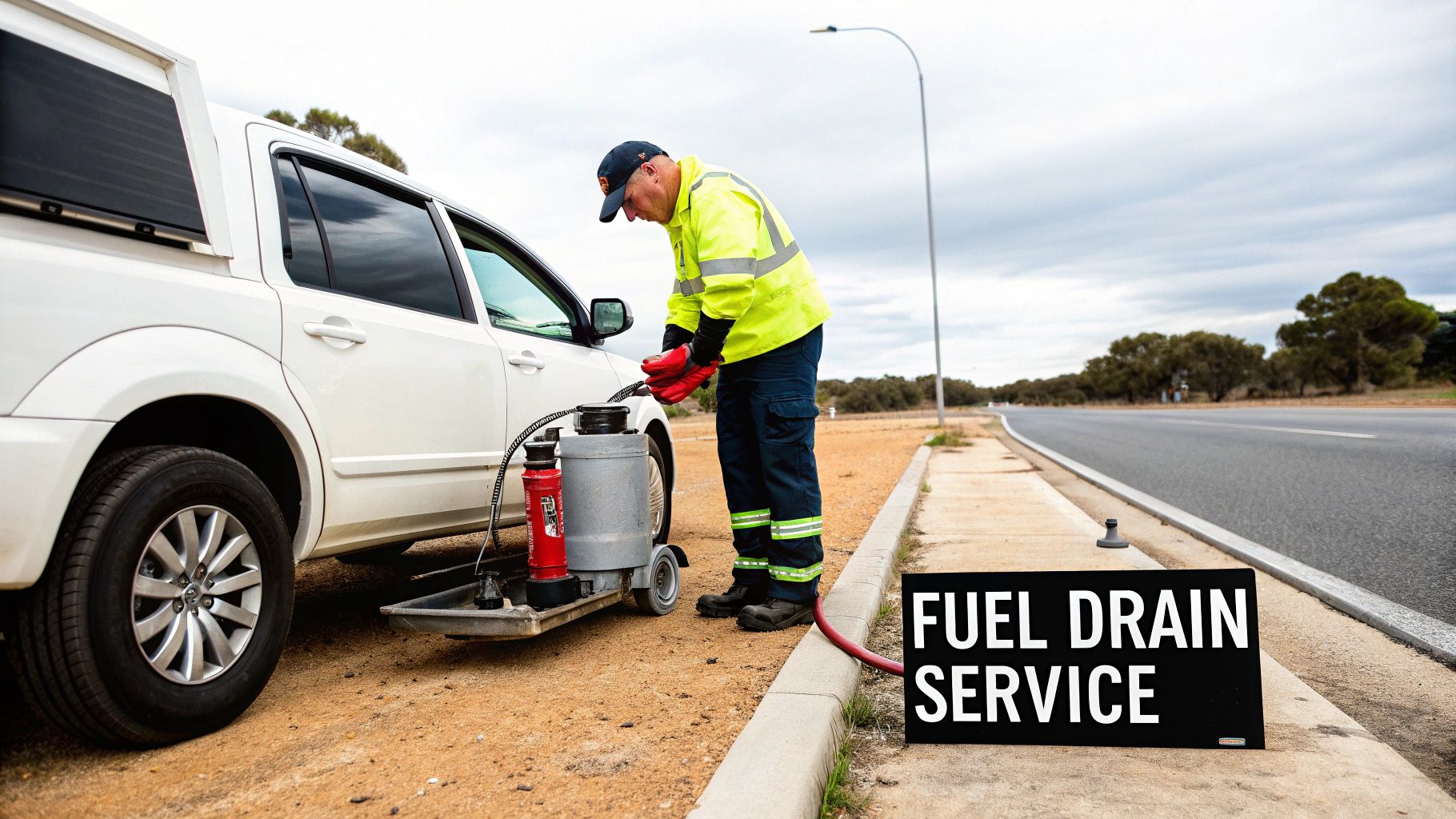
This is far more sophisticated than just siphoning fuel out. The entire goal is to safely remove every last drop of the contaminated mix to stop any further damage in its tracks. Getting this sorted correctly is a critical piece of vehicle maintenance after a mistake like this.
The Fuel Draining and System Flush Process
First things first, the technician will drain the entire contents of your fuel tank. They'll access the tank, often through the filler neck or by temporarily removing the fuel sender unit, and use their specialised pump to draw the AdBlue-diesel cocktail into a secure, onboard container.
Once the tank is bone dry, the real work begins. The job isn't done until the whole fuel delivery system has been purged of the harmful crystalline gunk that AdBlue leaves behind.
Flushing the Fuel Lines: Clean diesel is pumped right through the fuel lines, all the way from the tank to the engine, forcing out any trapped contaminants and crystals.
Cleaning High-Contact Components: Key parts like the high-pressure fuel pump and fuel rail are also given a thorough flush to ensure no abrasive particles are left lurking.
Replacing the Fuel Filter: This part is non-negotiable. The old filter will be clogged with crystals and has to go. A fresh, clean one is fitted to properly protect your engine.
The whole point of a professional flush is to remove 100% of the contaminant. Leaving even a tiny amount of the AdBlue mixture behind can cause the exact same expensive failures you’re trying to prevent.
Safe Disposal and Getting You Back on the Road
A crucial part of the service is dealing with the contaminated fuel correctly. This mixture is officially classed as hazardous waste and can't just be tipped down a drain. Professional services are legally bound to transport and dispose of it according to strict UK environmental rules. They’ll give you the proper paperwork, known as a consignment note, as proof that it was handled correctly.
After the system is flushed, the new filter is in, and the hazardous waste is secured, the technician will add some fresh, clean diesel to your tank. They'll then prime the fuel system and start the engine, listening to make sure it runs smoothly and checking that no warning lights pop up on the dash. From the moment they arrive to when they leave, the whole process usually takes about 60-90 minutes.
This professional service is designed to be a complete, one-call solution. If you want a more detailed look at what to expect when you're stuck on the roadside, our emergency guide on finding a https://www.misfuelledcarfixer-suffolk.co.uk/post/fuel-drain-near-me-your-emergency-guide offers more insight. The goal is simple: to fix the problem safely and efficiently, getting you back on your way with minimum stress.
Building Habits to Avoid an AdBlue Misfuelling Nightmare
Let's be honest, the best way to handle putting AdBlue in your diesel tank is to make sure it never happens in the first place. Prevention is always better (and a hell of a lot cheaper) than the cure. The good news is that dodging this wallet-emptying mistake boils down to a few simple habits you can weave into your refuelling routine.
These little changes cost nothing but a moment of your time, yet they can save you thousands in repair bills and the headache of being without your vehicle.
The most crucial habit? Just pause and look. Before you even grab a nozzle, take a breath and glance at the filler caps. The AdBlue cap is almost always blue, and its opening is designed to be smaller than the diesel one. This isn't an accident; it's the first line of defence against a very expensive slip-up.
We’ve all been there – rushing at the pump, distracted by a phone call, or trying to manage kids in the back. That’s precisely when mistakes happen. Make it a personal rule to focus on one thing and one thing only: refuelling your vehicle. Everything else can wait 90 seconds.
For the Everyday Driver
A consistent routine is your best friend here. Think of it like a mental checklist you run through every time you pull up to the pump, especially if you switch between different diesel cars.
Spot the Blue Cap: Your first check should always be for the blue cap. If your vehicle’s AdBlue tank is in an unusual spot, like the boot or under the bonnet, get to know exactly where it is so there's no confusion.
Feel the Nozzle Fit: An AdBlue nozzle is intentionally narrower than a diesel nozzle. It will feel loose and won't sit properly in the diesel filler neck. If it feels wrong, it probably is. Stop immediately.
Read the Pump: It sounds ridiculously simple, but in a rush, it's easy to skip. Take that extra second to read the label on the pump and the handle itself.
Here's a foolproof rule to live by: blue nozzle, blue cap. If you're holding something blue, it must go into the blue hole. This single visual check will stop almost every potential AdBlue mix-up.
For Fleet Managers
When you're managing a fleet of diesel vehicles, the chances of an AdBlue in diesel tank incident multiply with every driver on your team. A few straightforward policies can dramatically cut down this risk and protect your assets.
Training and clear visual reminders are non-negotiable. Make sure your driver induction process explicitly covers the right way to refuel with AdBlue for every type of vehicle in your fleet. Simple, bold labels placed right next to the fuel filler area can act as that final, critical reminder for your drivers.
It's also worth looking into physical prevention devices. You can get special misfuelling prevention caps that replace the standard diesel cap. These smart devices are engineered to only open for a standard-sized diesel nozzle, physically blocking the smaller AdBlue nozzle from ever going in. They're a small, one-off investment that provides a permanent safeguard against this frustratingly common error.
If the worst has happened and you need professional help right now, don't wait. Misfuelled Car Fixer provides a 24/7 emergency mobile fuel drain service across Suffolk and the surrounding areas. Call us immediately to get an expert out to you fast and prevent catastrophic engine damage. Find out more at https://www.misfuelledcarfixer-suffolk.co.uk.
Comments