



Wrong Fuel in a Car in Suffolk A Practical Guide
- Misfuelled Car Fixer

- Dec 31, 2025
- 15 min read
It’s that sinking feeling. You’ve just finished filling up, replaced the nozzle, and then you see it – the green petrol nozzle in your diesel car, or vice versa. It’s a moment of pure panic, but what you do next is absolutely critical.
The single most important thing to remember is this: do not start the engine. Don't even put the key in the ignition or press the start button. The real damage happens when the wrong fuel gets circulated through the system. Keeping it contained in the tank is the key to a simple fix.
What To Do The Moment You Realise You've Used the Wrong Fuel
First, take a deep breath. You’re not the first person to do this, and you won’t be the last. It’s a surprisingly common slip-up, catching out around 150,000 UK drivers every year. We see it a lot with commercial fleet drivers in Suffolk, who are often in a rush and switching between different vehicles. For a deeper dive into the numbers, you can read more about these wrong fuel statistics.
Your immediate priority is safety. If you're at a busy petrol station in Ipswich or anywhere else, let the staff inside the kiosk know what’s happened. They need to close the pump you used and will appreciate the heads-up to help manage other drivers around your stranded vehicle.
Secure Your Car, Not Your Engine
The next job is to get your car away from the pump and into a safe spot, like a designated parking bay. This is the crucial part: you must not start the engine to do this.
Pop the car into neutral. You’ll need to push it. Ask the station staff or a willing bystander for a hand. If you’re on your own, look for a slight slope on the forecourt that might help you get rolling. It's a bit of a hassle, but it’s infinitely better than the alternative.
The difference between a £200 fuel drain and a £5,000 engine rebuild often comes down to one simple action: leaving the keys out of the ignition. Pushing the vehicle to a safe place is inconvenient but essential for damage prevention.
Once you’ve moved the car out of the way, put the handbrake on securely and switch on your hazard lights. This makes you visible and clearly signals to everyone that your car isn't going anywhere for a little while.
This straightforward protocol is your first line of defence against costly repairs.
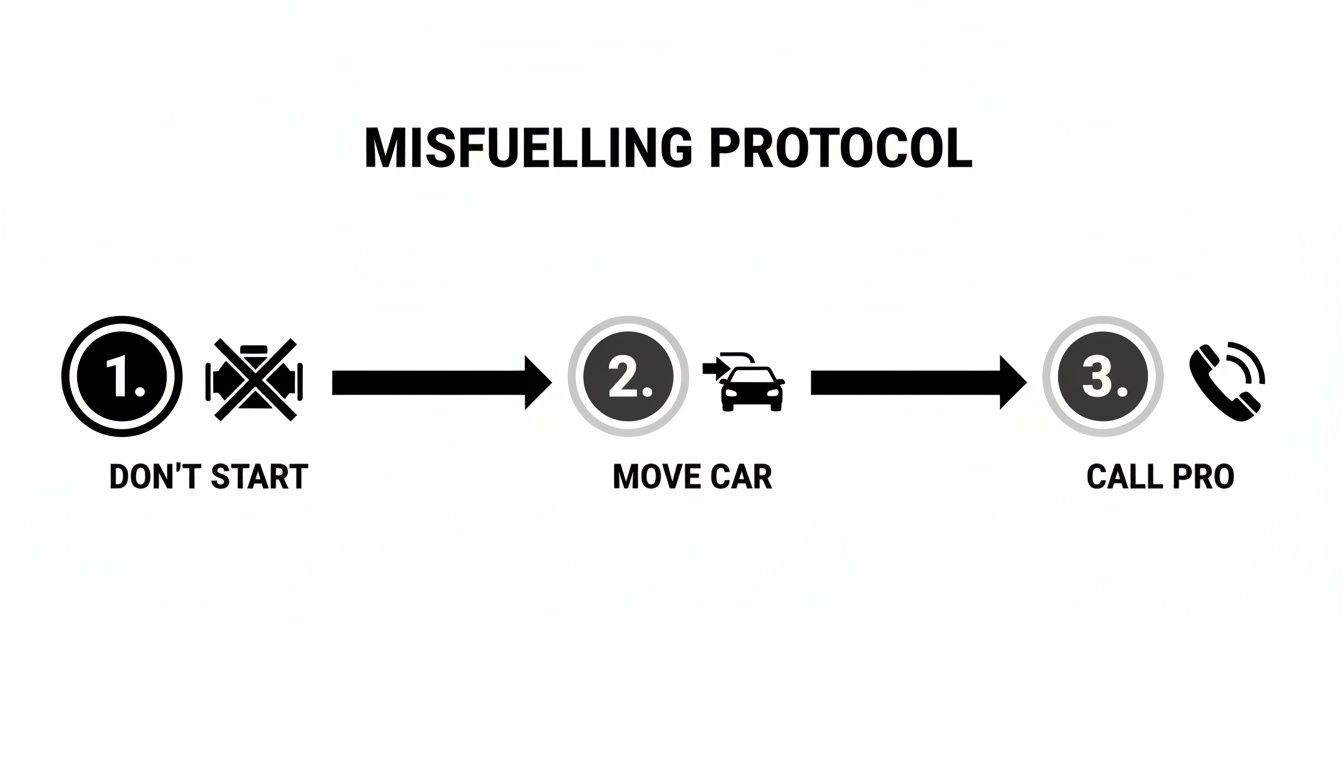
With the car secured and the engine off, your final and most important step is to call for professional help. You need a specialist mobile fuel drain service that covers Suffolk to come out and get you sorted.
Wrong Fuel Scenarios At a Glance
The two main types of misfuelling have very different consequences. Here’s a quick breakdown of what you might be facing.
Fuel Mix-Up | Common Symptoms | Potential Damage Severity |
|---|---|---|
Petrol in a Diesel Car | Misfiring, excessive smoke, knocking noises, complete engine cut-out. | High. Petrol strips the lubricating properties of diesel, causing severe friction damage to the fuel pump and injectors. |
Diesel in a Petrol Car | Engine struggles to start, misfires, produces thick black smoke, eventually cuts out. | Moderate. Less severe than the reverse, but can still foul spark plugs and clog the fuel system. |
As you can see, putting petrol into a diesel engine is by far the more serious error. However, in both cases, keeping the engine off is the best way to prevent the worst of the damage.
Recognising the Telltale Signs of a Misfuelled Car
It’s an easy mistake to make, especially when you’re in a rush at a busy Suffolk petrol station. Sometimes, you don't even realise you've grabbed the wrong nozzle until you're back on the road and the car starts acting up. Knowing what to look and listen for is your best defence against turning a simple slip-up into a major, wallet-busting engine repair.

The symptoms you'll experience depend entirely on which fuel has gone into which engine. Each mix-up creates a very different, and very specific, set of problems. These are the red flags that tell you to pull over – and fast.
Petrol in a Diesel Engine: The Most Damaging Mistake
Of all the misfuelling scenarios, putting petrol in a diesel is by far the most common and, unfortunately, the most destructive. The reason is simple: diesel fuel isn't just a fuel; it's also a lubricant for critical high-pressure parts like your fuel pump and injectors.
Petrol, on the other hand, is a solvent. It washes away that essential lubricating film, causing metal components to grind against each other. This friction generates tiny metal particles that can wreak havoc throughout your entire fuel system.
If you’ve driven away after putting petrol in your diesel, the signs will appear pretty quickly.
A Loud Knocking Noise: You’ll hear a very noticeable, metallic clattering sound from the engine as it struggles with the incorrect fuel.
Sudden Loss of Power: Your car will feel weak and sluggish, struggling to accelerate as you try to merge onto the A14 or pull away from a roundabout.
Excessive Smoke from the Exhaust: Look in your rearview mirror for plumes of white or grey smoke billowing out from the back.
Warning Lights on the Dash: The engine management light is almost guaranteed to pop up, glowing amber or red.
Engine Stalling: Ultimately, the engine will likely cough, splutter, and cut out entirely, refusing to restart.
If you spot any of these signs right after filling up, your only move is to pull over safely, switch off the ignition immediately, and call for professional help. Every second you continue to drive massively increases the odds of permanent, costly damage.
Diesel in a Petrol Engine: Less Common, Still Serious
Putting diesel into a petrol car is much harder to do, simply because the diesel nozzle is wider than the filler neck on most petrol cars. Still, it happens. While the damage isn't as immediate or catastrophic as the other way around, it will still bring your journey to a grinding halt.
Diesel is a thick, oily substance that requires high compression to ignite; petrol engines rely on spark plugs to ignite a fine fuel-air mist. The heavy diesel fuel will quickly overwhelm the system, clogging the spark plugs and fuel injectors.
You'll find the engine is very difficult to start, if it starts at all. If you do manage to get it running, it will run rough, misfire constantly, and produce thick, black smoke before cutting out. For a more detailed look, learn more about the specific wrong fuel in car symptoms you might encounter.
No matter the mix-up, acting fast is the key. The sooner you stop the engine, the greater the chance that a straightforward fuel drain will solve the problem without the need for expensive replacement parts.
What's Actually Happening to Your Engine?
Putting the wrong fuel in your car is far more than just a simple inconvenience—it's a direct threat to the health of your engine. But not all mix-ups are the same. The type of fuel you've put in determines just how serious the damage could be, with one scenario being far more destructive than the other.
Understanding what’s going on under the bonnet is the key to appreciating why you absolutely must not start the engine.
The most common, and by far the most damaging, mistake is putting petrol into a modern diesel engine. The entire problem comes down to one critical difference between the two fuels: lubrication.
Think of diesel as an oily, protective fluid. It’s designed to lubricate all the high-precision parts of your fuel system. The high-pressure fuel pump and the injectors are full of metal components moving at incredible speeds, and they rely on that oiliness to run smoothly without grinding themselves to pieces.
The Destructive Power of Petrol in a Diesel System
When petrol gets into that system, it acts like a solvent. It washes away that essential, lubricating film of diesel from every component it touches. Suddenly, you have a high-friction environment where metal is grinding directly on metal, creating tiny metallic filings known as swarf.
This abrasive sludge is then forced at high pressure through the entire fuel system, setting off a devastating chain reaction.
Fuel Pump Failure: The pump is usually the first and most expensive casualty. Stripped of lubrication, it rapidly overheats, wears down, and seizes up, leading to total failure.
Injector Damage: Those tiny metal particles will quickly clog and destroy the delicate nozzles of the fuel injectors, crippling fuel delivery and engine performance.
Widespread Contamination: The swarf doesn't just stay in one place. It travels through the fuel lines and filters, and can even make its way into the engine cylinders, causing widespread and often irreversible damage.
For fleet managers across Suffolk, a single petrol-in-diesel incident isn't just a headache. It can take a valuable asset off the road and lead to repair bills that easily spiral into the thousands. The financial risk is huge, making a professional fuel drain an absolute necessity.
Diesel in a Petrol Car: A Different Kind of Problem
On the flip side, putting diesel in a petrol car is usually less catastrophic, but it’s still a serious problem that needs a fuel drain. This mistake is also much harder to make, as the diesel nozzle is physically wider than most modern petrol filler necks.
Diesel is thicker and far less flammable than petrol. A petrol engine relies on a spark plug to ignite a fine mist of fuel and air. When thick, oily diesel enters the mix, it simply won't ignite properly.
Instead, it just gunks everything up. It clogs the spark plugs, coats the fuel injectors, and fouls up the sensors.
The engine will probably cough, splutter, produce a lot of smoke, and then just refuse to start or run at all. While this will certainly stop you in your tracks, it often prevents the kind of catastrophic, component-grinding damage we see with the petrol-in-diesel scenario. That said, some experts warn that symptoms can appear quickly, risking repairs of £1,000-£5,000 for injectors and pumps if the issue isn't sorted out fast. You can explore further details on wrong fuel repair costs to get a clearer picture of the potential financial hit.
What Happens When a Fuel Drain Technician Arrives?
When you make that dreaded call after a misfuel, it’s completely normal to feel a bit flustered and wonder what actually happens next. Rest assured, you’re calling in a specialist for a reason. This isn't a simple roadside fix; it's a precise, on-the-spot service designed to get you back on your journey with minimal fuss.
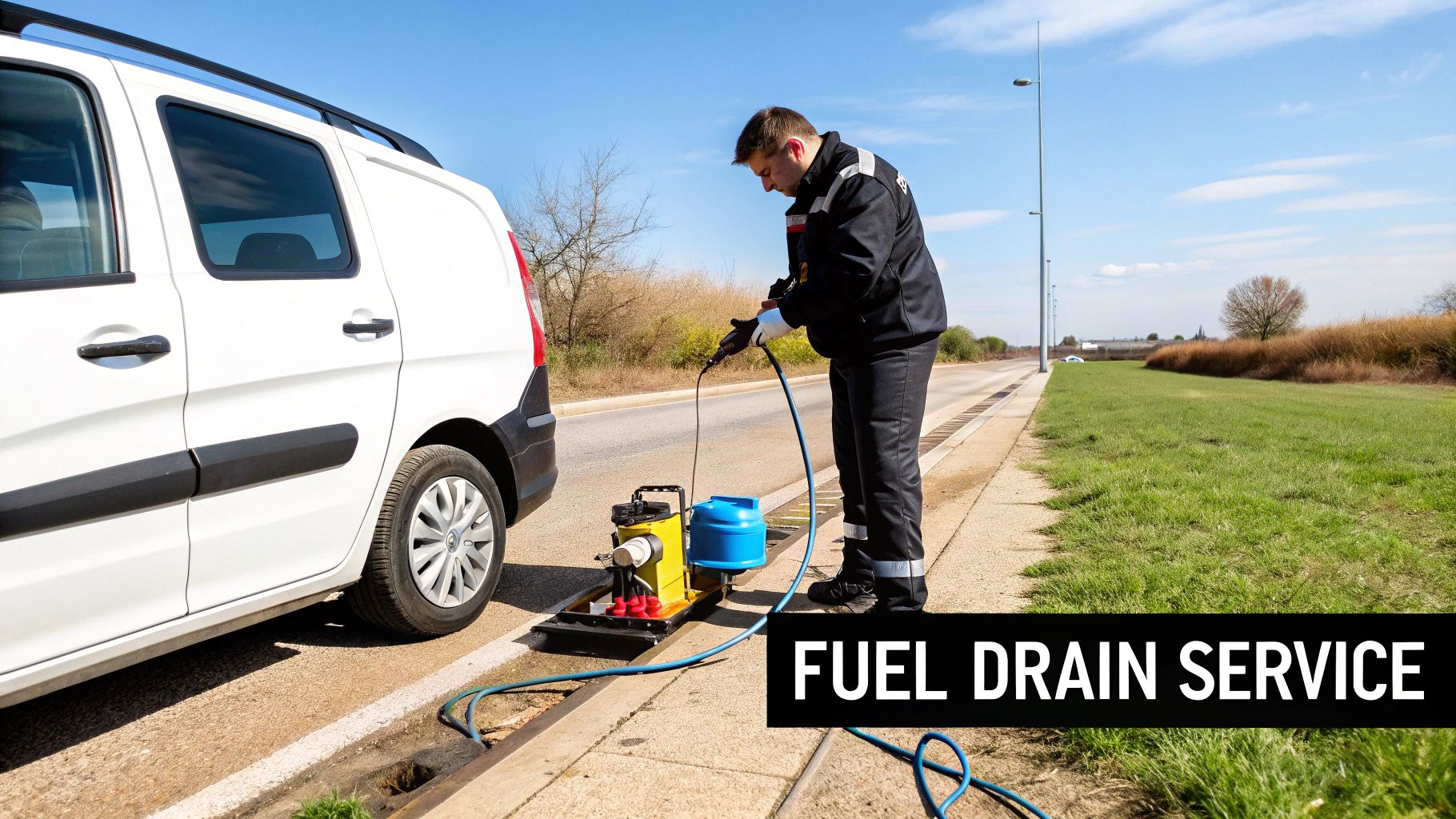
A professional technician doesn't just turn up with a siphon hose and a jerry can. They arrive in a fully equipped van that’s essentially a mobile workshop, complete with professional-grade, ATEX-approved pumping equipment. This certification is crucial, as it means the gear is specifically designed for safely handling flammable liquids without creating sparks.
The moment they arrive—whether you're stuck at a petrol station in Stowmarket or pulled over on the A14—the first priority is making the scene safe. The technician will secure the area around your vehicle, making absolutely sure there are no potential ignition sources nearby. They've seen it all before, so a good pro will calmly walk you through exactly what they’re about to do, giving you that much-needed peace of mind.
Draining the Contaminated Fuel
The heart of the job is, of course, the fuel drain. The technician will access your car’s fuel tank, which might be through the filler neck or sometimes by temporarily disconnecting a fuel line to get better access. They then use a powerful, sealed pumping system to draw out every last drop of the mixed petrol and diesel.
This is far more sophisticated than a simple suction job. The entire system is anti-static and sealed to eliminate any risk. The contaminated fuel is pumped directly into a secure, purpose-built container inside their van, ready for safe and environmentally compliant disposal later on.
A common myth is that you can just "dilute" a small amount of the wrong fuel by topping up the tank with the right stuff. The hard truth is that even a litre of petrol in a modern diesel engine can cause thousands of pounds in damage to injectors and the fuel pump. A complete drain is the only guaranteed safe fix.
Flushing the Entire Fuel System
Just emptying the tank often isn't enough, especially if you’ve switched on the ignition or driven even a few yards. The wrong fuel has already been pulled into the fuel lines, filter, and possibly right up to the injectors.
To fix this, the technician performs a full system flush. They’ll use a small amount of fresh, correct fuel to circulate through the system and purge any remaining contaminant. This usually involves:
Draining the fuel filter housing completely.
Flushing the fuel lines all the way from the tank to the engine.
Priming the system with clean fuel to remove any airlocks.
Once the entire system is pristine, they'll put a good amount of the correct fuel back into your tank—typically enough to get you comfortably to the next petrol station. They'll then ask you to start the car and will listen to the engine, making sure everything is running smoothly before they consider the job done. From arrival to you driving away, the whole process often takes less than an hour.
Finally, they handle the responsible disposal of the mixed fuel according to strict environmental regulations—a critical step you simply can’t manage on your own. For Suffolk motorists wanting to know more about getting help quickly, our guide on finding a local fuel drain near me provides some extra tips.
Mobile Fuel Drain Specialist vs Main Dealer
When you've misfuelled, you have a couple of choices. You could get towed to a main dealer or garage, or you can call a mobile specialist to come to you. The difference in time, cost, and convenience is significant.
Here's a quick breakdown of what to expect from each option:
Service Aspect | Mobile Fuel Drain Specialist | Main Dealer or Garage |
|---|---|---|
Location | Comes directly to you, wherever you are (roadside, home, petrol station). | You need to have your vehicle towed to their workshop. |
Speed | Typically on the scene within 30-90 minutes. Job done in about an hour. | Can take days. Your car joins a queue and waits for a free ramp. |
Cost | Far more affordable. You only pay for the specific service, not workshop overheads. | Significantly more expensive. Includes towing, labour at garage rates, and potentially unnecessary part replacements. |
Process | Drains and flushes the system to get you moving again quickly. | May insist on replacing parts like fuel filters, injectors, and pumps as a precaution, increasing the bill. |
Convenience | The most convenient option. Minimal disruption to your day. | Highly disruptive. You're left without your car for an extended period. |
Ultimately, a mobile service is purpose-built for this specific emergency. They are faster, cheaper, and get you back on the road with the least amount of stress. A garage or dealer treats it as a major repair, which is reflected in both the bill and the time you'll be without your vehicle.
Expected Costs, Timelines and Insurance Coverage
After the sinking feeling of putting the wrong fuel in your car, two questions immediately pop into your head: "How much is this going to cost me?" and "How long am I going to be stuck here?" Getting straight answers is the first step to feeling in control again.
The cost of a professional fuel drain isn't a simple, fixed price. It really depends on your specific situation. The final bill is influenced by your vehicle's make and model, exactly where you are in Suffolk, and how far the wrong fuel has travelled through the system.
A straightforward drain at a petrol station in Ipswich will cost less than a more involved job on a van that’s been driven and has conked out on a rural lane near Lowestoft. The type of fuel you've put in matters, too.
Breaking Down the Costs
Across the UK, this simple mistake can be an expensive one. Motorists can expect to pay anywhere from £120 to £1,000 for a professional drain, with the higher end of that scale usually reserved for extensive contamination or if something more corrosive like AdBlue has been added by mistake.
For fleet managers in Suffolk, the stakes are even higher. It's a frustrating fact that business drivers are often the most common offenders when it comes to misfuelling incidents, leading to significant vehicle downtime and repair bills.
If you've realised your mistake before starting the engine, you're in luck. A basic, preventative fuel drain will always be at the lower end of the cost spectrum. The price climbs if the contaminated fuel has been circulated and the whole system needs a thorough flush. For a more detailed breakdown, have a look at our in-depth guide to wrong fuel in car costs.
Realistic Timelines for Roadside Rescue
When you've misfuelled, speed is everything. From the moment you pick up the phone, our priority is to get a technician on their way to you without delay.
Arrival Time: We aim to reach you anywhere in Suffolk, from Bury St Edmunds to Felixstowe, within 60-90 minutes.
On-Site Time: Once our technician arrives, the fuel drain and system flush is a surprisingly efficient process. They can typically have the job done in about 45-60 minutes.
All in all, from your initial call to getting back behind the wheel, you can realistically expect to be back on your journey in under two hours.
One of the most common questions we get is about car insurance. Unfortunately, misfuelling is almost always classified as driver error, meaning it is not covered by standard, fully comprehensive insurance policies.
This is a crucial point to understand. While some premium breakdown policies might offer a bit of help, most drivers find that a specialist mobile service like ours is the most direct and affordable solution. If your insurance provider does reject your claim, it helps to know how to fight a denied car insurance claim.
Calling a mobile specialist completely bypasses the insurance headache and helps you avoid the hefty costs of being towed to a main dealer, who will likely charge a lot more for the exact same service.
A Few Simple Habits to Avoid Misfuelling Your Car
Let's be honest, prevention is always better than cure, especially when the cure involves a roadside drain and a bill you weren't expecting. The good news is that avoiding putting the wrong fuel in your car just comes down to building a couple of simple habits into your routine at the pumps.
First things first, always double-check the label on the pump and the one on your fuel cap. Don't just go by the colour of the hose. We all get used to seeing green for petrol and black for diesel, but this isn't a guaranteed standard across every single petrol station. Taking that extra second to read the label is the most foolproof way to sidestep a costly mistake.
A simple visual reminder can also work wonders. Think about a brightly coloured, hard-to-miss sticker on the inside of your fuel flap that screams "DIESEL ONLY" or "UNLEADED ONLY". It sounds almost too simple, but when you're tired, distracted, or in a rush, it's exactly the kind of prompt that can jolt you back to attention.
Here’s a great tip I picked up over the years, especially for anyone who swaps between different cars—like families with a couple of vehicles or fleet drivers. Just as you grab the nozzle, say the fuel type out loud. "Diesel." It feels a bit silly, but that little action forces your brain to engage and can override the muscle memory that often leads to putting petrol in a diesel engine.
For Suffolk businesses running a fleet of vans or cars, preventing misfuelling isn't just about avoiding a headache; it's about protecting your bottom line from vehicle downtime.
Label Everything Clearly: Make sure every vehicle has its fuel type clearly marked, both inside the cab as a reminder for the driver and right there on the fuel flap.
Consider Anti-Misfuel Devices: These are a brilliant invention. It's essentially a special cap that physically stops the narrower petrol nozzle from ever fitting into a wider diesel filler neck. It makes the mistake almost impossible.
Driver Training is a Must: It doesn't need to be a long session. Just a firm, clear reminder during onboarding and in regular team meetings about the importance of checking the fuel type can make all the difference.
Ultimately, these small, low-cost habits are your best defence. They take seconds to implement but can save you hundreds of pounds and a whole lot of hassle.
Common Questions About Wrong Fuel
When you find yourself stuck at a petrol station in Suffolk with the wrong fuel in your car, your mind probably starts racing with questions. It's a stressful moment, and you need clear, no-nonsense answers. Here are some of the most frequent queries we tackle every day, based on years of experience helping drivers just like you.
I Only Put a Little Wrong Fuel In – Do I Still Need a Drain?
Yes, you absolutely do. This is probably the most common question we get, and the answer is always the same. Modern diesel engines are incredibly precise bits of kit. Even a tiny amount of petrol can act like a solvent, stripping away the essential lubrication from the high-pressure fuel pump and injectors.
Trying to 'drown it out' by topping up with the correct fuel is a myth; it just means you now have a larger volume of contaminated fuel to deal with. The only surefire way to prevent damage is to have the system professionally drained, no matter how small the mistake.
An engine's fuel system is a closed loop. Once the wrong fuel is in the tank, it's in the system. Ignoring even a small amount is a gamble that could lead to thousands of pounds in repairs down the line.
Will Putting The Wrong Fuel in My Car Void My Warranty?
This is the hard truth: in almost all cases, yes, it will. Manufacturers view misfuelling as driver error, not a mechanical fault covered by their warranty. If that mistake leads to damage in the fuel system, you’ll be on the hook for the repair bill.
This is exactly why getting the problem sorted out properly and immediately is so crucial. A professional fuel drain is your best defence against the kind of damage that would force you into a difficult conversation with your dealership.
How Quickly Can a Technician Reach Me in Suffolk?
Our whole operation is designed for a rapid response. We have mobile technicians based strategically across Suffolk, covering key areas like Ipswich, Bury St Edmunds, Lowestoft, and all the rural spots in between. Our goal is always to get to you within 60-90 minutes.
Of course, your precise location and the state of the A12 or A14 at that moment can affect timings, but our dispatch team will give you a realistic ETA and keep you updated.
Is It Safe to Try and Drain The Fuel Myself?
In a word: no. We can't stress this enough – please don't even think about it. Petrol and diesel are highly flammable, and their fumes are toxic. A DIY drain without the right anti-static pumps and safety gear is a huge fire risk.
Beyond the immediate danger, there’s also the issue of disposal. You can't just pour contaminated fuel down the drain. It's classed as hazardous waste and needs to be disposed of by a licensed professional. It’s far safer, and legally correct, to let a trained technician handle it.
If you've put the wrong fuel in your car in Suffolk, don't panic. Call the experts at Misfuelled Car Fixer for a fast, professional, and affordable 24/7 mobile fuel drain service. We'll get you safely back on the road. Contact us now for immediate assistance.


