



Beware: 1 Litre AdBlue in Diesel Tank - What to Do After a Mistake
- Misfuelled Car Fixer

- Dec 22, 2025
- 14 min read
Updated: Jun 10
24/7 Hotline Nationwide: 0330 122 6640
National AdBlue in Diesel Tank Rescue: https://misfuelledcarfixer.co.uk/adblue-in-diesel-tank
WhatsApp Us for Enquiry: https://wa.me/447788650846
If you found this page, we cover you in England!
It's a moment that makes your stomach drop: you've just poured about 1 litre of AdBlue into your diesel tank. I've seen the panic on drivers' faces across Suffolk, and the first thing I always tell them is the single most important rule: DO NOT START THE ENGINE.
Seriously. Don't even turn the key to the 'on' position. Doing that can prime the fuel pump, which is all it takes to start circulating the contaminated mix and kick off a chain reaction of expensive, avoidable damage.
What Happens When You Put 1 Litre AdBlue in Diesel Tank?
Pouring AdBlue into the diesel tank is a surprisingly easy mistake to make, and thousands of UK drivers do it every year. It usually happens when you're in a rush or distracted at the pump. The problem is that AdBlue isn't a fuel additive at all. It's a Diesel Exhaust Fluid (DEF) made mostly of urea and deionised water, and it has no business being anywhere near your engine's fuel system.
When AdBlue mixes with diesel, a nasty chemical reaction starts immediately. The urea doesn't just dissolve; it forms hard, white crystals. Because these crystals are denser than diesel, they sink straight to the bottom of the tank—right where the fuel pump pickup sits, waiting to suck them up.
The real enemy here is crystallisation. Think of it like pouring fine sand into your fuel lines. If you start the engine, these abrasive crystals get forced through your vehicle's delicate fuel system, causing clogs and serious mechanical wear.
Your first move after realising the mistake is what makes all the difference. This decision tree lays it out perfectly.
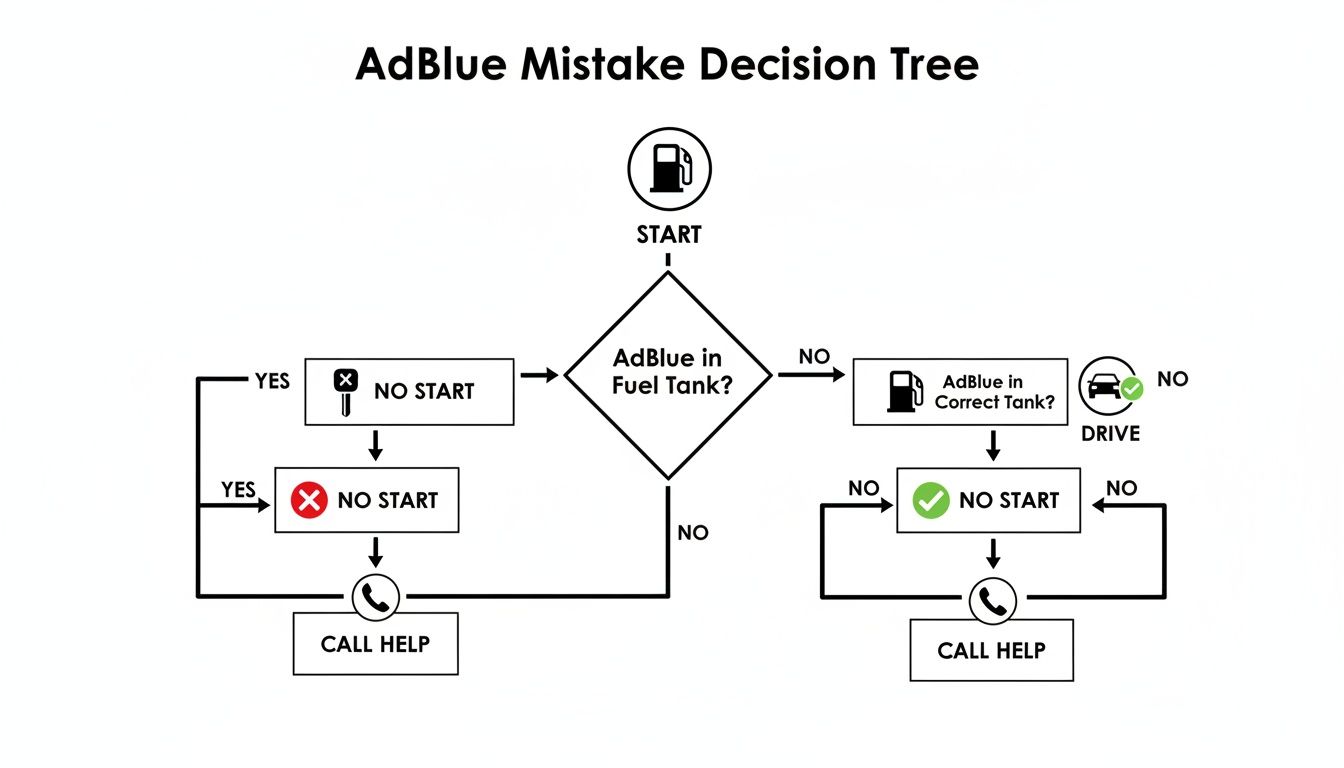
As you can see, your first action—or rather, your inaction—is the fork in the road between a simple fix and a major repair bill.
Why Even a Small Amount Is a Big Deal
It’s a common myth that a full tank of diesel will just dilute a small amount of AdBlue and make it harmless. I wish it were true, but it's not. The contamination starts its damaging work the second it hits the tank, which is why a professional fuel drain is the only real solution.
Data from fleet operators and breakdown services paints a clear picture. The AA has seen a 15% rise in callouts for AdBlue errors, and the repairs aren't cheap. Even 1 litre of AdBlue contamination can lead to:
Crystallised urea blocking fuel lines and injectors within hours.
Repair costs ranging from £1,500 to over £5,000 at a typical UK garage.
The moment you realise you've made a mistake, it’s critical to act correctly. Here’s a quick-reference guide to help you.
Immediate Actions After an AdBlue Misfuelling Incident
Your Action | Why It Matters |
|---|---|
DO NOT start the engine | This is the golden rule. It prevents the AdBlue from being drawn into the fuel lines, pump, and injectors. |
DO NOT put the key in the ignition | On many modern cars, even turning the key to the first position primes the fuel pump and starts circulation. |
Put the car in neutral | If it's safe to do so, this makes it easier to move the vehicle without needing to start the engine. |
Call a specialist immediately | The faster you act, the better. A mobile fuel drain service can solve the problem on-site, saving you a tow and a garage bill. |
Inform petrol station staff | They can help you move your car to a safe spot and are used to dealing with this situation. |
Following these steps turns a potential catastrophe into a manageable inconvenience.
The chemical properties of AdBlue and diesel are fundamentally different, and they should never, ever mix. To get a better handle on what AdBlue actually does, you can read our in-depth guide on AdBlue for diesel drivers. Understanding its proper role makes it obvious why keeping it out of your fuel is so vital.
While the situation is serious, remember that it's a problem we can fix right there on the roadside with a quick, expert response.
What Happens If You Start the Engine?
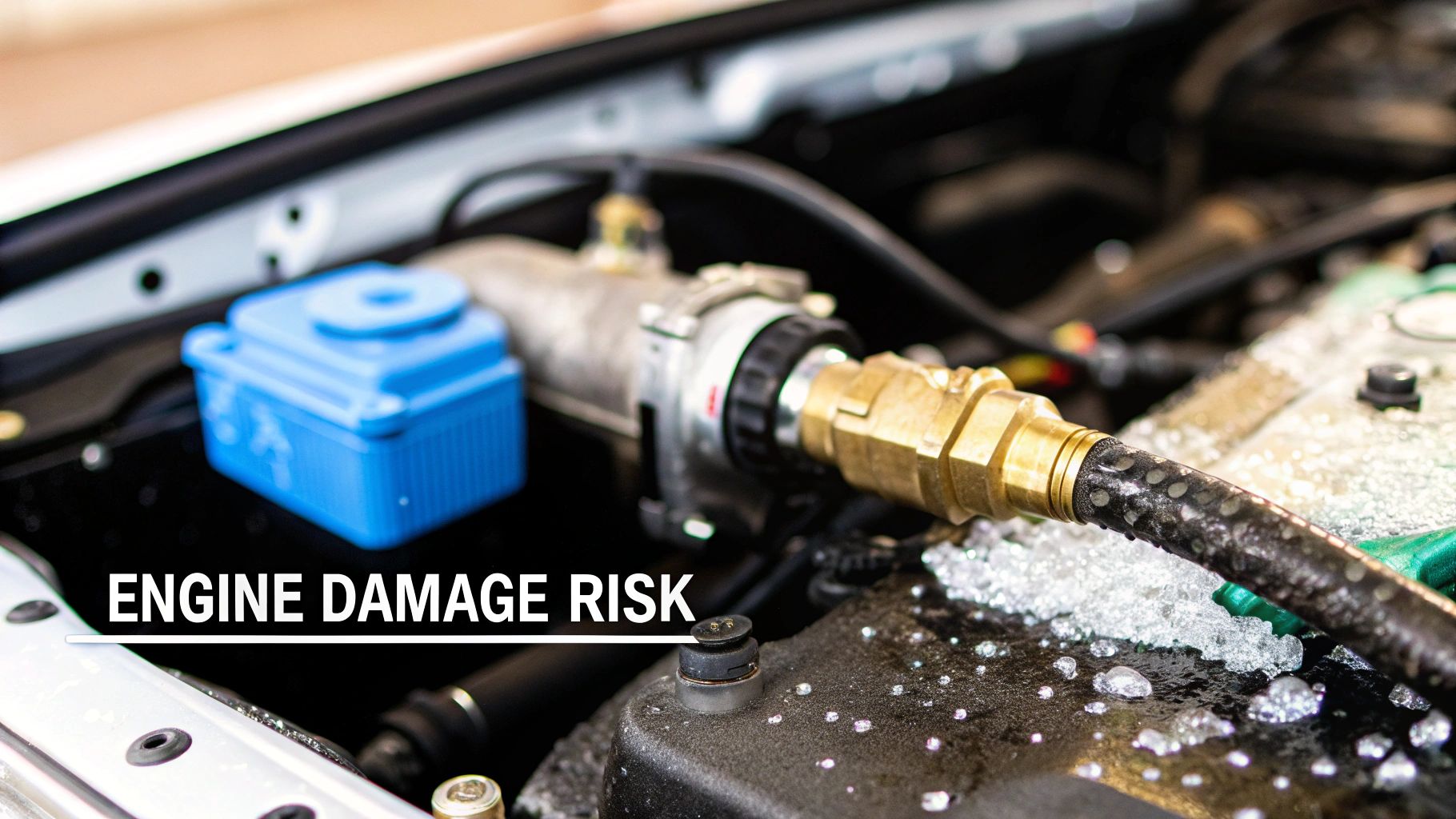
This is the critical moment. Turning the key in the ignition is what escalates a simple, fixable mistake into a potentially eye-watering repair bill. It kicks off a destructive chain reaction that pulls the AdBlue from the tank and forces it deep into your car's fuel system.
When you start the car, the fuel pump doesn't know there's a problem. It just does its job, drawing fluid from the bottom of the tank. The trouble is, AdBlue is much denser than diesel, so it sinks. This means the pump’s first gulp isn’t just contaminated fuel – it's a concentrated hit of AdBlue solution.
From there, this corrosive mix is pushed through the fuel lines. The first component to face the onslaught is your fuel filter. Its job is to catch tiny impurities, but it’s no match for this. The urea in the AdBlue reacts almost instantly with the diesel, forming solid white crystals that look a bit like slush. These crystals rapidly clog the filter, choking the fuel supply to the engine.
The Contamination Spreads to Critical Components
If any of the contaminated fuel manages to squeeze past the choked filter, its next stop is the high-pressure fuel pump. This is a very sensitive, precision-engineered piece of kit. It relies entirely on diesel's natural lubricating properties to function, but AdBlue is mostly water and offers zero lubrication.
Worse still, the abrasive urea crystals act like liquid sandpaper, grinding away at the pump's delicate internal parts. At the same time, the water content starts corroding metal surfaces that should never see a drop of moisture. This is where the real, serious damage begins to rack up.
Next in line are the fuel injectors. These are highly sophisticated nozzles that spray an atomised mist of diesel into the engine. The tiny holes in the injector tips are easily blocked by the AdBlue crystals, which can ruin the spray pattern or block the flow of fuel altogether.
The real nightmare scenario is when these urea crystals harden inside the high-pressure fuel system. The combination of abrasive grit and corrosive water is a death sentence for the fuel pump and injectors. We've seen repairs for this kind of damage run into the thousands.
The Telltale Signs of Trouble
If you’ve turned the engine on, even for a few seconds, you'll probably know about it very quickly. Spotting these symptoms will help you give us a clear picture of what’s happening when you call for help.
Engine Management Light: This is usually the first thing you'll see. The dashboard will light up as the car's sensors scream that something is seriously wrong with the fuel.
Rough, Juddering Engine: The engine will struggle, misfire, and sound awful as the injectors get blocked and the combustion process is thrown into chaos.
Serious Lack of Power: With the fuel filter blocked and the pump struggling, the engine is being starved. You'll feel a dramatic loss of acceleration.
White Smoke from the Exhaust: This is a classic sign. It's the water content in the AdBlue turning to steam as it hits the hot exhaust system.
Engine Cuts Out: Often, the engine will splutter into life for a few moments before giving up completely and refusing to restart.
These signs are your car’s last-ditch effort to tell you to stop. Every single moment the engine runs, the contamination gets worse, and the potential repair bill gets bigger. It's exactly why our number one rule is always the same: do not touch that ignition.
What Happens When We Arrive? Our Mobile Fuel Drain Process
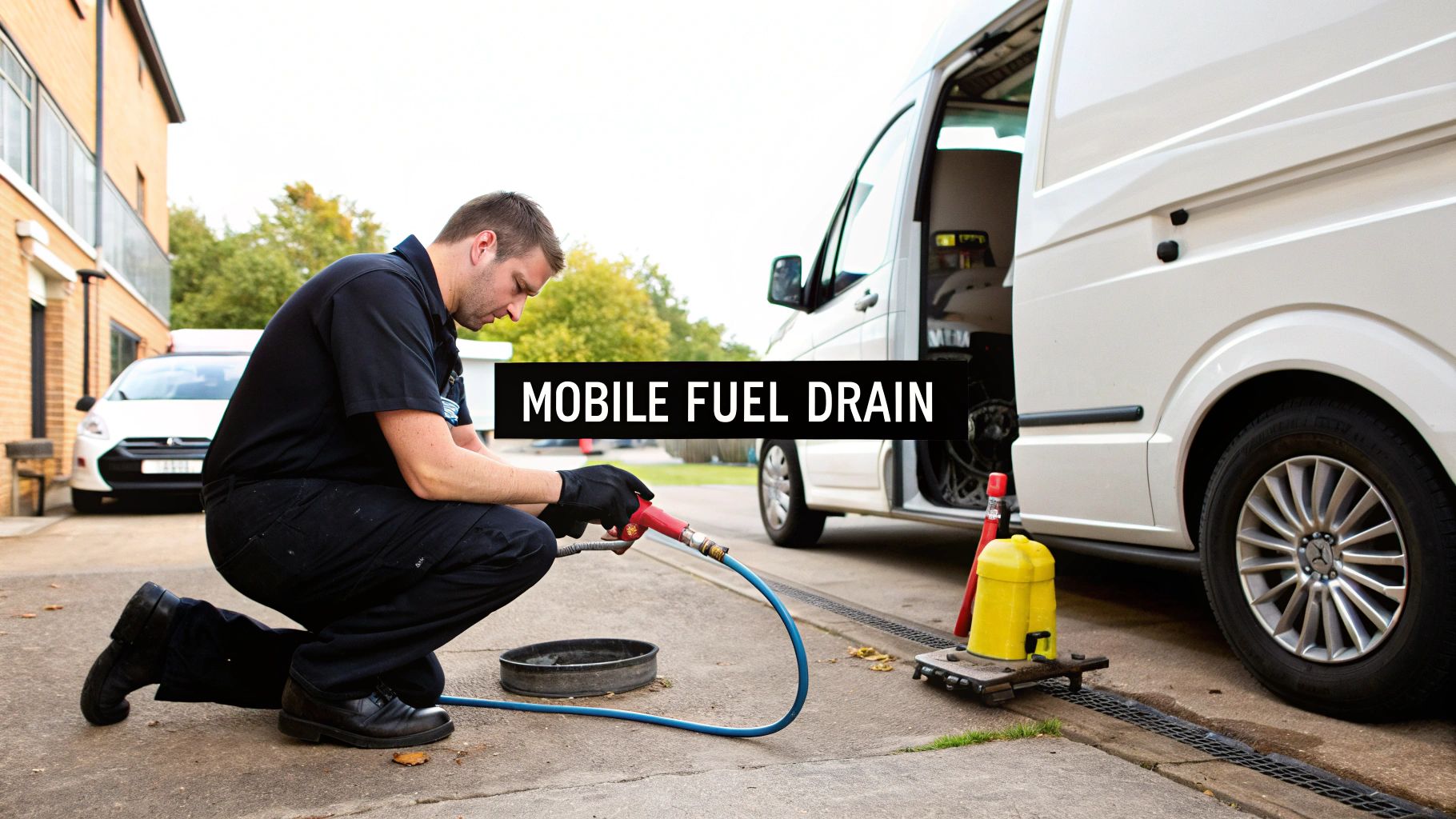
When you’ve just put 1 litre of AdBlue in your diesel tank, the last thing you need is more stress. You need an expert to show up and just handle it. That's exactly what we do. Our whole process is designed to be straightforward and safe, bringing the workshop to you, whether you’re stuck on the forecourt in Ipswich or in your own driveway in Bury St Edmunds.
The moment our technician pulls up, their first job is to make the scene safe. They’ll get the safety cones out and make sure the area around your car is secure, with no potential ignition sources nearby. This gives us a controlled space to work in, so we can focus entirely on your vehicle without any risks.
The Drain and Flush: Getting the AdBlue Out
Getting the contaminated fuel out is the main event. Our technician will use professional, explosion-proof pumping gear to completely drain your fuel tank. This isn't just sticking a tube in and hoping for the best; it's a specialised process that safely moves the AdBlue and diesel mixture into a secure container inside our van.
But here’s a crucial bit of information that many people don't realise: just draining the tank isn’t enough. AdBlue is notorious for leaving behind a sticky, crystalline residue that latches onto everything it touches. If we just put fresh diesel in on top of that, those crystals would dissolve and head straight for your engine, causing the very damage we're here to prevent.
That’s why the system flush is non-negotiable. We circulate a special cleaning agent through the entire fuel path—the lines, injector rail, and filter housing—to dissolve and flush out every last trace of that AdBlue residue. It’s a meticulous deep clean that gets your system back to how it should be.
We never just "drain and go." Every job is a full system decontamination. It’s about completely erasing the mistake to protect your engine. Skipping the flush might seem cheaper at first, but it's a gamble that can easily lead to thousands in repair bills later.
Final Checks to Get You Back on the Road
Once the system is sparkling clean, our technician gives key parts like the fuel filter a visual check-over, looking for any early warning signs. We don't just hand you back the keys to an empty car, either.
We’ll put enough fresh, clean diesel in your tank to get the system primed and see you safely to the nearest petrol station. The final steps are all about making sure everything is running perfectly:
Priming the Fuel System: We'll make sure the new diesel is drawn right through to the engine, pushing out any air pockets in the lines.
Starting the Engine: Next, we start the car. We’ll let it run for a bit, listening to the engine and making sure it’s idling smoothly.
Final System Check: Before we pack up, we do one last look-over to confirm there are no leaks and the engine is happy.
We only sign the job off when we are 100% satisfied your vehicle is running exactly as it should be. Our goal is to fix the problem completely, right there on the spot, so you can drive away with total peace of mind. It’s the proper way to handle a misfuel, and you can learn more about how we provide quick help for wrong fuel in cars near you.
What Damage and Repair Costs Can I Expect?
When you’ve put even a litre of AdBlue into your diesel tank, the final bill all boils down to one simple, critical question: did you start the engine? That one action creates two vastly different outcomes. One is a manageable hiccup, while the other can quickly spiral into a financial nightmare.
If you caught the mistake right away and left the ignition well alone, the situation is contained. Phew. The cost is typically just for our mobile fuel drain and system flush. It’s a straightforward fix we can do on the spot, designed to get you back on the road with minimal fuss and a clear, predictable cost.
If the Engine Has Been Started
Things get a lot more serious if the engine was turned over, even for a moment. That AdBlue isn't just sitting in the tank anymore; it's been pumped through the most sensitive and expensive parts of your car's fuel system. This is where the repair costs can really start to mount up.
Don't just take our word for it. Recent breakdown data from across the UK shows that AdBlue incidents now make up 22% of all misfuelling call-outs. That figure has shot up by 30% since ULEZ expansions pushed more people into modern diesel cars. The RAC estimates that while a simple drain might set you back around £800, damaging the injectors on a common van like a Ford Transit or Vauxhall Vivaro can average £3,200.
The single most effective way to keep costs down is to stop the contamination from spreading. Calling us for a professional drain before you start the engine isn't just a fix—it's a financial damage limitation exercise.
What Parts Are at Risk?
To give you a clearer picture of where those costs come from, here’s a look at what we often have to repair or replace once contaminated fuel has circulated.
Fuel Filter: This is your engine's first line of defence, and it will be completely choked with white AdBlue crystals. It’s a definite goner and needs replacing.
Fuel Injectors: If the crystals get this far, the injectors might be salvageable with specialist cleaning. More often than not, though, the delicate nozzles are permanently damaged and the whole set needs to be replaced.
High-Pressure Fuel Pump: This is one of the biggest and most expensive repairs. The pump relies on diesel fuel for lubrication. AdBlue, being mostly water, strips that away, causing rapid abrasive wear and corrosion. Complete failure is very common.
SCR System: In a worst-case scenario, the contamination can even work its way back into the exhaust system, damaging components of the Selective Catalytic Reduction (SCR) system—the very system AdBlue is designed to help.
The cost of misfuelling doesn’t just stop with your vehicle. The AdBlue and diesel mixture is legally classified as hazardous waste. Trying to dispose of it yourself could land you in hot water with some hefty fines under the UK hazardous waste disposal regulations.
Our service always includes the safe, legally compliant removal and disposal of all the contaminated fuel, taking that worry completely off your plate.
Potential Repair Costs for AdBlue Contamination
To put it all into perspective, here’s a typical breakdown of how costs can differ depending on whether the engine was run.
Component or Service | Engine Not Started (Typical Cost) | Engine Started (Potential Cost) |
|---|---|---|
Mobile Fuel Drain & Flush | £250 - £450 | £250 - £450 (initial step) |
Fuel Filter Replacement | N/A | £80 - £200+ |
Fuel Injector Replacement | N/A | £1,000 - £3,500+ |
High-Pressure Fuel Pump | N/A | £1,500 - £4,000+ |
SCR System Diagnostics & Repair | N/A | £500 - £2,000+ |
Total Estimated Cost | £250 - £450 | £3,000 - £10,000+ |
As you can see, the difference is stark. A moment's hesitation before turning the key can save you thousands of pounds and a whole lot of stress.
For a broader look at how these figures stack up against other types of misfuelling, take a look at our complete UK guide to wrong fuel in car costs.
How to Make Sure This Never Happens Again
After the stress and expense of an AdBlue misfuelling scare, you’ll naturally want to make sure it’s a one-time event. The good news is that preventing a repeat performance is straightforward. It really just comes down to a bit of mindfulness at the pump and understanding your car's design.
Most modern diesel cars are actually built to stop you from making one type of mistake. Have a look at your fuel filler flap—you'll see the AdBlue cap is almost always coloured blue and is much smaller than the diesel filler neck. This is deliberate. The wide diesel nozzle from the pump physically won't fit into the little AdBlue tank opening, so that’s one less thing to worry about.
The real danger, and the mistake we see most often, is putting the slim AdBlue nozzle into the wide-open diesel tank. That’s where a good routine comes in.
Build a Solid Fuelling Habit
The best defence is simply creating a consistent habit every single time you’re at the petrol station. Think of it as a quick mental checklist that becomes second nature.
Stop and Look: Before you even think about putting a nozzle in, just take a breath. Glance at the pump handle. Is it blue? Is it black? Read the label. That one-second pause is your best friend in preventing a mix-up.
Cut Out Distractions: A busy forecourt is full of things competing for your attention. Try to avoid chatting on the phone or getting deep into a conversation right at the moment you're about to fill up. Most mistakes happen when our focus is elsewhere.
Tell Anyone Else Who Drives the Car: If your partner, a family member, or a colleague ever uses your car, make sure they know it uses AdBlue. Show them the separate blue cap and explain why it’s so important. A quick chat could easily save you thousands.
Despite car manufacturers' best efforts, misfuelling is still a surprisingly common problem. Green Flag mentioned they rescued 14,500 drivers for misfuelling last year alone, and a significant 19% of those cases were AdBlue-related. Campaigns from the DVSA to introduce clearer pump labels have helped reduce errors by 11%, but at the end of the day, simple human error remains the biggest factor. You can find more insights into the future for diesel drivers over on the RAC's website.
The key to prevention is just treating the AdBlue filler as a totally separate system from the fuel tank—because that's exactly what it is. This mindset shift alone will dramatically lower the risk of another costly mistake.
If you’re looking for a bit of extra peace of mind, you could also look into an aftermarket misfuelling prevention device. These are clever little gadgets that fit onto your diesel filler neck. They work by physically blocking any nozzle that’s too small, like one for petrol or AdBlue, giving you a final, foolproof line of defence.
Your AdBlue in Diesel Questions Answered
If you’re stuck on the side of the road after an AdBlue mix-up, your head is probably spinning with questions. We get calls like this every day from drivers across Suffolk, all worried and wondering what to do. Here are some straightforward, honest answers to the questions we hear most often.
Will Just 1 Litre of AdBlue Really Cause Damage?
Yes, without a doubt. People ask us this all the time, hoping a small amount might be okay, but unfortunately, the answer is always the same. Putting even 1 litre of AdBlue into a diesel tank is enough to kickstart the crystallisation process that will block your fuel filter and destroy your injectors.
It’s a common misconception that it will just dilute. AdBlue is much denser than diesel, so it sinks straight to the bottom of the tank—right where the fuel pump draws from. This means the pump sucks up a highly concentrated slug of AdBlue almost instantly. No matter how little you’ve put in, a full system flush is the only way to be completely sure you’ve avoided damage.
Can I Just Drain the Fuel Tank Myself?
We’d strongly, strongly advise against trying to drain the tank yourself. For a start, it’s not as simple as it sounds. Modern fuel tanks have anti-siphon devices built in, making it virtually impossible to get the fuel out without the specialised pumps we use. It’s a messy, tricky job that’s easy to get wrong.
But the bigger issue is what gets left behind. Simply draining the tank won't remove the sticky, crystal-like residue that AdBlue forms. The entire fuel system—pipes, filters, pumps, and injectors—needs to be professionally flushed clean. A DIY attempt often leads to personal injury, environmental fines for spilling fuel, and, ultimately, incomplete cleaning that causes thousands of pounds of engine damage a few days later.
"We've seen well-intentioned DIY drains go wrong more than once. A driver empties the tank but doesn't have the gear to flush the lines. A week later, they call us with a seized high-pressure fuel pump, looking at a repair bill in the thousands. It’s just not worth the risk."
How Long Does a Mobile Fuel Drain Take?
Getting you back on the road safely and swiftly is our number one goal. For a typical car where the engine hasn't been started, you'll be surprised at how quickly we can sort it. From our technician arriving on-scene to you driving away, the whole process usually takes between 60 and 90 minutes.
That time covers setting up a safe workspace around your vehicle, carrying out the full tank drain, flushing the entire fuel system properly, and getting enough clean diesel back in to get you going. If the engine has been run, the job is more involved as we have to clear every last component, so it might take a bit longer.
Does My Car Insurance Cover AdBlue Misfuelling?
This is a tricky one, and the answer really depends on your specific policy. Many fully comprehensive plans do cover misfuelling as "accidental damage," but some insurers sneakily exclude it in the fine print. The only way to know for sure is to dig out your policy documents or give your provider a call.
Even if you are covered, don't forget to weigh up the cost of your excess against the potential loss of your no-claims bonus. In many cases, calling a specialist mobile service like ours is not only faster and a lot less hassle than making a claim, but it can often work out cheaper in the long run.
If you've put even a drop of AdBlue in your diesel tank in Suffolk or the nearby areas, stay calm and absolutely do not start the engine. Call the experts at Misfuelled Car Fixer straight away for fast, professional help, 24/7. Get in touch with Misfuelled Car Fixer Suffolk


