



Wrong Fuel in Vehicle: Quick Fixes and Safe Recovery for wrong fuel in vehicle
- Misfuelled Car Fixer

- Jan 13
- 14 min read
The moment of realisation hits you. You've just put the wrong fuel in your car. Your very next move is the most important one you'll make: do not start the engine. Don't even turn the key to the 'on' position to listen to the radio. This single decision can be the difference between a quick, relatively painless fuel drain and a bill that runs into thousands for engine repairs.
Your Immediate Actions at the Petrol Station
That sinking feeling at the pump is an all-too-common one. If it’s any consolation, you're in good company. Around 150,000 drivers in the UK make the same mistake every year, turning a routine fill-up into a major headache. In fact, it's so frequent that online searches for help spike by as much as 51% in early spring. You can read more about this common driver error on gbnews.com.
How you act in these first few minutes is what really counts. It’s all about containing the problem before it escalates.
First, Secure Your Vehicle
Leave your car exactly where it is. Don't be tempted to push it to a quieter spot or another parking bay. The priority is to keep it completely stationary to stop the wrong fuel from sloshing around any more than it has to.
Pop the car into neutral and pull the handbrake on tight. Then, flick on your hazard warning lights. This signals to other drivers and the forecourt staff that your vehicle isn't going anywhere and needs a bit of space.
Let the Petrol Station Staff Know
With your car secured, head inside and calmly tell the staff what’s happened. Trust me, they've seen this countless times before. They can help manage the situation by putting out cones or guiding other cars away from the pump you've used. Getting them on your side is key to keeping everything safe and calm while you sort things out.
Your gut reaction might be to panic, but the best thing you can do right now is nothing at all. By keeping your hands off the ignition, you keep the contaminated fuel isolated in the tank. This makes the fix dramatically simpler and cheaper.
This simple flowchart lays out the two very different paths your day can take, depending entirely on whether the engine was started.
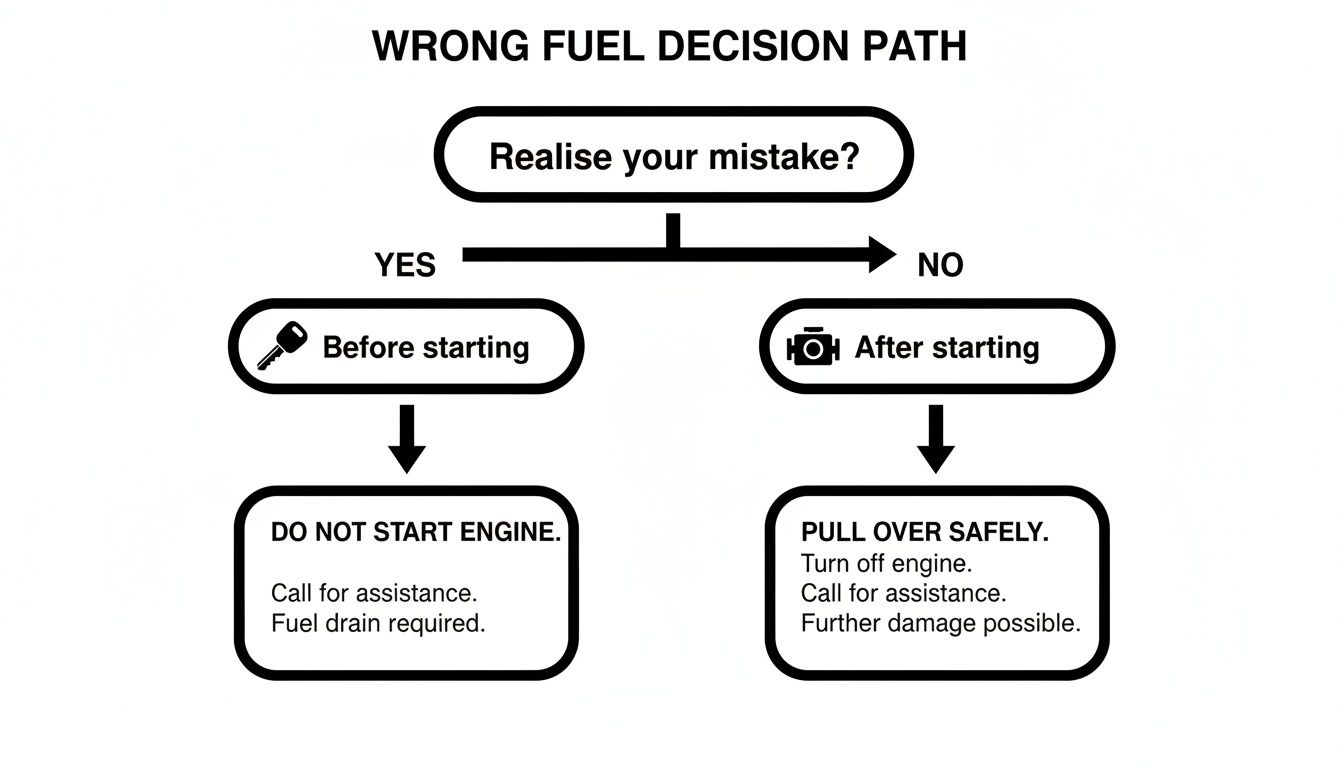
As you can see, keeping the key out of the ignition leads to a much less complicated and costly outcome.
To help you remember these crucial first steps in a stressful moment, here's a quick reference table.
Immediate Actions for a Misfuelling Incident
Action to Take (DO) | Action to Avoid (DON'T) | Why It Matters |
|---|---|---|
Leave the car where it is. | Do not start the engine. | Prevents the wrong fuel from circulating and causing severe engine damage. |
Put the car in neutral and apply the handbrake. | Don't turn the key to the 'on' or 'accessory' position. | Many modern cars prime the fuel pump when the ignition is switched on, which starts the contamination process. |
Switch on your hazard lights. | Don't try to move the vehicle yourself. | Alerts others to the situation and ensures safety on a busy forecourt. |
Inform the petrol station staff. | Don't feel embarrassed or try to hide the mistake. | Staff can secure the area and provide assistance, preventing further issues. |
Call a mobile fuel drain specialist. | Don't just call a standard breakdown service. | A specialist can fix the problem on-site, which is faster and often cheaper than a tow to a garage. |
Following these dos and avoiding the don'ts is the key to minimising the damage, cost, and stress of a misfuelling mistake.
Make the Right Phone Call
Once the car is safe and the staff are aware, your final immediate task is to call for the right kind of help. Your first thought might be your usual breakdown provider, but they'll likely just tow your car to a garage, adding time and expense.
Instead, search for a specialist mobile fuel drain service. These technicians are the pros you need. They come to you and have all the equipment to handle the entire job right there on the forecourt. Their process typically involves:
Safely draining the contaminated fuel from your tank.
Flushing the fuel lines to get rid of any nasty residue.
Putting in a small amount of the correct fuel to get you going.
Making sure the car starts and runs smoothly before they let you drive away.
This is almost always the quickest and most cost-effective solution. It gets you back on the road in an hour or two with the minimum amount of fuss.
Petrol in Diesel vs. Diesel in Petrol: What’s the Real Damage?
It’s a horrible feeling when you realise what you’ve done, but not all misfuelling mistakes cause the same amount of chaos. Putting the wrong fuel in your vehicle is always serious, but one scenario is far, far worse than the other.
The potential for damage really comes down to which fuel you've put in and what kind of engine it's gone into. The most common mix-up, and by far the most destructive, is putting petrol into a diesel car.
The Problem with Petrol in a Diesel Engine
Putting petrol into a diesel engine is the number one cause of catastrophic fuel system failure. It's a costly mistake. Why? Because diesel fuel does two jobs: it powers the engine and it acts as a vital lubricant. It keeps all the high-precision parts of the fuel system, like the high-pressure pump and injectors, running smoothly under extreme pressures.
Petrol is the opposite. It’s a solvent. When you introduce it into a diesel system, it immediately starts to strip away that protective, lubricating film.
Without lubrication, you get metal grinding directly on metal. This creates immense friction and heat, causing the delicate components in the fuel pump to tear themselves apart. This process generates tiny metal shavings—we call it ‘swarf’—which are then pumped at high pressure through the entire system, wrecking the injectors and blocking filters.
Just turning the key is enough to circulate this damaging mixture. It can instantly turn a simple fuel drain into a job requiring a full system replacement that costs thousands of pounds.
You'll know something is badly wrong if you notice:
A loud, knocking noise coming from the engine.
A sudden loss of power or jerky, juddering acceleration.
Lots of smoke pouring from the exhaust.
Your engine management light flashing up on the dashboard.
The core issue here is lubrication failure. Think of it like running your engine without oil; the internal components grind against each other, causing irreversible damage in a very short amount of time. This is why not starting the car is the most critical advice.
The Consequences of Diesel in a Petrol Engine
This is a much less common mistake, mainly because the diesel nozzle is physically larger than the filler neck on most petrol cars. But if it does happen, the consequences are usually less severe.
A petrol engine uses spark plugs to ignite a fine mist of fuel and air. Diesel is much heavier and oilier than petrol and doesn't ignite easily with a spark. Instead of a clean burn, it just coats the spark plugs in a thick, sooty residue, preventing them from creating a spark at all.
Your car will let you know pretty quickly that it’s not happy. The immediate effects you'll notice are:
The engine will misfire, run incredibly rough, or may not even start.
If it does manage to run, you'll likely see thick black or white smoke from the exhaust.
It will probably cut out or stall constantly.
While it can certainly clog up your fuel filter and ruin a set of spark plugs, it doesn't cause the same instant, destructive friction that petrol does in a diesel engine. The fix is usually a full tank drain, a flush of the fuel lines, and cleaning or replacing the spark plugs.
It’s still a problem that needs a professional to sort out, but the risk of writing off your engine is much, much lower. Knowing the basics of how these fuels work is a great first step in avoiding the problem altogether. For a deeper dive, check out our essential UK driver guide on the difference between petrol and diesel.
How a Professional Fuel Drain Service Works
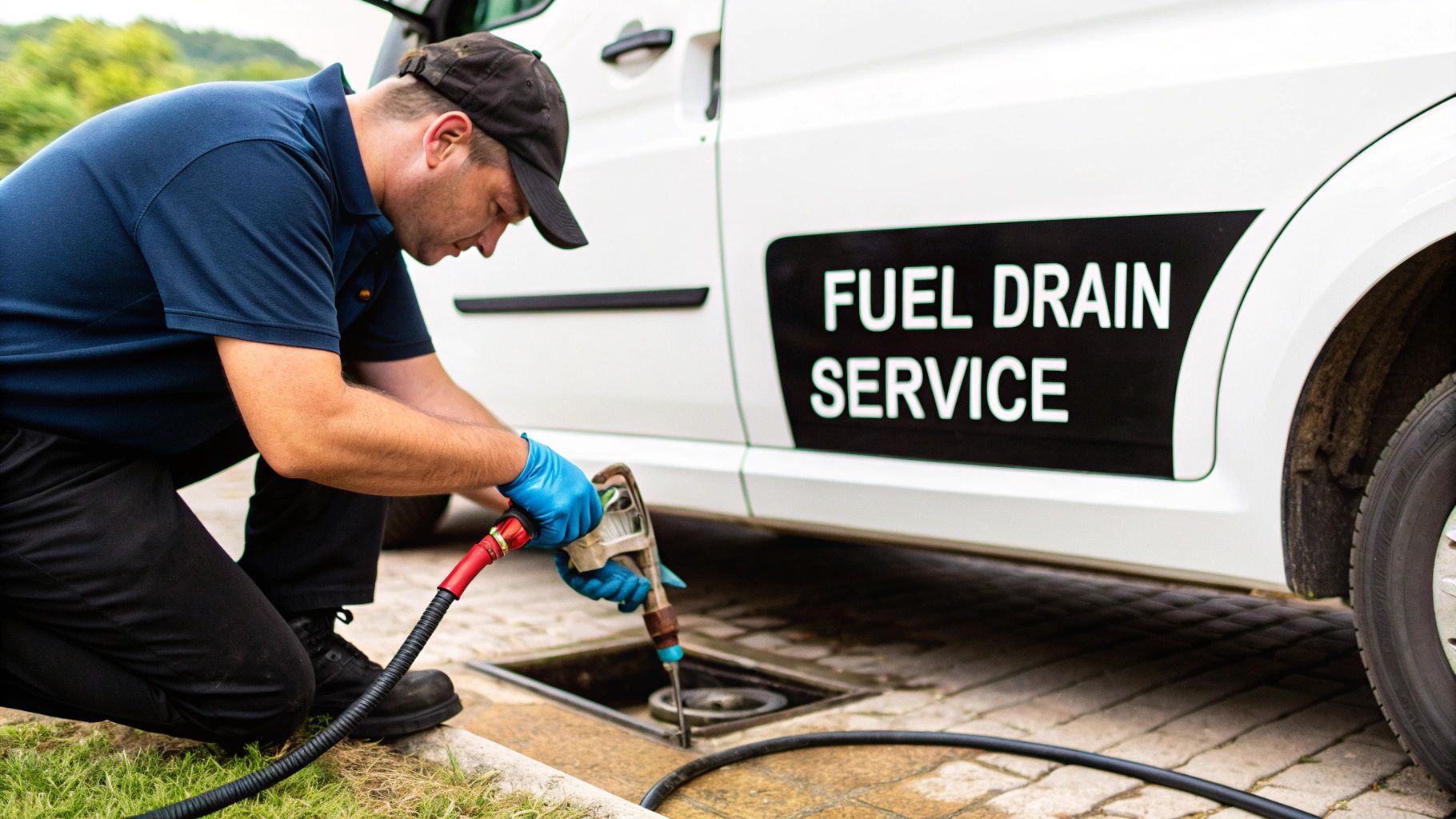
When you make that dreaded call after a misfuelling mishap, your mind probably jumps to a long, complicated fix at a garage. The reality, however, is much simpler. A mobile fuel drain service is a finely tuned operation designed to sort the problem out safely and get you back on your way, right where you are.
The specialist technician who arrives at your location is an expert in this specific scenario. Their first job is to make the area safe, both for you and for other road users. After a quick chat to confirm the details, they'll walk you through exactly what they’re about to do, so there are no surprises.
The Fuel Draining Process
At the heart of the service is the complete removal of every last drop of contaminated fuel from your vehicle. This isn’t a simple case of siphoning with a bit of old hosepipe; technicians use highly specialised, industry-approved pumps. This equipment is built to be "intrinsically safe," meaning it's designed to prevent any sparks or static electricity that could ignite fuel vapours.
A suction hose is carefully guided into your fuel tank to pump the incorrect fuel mix out and into a secure container inside their van. They are meticulous about this, ensuring the tank is bone dry. For a standard car, this often means removing between 40 and 70 litres of contaminated fuel.
But the job doesn't end with the tank. The technician then works through the entire fuel system to clear it out.
Fuel Lines: They'll purge the lines that run from the tank to your engine.
Fuel Filter Housing: The filter is checked and any trapped bad fuel is removed.
Injectors and Rails: If you’ve turned the ignition or started the engine, these components may also need a thorough flush to clear them completely.
A professional service doesn’t just drain the tank; it cleanses the entire fuel delivery system. This comprehensive approach is vital to prevent any lingering residue from causing running issues or long-term damage later on.
System Flush and Getting You Started
With the contaminated fuel gone, the next step is to flush the system with a small amount of clean, correct fuel. Think of it as a rinse cycle—it pushes out any final droplets of the wrong mixture, leaving the lines pristine.
Once the flush is complete, the technician will add around 5 to 10 litres of the right fuel to your tank. This is just enough to get the engine primed and running smoothly so you can drive to the nearest petrol station to fill up properly.
Before they leave, they'll start your car and let it run for a few minutes, keeping a close eye on the dashboard for any warning lights and listening to the engine. This final check is their way of confirming the problem is completely solved.
It's a process that highlights just how disruptive unplanned downtime can be. Research from the RAC shows that 39% of UK drivers had their main vehicle off the road for at least a day last year due to unexpected issues. A mobile fuel drain is all about minimising that disruption. You can read more in the full RAC Report on Motoring.
Finally, all the contaminated fuel they've collected is taken away for safe and environmentally compliant disposal. If you ever find yourself in this situation, our emergency guide for finding a fuel drain near you has more local advice to help you out.
What This Mistake Will Cost You (And What Insurance Covers)
Let's talk money. The moment you realise you've put the wrong fuel in your car, your mind probably jumps straight to the cost. The final bill hinges on one simple question: did you start the engine? The answer separates a relatively minor inconvenience from a potentially wallet-emptying ordeal.
If you caught the error at the pump and left the engine off, you're in the best-case scenario. A mobile specialist can perform a roadside fuel drain, which is by far the most common and affordable fix. We’re talking a few hundred pounds to get you sorted—this covers draining the tank, flushing the lines, and adding some of the right fuel to get you back on your way.
Specialist vs Main Dealer: Who Should You Call?
Your instinct might be to ring up the main dealer, but a mobile fuel drain specialist is almost always the quicker and cheaper option. Main dealers will want your car towed to their workshop, which immediately adds recovery fees and hefty garage labour rates to your bill.
A mobile service, on the other hand, comes to you. We fix the problem right there at the roadside or on the forecourt, which saves a huge amount of time, hassle, and money.
The real financial danger is starting that engine. A straightforward roadside fuel drain typically costs between £150 and £300. But if that contaminated fuel gets into the engine and causes damage, repair bills can easily shoot into the thousands, often topping £4,000 for components like high-pressure fuel pumps and injectors.
The Big Question: Does Car Insurance Cover Misfuelling?
This is the part that catches most people out. Putting the wrong fuel in your car is incredibly common. In fact, a recent study showed a shocking 29% of UK motorists have done it, with that number rising to over half for younger drivers. Despite how often it happens, the vast majority of standard car insurance policies do not cover misfuelling. You can read more about these surprising misfuelling statistics on MotorTradeNews.com.
Why not? Insurers usually see it as a self-inflicted, preventable error, which means you're on your own to cover the costs. Some top-tier, comprehensive policies or specialist breakdown add-ons might include it, but you should never assume you’re covered. It's always worth checking your policy wording, but be prepared to pay out of pocket. For a detailed breakdown of what to expect, take a look at our complete UK guide to wrong fuel costs.
This is exactly why that first step—don't start the engine—is so crucial. The initial expense of a fuel drain is nothing compared to the eye-watering cost of uninsured engine repairs. To put it in perspective, component failures on vehicles can get expensive fast; looking at repair scenarios like RV refrigerator replacement costs shows just how quickly a single system failure can lead to a significant bill.
Misfuelling Cost Comparison Engine Off vs Engine Started
Here’s a simple table to illustrate just how different the financial outcomes can be. It clearly shows why keeping the engine off is the single most important thing you can do.
Service / Repair Item | Engine NOT Started (Typical Cost) | Engine WAS Started (Potential Cost) |
|---|---|---|
Mobile Fuel Drain Service | £150 - £300 | £150 - £300 (initial drain still needed) |
Vehicle Recovery/Towing | £0 (roadside fix) | £100 - £250 (to a garage) |
Diagnostic Labour | £0 | £100 - £300 (to find damage) |
Replacement Fuel Filter | Often not needed | £50 - £150 |
Fuel Pump Replacement | £0 | £400 - £1,500+ |
Fuel Injector Replacement | £0 | £800 - £2,500+ |
TOTAL ESTIMATE | £150 - £300 | £1,600 - £7,000+ |
As you can see, the difference is stark. A moment's mistake at the pump can remain a manageable problem or escalate into a major mechanical and financial nightmare, all depending on that one action.
Right, you've been through the hassle and the expense of a misfuelling incident, and you're determined it won't happen again. Good. The great news is that avoiding a repeat performance is less about luck and more about building a few solid habits.
Most of the time, putting the wrong fuel in isn't down to carelessness; it’s simply distraction. A phone call at the wrong moment, kids causing a fuss in the back, or just being in a mad rush—that's when mistakes happen. The trick is to build a little routine that cuts through the noise.
This is especially vital if you often drive different vehicles. Hopping from your personal diesel car into a petrol work van is a classic scenario for a mix-up.
Make a Routine at the Pump
The single best way to dodge another misfuelling mishap is to create a simple, repeatable check for every single fill-up. It doesn't need to be complicated, just a deliberate pause to engage your brain before you grab the pump.
Before your hand even touches the nozzle, get into the habit of confirming the fuel type. You can say it out loud or just think it—"This is the diesel car, I need the black pump." It feels a bit odd at first, but it works wonders at snapping you out of autopilot.
Here’s a quick mental checklist to run through:
Check the Pump Colour: In the UK, pumps are colour-coded. Green means petrol, and black means diesel. Glance at it and confirm.
Read the Trigger Label: Every nozzle is clearly marked with the fuel type. Take a second to actually read the words.
Look at Your Fuel Flap: Your car tells you what it needs right there on the inside of the flap. Double-check it matches the pump in your hand.
This little three-step verification takes all of five seconds, but it's the difference between driving away happy and facing another bill for hundreds of pounds.
"We see it all the time—drivers running on autopilot. The best prevention is a simple, conscious pause. Stop, look at the nozzle, look at your fuel cap, then proceed. That five-second habit is the best insurance you can have against misfuelling."
Use Physical Reminders and Gadgets
If you're often tired, stressed, or just know you're prone to distraction, a physical reminder can be a game-changer. There are a few cheap and effective ways to give yourself a final, unmissable warning.
A brightly coloured sticker inside your fuel flap can work wonders. You can pick one up online for a couple of quid that screams "DIESEL ONLY" or "PETROL" in big, bold letters. It’s hard to ignore when you open the cap.
For diesel owners, there are some pretty clever gadgets out there too. You can buy a special replacement fuel cap, like a SoloDiesel cap, which is designed to physically block the smaller unleaded petrol nozzle from ever entering your car's filler neck. It makes the most common (and most damaging) misfuelling mistake physically impossible.
Your Misfuelling Questions Answered
Once the initial "Oh no!" moment passes, you're bound to have a lot of questions running through your mind. It's a stressful situation, and you need clear answers from people who deal with this every single day. Here's what our technicians are most often asked out on the road.
Does Even a Little Bit of Wrong Fuel Matter?
Absolutely. It's one of the biggest misconceptions we encounter. Even a small amount of the wrong fuel can cause serious issues, especially when petrol goes into a modern diesel engine.
Just one litre of petrol is enough to thin out the diesel and destroy its natural lubricating qualities. Think of diesel as an oily, protective film for your high-pressure fuel pump and injectors. Petrol acts like a solvent, washing that film away. Start the engine, and you get metal grinding against metal – a recipe for a very expensive failure.
What if I Just Topped Up a Full Tank by Mistake?
So you've put a splash of petrol into a nearly full tank of diesel, or vice-versa. It’s tempting to think you can just drive on and let it "burn through." Please don't. It's a massive gamble that rarely pays off.
Even though the fuel is heavily diluted, the harmful properties are still there. In a diesel car, you still have that risk of catastrophic lubrication failure. In a petrol car with a bit of diesel, you're looking at a rough-running engine, clouds of smoke from the exhaust, and potential damage to your catalytic converter.
We see the aftermath of this gamble all the time. The only 100% safe solution is to get the tank drained. Trying to "drive it out" could turn a simple fix into a repair bill running into the thousands. It’s just not worth the risk.
How Long Does a Fuel Drain Actually Take?
You’ll probably be surprised at how fast a professional mobile fuel drain is. For a standard car where the engine hasn't been run, our technicians can usually have the entire job sorted in about 60 to 90 minutes from the moment they arrive.
The whole process is pretty streamlined:
They get to you, make the area safe, and set up.
The contaminated fuel is drained completely from the tank.
They flush the fuel lines and filter to clear out any residue.
A small amount of fresh, correct fuel is added to get you going.
Finally, they'll start the car and make sure it's running smoothly before they leave.
It's a world away from getting towed to a garage, which often means losing your car for a day or even longer.
I Started the Engine. Is It Definitely Wrecked?
Not necessarily, but the clock is ticking. The risk of serious damage shoots up with every second the engine is running on the wrong fuel.
If you fired it up, realised your mistake almost instantly, and shut it down within a minute or so, you might have gotten lucky. The contaminated fuel may not have had enough time to circulate through the entire system and cause major harm.
However, if you drove off and noticed the engine knocking, spluttering, losing power, or billowing smoke, then damage to the fuel pump and injectors is a very real possibility. After the drain, a diagnostic check is crucial to see what's going on inside. The simple truth is, the longer that engine ran, the higher the chance of a costly repair.
If you've put the wrong fuel in your vehicle in Suffolk or the surrounding areas, don't leave it to chance. Contact Misfuelled Car Fixer for immediate, professional help, 24/7. Our mobile technicians can get to you fast, perform a safe fuel drain, and get you moving again. Visit our website at https://www.misfuelledcarfixer-suffolk.co.uk or give us a call now.


